
Sermon preached at St. Mark’s Lutheran, Spokane. This was the second sermon in a series titled “Work of the People.” Last week’s sermon was on the Gathering and Confession and Forgiveness.
Acts 8:26-40
26 Then an angel of the Lord said to Philip, ‘Get up and go towards the south to the road that goes down from Jerusalem to Gaza.’ (This is a wilderness road.) 27So he got up and went. Now there was an Ethiopian eunuch, a court official of the Candace, queen of the Ethiopians, in charge of her entire treasury. He had come to Jerusalem to worship 28and was returning home; seated in his chariot, he was reading the prophet Isaiah.29Then the Spirit said to Philip, ‘Go over to this chariot and join it.’ 30So Philip ran up to it and heard him reading the prophet Isaiah. He asked, ‘Do you understand what you are reading?’ 31He replied, ‘How can I, unless someone guides me?’ And he invited Philip to get in and sit beside him. 32Now the passage of the scripture that he was reading was this:
‘Like a sheep he was led to the slaughter,
and like a lamb silent before its shearer,
so he does not open his mouth.
33 In his humiliation justice was denied him.
Who can describe his generation?
For his life is taken away from the earth.’
34The eunuch asked Philip, ‘About whom, may I ask you, does the prophet say this, about himself or about someone else?’ 35Then Philip began to speak, and starting with this scripture, he proclaimed to him the good news about Jesus. 36As they were going along the road, they came to some water; and the eunuch said, ‘Look, here is water! What is to prevent me from being baptized?’ 38He commanded the chariot to stop, and both of them, Philip and the eunuch, went down into the water, and Philip baptized him. 39When they came up out of the water, the Spirit of the Lord snatched Philip away; the eunuch saw him no more, and went on his way rejoicing. 40But Philip found himself at Azotus, and as he was passing through the region, he proclaimed the good news to all the towns until he came to Caesarea.
Sermon – Bp Meggan Manlove
When Pastor Lori first mentioned that by preaching today, I had drawn the sermon on sermons card, I went back on my heels a bit. Fortunately, my week in Spokane began with a conversation about the United States-Canada Salmon Treaty. This led me to a series of linkages: Columbia flood plains, memories of my junior year at Concordia, Moorhead and the 1997 Red River Flood; then the 1997 Youth Gathering in New Orleans at the mouth of the Mississippi River.
The Youth Gathering theme was River of Hope and everyone working on a Hotel Life team, including me, was charged not only with providing hospitality to Youth Gathering participants, but of telling a story or two for morning worship. Despite several years giving messages as a counselor at Camp Christikon in Montana, this is what I always remember as my first sermon. I have loved writing (poems, essays, stories) from a young age, but exploring this oral communication was quite new. To proclaim love and hope with my voice, not just my pen was humbling.
I don’t remember my whole message, but I know I talked about the joy of going on a Habitat for Humanity trip to rural Mississippi and the warmth and hospitality my friends and I experienced. After that morning worship in the hotel ballroom in New Orleans, an African American man, a chaperone for a youth group, approached me and said that he had grown up in a community like the one I described.
This many years later, I might have had a more nuanced response to him, but my twenty-year-old self was struck by the sense of connection; that in a sermon one can connect the story of scripture with one’s own life and in turn connect with another human being. This act of witness, pointing to Jesus Christ, is of course something followers of Jesus have been doing since the beginning of the movement.
I have loved the story of Philip and the eunuch for a long time. Growing up in the Black Hills, where distances are vast, I appreciate that the story takes place on a road, which is, as one scholar [WJ Jennings] says, a place of “survival, moving from one place to the next and searching for life possibilities or at least running from the forces of death. . . . This is a God who wills to be found on the road in order to transform it, collapsing near and far, domestic and foreign onto the body of the Son. There on the road that leads from Jerusalem to Gaza, from the near and known to the distant and unknown, Philip will again witness a God whose love expands over every road and transgresses every bordered identity. The Spirit is Lord of the road.”
In a way, you have, like all of our congregations from Leavenworth to Jackson, been on a road coming out of the pandemic and now you will be on a road with your pastor, living with a hard diagnosis. I assume that you are also on all sorts of other roads as well—the road of grief, the road of my loved one is several states away and I feel helpless, the road of job searching, the road of coming-of-age, the road of your own changing health. And, chances are, we all know someone who is on the road, searching, transforming, discovering. Can you picture those friends, neighbors, relatives in your mind this morning?
Bring those people along with you as we enter our story from Acts Chapter 8, a powerful story of witness, of pointing to a God of love, of providing hope, of interpreting Scripture, of yes, a brief sermon. Philip demonstrates with his words and actions how one can make a passage of Scripture deeply relevant and meaningful to another person.
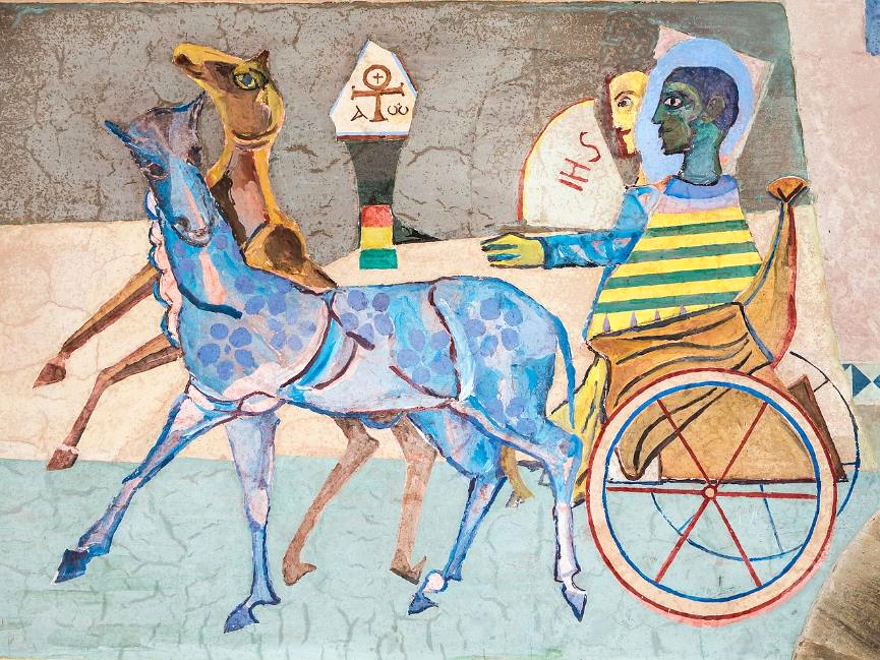
The Holy Spirit brings Philip to a road in the wilderness where he encounters an Ethiopian riding a chariot. He was well employed—a minister of Candace, the queen of Ethiopia. He is educated enough to be reading Greek. He has dark skin. And he had come to Jerusalem to pray. But he could never have gone into the inner temple. Deuteronomy 23 makes it plain that no eunuch could be admitted to the assembly of the Lord.
This is who Philip meets on the road. The encounter is what Gloria Anzaldúa “would call a borderland moment, where people of profound difference enter a new possibility of life together in a shared intimate space and a new shared identity.” His ethnicity, his blackness, and his sexuality made the eunuch an outsider. “This Ethiopian eunuch is the outer boundary of the possibility of Jewish existence, and there at that border God will bring that difference near, very near, to hearth of home in the Spirit.”
The eunuch wonders about the passage from Isaiah, who is this person in pain and suffering, humiliation and shame? And Philip preaches an intimate sermon in which he brings the eunuch into what one scholar writes is “a future promised especially for him, one in which he will not be in the shadows or at the margins of the people of God, but at a center held together with strong cords that capture our differences, never despising them but bring them to glorious light and life.”
“God has come for the eunuch precisely in his difference and exactly in the complexities of his life. He matters, not because he is close to worldly powers and thus a more appealing pawn. He simply matters, and he is being brought close.”
If the eunuch had only the written words of Scripture, how could he know what is true? Is it Deuteronomy or Isaiah? Is he in or out? How can he understand unless someone guides him? What he needs is someone who knows the God of Scripture. He needs someone to teach him who has felt the embrace of God, who can read the cold ink on the page in the warm light of God’s Spirit. He needs Philip and Philip needs the Holy Spirit.
Finally, the eunuch asks Philip, “What’s to prevent me from being baptized?” Philip could have answered, “Everything!” You are a foreigner, not from the land of Israel. You are a eunuch, a violation of purity codes. You’re a member of the queen’s cabinet, so you’re loyal to the wrong sovereign—wrong nation, wrong sexuality, and wrong job.
But Philip heard the Holy Spirit speak a different answer, “Absolutely nothing.” So, the eunuch commanded the chariot to stop. He was baptized on the spot. Walls of prejudice and prohibition that had stood for generations came tumbling down, blown down by the breath of God’s Holy Spirit.
We cannot tether the Holy Spirit. Philip is a servant of the Spirit, not a gatekeeper. Which role do we choose? Philip was attuned to the Holy Spirit. He was a great evangelist who got sent to the wilderness road. But when the Spirit snatched him up, he didn’t fight it. And what fruit the encounter bore. The Ethiopian eunuch goes on his way rejoicing.
We need the Spirit to empower us and guide us still today. It is the Spirit that will help us discern how we should be the church for the world in 2023. Discernment will happen through Bible Studies, prayer, listening, getting to know our neighbors near and far, and with the help of sermons preached by pastors, deacons, and lay people. I am left to cling to the hope that it is the Spirit-filled church that continues to do the work of God; to bring wholeness to our lives.


 A Place at the Table