
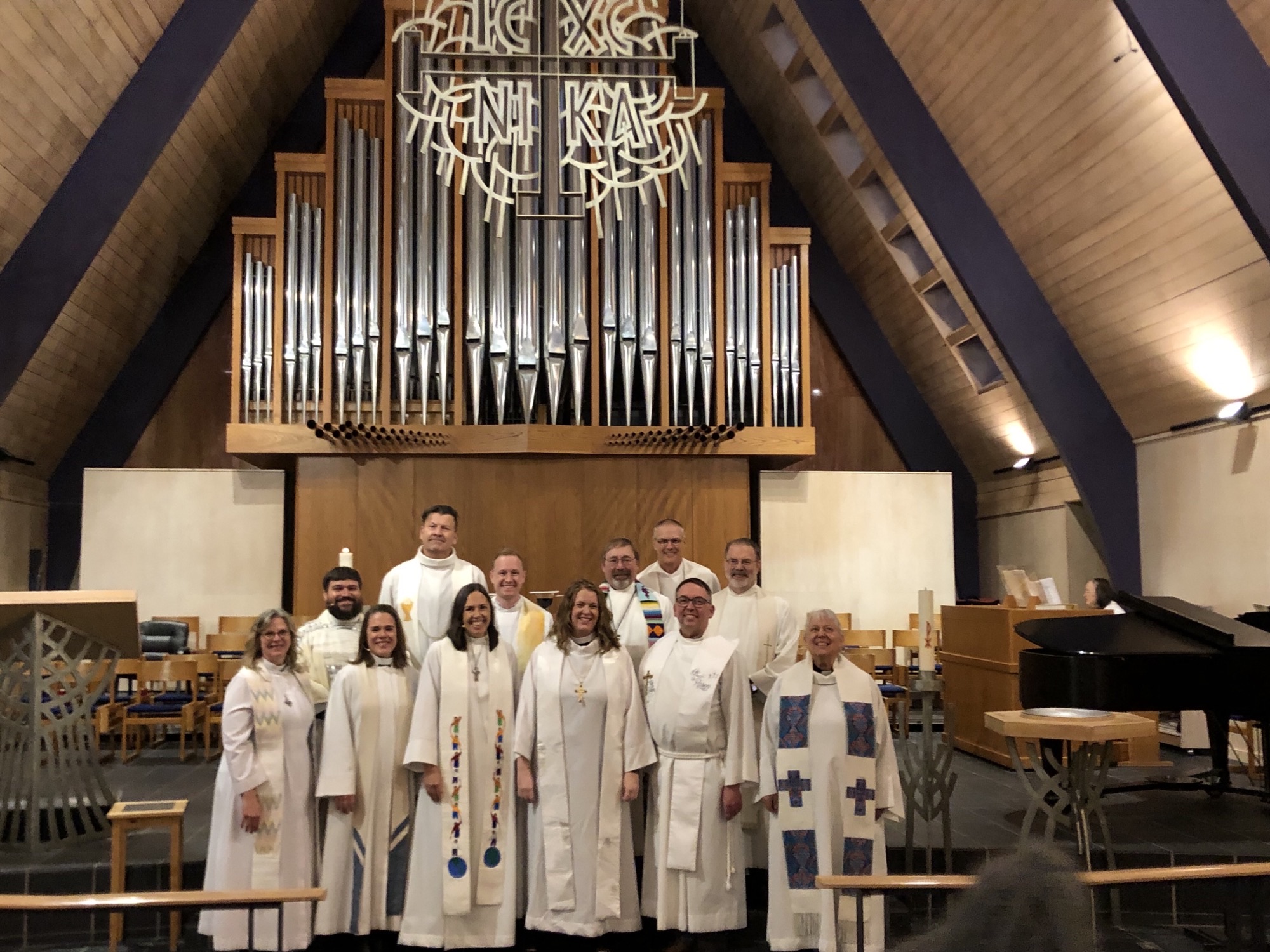
Installation of Emily Kuenker as Pastor of Greater Spokane Campus and Young Adult Ministry
St. Mark’s Lutheran, Spokane, WA
Ezekiel 37:1-14, Galatians 3:23-29
With gratitude to Mpls Synod Bishop Ann Svennengson for her sermon at fall 2023 Conference of Bishops, in which her thread was O God, you know from Ezekiel 37.
I love this passage from Ezekiel for so many reasons. It is raw and earthy. It has a storied history of interpretation in this country and around the world. After Easter morning and the Exodus, it is one of the most powerful images of new life and new creation in all of scripture. It is a wonderful passage for a ministry embarking on something new, full of hope and possibilities, recognizing that what we become will be similar but not identical to what we have been.
And God asked, “Mortal, can these bones live?” And Ezekiel replied, “O God, you know.” “O God, you know.” That may be the phrase I like best about this story in this season of my life. As in, O God you know if students, faculty, and staff will resonate with what we are doing. O God, you know if our alumni and constituents can bear this big change in direction. O God, you know if we are on the right path, making the right decisions. You all can fill in the blanks yourselves. O God, you know.
Ezekiel had lots of reasons to say “O God, you know. Only you.” How could he, or any of the Israelites know if a valley of dry bones could live? They had lost everything. Everything had been stripped away from them—nation, temple, community, and land. How could this have happened?
We know that the first half of Ezekiel tries to explain why the bones are dry—why the exile occurred. We read some of it this morning for Reign of Christ Sunday. It was judgment—for Judah’s idolatry and sin. God, who is holy, responded to this unholiness and corruption. Leaders in particular, the shepherds of God’s people were called out for their part. There’s a particular judgement again the leaders, the shepherds, people like me.
But in chapter 37 something shifts, and God asks Ezekiel to imagine, to see the bones coming to life. What’s more, God asks Ezekiel to prophecy, to speak new life into being. God said, “Prophecy to these bones, saying God will cause breath to enter you, and you shall live.”
To envision and imagine new life, is that not the call of Lutheran Campus Ministry? It was certainly my own lived experience. I am rightly known for my fierce commitment to outdoor ministry, but my commitment to campus ministry is just as robust, not because of my four years on a church college campus or because of my internship with Lutheran Campus Ministry in Cheney.
Two campus ministries in Hyde Park Chicago were vital to my Christian imagination and formation and general well-being. Knowing very little about where I was going to earn my M.Div., except that Rockefeller had built a gorgeous campus in Chicago, I did not pay as much attention to my living quarters as I should have.
My first year at the Univ of Chicago Divinity School I lived in a tiny room in the International House—full of graduate students studying every discipline, half from the United States and half from across the globe. There was no dining service and community events were sporadic. Add to this that Hyde Park was like nowhere else I had ever lived. And oh, that first year was the year my body decided to have more seizures in public than in any other year of my life.
Lutheran Campus Ministry housed at Augustana Lutheran and Brent House, the Episcopalian campus ministry, were the communities that helped me put so many pieces together. They provided actual daily bread but also nourishment for my soul. They gave me space to connect ideas in the classrooms with this new neighborhood.
Those famous verses from Galatians came to life in campus ministry. Without the sternness of the Divinity School classrooms, I was free to ask questions, wonder, and build relationships with people different than myself—different in their interests, background, sexual orientation, ethnicity.
On our recent trip to the Ulanga Kilombero Diocese in Tanzania, I read two books: The Power of Ritual (which the LCM board is reading) and The Forgotten Creed: Christianity’s Original Struggle against Bigotry, Slavery, and Sexism. In the latter, Christopher Patterson, a specialist in early Christianity, argues that these words were already well-known when Paul wrote Galatians. They were an early Christian baptismal creed.
It was a bit surreal to read this book while traveling through our companion synod in East Africa, but it was just as humbling to think back over all the experiences that have shaped my understanding of the other, including my three years in campus ministry.
I had not thought so much about the Roman Empire since those years in graduate school, and Patterson’s scholarship is impressive, though I am sure there has been resistance. At the end, Patterson concludes about those verses now in Galatians, “the creed must have been, finally, about imagining a world in which female slaves could be leaders of free men, where foreigners and native bon stood with equal power and equal rights. ‘You are all one’ signifies solidarity.”
It’s ironic and tragic that later, baptism became one more way to separate people, those who were or were not baptized. Patterson writes, “Our ancient baptismal creed speaks a very clear word: there is no us, no them. Everyone is a child of God, made one in a common kinship….”
For me in the rituals of campus ministry, in the words from the Lutheran tradition, in the neighboring words from the Anglican/Episcopal Book of Common Prayer, I was also reminded of my baptismal identity, child of God. This made me no better or worse than those I was breaking bread with. But in a new urban environment, with my body not cooperating on a daily basis, with no old friends nearby, I clung to the rituals and words that reminded me I was God’s beloved child. The words of Ezekiel were true then too. O God, you know, you know that we are your children. O God, you know me and love me regardless.
Will the next iteration of Lutheran Campus Ministry in the Spokane/Cheney area look like my experience 20 years ago? No. The world and the church have changed so much from when I walked onto the campus in the fall of 1999. Many of the students we hope to encounter may never have been baptized or they may have walked away from the church where that ritual took place.
But I will bet everything I have that the words of the Forgotten Creed from Galatians will ring true to students. We are as hungry for real solidarity and common kinship as Jesus’ first followers, and for good reason. They are ingredients to the reign of God that is always being reimagined.
But even those high hopes of mine are no guarantee. O God, you know. You know the future. You also know each one of us. You call us beloved. You hold us in life and love. You will never let us go. Amen.



 A Place at the Table