
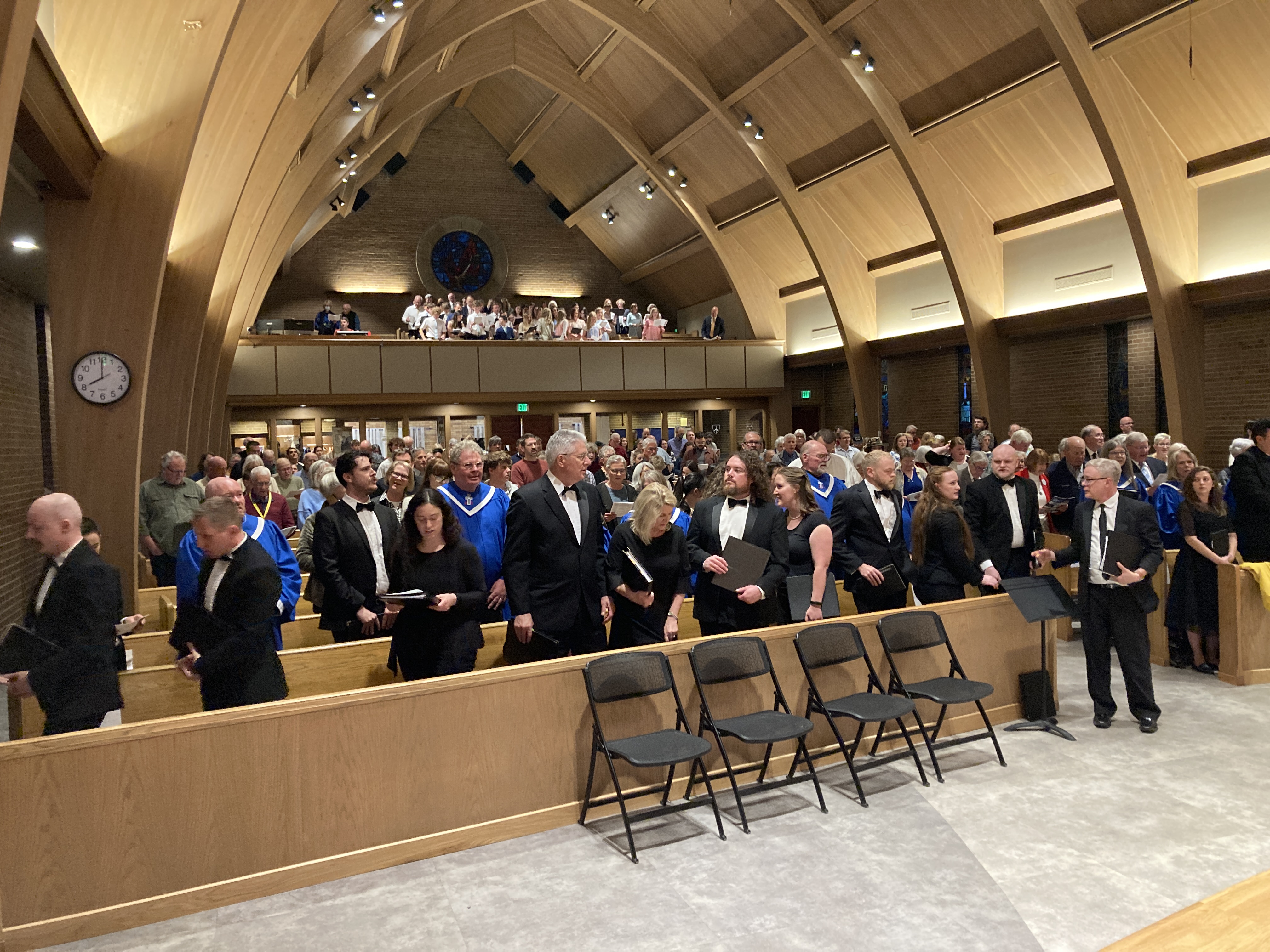
Boise Music Week Community Worship Service – May 5, 2023
First Presbyterian Church
Psalm 46
1 God is our refuge and strength,
a very present help in trouble.
2 Therefore we will not fear, though the earth should change,
though the mountains shake in the heart of the sea;
3 though its waters roar and foam,
though the mountains tremble with its tumult.
4 There is a river whose streams make glad the city of God,
the holy habitation of the Most High.
5 God is in the midst of the city; it shall not be moved;
God will help it when the morning dawns.
6 The nations are in an uproar, the kingdoms totter;
he utters his voice, the earth melts.
7 The Lord of hosts is with us;
the God of Jacob is our refuge.
8 Come, behold the works of the Lord;
see what desolations he has brought on the earth.
9 He makes wars cease to the end of the earth;
he breaks the bow, and shatters the spear;
he burns the shields with fire.
10 ‘Be still, and know that I am God!
I am exalted among the nations,
I am exalted in the earth.’
11 The Lord of hosts is with us;
the God of Jacob is our refuge.
I attended college in Moorhead, Minnesota, at the one ELCA Lutheran Concordia. My junior year, the Red River flooded. It was an awful natural disaster—resulting from over 100 inches of snow, a late and sudden melt, rainstorms, and a slow shallow river that flows north, which meant it was blocked by ice further north. My classmates and I watched the flood to our south in the towns of Wahpeton and Breckenridge. It came to Fargo-Moorhead. Then it forged north to Grand Forks-East Grand Forks. The Red River Valley is incredibly rich farmland because of the remnants of being a lake formed by glaciers, but when the levy in Fargo-Moorhead broke, it wasn’t beautiful soil we thought of, it was devastation.
My classmates and students at neighboring Moorhead State Univ. and North Dakota State Univ. were mobilized to sandbag, evacuate livestock from farms, make sandwiches for volunteers, and any other number of tasks. But, at this is why this story makes it into a sermon during Boise Music Week, there was another event that spring. That was the spring that the four Concordia Choirs and Orchestra were preparing Mozart’s Requiem for performances in Moorhead and Carnegie Hall.
The waters never ended up reaching our college campus, but it was still an emotionally and spiritually heavy spring full of predicaments and sorrow. Was I supposed to keep volunteering, or should I study for finals? Was it okay to sleep in my bed while people were becoming homeless? And how, in the midst of this tragedy, could any of us justify going to multiple music rehearsals? Add to this that over spring break I had been given a new diagnosis—Epilepsy. It was a lot.
One spring day, music director Renee Clausen addressed all of us at the end of a rehearsal. He said people would need our concert, even if it sometimes felt frivolous to us. This powerful piece of music we were preparing would be balm for the larger Red River Valley community. I never talked to a member of one of our Moorhead audiences, but I know one thing for sure. I made it through that spring in large part because of the Requiem rehearsals. I don’t know that I could have explained it this in the spring of 1997, but it’s clear looking back that the rehearsals became my time of prayer—for the community, for people I would never meet whose lives had been altered forever, and for myself.
Martin Luther supposedly said that when you sing, you pray twice. It’s hard to confirm if Luther actually said this, but I know it to be true and I assume that because you are here, you have experienced this too. When you sing, you pray twice. I think Luther knew it to be true when he turned Psalm 46 into my tradition’s anthem A Mighty Fortress. It is a good thing to read this beautiful psalm. It is gift to read aloud a song writer’s adaptation for their own time.
Rolf Vegdahl, a musician in Chelan, Washington, adapted Psalm 46; his words are less triumphant than Luther’s. Hear part of Vegdahl’s adaptation:
Though the earth shall change,
though the mountains tremble,
though the waters roar,
we will not fear.
You are our refuge and our strength.
In times of trouble,
you are here.
God is our refuge and our strength,
a very present help in trouble.
Therefore, we will not fear,
though the earth be moved,
though the mountains shall fall into the sea.
Though its waters rage and foam
and mountains tremble at its tumult,
the Lord of hosts is with us.
The God of Jacob is our stronghold.
This setting was sung as a duet at my installation across town last fall. I still go back and listen to the recording and draw strength from the words and music. Vegdah’s tune is more melodic and lilting than Luther’s German hymn. (Go to 25:12 in this YouTube video)
What we all needed that spring when the Red River was reaching beyond its banks to become ancient Lake Agassiz, what I assume the psalmist and their friends needed, what I think you and I need today, is the reminder that God is still here. God is still here mending, redeeming, healing, and making things new.
You who are gathered here know, as the psalmist did, that all things change. Worse, all things are inherently unstable, including the earth itself, its rivers, mountains and seas, as well as the nations and peoples on the earth. Only God is a stable refuge, and that becomes the psalmist’s refrain.
The psalmist goes on to sing a hymn to this strong and stable God. Most important, God makes wars cease, which, of course, will take care of the “uproar” of the nations in v. 6. The psalm looks forward to God’s stabilized world, which will be a world of peace; all weapons will be destroyed. We then hear a word direct from God, perhaps announced by a priest. Hear the assurance that God’s strength and God’s promise is for you. The control of chaos is beyond human ability, so the counsel is simple but profound, “Be still, and know that I am God!” The song ends by returning to the theme and refrain: “The Lord of hosts is with us; the God of Jacob is our refuge.”
Like all promises, this one, could be misunderstood. You could mistakenly hear it as though Zion were invulnerable because God’s presence could be taken for granted. Eventually, the prophets of old had to denounce such thinking. We might recall especially Jeremiah, with his insistence that people could not simply chant the mantra “The temple of the Lord, the temple of the Lord, the temple of the Lord” and think nothing bad could happen to them. No aspect of biblical religion can ever be used as a good-luck charm. Jeremiah would also remind you and I that God’s presence and God’s security is found among those who repent, change their ways, and do justice (Jeremiah 7:5-7). Poetry, melodies, and sacred songs, it turns out, can help you do all those things: repent, change, and do justice.
It strikes me that the spring my classmates and I sang Mozart’s Requiem, it was the Kyrie that stood out the most and that I most vividly remember. Perhaps that’s simply because of the music Mozart composed. But I wonder if it is because after years of liturgical worship, those were the words I actually understood (Lord have mercy) and that I needed to pray to God.
Though different than the confession and forgiveness they are surely related. I think of the kyrie as the entire congregation crying out to the creator. Lord have mercy on this flooded region. Have mercy on me for not doing enough to aid all those hurting. A friend’s mentor said, “anytime you sing a kyrie, you have participated in a confession.”
Again, it is one thing to speak the words, “Lord of have mercy. Christ have mercy. Lord have mercy.” But you who are sitting here and experiencing Boise Music Week, I trust get it when I say that to sing those words, or the Latin Kyrie in worship or while singing Mozart’s Requiemadds something.
Those of you who are musicians then have great responsibility. You can use the emotional power of music for many goals. I give thanks during a worship service like this for the liturgists and church musicians who use their skills for the following: to help the worshiper communicate with the divine, to help the worshiper give God thanks and praise, to assist the worshiper who is ready to move through grief and anguish, and even the musician who knows when to leave moments of silence between the notes for whatever the worshiper may need.
Music is a gift from God, a gift to be treasured and stewarded well. Like the book of psalms, my tradition’s ancient book of songs and prayers, music is its own language. This language can, at its best, help nurture your relationship with God, give you the deep hope we need, and finally move you to keep bringing peace to your corner of the universe. Thanks be to God.


 A Place at the Table