
Mark 5:21-43
21When Jesus had crossed again in the boat to the other side, a great crowd gathered around him; and he was by the sea. 22Then one of the leaders of the synagogue named Jairus came and, when he saw him, fell at his feet 23and begged him repeatedly, “My little daughter is at the point of death. Come and lay your hands on her, so that she may be made well, and live.”
24So he went with him. And a large crowd followed him and pressed in on him. 25Now there was a woman who had been suffering from hemorrhages for twelve years. 26She had endured much under many physicians, and had spent all that she had; and she was no better, but rather grew worse. 27She had heard about Jesus, and came up behind him in the crowd and touched his cloak, 28for she said, “If I but touch his clothes, I will be made well.” 29Immediately her hemorrhage stopped; and she felt in her body that she was healed of her disease.30Immediately aware that power had gone forth from him, Jesus turned about in the crowd and said, “Who touched my clothes?” 31And his disciples said to him, “You see the crowd pressing in on you; how can you say, ‘Who touched me?’” 32He looked all around to see who had done it.33But the woman, knowing what had happened to her, came in fear and trembling, fell down before him, and told him the whole truth. 34He said to her, “Daughter, your faith has made you well; go in peace, and be healed of your disease.”
35While he was still speaking, some people came from the leader’s house to say, “Your daughter is dead. Why trouble the teacher any further?”36But overhearing what they said, Jesus said to the leader of the synagogue, “Do not fear, only believe.” 37He allowed no one to follow him except Peter, James, and John, the brother of James. 38When they came to the house of the leader of the synagogue, he saw a commotion, people weeping and wailing loudly. 39When he had entered, he said to them, “Why do you make a commotion and weep? The child is not dead but sleeping.” 40And they laughed at him. Then he put them all outside, and took the child’s father and mother and those who were with him, and went in where the child was. 41He took her by the hand and said to her, “Talitha cum,” which means, “Little girl, get up!” 42And immediately the girl got up and began to walk about (she was twelve years of age). At this they were overcome with amazement. 43He strictly ordered them that no one should know this, and told them to give her something to eat.
I love this scripture passage from Mark because of the way the stories invite me and you into the text—so many details and characters and twists and turns plus two happy endings. But these stories have occasionally frustrated me because I have sat with parishioners and families over the past nearly twenty years and after pleas to God and many prayers, healing as we had hoped and prayed did not happen.
Are these stories about Jesus’ healing two different women meant to encourage us to ask God for healing? Maybe. But maybe healing with a more nuanced understanding. Jesus’ ministry in Mark’s gospel begins with the declaration that the kingdom of God has come near, “repent, and believe in the good news.” The reign of God has come near—to you.
Our stories today from Mark’s gospel are all about relationships. We might say that these two incidents together help us understand each of them. They both involve women in crisis—in fact we do not know them by their names but by their needs. They were not outsiders to begin with, but both are now subject to the taboos around the mysterious power of life and the even more mysterious (and seemingly unconquerable) power of death.
The first nameless and needy woman is barely a woman, just twelve years old and ready to begin her adult life. However, an unknown illness has struck her down, driving her father to extremes in his desperate search for help. He was a leader, a religious leader in the synagogue, and yet this precious child’s illness has reduced him, weakened him, lowered him to the ground in front of a traveling folk healer in a last-ditch effort to prevent the worst from happening.
It seems that desperation, drives Jairus, the synagogue leader to Jesus. Jairus’ moment of faith comes a little while later, when the news arrives of his daughter’s death. Jesus then preaches briefly: “Do not fear,” he says to the grief-besotted man, “only believe.” Fear not; only believe. Jesus’ sermon was for all of us who suffer from the human condition.
Into the midst of this comes the silent woman with the hemorrhage, without the boldness of the leader, simply hoping for one healing touch. I think a good word to describe the woman is “tired.” A flow of blood for twelve years would exhaust a person, as if her life force were draining away. Given ancient understandings of anatomy, menstruation, and ritual purity, Mark’s implicit point would therefore be that her womb is no longer a source or a site of life.That could be an instigator of shame in her culture and a cause of particular grief for her and her family. Jesus reaches beyond the shame for the sake of relationship.
Further, he doesn’t permit this touch to stay anonymous, a passive healing on his part. He lets himself be sidetracked from hurrying to Jairus’ home long enough to find the person who has reached out to him with a touch that is more specific, more intentional, than merely jostling him in the crowd. Perhaps the crowd wanted to get near a celebrity, but this woman was reaching for her life. Jesus felt both her weariness and her deep hope. How could he simply walk away?
And for Jesus, the most important thing in that moment is to face the person who has touched him, to encounter her has human being and not just as an anonymous touch. Another translation might read: “Daughter, you took a risk of faith, and now you’re healed and whole. Live well, live blessed! Be healed.” And her neighbors witness this restoration of dignity.
During the delay, the synagogue leader gets the bad news that his daughter is already dead, and Jesus is no longer needed. “Don’t bother,” the messengers say, “it’s too late.” Jesus speaks quietly, personally to Jairus right then, reassuring him: “Don’t listen to them; just trust me.” When they arrive at Jairus’ home they make their way through the hired mourners. Jesus addressed them as he did the frightened, faithless disciples back in the boat, during the storm. Where is their trust?
It must have been a tender scene, in the quiet that surrounds the sorrow for a dead child, yet Jesus is once again calm and confident. He reaches down to invite the little girl to rise up and live. And the little girl gets up immediately and walks around to the amazement of all. Jesus has to be the one to remember that she might be hungry after her ordeal and tells them to feed her. He doesn’t miss the most ordinary and compassionate details.
Why does Jesus perform such miracles? The purpose is to establish Jesus’ identity: They are not stories about how to get God to do what we want, which is just another way of trying to stay in control. Instead, they are stories about who God is and how God acts, and what God is like. This is no ordinary man. This man is the son of God. Trust him. Holding on to that knowledge would sustain the early Christian community and the church today, all of you, and give you strength to meet the days to come and not lose heart.
Frederick Buchner puts us in the place of the little girl, with Jesus speaking to you, taking your hand and telling you to rise up and live: “You who believe, and you who sometimes believe and sometimes don’t believe much of anything, and you who would give almost anything to believe if only you could…’Get up,’ he says, all of you—all of you.” Jesus gives life not only to the dead, but to those of us who are “only partly alive…who much of the time live with our lives closed to the wild beauty and the miracles of things, including the wild beauty and miracle of every day we live and even of ourselves.”
I started this sermon wondering about our asking God for healing, wondering about our prayers. I know that sometimes prayers for healing have not been answered in the ways my parishioners and I had hoped they would be. But I also know the prayers were not fruitless. Have you had such an experience? With each prayer, each petition, each amen, your relationship with God deepened. You will never know if God’s mind was changed, but you understand that you were transformed—transformed by remembering Jesus is with you and sees you and loves you.
Who needs to know they are not alone in the town of Shoshone, in greater Lincoln County? I grew up in Custer, SD (population 2500 with a service population of 5000 in the 1980s). My parents were newcomers for at least their first twenty years there.
The first congregation I served was Soldier Lutheran in Solider, Iowa (a farming town of 200 people near the Nebraska border). I absolutely loved the way people came together when there was a death or other tragedy. And yet, it was hard to break into the community. Most people were not intentionally malicious. It was simply the age-old human instinct to have insiders and outsiders. It’s the feeling so many of us have had—being in a crowded room full of people and realizing we’ve never felt so alone before.
Small towns are not immune to that part of human nature. So, when you pray for healing in this county and place, who do you pray for? Who is wallowing in shame because of something they did or because of circumstances beyond their control? Who is desperate to regain an ounce of dignity? Who is longing to be seen, truly seen, an accepted? Maybe you know who that person is or who they are. Maybe it’s you.
Today, Jesus bids you, “Get up.” And at the table he gives us something to eat, something extraordinary—his own body and blood, simply bread and wine, the bread of life, the cup of salvation, or healing. In this simple sacrament we participate in the means of God’s grace once more and each one of us is restored. The psalmist’s words become our own:
11 You have turned my mourning into dancing;
you have taken off my sackcloth
and clothed me with joy,
12 so that my soul may praise you and not be silent.
O Lord my God, I will give thanks to you for ever.
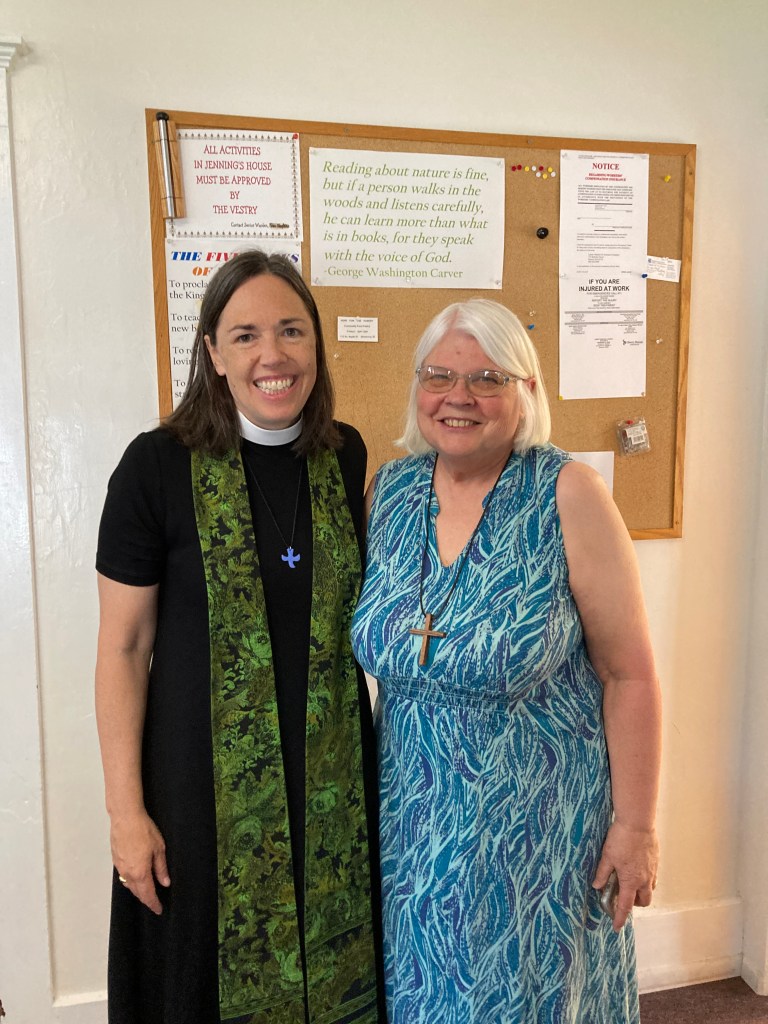
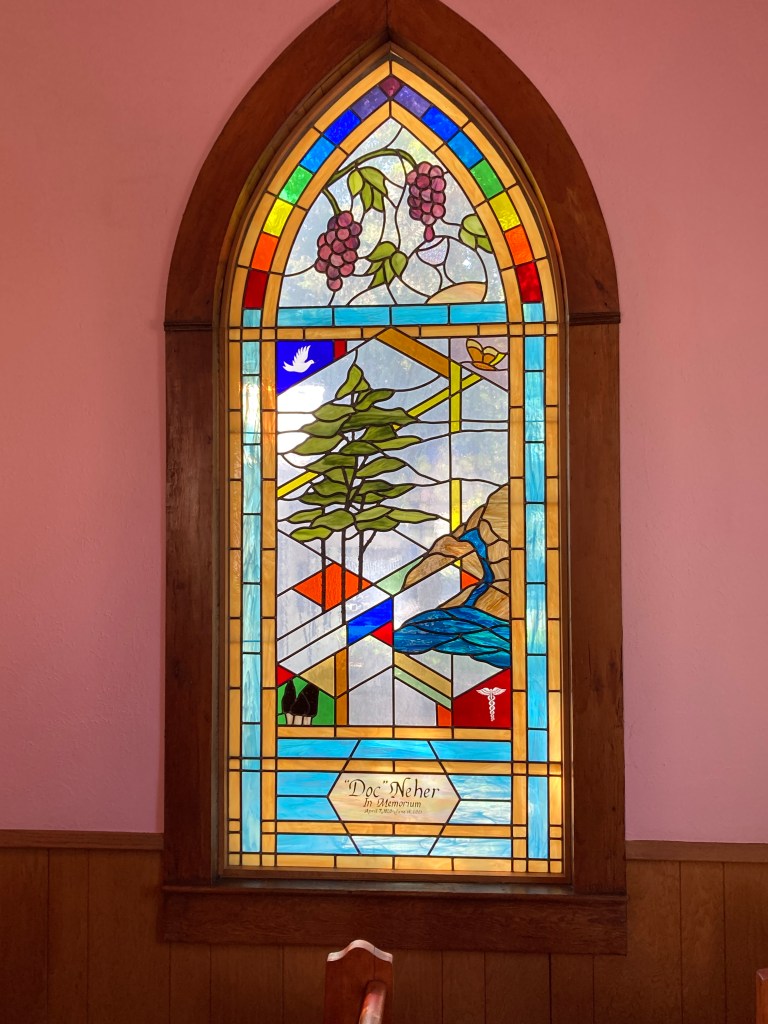
Me with Synod Authorized Minister Diane Davis. Newest stained glass window in sanctuary.


 A Place at the Table