
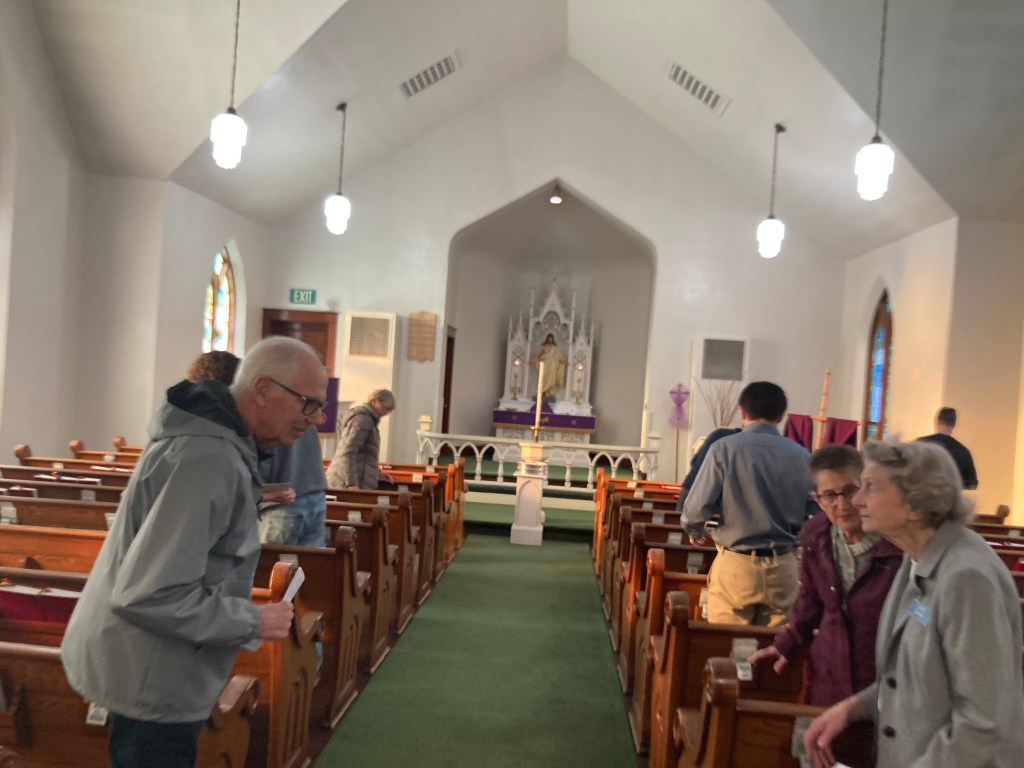
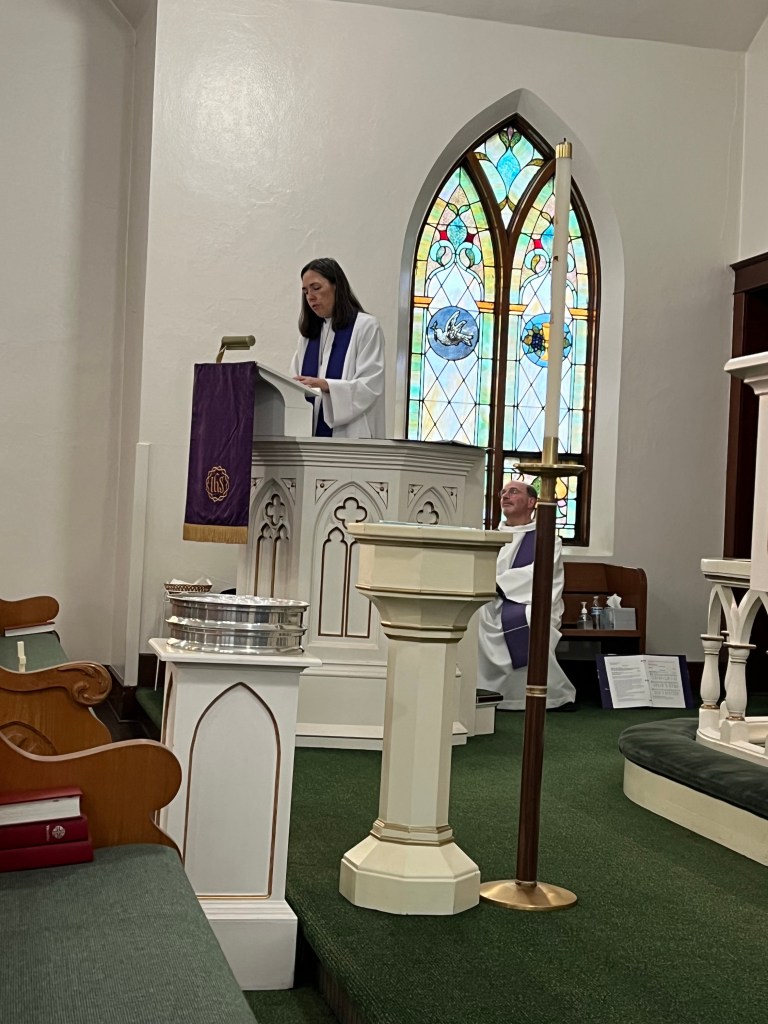

Above – 8:30 worship in the old Augustana Chapel
Luke 4:1-13
Grace to you and peace from God our Father and the Lord Jesus Christ. And thank you for the invitation to be with you this First Sunday in Lent. The current practice of forty days of Lent recalls Moses’ forty-day fast on Mount Sinai, Elijah’s 40 days on the mountain, and of course Jesus’ 40 days in the wilderness after his Baptism.
Let’s go back briefly to his baptism. Then and there, God declared Jesus to be his Beloved Son, in whom God is well pleased. Jesus is marked as the Messiah, the Anointed One. The words of that address are taken up in today’s story of testing. This time they are on the lips of the adversary. Who exactly is this tester?
One scholar suggests that the diabolos in today’s scene is doing what the satan does in the Book of Job; he is carrying out his divinely ordained role by testing the durability of God’s creation. In this case, it is the Son of God who is being tested to see if he holds true. Two times the devil recalls God’s address at Jesus’ baptism. He calls it into question with the taunt, “If you are the Son of God.”
These are not tests to do things that are desirable but not good for him (like our temptation to eat an extra piece of cake). These are tests to see whether even good things can lure Jesus away from his fidelity to God and God’s will.
The first test is to turn a stone into a loaf of bread. This would certainly ease Jesus’ hunger after 40 days of fasting. If Jesus can do that then he can also turn the many stones covering Israel’s landscape into food. He could feed the many hungry people in a land often wracked by famine. This sounds like the manna in the wilderness that fed the Israelites.
Later Jesus will teach his disciples to pray, “give us this day our daily bread.” Bread is necessary for life. Martin Luther said bread is “Everything that nourishes our body and meets its needs.” So turning stones into bread sounds pretty good to me every time I read this passage, but this year it sounds very good!
Maybe it is serving as bishop and the size of my flock, maybe it’s 20 years as a pastor, maybe it’s the state of the world, maybe it is my gut telling me there could soon be great need in our synod, state, and country and my awareness of how much need there is in the world.
Whatever the cause, I have never before so badly wanted Jesus to go ahead and fail this test. Jesus, just go ahead and make the bread. Feed your own hunger and everyone else’s. Or give that power to the church to do it on your behalf. I could never pass this test, so it’s a good thing I am not the one being tested. Jesus, the Messiah, the Son of God, responds, “Of course I am famished. I am fasting. There is more to life than food.” Such self-control is important in a human being, but in a messiah it is essential. Jesus’ fidelity to God is steadfast.
The second test portrays the tester in the role of “ruler of this world” who can manage the governance of the world’s kingdoms. The price is to worship or honor that authority. In return, the tester will hand it all to Jesus. Remember that most of the known world in our author Luke’s day was under the strong and oppressive control of the Roman Empire. A change in regime could only be for the world’s good, right?
And here again, as empire simply takes a different form in modern life, there is a part of me I am a little embarrassed by, that would just a soon Jesus fails this test. Wouldn’t it be better if Jesus ruled over all? He would get rid of all his enemies, who I am quite sure are also my enemies. It would be glorious for Jesus to have all the power, then we would all be safe.
Again, Jesus answers no. The price is too high. The test is about the desire for power, but the tester disguises this behind a call for Jesus to bow down. Jesus responds, “You are to worship the Lord your God.” The word Lord signals the presence of the unpronounceable divine name. The rabbis note that this name attributes mercy to God. The other name for God, Elohim (translated as God), names the justice attribute. So, Jesus brings both qualities together—justice and mercy. In other words, the justice of God is lived out in acts of mercy, not power. This is a clear rejection of our love of power. But the rejection also makes it possible for any human being (including the Messiah) to participate in the reign of God.
Let me say that again. In naming the Lord your God, Jesus brings together justice and mercy. The justice of God is lived out in acts of mercy, not power. This means all of us, all of you, can participate in the reign of God.
The final test is for Jesus to trade his calling, his destiny, his integrity for life above the law of gravity. This test offers the Messiah the chance to be absolutely free. And, as one scholar [Swanson] said, if the Messiah is free even from the law of gravity, then the Messiah is invulnerable. Which is precisely what it does not mean to be Messiah. Or a human being. Humans are vulnerable.
I was reminded of this twice this weekend. The first time was Friday evening in Nampa when another car didn’t see or yield to me and crashed into my passenger front door while I was in a turn lane. The second time was Saturday morning, when hearing my friend’s voice on the phone suddenly released all the adrenaline and I was brought to tears, finally facing mortality. Even though no one was injured, and no airbags went off, there’s nothing like two vehicles colliding to remind us that we are in fact vulnerable.
God in Jesus takes on humanity and human vulnerability. For Jesus this leads to much more than a mere car accident. We, who know the end of the story, know that the Messiah must suffer and die. The Messiah must be subject to gravity and to the Roman power to torture and kill. Otherwise, the Messiah is not one of us at all.
The three tests in the wilderness having concluded, we finally read, “When the devil had finished every test, he departed from him until an opportune time.” The devil came back. It happened during Jesus’ last week in Jerusalem. The devil entered Judas and set in motion the betrayal and arrest, the trial and the denial, the abandonment and the crucifixion. He spoke through a variety of voices. Religious leaders said, “Let him save himself if he is the Messiah.” A criminal asked “Are you not the Messiah? Save yourself and us.” Again, there is testing for proof, a sign, or some kind of power and action.
The devil always comes back. We will never pass the devil’s testing. And we do not look at Jesus to see how to do it. We are like the criminal on the cross. We are in captivity and cannot free ourselves, as we confess. But Jesus’ fidelity to God is steadfast, in the wilderness, throughout his ministry, on the cross.
There are many voices in the wilderness today asking us to abandon who we have been called to be and to become something we are not. These voices lure us to give in to false promises of power, safety, and security. These voices tempt us to put our own self-interest ahead of the needs of others. These voices tempt us to trade in the cross for false glory. And, worse yet, many of these voices are doing so in the name of Jesus Christ.
You have been called by water and the word, claimed as a child of God, and united with Christ, the same Jesus Christ whose fidelity to God is sure. The service of Holy Baptism includes a three-part renunciation of “the devil and all the forces that deny God” reminiscent of Jesus’ encounter with the tester in the wilderness. You pledge our fidelity to God, knowing that your faithfulness depends on being bound to the life, death, and resurrection of Jesus Christ.
Furthermore, that faithfulness depends on nourishment. And so, this morning, the same Jesus Christ feeds you at the table, not with stones turned into bread, but with his own broken body. You will be fed for justice and mercy in your neighborhood, your community, and this world we all inhabit. When you hear the words “given for you” and “shed for you,” hear Jesus’ fidelity not only to God but to this community of faith and to each of you. Amen.


 A Place at the Table
Glad you’re okay.
Crashing cars is only fun for a scant few who most regard as insane.
Cheers!
Aaron Barrett
Grace, Mtn. Home
Great sermon Bishop Meggan, thank you very much!