
Luke 13:1-9
I have always been a big fan of the show Law and Order. I loved this show in my late teens and would watch reruns for hours while home on college breaks. I still think the first four seasons are the best. Much has been written and discussed about the show’s appeal. I am confident that one factor is the dependable formula–solving the crime, making the case, and the District Attorney, representing the people, us, always wins. At the close of every episode someone is blamed and held accountable. Humans are prone to place blame. We certainly want to place blame when a tragedy is cause by other humans. We find comfort finding a cause or placing blame when there is a natural disaster. I actually don’t fault my teenage self for wanting to escape into the world of Law and Order, so long as I remembered that it is not reality.
Jesus brings an alternative perspective, outlook, and way of living. Instead of focusing on other people’s misbehaving, make sure you are producing good fruit. Instead of assigning causality to others misfortune, ensure that you are not ignoring your own missing fruit. Tragedies, unexplainable and mysterious though they maybe, call survivors to greater obedience.
There is more. Jesus’ words suggest that tending to one’s own life and changing one’s own mind is the best strategy to prevent or even persevere through unexpected calamity. The call to repent, to change our perspective and actions, turns out to be life-giving.
The event that sparks Jesus’ response is Governor Pilate’s execution of Galileans during some ritual practice. In telling Jesus of the horrible thing that has happened to these Galileans, the people are raising the commonly held belief among Jews that Galileans were less faithful than other Jews. Maybe this is why Jesus responds: Do you think that these particular Galileans were worse sinners than other Galileans? Then he sharpens the question by bringing it closer to home: Those eighteen upon whom the tower of Siloam fell and killed them, do you think that they were worse offenders than all the others who dwelt in Jerusalem?
Jesus carries the matter one step further, and shows that we are posing the question in the wrong way. The surprising thing is not that so many die but that we still live. If it were a matter of sin, we would all be dead. Twice Jesus says: “Unless you repent, you will all likewise perish.”
Jesus seems to honor his audience’s fear and the vulnerability that their fright has opened up in them. It is not a bad thing for them to feel the full fragility of their lives. It is not a bad thing for them to count their breaths in their fear–not if it makes them repent.
Don’t worry about Pilate and all the other things that can come crashing down on your heads. Jesus seems to tell his listeners that terrible things happen and you are not always to blame. But don’t let that stop you from doing what you are doing. That torn place your fear has opened up inside of you is a holy place. Look around while you are there. Pay attention to what you feel. It may hurt you to stay there and it may hurt you to see, but it is not the kind of hurt that leads to death. It is the kind that leads to life. To drive the point home, he tells a parable.
The parable of the fig tree has often been read allegorically, assuming that the landowner is God, and the gardener is Jesus. But nowhere else in this gospel do we find a picture of an angry, vindictive God that needs to be placated by a friendly Jesus. Think instead of the prodigal son being welcomed home by the gracious father.
I liked how one scholar [Gonzalez] put the parable in the context of a vineyard. Remember what a vineyard looks like at the last possible time when one would normally come looking for figs on a fig tree. The vineyard would have already yielded its grapes and would have been severely pruned. It would all have been cut down, and one would see nothing by dry and gnarled stumps. In the midst of this scene of apparent desolation stands a verdant fig tree. It has never been pruned. Now it will receive even better treatment. The vinedresser will dig around it and give it an exceptional dose of fertilizer.
To a casual observer, the tree would appear to be specially blessed, and the vines cursed and forgotten. One would think that the fig tree must be particularly valuable if it is treated with such care. This is what one would expect on the premises of the so-called gospel of prosperity: good things are a reward for faith and fruitfulness. But the truth is exactly the opposite. The fig tree is receiving special care because it has yet to give the fruit it was meant to bear. That’s because God keeps nurturing, forgiving, and loving.
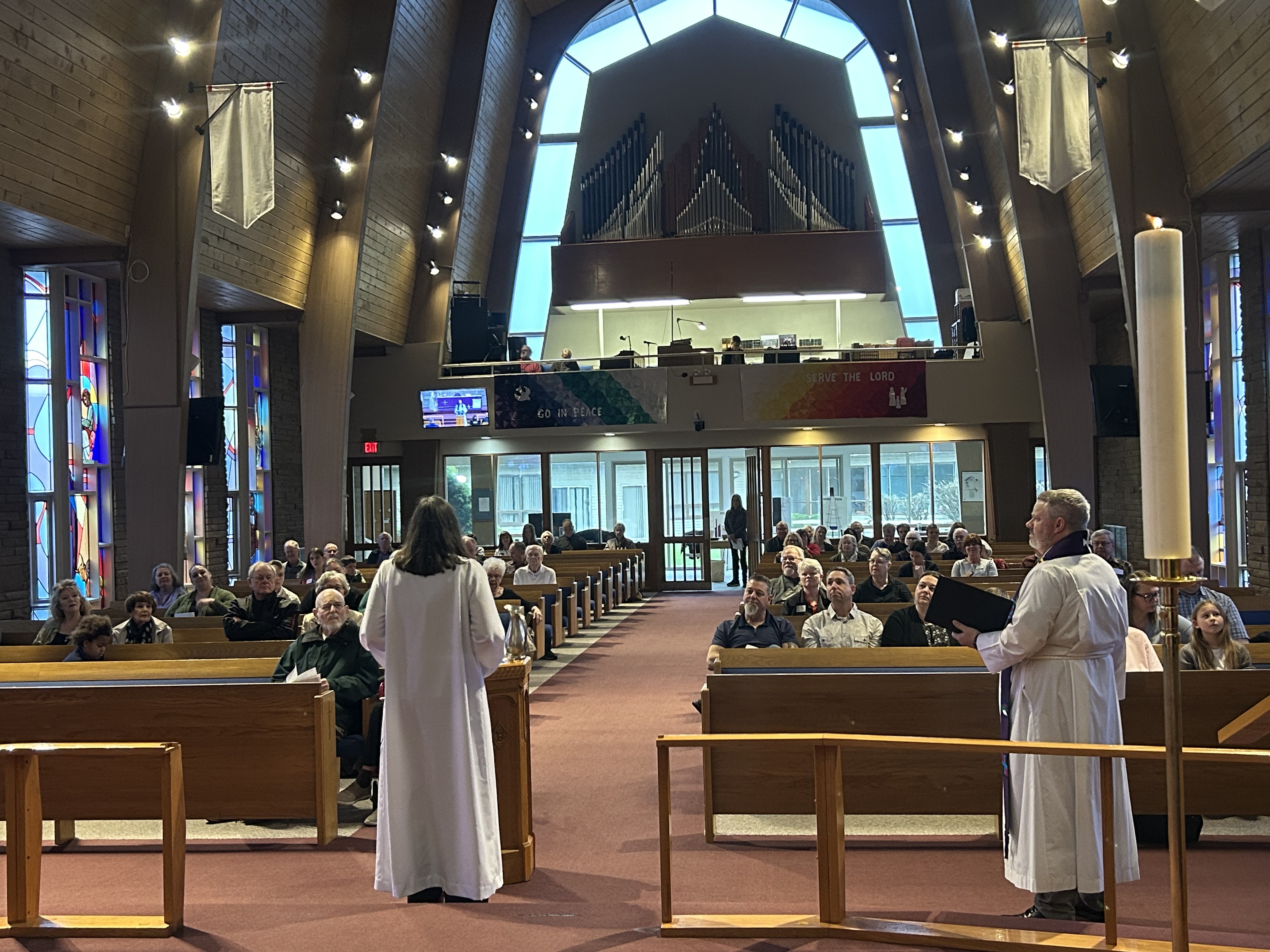
I actually like to think about this parable more communally and less individually. That is, what does this parable say to the entire Northwest Intermountain Synod, all 85 congregations plus specialized ministries? Or what does it say to the congregation of First Lutheran in Kennewick, WA in March 2025? I’ll say more about this after worship, but your synod staff has started to use the phrase Wellsprings of God’s Love to describe our ministry sites, congregations like yours. That’s because so often when we are out in congregations on a Sunday or midweek and then report back at our staff meeting, we are bubbling over with stories of God’s love. We have so many fruit bearing stories. That was true last week when I visited Christ Lutheran, down the road in Yakima and it’s true today.
Justo Gonzalez writes, “We tend to think that the fact that a church as many resources at its command is a sign that it has been faithful. But this parable raises the possibility it may be otherwise. Could it be that our own abundance has been given to us in an effort to lead us to bear fruit, to share those resources, to share of ourselves, and that the reason we survive is not … [our greatness], but this miraculous grace of the Owner of the vineyard who has decided to give us one more chance?”
You all have said yes to that one more chance and fruit is obvious here through the welcome to stranger, the sense of belonging, your obvious partnership with local organizations like Lutheran Community Services and Sent to Serve. You share your building with 12 steps programs. Fruit bearing extends beyond Sunday morning and beyond your walls and, most importantly, your fruit bearing is aligned with the very gospel of Jesus Christ.
I actually think one of the most interesting or challenging parts of interpreting today’s passage is that Christianity is not of one mind when it comes to repenting and changing our perspective or fruit bearing. It is not the purity culture, it is not the prosperity gospel, it is not some form of Christian Nationalism. We do well to remember Jesus’ inaugural address when he quoted the prophet Isaiah, “The spirit of the Lord God is upon me, because the Lord has anointed me; he has sent me to bring good news to the oppressed, to bind up the broken-hearted, to proclaim liberty to the captives, and release to the prisoners;2 to proclaim the year of the Lord’s favor.” If there is any question about what perspective repentance ought to lead us to, there it is in Jesus’ first public address.
The Season of Lent gives us tools for repentance as well. We adopt the disciplines of Lent, all for the sake of our relationship with God and our neighbors. We remember that in the waters of Baptism we are reborn children of God and inheritors of abundant life. We are made members of the body of Christ. We live with Christ and with his people. We grow in faith, love, and obedience to the will of God. In Baptism we renounce the forces of evil, the devil, and all his empty promises. We are sealed with the Holy Spirit and marked with the cross of Christ forever. Part of repentance is remembering whose we are.
Thank you for remembering, First Lutheran, for being fruit bearers. Know that the God who claimed you in the waters of baptism and brought you together as a congregation for this chapter of ministry, will never give up on you, will keep pruning and nurturing you, will keep offering you chances to bear fruit. Thanks be to God.


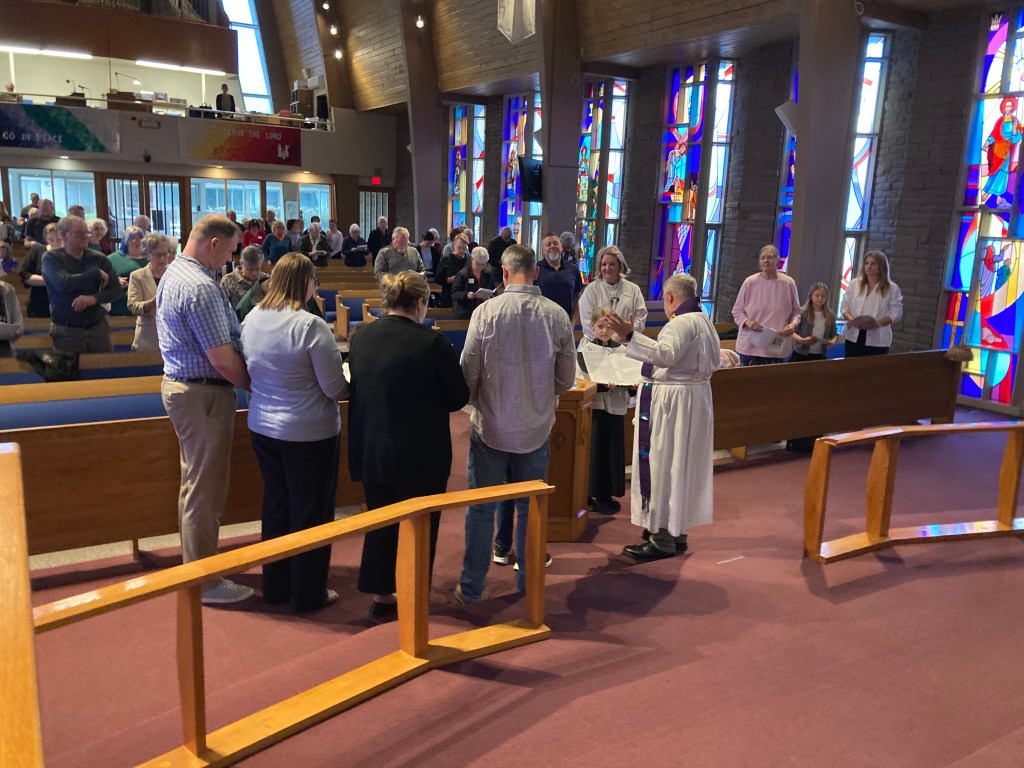
So grateful for a morning with the saints of First Lutheran in Kennewick, served by Pastor JJ Dygert. This congregation is bearing fruit through their generous welcome, their partnerships with Lutheran Community Services NW, Sent to Serve, and others, and the many AA groups they host all week. We had a baptism and I learned that First will keep the baptism banner in the sanctuary for a year-their reminder to pray for the newly baptized for the first year-lovely.


 A Place at the Table