
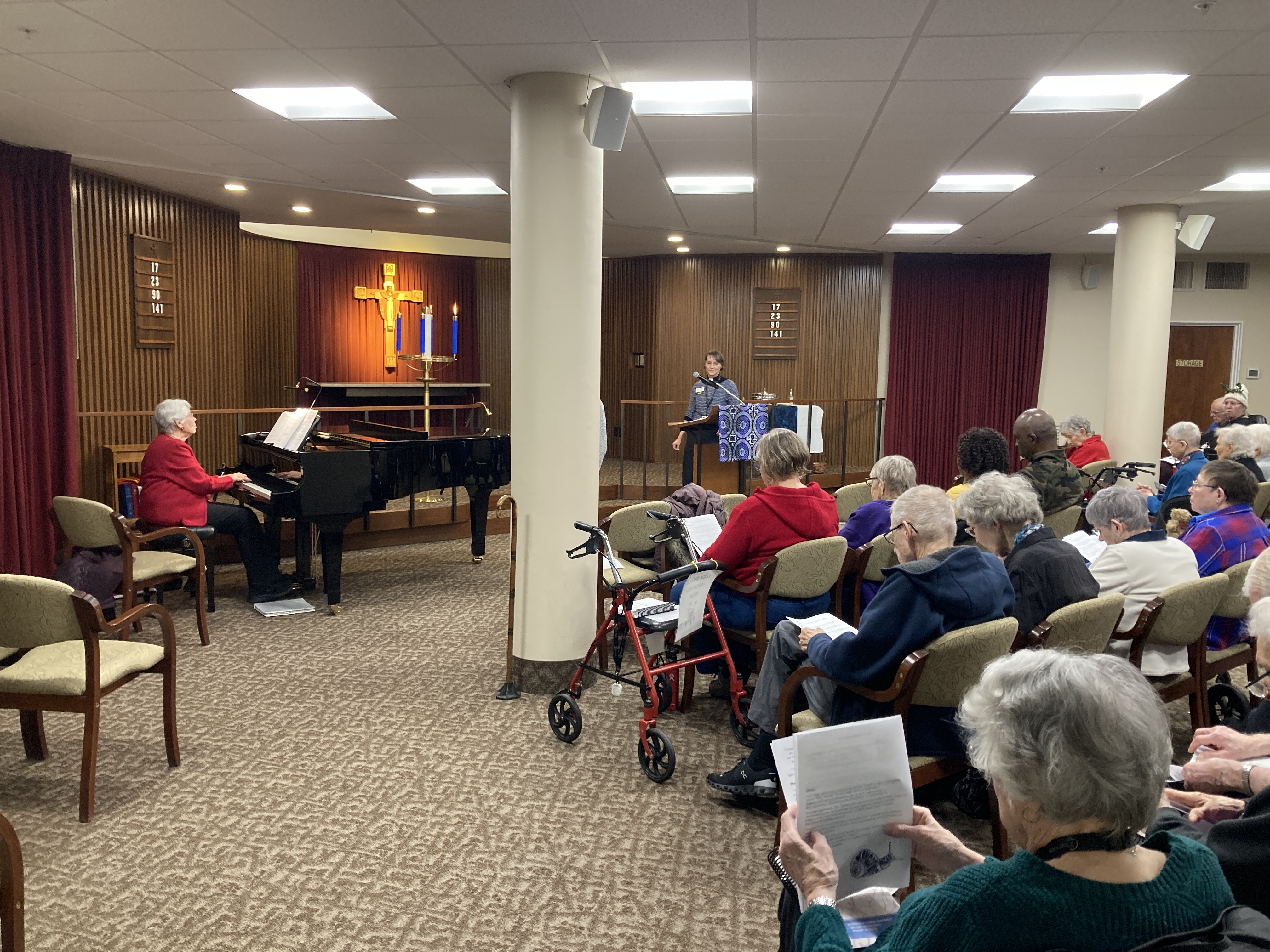
Sunday evening I had the honor of preaching and helping distribute Holy Communion at Riverview Retirement Community in Spokane. Rev. Yvette Schock serves as the chaplain for this community started years ago by Spokane Lutherans.
Matthew 3:1-12
I want to admit upfront that preaching on John the Baptist’s own message of repentance to members of a retirement community is a bit daunting to me, and I do quite a bit of guest preaching. If repentance is about a having a new perspective, what can I possible say to those of you who have likely been adopting new perspectives for decades. My own 85-year-old mother just moved into a 55 and older co-operative and we have had many conversations about how her perspective has been altered and then altered again over the years of her life.
Of course, at the heart of today’s scripture passage is the perspective to change all perspectives. It’s not a simple jump from two-dimensional to four-dimensional. It’s the old view to something radically new. The absolute power and authority that God exercises in heaven are now close to being exercised on earth. The second and third petitions of the Lord’s Prayer are about to be granted: May your kingdom come. May your will be done on earth as it is in heaven. Repentance is both possible and imperative.
I also want to name here that repentance itself can be a tricky thing to talk about. For some of you, it might dredge up feelings of guilt and unworthiness. It may even evoke a deathly fear of a day of judgment when God will separate good people from bad people. Didn’t we do away with repentance during Advent in the early 2000s when we tried to differentiate it from that other penitent season of Lent?
On this Second Sunday in Advent, John the Baptist reminds us that repentance is not primarily about our standards of moral worthiness. To repent is to take a clear-minded look at the ways in which one’s life colludes with the assumptions and behaviors of the old age, to turn away from such complicity, and to turn towards God and the attitudes and actions of the realm of heaven. Repentance is about God’s desire to realign us to accord with Christ’s life. Repentance is not about our guilt feelings. It’s about God’s power to transform us into Christ’s image—an image of love, abundant life, enough for all, flourishing for all creation.
The truth is, it is God who gets to determine the character of repentance. John the Baptist was not offering a better way to live, although a better way to live was entailed by the kingdom that he proclaimed was near. But it is the proclamation of “the kingdom of heaven,” or the reign of God, that creates the urgency of John’s ministry.
Such a reign does not come through out trying to be better people. Instead, the reign comes. Period. It’s coming makes imperative our repentance—our new lenses—new perspective. John’s call for the people to repent is not a prophetic call for those who repent to change the world. Rather, he calls for repentance because the world is being and will be changed by the one whom Johns knows is to come. To live differently, then, means that the status quo can be challenged because now a people are the difference. In so many ways, this Sunday is not about anticipating the birth of Jesus, but anticipating Jesus coming again in the fullness of time.
Preparing for this evening, I could not help but thinking about the most recent novel I read: Barbara Kingsolver’s Pulitzer Prize winning 2022 work Demon Copperhead. Yes, Kingsolver’s novel is inspired by Dicken’s David Copperfield, but instead of being set in old-England, her novel is set in present-day Appalachia. Damon Fields is born to a single teenage mother in a trailer home in Lee County, in the Appalachian Mountains of Virginia. He is nicknamed “Demon Copperhead” for his red hair, which he inherited from his father, who died in a drowning accident. Demon’s life and the novel touch on child poverty, rural America, and drug addiction, specifically the opioid crisis.
What makes this novel relevant to Advent and our gospel text is that though Demon is resilient and shows grit, what transforms him and his perspective on the world are the moments when other people show him love, we might even call them moments of holy grace. Demon’s life is one tragedy after another. But also making appearances are people like Coach Winfield, the coach of the Lee High football team who takes Demon into his home and eventually coaches him. Winfield’s daughter Angus becomes Demon’s steady friend. There is also Art teacher Annie nurtures Demon’s artistic abilities. And always there is June, his childhood friend’s aunt, always a protective and steady presence especially when he hits rock bottom. It’s the cumulative impact of each of these people helping Demon see his community and himself differently that eventually makes possible his own healing, or salvation. As people of faith, we would say they proclaim to him, “The kingdom of heaven has come near.” Jesus’ reign of love and life abundance is for you. And each time someone encounters Demon with that love and reign, his life bears fruit.
The potential problem with using a story like Kingsolver’s to draw a comparison is that we can think the Gospel is only for those who have really hard lives. I’ve experienced hardships, but nothing like Demon’s. And yet, I still hunger for Jesus’ vision of the reign of God coming soon. I still yearn for hope. My idols aren’t drugs or money but I put my trust in plenty that is not God—political parties, movements, my own skills. I long for God’s transforming power to intercede. I am grateful when I catch glimpses of God’s reign breaking in.
Here are some examples. A few weeks ago, I was at a congregation in a different part of our synod talking to some people who were going to join the church, from a different tradition, this week. One after the other, the three of them said something like, “we never knew we could feel such peace in worship.” I think of our synod ministry Cultivating Justice out in the Wenatchee area, a community of contemplation and action gathering around the ongoing work of true welcome and inclusion rooted in the teachings of Jesus. They have been harassed for standing with the marginalized in their community, but they do not back down. And I think of the recent visit of our two guests from the Ulanga Kilombero Diocese of Tanzania. For 30 years we have been sending people back and forth between that diocese and our synod—building real relationships, celebrating our differences and our unity in Jesus Christ.
We are called to prepare, even as God is already preparing us, usually when we are unaware. This happens in radical trust that Jesus Christ himself is working to purify us and the world around us. Christ is equipping us to become a dwelling place fit for himself. When we remember God’s promises, we nurture this trust and God grows us into faithful servants.
At our baptism we are joined with Christ to bring God’s will into the world. Baptism does not so much welcome the baptized into an institution (as we might think of the church) but into an alternative (or countercultural) community empowered by the Holy Spirit for life and witness. Isaiah’s prophecy from today is read at baptisms. “Pour your Holy Spirit: the spirit of wisdom and understanding, the spirit of counsel and might, the spirit of knowledge and the fear of the Lord.”
The Holy Spirit is poured in, and we are washed into a baptismal life in Christ–life in a wilderness with deprivations and hard lessons, but also everlasting joy in the kingdom. We are promised forgiveness and eternal life, and we are called to imagine a new community now, in this life.
Newly prepared to meet God-With-Us this season, we can pray with the Apostle Paul that “the God of hope fill you with all joy and peace in believing, so that you may abound in hope by the power of the Holy Spirit.” We will be changed, transformed, renewed by the gift of grace. Anne Lammot wrote, “I do not understand the mystery of grace—only that it meets us where we are and does not leave us where it found us.” My prayer for you this Advent that God’s grace will not leave you where it found you.


 A Place at the Table