Annual Report Letter

Originally sent to the congregations of the Northwest Intermountain Synod to be included with 2023 congregational annual reports.

“13 Now on that same day two of them were going to a village called Emmaus, about seven miles from Jerusalem, 14and talking with each other about all these things that had happened. 15While they were talking and discussing, Jesus himself came near and went with them…” (Luke 24)

Dear Friends in Christ,

Welcome to annual meeting season! I hope that in addition to doing the important work of electing leaders and/or approving budgets, your congregation’s annual meeting is a time to celebrate the way the Holy Spirit is working through your congregation and the many ways God’s love is shared in your larger community, across the Northwest Intermountain (NWIM) Synod, and around the world. I am writing this letter in early January, after reading Christmas cards full of laments for Israel and Palestine, Ukraine, and so many other places where violence harms the innocent. But the letters also spoke of the deep hope that comes from trusting in the abundant love and life that comes from the Triune God we worship. I encourage you to rejoice in this hope during your meetings even as you pray for peace.

At the end of April, the NWIM Synod Assembly gathered under the theme Bega Kwa Bega (shoulder to shoulder). We use this Swahili phrase because Swahili has no word for accompaniment, the term the ELCA uses to describe companion synod relationships (like our relationship with the Ulanga Kilombero Diocese of Tanzania) and the many other relationships in our neighborhoods and communities. The scripture story at the heart of our understanding of accompaniment is the Road to Emmaus from Luke Chapter 24, which begins with Jesus walking should to shoulder with two disciples who do not recognize him. The teaching document on accompaniment states, “We, and our acquaintances on the road, are all part of the body of Christ. We walk the Emmaus road every day and the people with whom we share the journey accompany us and we accompany them. The Emmaus road story helps to illuminate Accompaniment, a theology of mission. We see that mission is a journey, and that this journey, taken with many companions, shows us the unexpected and sometimes unrecognized Christ who walks with us. In this journey, we break bread together, we move toward Christ’s mission of reconciliation between us and God, between us and one another.” 

Now, anything can become an idol, even a theology. I am not inviting us to worship at the altar of accompaniment, but I do find it a helpful theme and thread for our mission as a synod. Our rostered leaders leaned into accompaniment when we heard from Vance Blackfox at Bishop’s Fall Convocation. Accompaniment will be in the background during our three spring regional gatherings (Spokane Valley, Twin Falls, and Ellensburg) where we will talk about Funding Forward and stewardship. Most important, accompaniment is what each of our congregations and ministries do locally—you are accompanied by your neighbors, and you accompany them. Accompaniment is sometimes hard, other times joyful, and occasionally puzzling. Our synod staff also seeks to accompany you, whether in the call process, a new adventure, or a time of struggle. The English word synod combines two Greek words that literally mean a way together.

In the life of the church, the other place the word accompaniment arises is of course in worship, during which the instrumentalist accompanies the assembly in singing. This may not be shoulder to shoulder, but what joy we have when the instrument and assembly are in sync! All our accompaniment in the world is grounded in worship. We are both sent from worship to serve, and we return to be fed and nourished. Thank you, finally, for your faithful worship of a God whose love in boundless.  

Bishop Meggan Manlove

A number of other resources are available to tell about the impact of your partnership and generosity. We hope you include these in your annual reports or as part of your annual meeting, and share the story of our life together!

Annual Report Cover : (Single page and cover spread available)

NWIM Synod Together in Ministry

Stories of Faith in Action

The Road to Emmaus by Gisele Bauche
Posted in NWIM Synod | Leave a comment

Baptism of of our Lord, 2024

St. John’s American Falls – Jan. 7, 2024

Mark 1:4-11

4John the baptizer appeared in the wilderness, proclaiming a baptism of repentance for the forgiveness of sins. 5And people from the whole Judean countryside and all the people of Jerusalem were going out to him, and were baptized by him in the river Jordan, confessing their sins.6Now John was clothed with camel’s hair, with a leather belt around his waist, and he ate locusts and wild honey. 7He proclaimed, “The one who is more powerful than I is coming after me; I am not worthy to stoop down and untie the thong of his sandals. 8I have baptized you with water; but he will baptize you with the Holy Spirit.”

9In those days Jesus came from Nazareth of Galilee and was baptized by John in the Jordan. 10And just as he was coming up out of the water, he saw the heavens torn apart and the Spirit descending like a dove on him.11And a voice came from heaven, “You are my Son, the Beloved; with you I am well pleased.”

Yesterday was Epiphany, the day the church celebrates the magi’s bringing gifts to infant Jesus. That day served as a bridge between the short Christmas Season and the Time after Epiphany, a season of manifestations of who Jesus is. We who follow the three-year cycle of scripture passages find ourselves back in Mark’s gospel.

There is no prelude to this gospel where you will read about shepherds, angels, magi, a star or a stable. There’s not a word about Mary and Joseph. Mark’s story of Jesus begins at the river: “In those days Jesus came from Nazareth of Galilee and was baptized by John in the Jordan.” We do not even hear the cosmic wonder that opens John’s Gospel: “In the beginning was the Word and the Word was with God and the Word was God.” Mark is far more ordinary and direct” “In those days Jesus came from Nazareth of Galilee and was baptized by John in the Jordan.” Jesus entered the river with others to be washed in a baptism of repentance for the forgiveness of sins. 

Does it seem strange that Jesus submits to a baptism of repentance? It’s okay if you wonder about that. Just remember this is where Jesus will spend his earthly life–in the midst of sinners–eating with them, talking with them, healing them, calling them. Why should his baptism be any different? Jesus went under the waters of the Jordan as the others had–under the waters his ancestors crossed after 40 years of wilderness wandering. Historic waters, even though they looked quite ordinary. 

Did Jesus look up at the sky before he went under the water? The narrator doesn’t say. But we do read that when Jesus came up out of the water, wet from the Jordan, he did look up, and he saw the heavens torn apart and the Spirit descending on him like a dove. 

There’s no indication that others saw this–only Jesus. He saw the heavens torn apart. The Greek word there is a form of the verb schitzo as in schism or schizophrenia. It is not the same word as open. I open the door. The door looks the same. But something torn apart is not easily closed again. Picture in your mind’s eye the ragged edges that will never go back together as they were. The use of schitzo is deliberate. It recalls the prophet Isaiah’s plea centuries before when he cried out to God, “Oh, that you would tear the heavens open and come down to make your name known to your enemies and make the nations tremble at your presence.” 

Now Jesus stood in the Jordan, dripping wet, without a hint that anyone else saw the heavens torn apart or saw the dove or heard the voice. We have no indication that the nations were trembling. But that did not mean that nothing had changed. It does not mean that the world was about to turn, to quote Jesus’ mother Mary. Though we usually imagine God speaking in a booming voice, resonant and deep, that voice is more often heard in movies than in Scripture. God’s voice can be a whisper, a breath, quiet as the still small voice that reached Elijah hiding in his cave. 

At the Jordan River the voice that came from heaven spoke to Jesus alone. I like to imagine that it was intimate and direct. “You are my Son, the Beloved. With you I am well pleased. In you my Spirit will be present on the earth in a new way.” The heavens were torn apart, and they would never close again. 

Sometimes that’s how I feel about the world right now. When I was in high school, the Berlin Wall came down. The Cold War that shaped so much of my youth seemed to be ending. I didn’t understand it all, but I heard about real Peace Talks in the Middle East. I remember watching the film of Rodney King being beaten but there seemed to be so much progress in race relations in our country. National and state politics consisted of a two-party system, but there were regular stories about compromise. All of that feels torn apart to me and I can’t see how we’re going to piece things back together.


And yet, and yet I know that the torn place is where God comes through, the place that never again closes as neatly as before. One pastor [Barbara Lundblad] reminds us that from the day he saw the heavens torn apart, Jesus began tearing apart the images of who people thought the Messiah was supposed to be– 

Tearing apart the social fabric that separated rich from poor. 
Breaking through hardness of heart to bring forth compassion. 
Breaking through rituals that had grown rigid or routine. 
Tearing apart the chains that bound some in the demon’s power. 
Tearing apart the notions of what it means to be God’s Beloved Son. 

Nothing would ever be the same, for the heavens would never again close so tightly. 
At the end of his life Jesus hung on a cross between heaven and earth. When he breathed his last, the curtain of the temple was torn in two from top to bottom, torn apart as the heavens had been torn apart. The holy of holies no longer separated the sanctuary from the people. That curtain could never be repaired either. There was no voice from the darkened heavens that day. God was silent, not even a whisper. 

But there was a voice not far off but close. A centurion soldier stood at the foot of the cross keeping order, marking time, waiting to pronounce death. When he saw that Jesus had breathed his last, he said, “Truly this man was God’s Son.” Who gave him that word? We are never told. That soldier had somehow heard for himself the words whispered to Jesus alone at the Jordan. The word came through the torn place in the sky, through the torn curtain: “This is my Son, the Beloved, with whom I am well pleased.” 

Is there a torn place in your life: relationship that ended, an addiction finally confronted, the loss of a job, a lifelong dream that’s shifted? Or maybe it’s watching the American Falls community change as growth continues—new jobs but also new people and a crunch when it comes to housing? Whatever life looks like going forward, it may be more like a true crazy quilt or it may be full of patches, still beautiful, but not what it was before it was torn apart.

Jesus stepped into all of this when he was baptized, an act of solidarity with the rest of the community, with all of humanity. What a gift, what good news for each of us who is called Child of God. The same Spirit that entered him, entered each of us in our baptism, not the entrance to a special club, but as an inauguration to abundant life. This abundant life is not without pain or brokenness. If we truly follow Jesus, there will in fact be difficulties.

 But it is a life with hope and companion and a God who loves us. And God continues to enter into the torn places and moments. It truly is God’s method of operation. “You are my own Beloved Child.” You likely have had or have now a torn place, but God is in it. The same is true for your neighbor and me, for this community of faith, for the larger Upper Snake River Valley. Even as we leave the season of Christmas, we remember that Jesus remains Immanuel, God with us.

Posted in Sermons | Leave a comment

Manifestations

Originally published in the Northwest Intermountain Synod January 2024 e-news:

“…. anthems be to thee addressed, God in flesh made manifest.” ELW 310

Songs of Thankfulness and Praise has always been a favorite hymn of mine, ever since I had to memorize it for a Concordia College Christmas Concert. Epiphany and the Sundays that follow make up a season with stories which show forth who Jesus Christ truly is. The magi’s visit, Jesus’ baptism, the call of disciples, casting out demons, healing, and the transfiguration are all epiphanies, moments in which God in Jesus Christ is made manifest.

It always struck me as an interesting coincidence that Time after Epiphany overlaps with at least the beginning of the state legislative sessions. In the first few weeks of the session (both Washington and Idaho’s sessions begin Jan. 8 this year), citizens get manifestations of the legislative bodies, through bills, speeches, meetings, and local reporting. We talk often in the church about how Jesus made sure people on the margins were brought into the main story; these individuals often take primary space in the pages of the four gospels. As people following Jesus, our eyes and ears should be attuned to what space the marginalized today have in legislative bills and at their hearings.

As we collectively prepare for the legislative season, I think we also do well to borrow the language Franciscan Father Richard Rohr used when naming his Center for Action and Contemplation. Jesus himself modeled both of these—casting out demons, feeding, and healing and then stepping away to pray. We are called to both advocacy and prayer, always both. Some of us are more gifted or our natural charisms may lean into one or the other, but as communities of faith we should hold these two together and probably in conversation.

Our new worship resource, All Creation Sings, has an abundance of prayers for the individual and assembly. I love the first two in the Faithful Living section, the first for each of us and the second for public servants (p. 50). The ELCA has a plethora of resources for advocating on a variety of issues. Our synod supports the Faith Action Network in Washington and in Idaho I found many active coalitions that are issue specific.

The ELCA recently posted the DRAFT ELCA Social Statement on Civic Life and Faith. The Introduction begins, “Daily we are to pray as Jesus taught: ‘Your will be done on earth as in heaven. Give us today our daily bread.’ These words teach us that God’s will seeks the well-being of creation and all aspects of human life, including civil society (Micah 6:8) and the blessing of the gospel to join God’s work in society….” I encourage you to read the draft and comment. The Civic Life and Faith study is also still available and very well done.

But also stay informed about the state legislatures, your local city council and school board, and planning and zoning commissions. Write emails expressing why your faith compels you to speak for those whose voices are hushed or silenced. And pray for public servants, those in your congregation, those you agree with, and those you disagree with. Pray for your own neighborhood. 

We are also called to listen. Listening is crucial to both prayer and advocacy. It is a huge part of Christian discipleship, to listen—to the Word of God through scripture, to neighbors and strangers and friends, to the stirrings in our own souls, to other followers of Jesus, to people who society tries to mute, and to the Holy Spirit.

German pastor and theologian Dietrich Bonhoeffer wrote this about listening, “The first service that one owes to others in the fellowship consists in listening to them. Just as love to God begins with listening to His Word, so the beginning of love for the brethren is learning to listen to them. It is God’s love for us that He not only gives us His Word but also lends us His ear,” Life Together. God be with you as you pray, advocate, and listen in this Time after Epiphany.

Bishop Meggan Manlove

Posted in NWIM Synod, Reflections | Leave a comment

Winter in the Upper Snake River Valley Cluster

I just returned from a full weekend in the farthest east cluster of our synod, though I did not make it into Wyoming on this trip.

Not wanting to risk driving in the snow after dusk, I drove over Friday afternoon. This gave me some time to rest Saturday morning before the ecumenical Epiphany worship service at Good Shepherd Lutheran, Pocatello. The Episcopal priest preached, the Methodist pastor presided at Communion, and ELCA Pastor Wayne Shipman led the rest of the liturgy. We each got chalk as we left worship to chalk our thresholds.

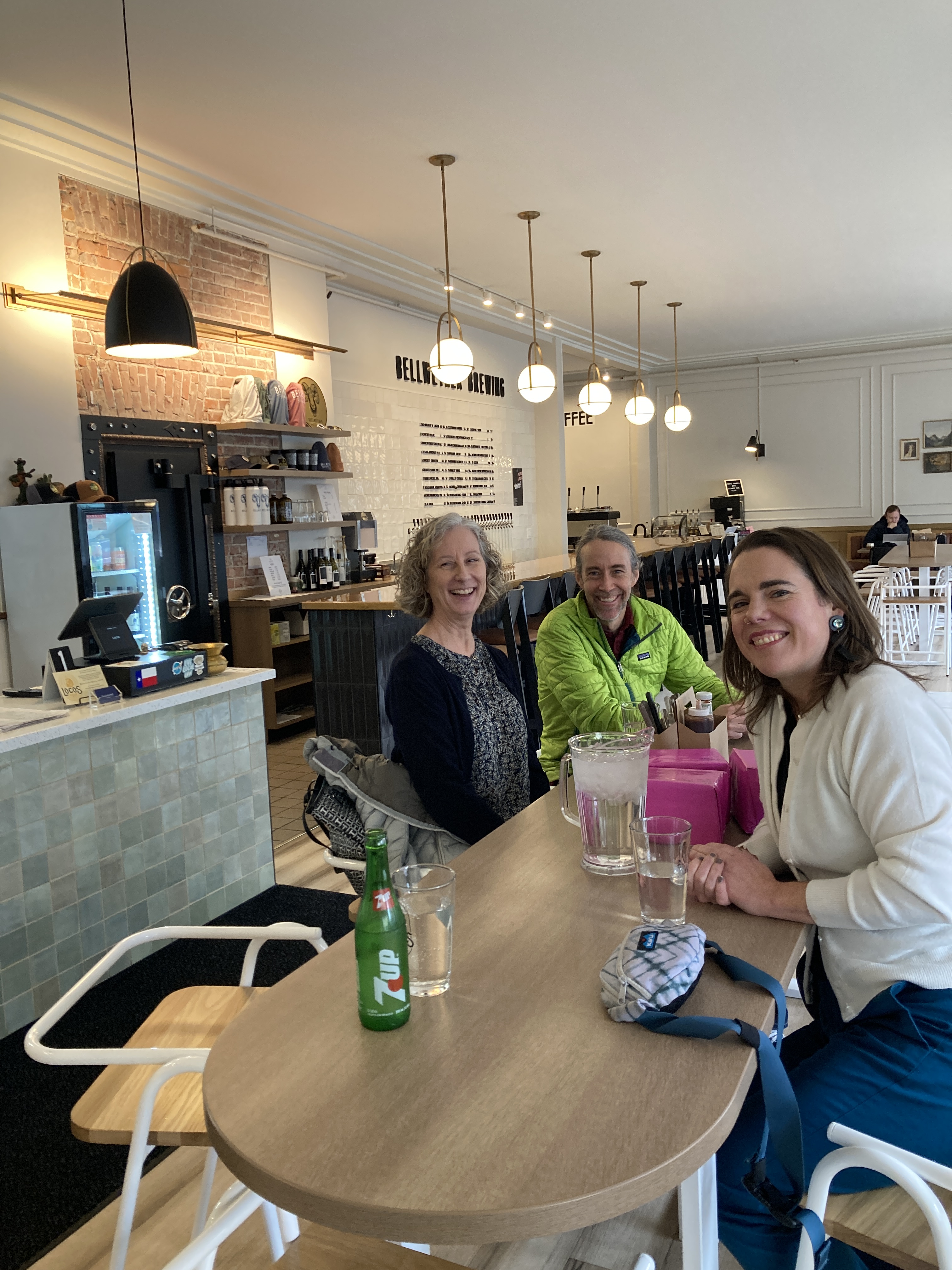
Our synod covers four presbyteries and we do a lot ecumenically, so I try to keep nurturing my relationships with the four presbyters. Cathy Chisolm and I met for coffee at Gate City. I parked in a business’ parking lot and got to enjoy the art in this alley, not quite as professional as Freak Alley in Boise, but some fun art nonetheless.

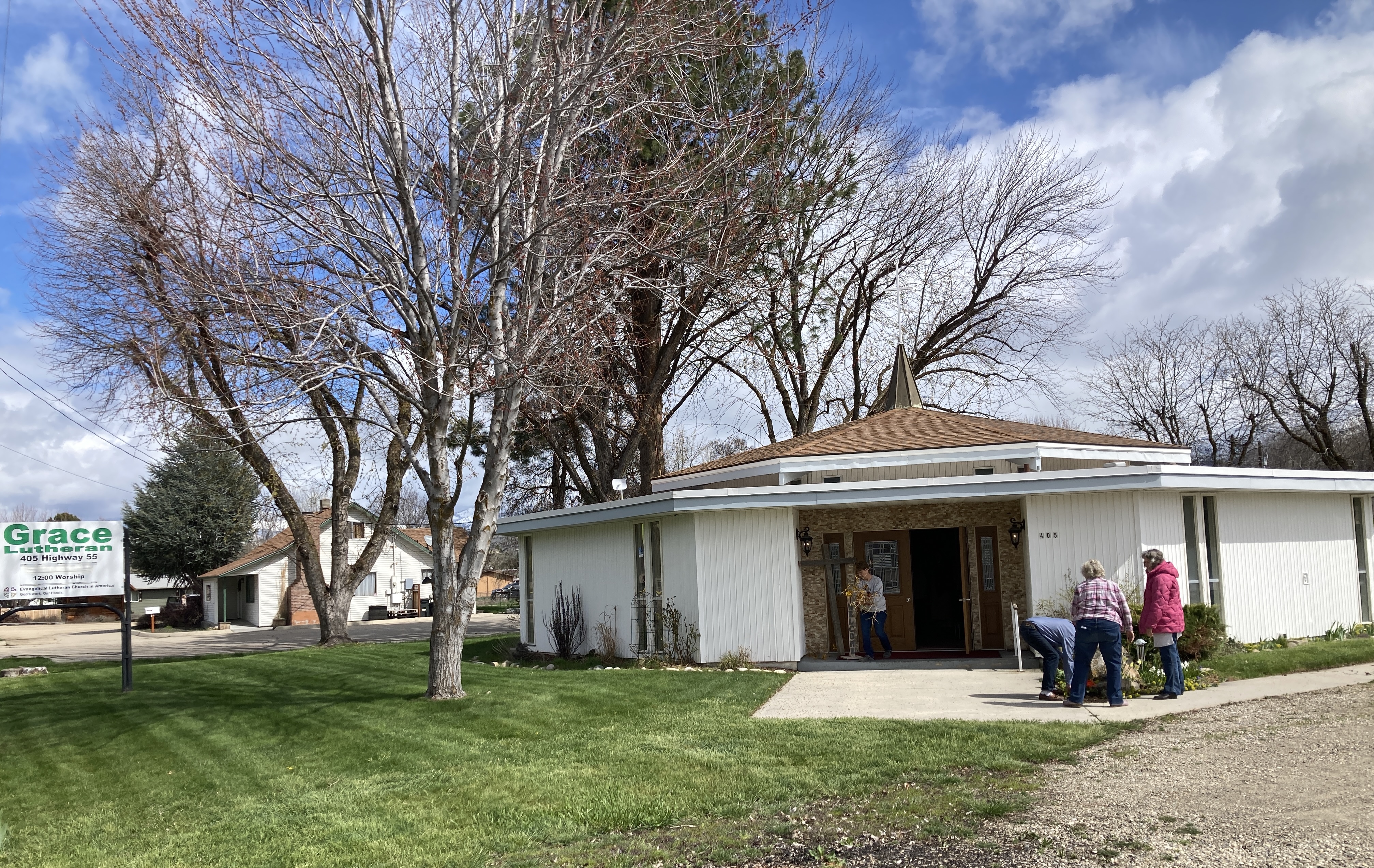
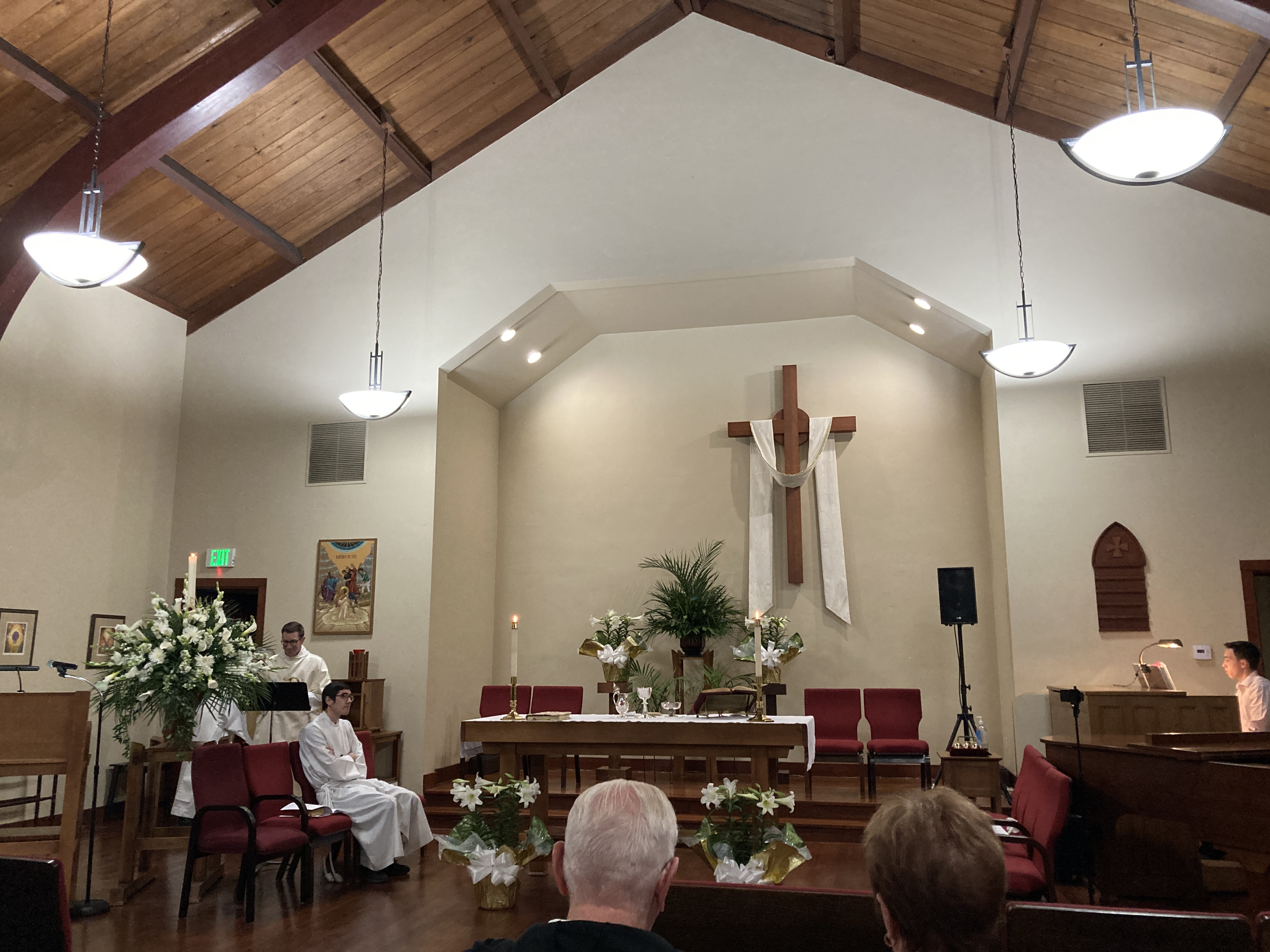
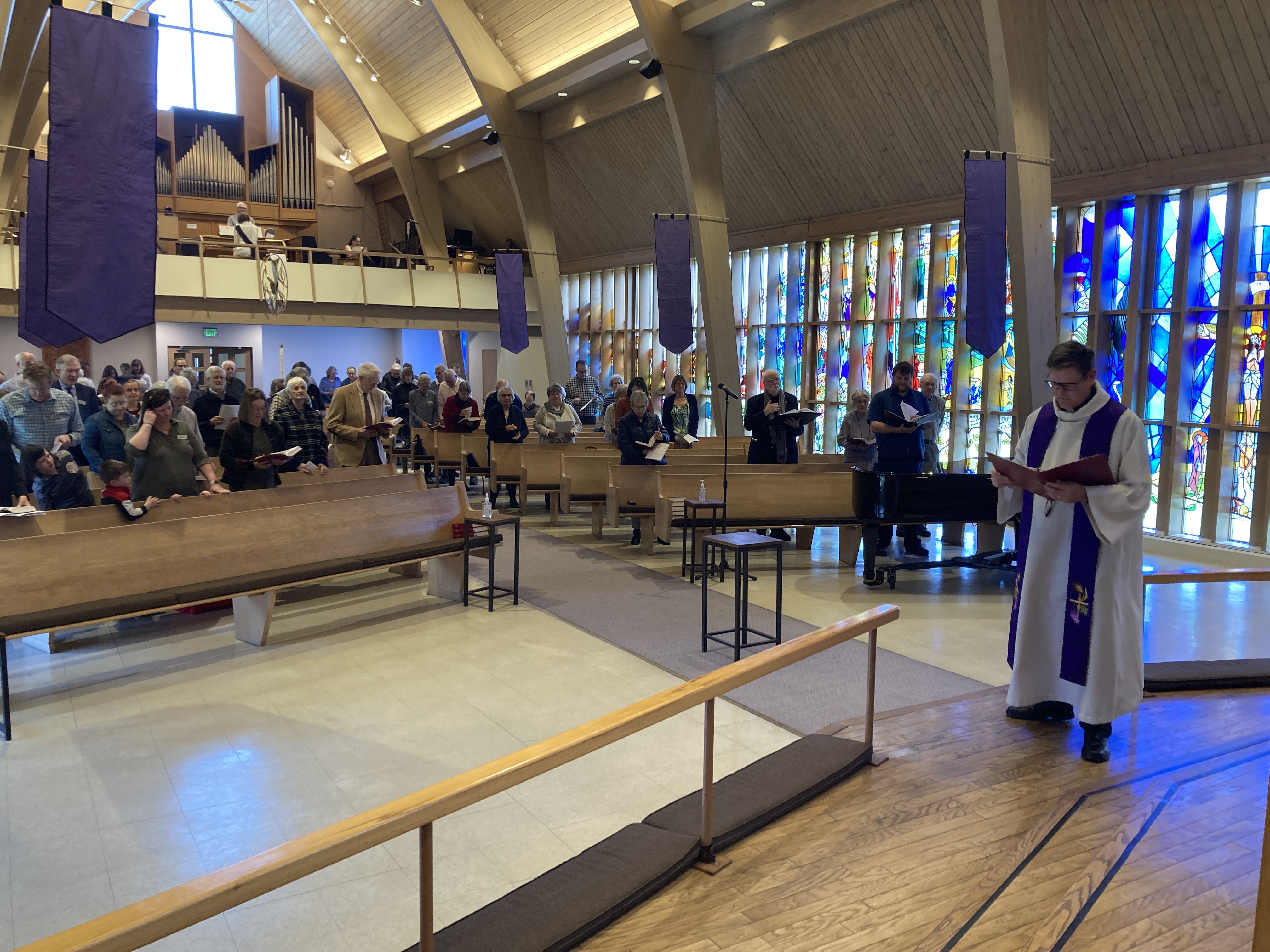
Sunday morning I preached at St. John’s Lutheran in American Falls. Pastor Jon Beake, who as been there over 15 years, presided. It was quite a snowy morning so attendance was low but we all had a great conversation after worship, talking about the changes in the community, what the congregation has meant in people’s lives, why their Christian faith remains vital. Everyone really does have a faith story.

Pastor Beake gave me a tour of the massive building. The gymnasium is used for community youth basketball five nights a week. The congregation moved children’s faith formation to Thursday evening and it’s thriving. American Falls has new businesses coming in–Lamb Weston (think McDonald’s french fries) is building a plant which should employ 600 people and a Ridley’s Grocery store just opened. The community also has a housing shortage.

Pocatello is home to Idaho State University, which houses the Idaho Natural History Museum, open on Sunday afternoons. So after lunch with Pastor Beake, I toured the museum. It is fabulous! Parts of it reminded me of the Mammoth Site in Hot Springs, SD, an hour south of my home town of Custer.

Pastors from the cluster drove to Pocatello from Twin Falls, American Falls, and Jackson so we could all enjoy lunch together before I headed back home. It takes five hours to drive across this one cluster, but this group has worked hard on collegiality and it was so good to see and hear their mutual support of one another. We missed Pastor Ann, but she couldn’t miss her ELCA Family Systems Academy sessions.

Posted in NWIM Synod | Tagged | Leave a comment

Synod End of Year Appeal

7Jesus said to them, ‘Fill the jars with water.’ And they filled them up to the brim. 8He said to them, ‘Now draw some out, and take it to the chief steward.’ So they took it. 9When the steward tasted the water that had become wine,” John 2:7-9a.

Dec. 18, 2023

Dear Friends in Christ,

I have always loved the story of the Wedding at Cana and can still hear my dad singing this line from my family’s favorite table grace, “He who fed the multitude, turned the water into wine, to the hungry calleth now, come and dine.” What does abundance look like for a synod?

This past summer, Assistant to the Bishop Pastor Phil Misner began convening monthly all of the pastors in our synod who are leading congregations in transition. They read materials in advance, check-in, share practices, pray, and provide support to one another. This support is possible because of Mission Support given to the synod.

Our synod council designated funds this summer so that each one of our pastors and deacons in their first three years of ministry could receive coaching for a year. Pastor Peg Harvey-Marose is paid a stipend to coordinate these relationships and she recently reported that everyone now has a coach! This ministry is possible because when a church closed, they gave a gift to the synod.

In the fall I led a series on Martin Luther’s treatise Freedom of a Christian and now DEM Pastor Liv Larson Andrews is leading a book study on Vine Deloria Jr’s God is Red: A Native View of Religion. The generosity of your congregation and other congregations in this synod allows us to provide learning opportunities on what it means to be a Lutheran Christian in the world today.

Our Presbyterian colleagues in Spokane have just been awarded a grant to help congregations with land stewardship discernment and they are committed to this work being ecumenical. Our Episcopal colleagues have shared that they would welcome our congregations to participate in their two-year College for Congregational Development. Mission Support gives the Northwest Intermountain Synod opportunities to foster strong ecumenical relationships that help us share the good news of Jesus alongside these partners.

We worship a God of abundance and that is clearer to me than ever as I finish my sixth month as bishop of our synod. Everywhere I turn, people, organizations, and full ecumenical bodies have time and resources to share for the sake of the gospel. Take a moment during this season of hopeful waiting and just imagine what more we could do as a synod with even more financial resources. What more resourcing, equipping, consulting, coaching, and building up of the church could this synod do, all for the sake of sharing the good news of Immanuel, God with us? 

At our current rate, our synod will need an extra $35,000 to meet our budget, just $410 per congregation. Thank you in advance for your end-of-year Mission Support. The synod hopes to build on the ministries named in this letter in 2024!

Bishop Meggan Manlove

To give online to the synod, follow THIS LINK.

Checks can be mailed to:

NORTHWEST INTERMOUNTAIN SYNOD OF THE ELCA
245 E 13TH AVE, #A
SPOKANE, WA 99202-1114

Posted in NWIM Synod | Tagged , | Leave a comment

Remembering Dad

Last Sunday would have been my parents’ 52nd wedding anniversary and today is the third anniversary of my dad’s death. I’m so grateful to my former congregation for the way they cared for me in December 2020 and I’m thankful my new job let me spend this week in Arizona with my mom. We went out the saguaro forest Sunday, which dad would have loved. The Black Hills, the land near Highland Lake, NY where camp Koinonia sits, the banks of the St. Croix River, the Iron Range of Northern Minnesota, and so many other natural places are what my dad loved so much. He and mom spent a lot of time exploring the desert the last 20 years of his life so it was fun to go and stand under the saguaros.

Lots of people have speculated about what my dad would have thought of my becoming an ELCA synod bishop this year. We’ll never know. Lately I have mostly not worried about it and instead given thanks for the love he gave me and so many others and the things I learned from watching him. In November, Ralph Yernberg was honored with the Manlove-Howells Leadership Award, named after my dad and Paul Howells. In his acceptance speech, Ralph said of my dad, “Jerry was into leadership development. He was the great connector of all time. He always asked “do you know this person? Have you met that person?” Both of my parents are great connectors and somewhere along the way, I must have seen that and paid attention to it because it’s absolutely one of my methods of operation. I think, “the world would be better if I could connect those two people.”

My dad in 1969.
Posted in Uncategorized | 1 Comment

Staff & Community

Back in the spring I applied to the Idaho Nonprofit Center’s leadership cohort. I was accepted after the bishop’s election but even with the job change, they let me in. We began with a retreat at the YMCA camp near Cascade. It was a wonderful few days of introspection and new friendships. One of our leaders told me I had a unique opportunity to invest time and energy in staff development at the beginning of my term. Three of our staff live near Spokane and I had a friend who earned her PhD in leadership from Gonzaga, so I reached out to the Leadership Department. After many emails and phone calls, we had two professionals ready to lead us for a two-day retreat in December: getting to know each other, talking about roles, setting some goals, and engaging in Ignation spiritually. I went through the busy busy fall and then this past Monday morning I woke up and thought, “it’s finally here-staff retreat!” It truly exceeded my expectations and I’m so grateful for both our time together and what we accomplished.

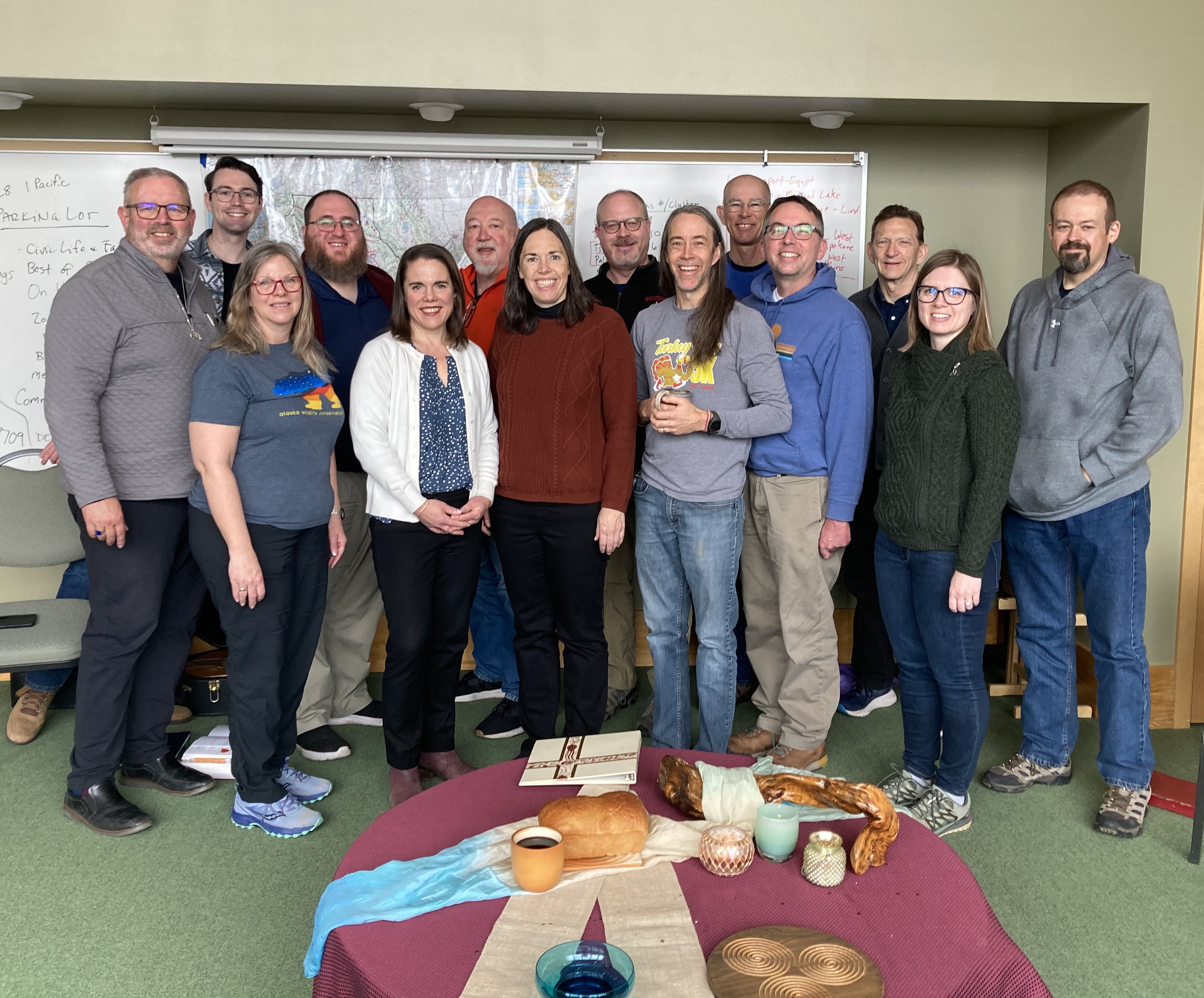
Staff!
Facilitators Rebecca and Lauren

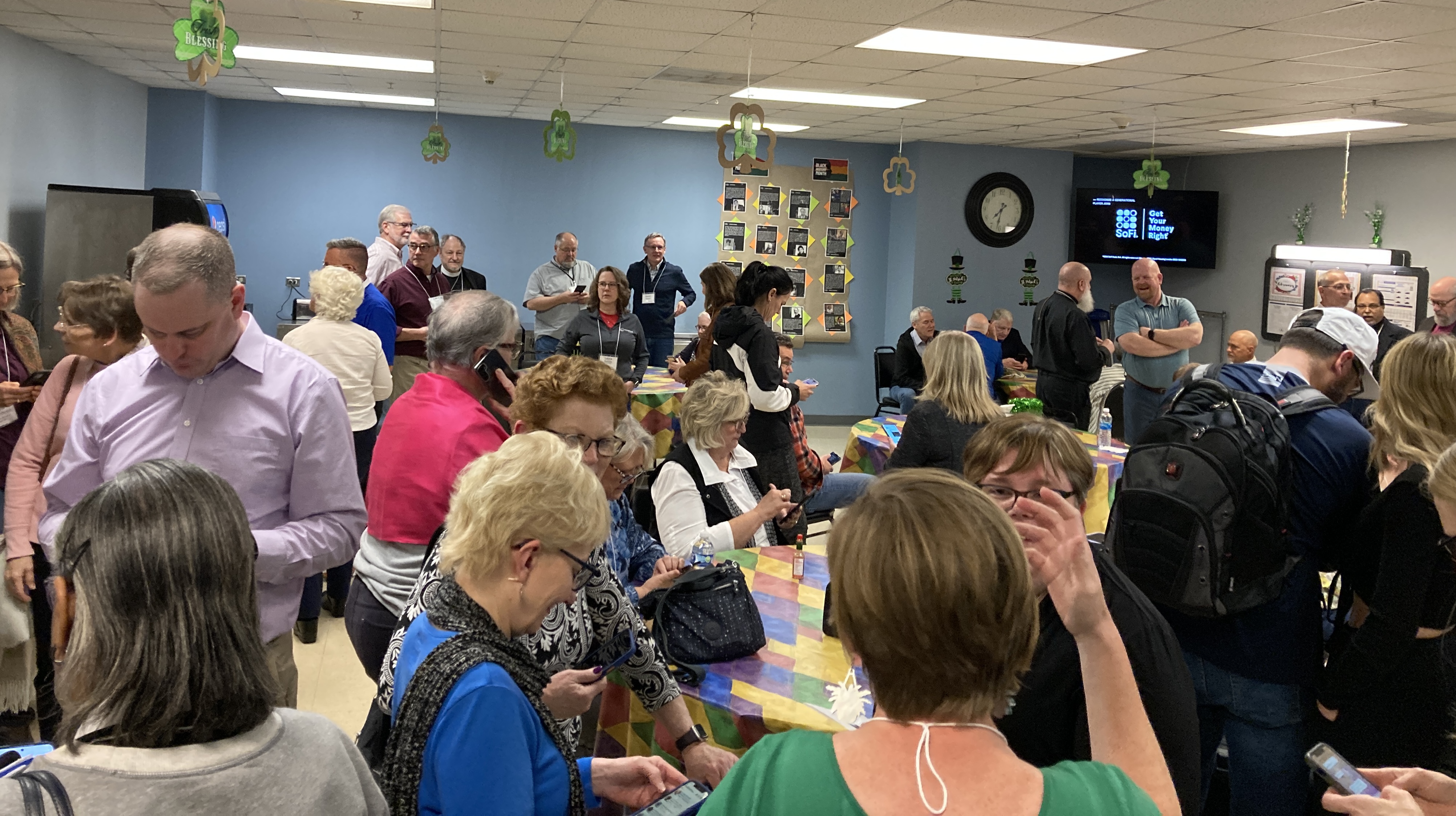
My time in Spokane ended with a joint fundraiser for Lutheran Community Services Northwest and Greater Spokane Campus and Young Adult Ministries.

Posted in NWIM Synod | Leave a comment

Our Savior Lutheran, Pinehurst

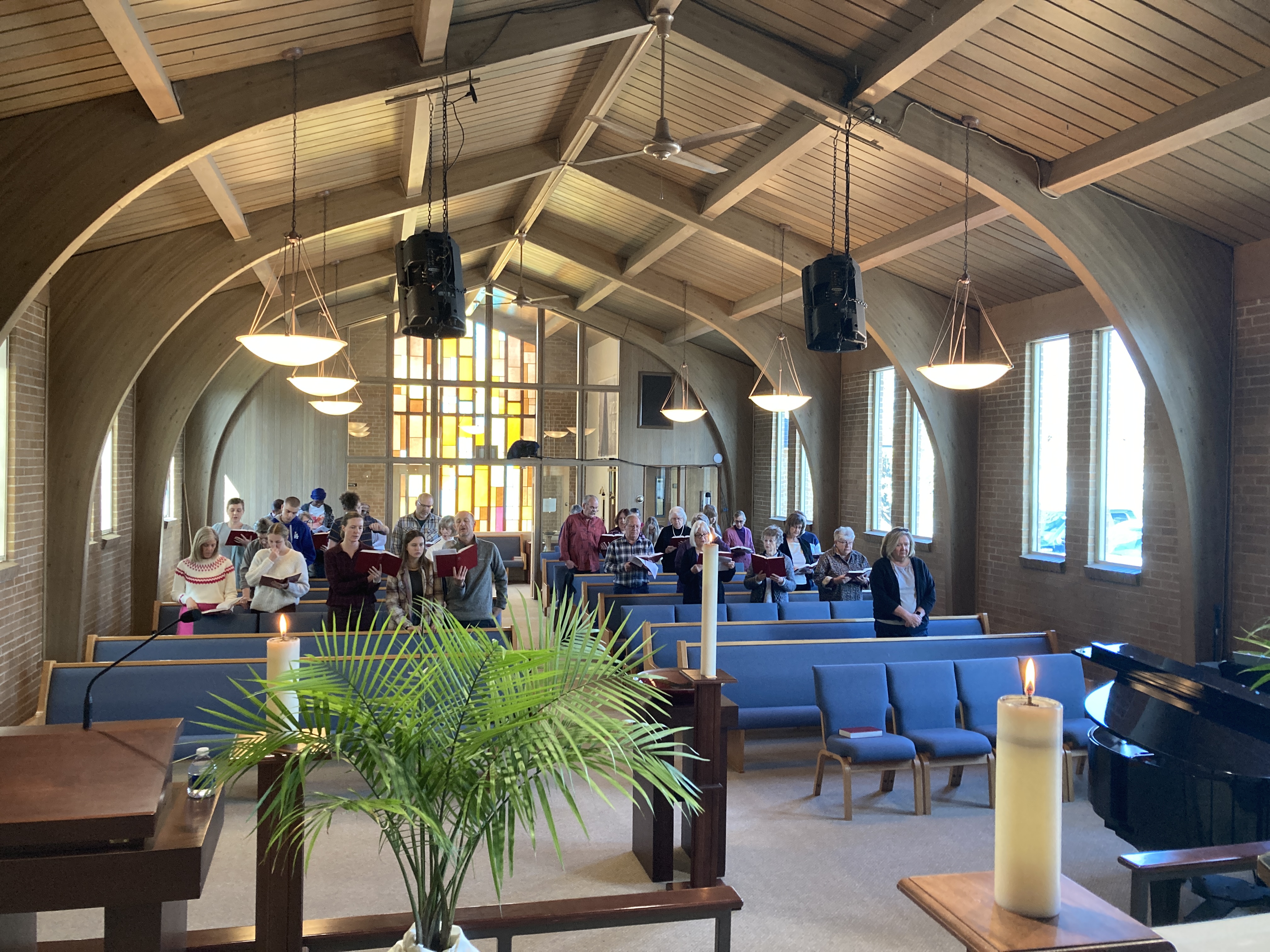
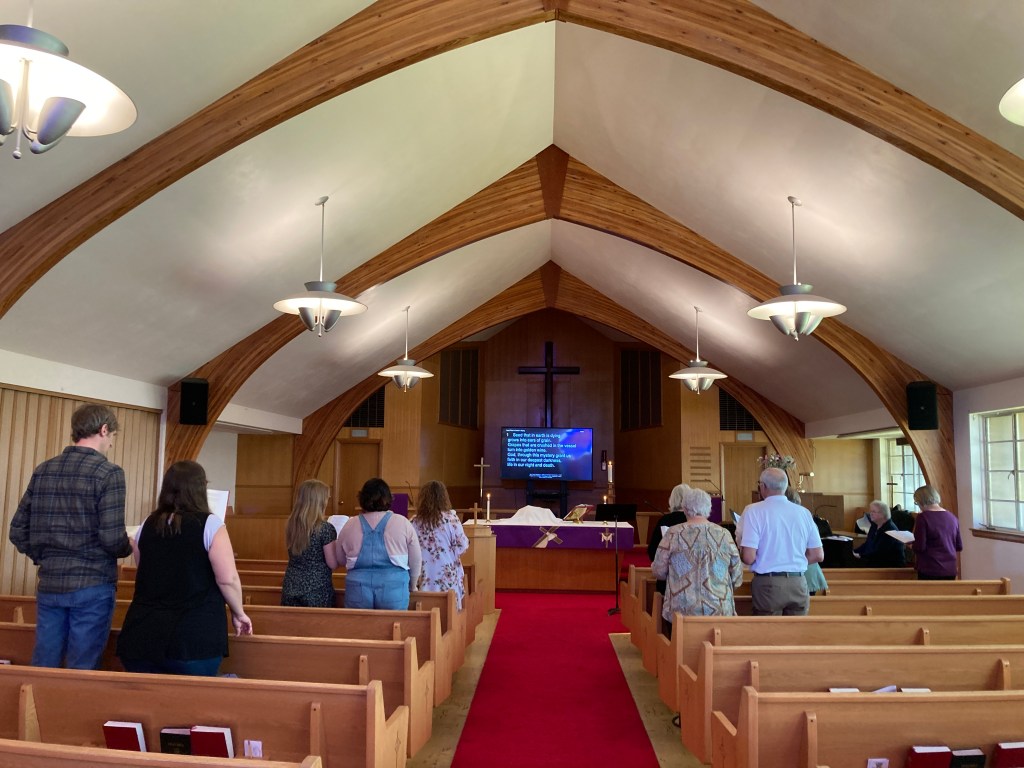
I cannot remember when I first heard about Our Savior Lutheran Church in Pinehurst, Idaho. I knew Pastor Seth Rummage had a good year there with his family before taking a call to Billings. I knew it was retired Pastor Kate LePard’s first call a few years ago. I knew I would need a place to be this Sunday, between a week of activity in Spokane and our staff retreat tomorrow and Tuesday. I called the office phone to invite myself and volunteer Judi Burks called me back and said they would love to have me. Retired Pastor Ken Bartle would help with leading worship and we could all share lunch afterwards.

The drive over through Spokane Valley and North Idaho was nice and easy. I’m always amazed that that is the same Interstate 90 that goes across my home state of South Dakota as ones needs to pay a bit more attention to the road in the panhandle, even in good weather. I got a glimpse of their nice parsonage on my way into the church building. Our Savior has a very active choir, which rehearsed before worship for this Sunday and after lunch for their cantata on Dec. 17. Council President Scott Reed got some biographical information from me before worship and I learned a little about his time up near Glacier. My biggest regret of the morning was not thanking Scott or the entire church more for their commitment to hunger work in the Silver Valley. I had read in a Facebook post that, “At the recent church council meeting, it was decided to send a check for $2,500 to our local food bank and also a check to Second Harvest for $2,500. Second Harvest blessed our Silver Valley families with 5 food distributions in 2023. At the November distribution, food was given out to 251 families.” When the bishop is not present to preach, Pastor Ken and three lay people take turns. It was fun to follow up with with Judi during lunch about text studies she and the other lay preachers might join and trainings that the synod will soon be announcing. I realized that Our Savior, Pinehurst is just the kind of congregation I have had in mind when it comes to equipping lay people for the next chapter. That said, our whole synod staff would still love to find a pastor to serve Our Savior. With the parsonage, closeness to Coeur d’Alene, proximity to the great outdoors, and great lay leadership, it would be a great call.

By the time we finished our potato and chili lunch, it was snowing. Fourth of July Pass looked a little different on the drive back to Spokane, but the road was only wet and everyone out there seemed to know what they were doing.

With current Council President Scott Reed

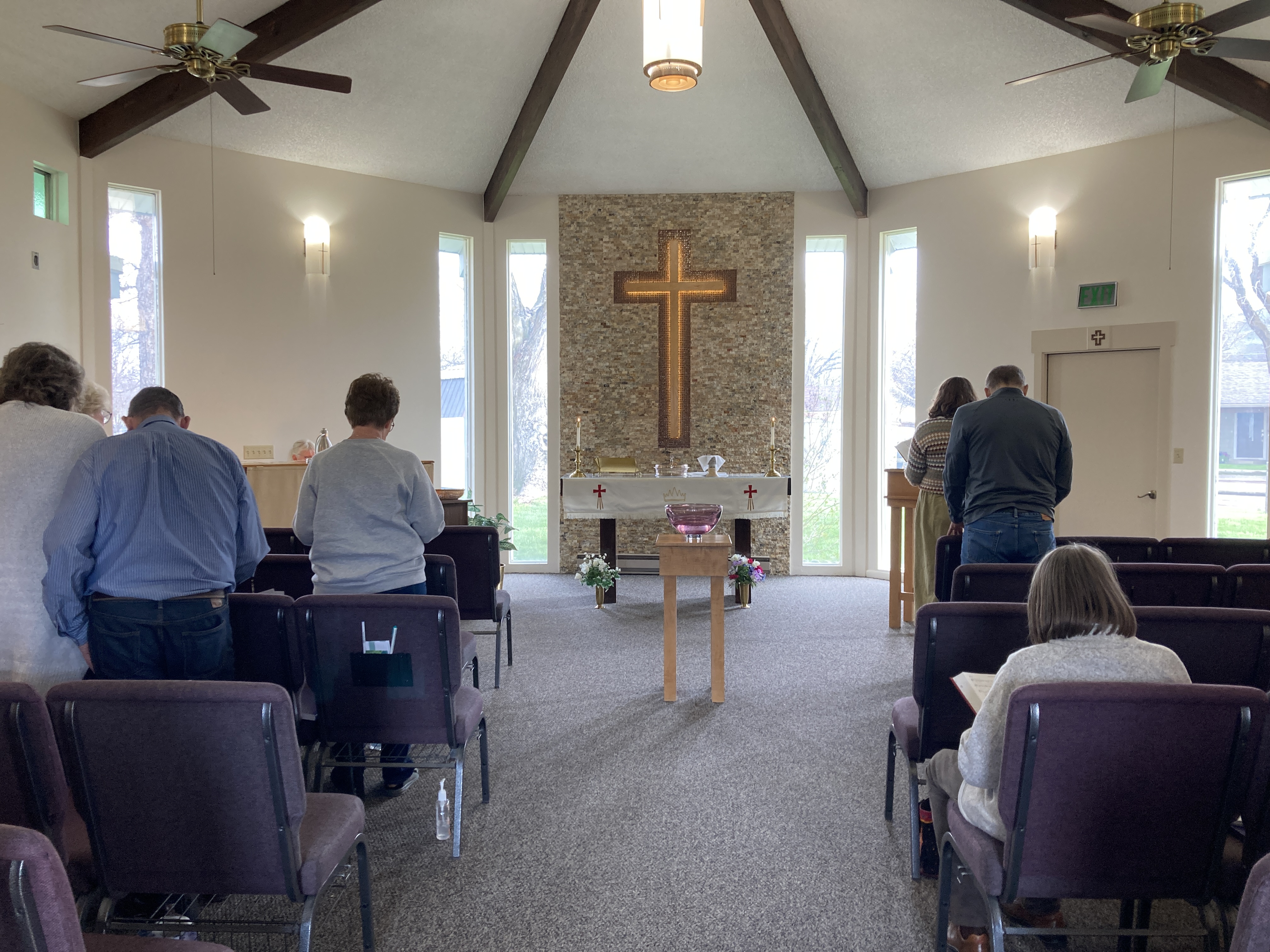
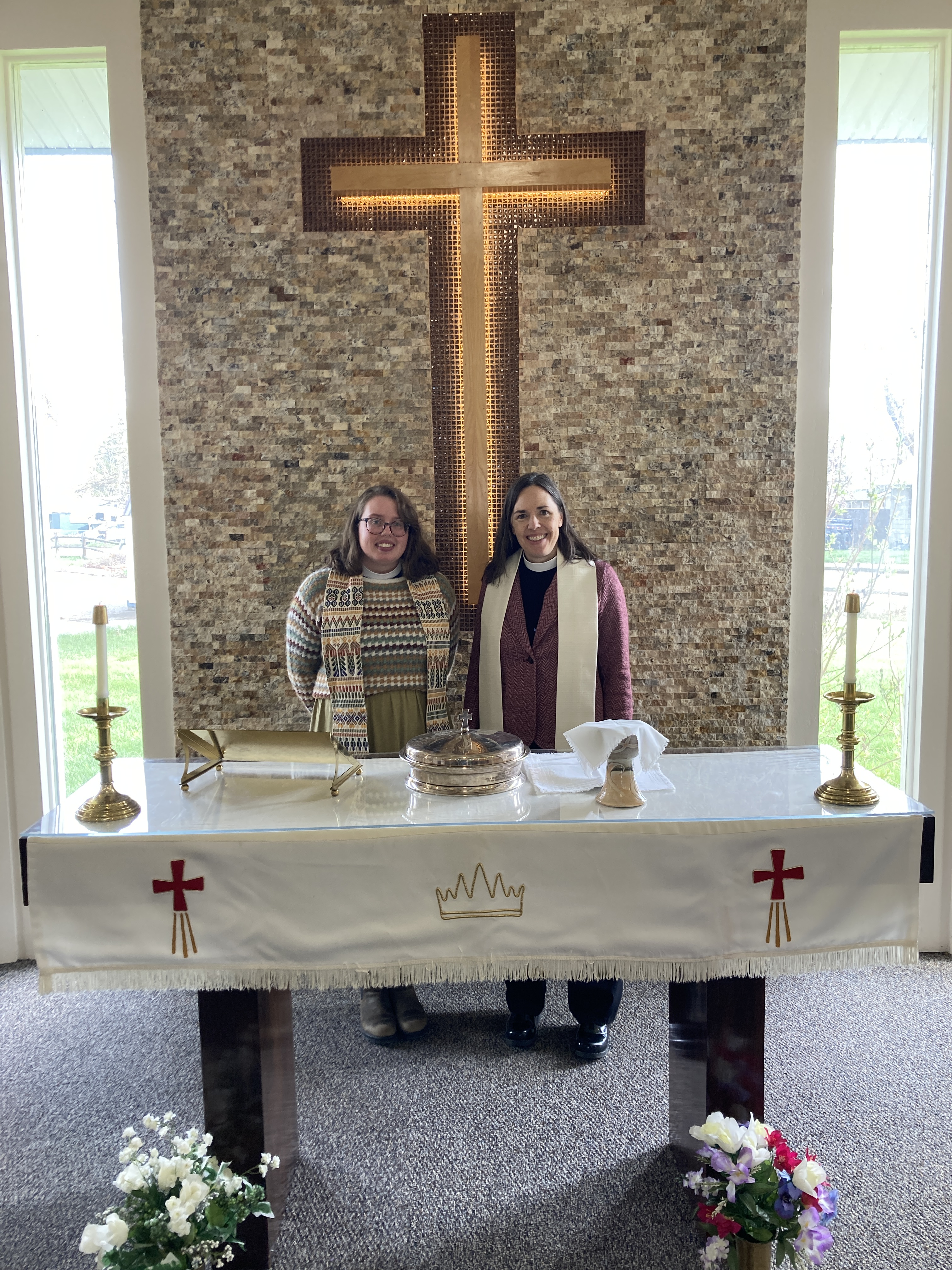
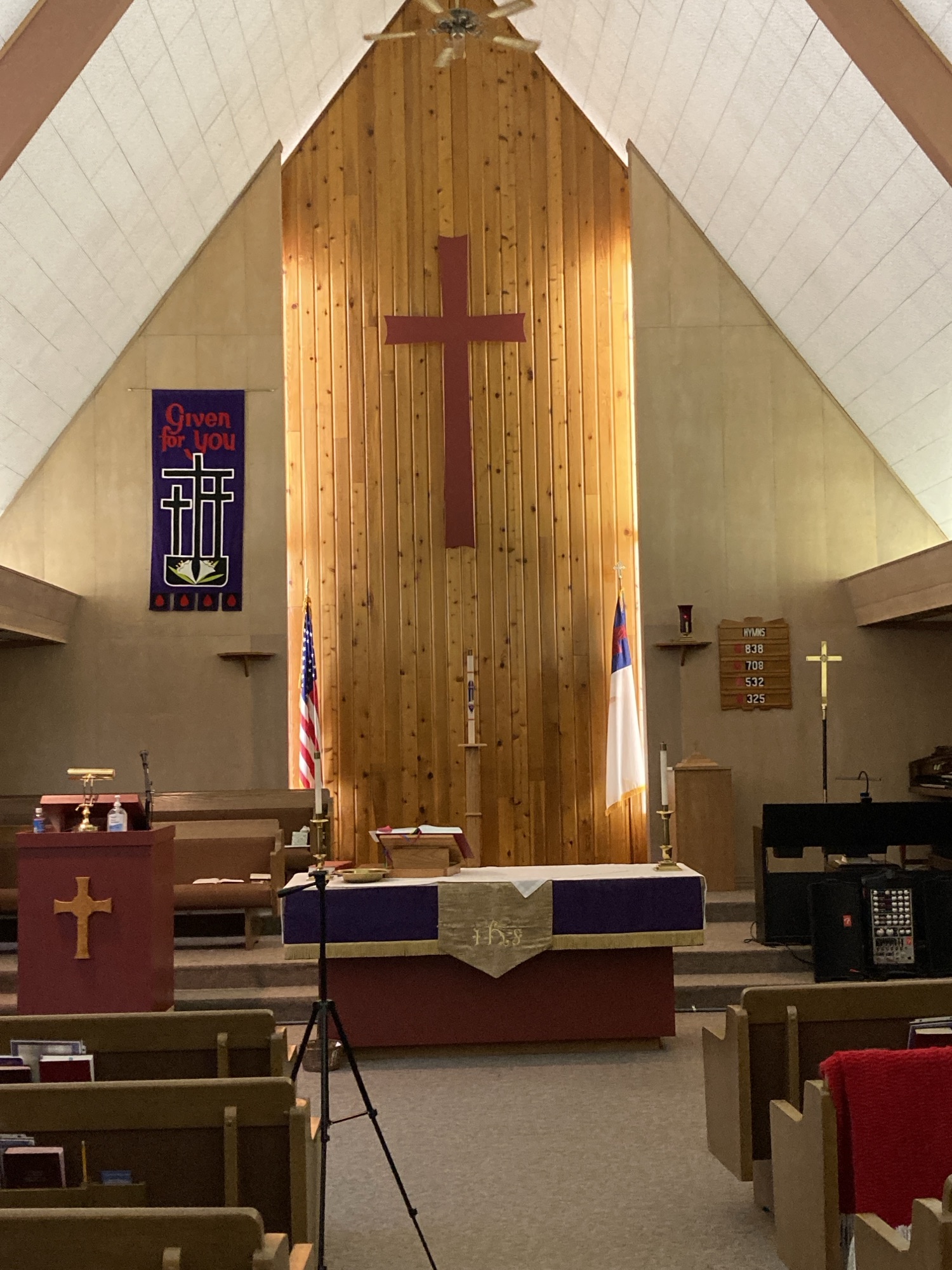
Fun facts about the building, constructed in 1957: The rock wall was laid by Carroll Chaffee. The materials are natural rock from the Kellogg area. The 14 foot rough hewn cross was made and placed by Clarence Stillwell, former manager of the Kingston Ranger Station. The altar, laid on stone columns, was made from a stately white pine tree which once stood on the very spot of the altar. (Celebrating the First 50 Years, in 2007)

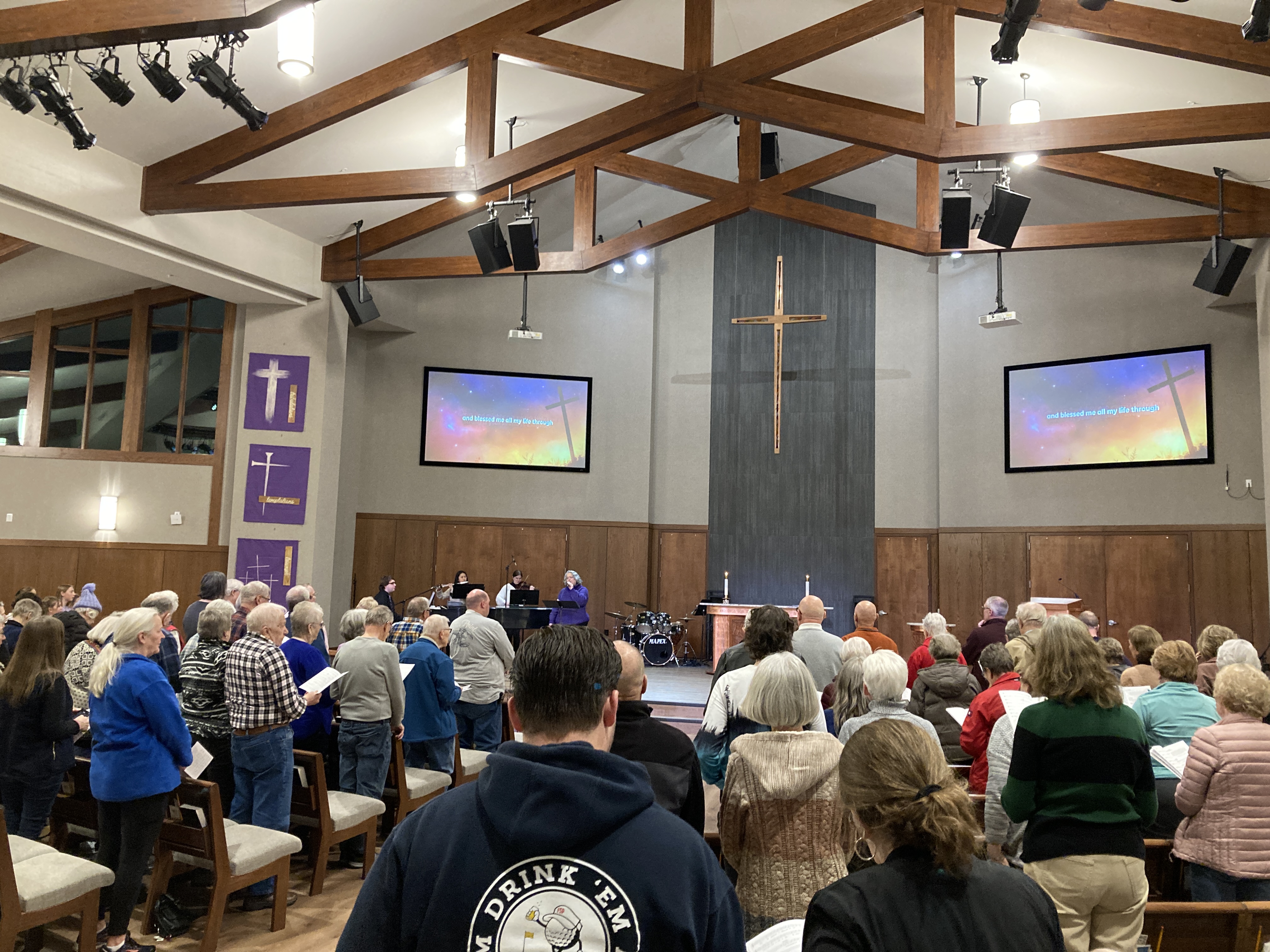
Choir rehearsal before worship, with more people joining during worship.

If you want to SUBSCRIBE to my blog and get email notifications, there are a couple ways to do it.

  • If you are reading this on a mobile device, there may be a Follow button at the bottom that you can simply click on and type in your email.
  • Or, go to the menu on top (three lines). Click About. Scroll to the bottom where in fine blue print (within a blue background) it says View Full Site. Click on those words. Over in the right column you can type in your email address and hit Follow.

Posted in NWIM Synod | Tagged | Leave a comment

Dec. 3, 2023 at Our Savior

Sermon preached for Advent 1 at Our Savior, Pinehurst, Idaho

Mark 13:24-37

24“But in those days, after that suffering, 

the sun will be darkened,and the moon will not give its light,
25and the stars will be falling from heaven,and the powers in the heavens will be shaken.

26Then they will see ‘the Son of Man coming in clouds’ with great power and glory. 27Then he will send out the angels, and gather his elect from the four winds, from the ends of the earth to the ends of heaven.

28“From the fig tree learn its lesson: as soon as its branch becomes tender and puts forth its leaves, you know that summer is near. 29So also, when you see these things taking place, you know that he is near, at the very gates. 30Truly I tell you, this generation will not pass away until all these things have taken place. 31Heaven and earth will pass away, but my words will not pass away.

32“But about that day or hour no one knows, neither the angels in heaven, nor the Son, but only the Father. 33Beware, keep alert; for you do not know when the time will come. 34It is like a man going on a journey, when he leaves home and puts his slaves in charge, each with his work, and commands the doorkeeper to be on the watch. 35Therefore, keep awake—for you do not know when the master of the house will come, in the evening, or at midnight, or at cockcrow, or at dawn, 36or else he may find you asleep when he comes suddenly. 37And what I say to you I say to all: Keep awake.”

Sermon

Advent always begins at the end, with an apocalyptic text like this one from Mark 13. I read last week that 100 years ago Lutherans in North America got together and decided to suspend preaching on the second coming and the end of the world. They judged that such preaching was doing more harm than good and that they would do better to give it a rest. In some ways that was a good thing, as many of us were spared from hellfire and damnation theology.

But it also left many of us ill-equipped both to deal with apocalyptic literature (scriptural and other) and maybe even less equipped to deal with times like our own. So here we are today, reading Mark 13, trying to understand how it speak to our lived experiences. I am going to take us back to its context and then work our way towards today.

First, we might notice that the celestial events listed in Mark 13 begin after that suffering. In other words, this is no time to fire up rants about the tribulation. That is not what Mark 13 is talking about. If not that, then what? Early readers would have called to mind the horrors of the crushing of the First Jewish Revolt against Rome. Ancient sources say that something like 1 million Jews died. The disaster came to its climax in the siege of Jerusalem, which was horrifying. 

After the suffering, the powers of the heavens are shaken. Imagine what such events would have meant for the first audience of this story, centuries before electricity and GPS. The sun rules the day, says Genesis 1, and the moon rules the night. The stars are for the marking of the regular and reliable seasons. So even during the darkest days of the siege, the sun always rose in the east every morning, and set every night in the west, reliable and regular even in disaster. The moon walked through its phases, week by week, moving from new moon to full, and back again, every month, every year. 

And so, for these guarantors of regularity to be knocked from their places would have meant that all reliability, all predictability, was gone. I imagine that these images named quite precisely how people felt after the Revolt was crushed. After that suffering, there was nothingleft to count on, nothing to trust, nothing to hope for.

Today’s scripture takes the feeling of deadly vertigo that comes at such moments and makes it into a sign that the end of the suffering is near. In other words, this is not a scene about the end of the world. It is a scene about the end of suffering, the end of hopeless desperation. That sounds like some good news.

The gospel continues.  After that suffering, after the loss of so many friends and family members, God will gather all of the lost and scattered Chosen People “from the four winds, from the ends of the earth to the ends of heaven. With the orienting stars and ruling sun shaken and unreliable, Jesus promises that when the sufferings end, the lost and scattered will return.

“This generation will not pass away,” he says. But “about that day or hour no one knows.” This is an important collision of ideas, I think. Consolation is close, Jesus says, but not so close or so readable that you could put it on a calendar. 

The “generation” that experiences all these things (Mark 13:30) is simply the followers of Jesus who continue the movement he began. That movement will not be extinguished but will endure until all is accomplished.

One scholar writes, “Thus, hope does not disappoint; salvation does become reality….  We get no explanation as to why there is suffering, but we do get a promise: when all is said and done, we will have our happy ending — and it will never end. This triumph of hope, furthermore, will be truly cataclysmic: the world as we know it projects pessimistic outcomes, but that world belongs to God and it can be changed. It will be changed, and changed so radically that people will someday speak of a time when heaven and earth passed away (Mark 13:30-31)” (Powell).

I grew up Lutheran and so weekly I spoke the words of the second article of the Apostle’s Creed, “He will come again to judge the living and the dead.” Despite this, my parents and home church talked little about the time of Jesus’ coming. I believe the thinking went, since the time of Jesus’ coming cannot be known, we do need not think much about it. To which gospel writer Mark would have replied: since the timing is unknown, we should think about it all the time! Today, I assume that since the time is unknown it could be hundreds or millions of years from now. Mark again draws an opposite conclusion: it could be today!

There is much to celebrate in this wonderful world, but the days in which we live are described in Mark as a time for fasting as well as feasting, as a time in which we will often be acutely aware of the absence of our Lord and Savior (Mark 2:20; cf. 14:7c).

Of course, through our faith, we affirm the presence of Christ through Word and Sacrament, in the companionship of other believers. And yet, the point remains: Christ is not with us as he once was, and he is not with us as he will be!

For many, those we know as friends and those we read about half a world away, life in this world is actually not very pleasant. But even those fortunate enough to have a life filled with joy and blessing should not be satisfied to the point of complacency. There is more! There is better!

I believe innocent people caught in the middle of the war in Israel-Palestine and Ukraine pray for what is better. People living in dire poverty, whether in rural Idaho or in our companion synod, the Ulanga Kilombero Diocese of Tanzania, know what it is to have this hope for Christ’s coming again. 

My mom and I are getting ready to live through the third anniversary of my dad’s death. He was 94, had lived an incredibly full life, and he was only on hospice for one week. He died of pneumonia, and we were able to visit him every day at a residential hospice in Mesa, AZ. By all accounts it was a good death, but it was still one of a half-dozen times in my life when my heart broke in a particularly painful way. In the days and months that followed I was so grateful for the deep hope that comes in confessing and trusting that Christ will be with us again.

My heart also breaks as I live through these hard times, some would say apocalyptic times, in which the nation and the world seem so fractured. There is so much loneliness and fear and anxiety. At times it scares me. I worry about people turning to violence and I pray for suffering to end. Our Christian story is not the only life-giving narrative that exists, but it is the one I turn to and give thanks for. To borrow words from the Lord’s Supper: Christ has died, Christ is risen, Christ will come again.

And so, we live in the already, but not yet time. In our small corners of the universe, we prepare for Christ once again by following his instructions to love God and love our neighbor in whatever ways we are able, to live with the sure hope that knows Jesus came once as a baby laid in a feeding trough and he will come again and complete all things.

The season of Advent invites us to wait impatiently for the consummation of hope, longing to know God as fully as we have been known; to see no longer through a dark pane, but face to face; to love as we have been loved; to experience Jesus Christ as he is, and in so doing, to become like him (1 Corinthians 13:12; 1 John 3:2). Thanks be to God and blessed Advent.

Posted in Sermons | Tagged , , | Leave a comment

Campus Ministry Installation – Nov. 26

Installation of Emily Kuenker as Pastor of Greater Spokane Campus and Young Adult Ministry

St. Mark’s Lutheran, Spokane, WA

Ezekiel 37:1-14, Galatians 3:23-29

With gratitude to Mpls Synod Bishop Ann Svennengson for her sermon at fall 2023 Conference of Bishops, in which her thread was O God, you know from Ezekiel 37.

I love this passage from Ezekiel for so many reasons. It is raw and earthy. It has a storied history of interpretation in this country and around the world. After Easter morning and the Exodus, it is one of the most powerful images of new life and new creation in all of scripture. It is a wonderful passage for a ministry embarking on something new, full of hope and possibilities, recognizing that what we become will be similar but not identical to what we have been.

And God asked, “Mortal, can these bones live?” And Ezekiel replied, “O God, you know.” “O God, you know.” That may be the phrase I like best about this story in this season of my life. As in, O God you know if students, faculty, and staff will resonate with what we are doing. O God, you know if our alumni and constituents can bear this big change in direction. O God, you know if we are on the right path, making the right decisions. You all can fill in the blanks yourselves. O God, you know.

Ezekiel had lots of reasons to say “O God, you know. Only you.” How could he, or any of the Israelites know if a valley of dry bones could live? They had lost everything. Everything had been stripped away from them—nation, temple, community, and land. How could this have happened? 

We know that the first half of Ezekiel tries to explain why the bones are dry—why the exile occurred. We read some of it this morning for Reign of Christ Sunday. It was judgment—for Judah’s idolatry and sin. God, who is holy, responded to this unholiness and corruption. Leaders in particular, the shepherds of God’s people were called out for their part. There’s a particular judgement again the leaders, the shepherds, people like me.

But in chapter 37 something shifts, and God asks Ezekiel to imagine, to see the bones coming to life. What’s more, God asks Ezekiel to prophecy, to speak new life into being. God said, “Prophecy to these bones, saying God will cause breath to enter you, and you shall live.” 

To envision and imagine new life, is that not the call of Lutheran Campus Ministry? It was certainly my own lived experience. I am rightly known for my fierce commitment to outdoor ministry, but my commitment to campus ministry is just as robust, not because of my four years on a church college campus or because of my internship with Lutheran Campus Ministry in Cheney. 

Two campus ministries in Hyde Park Chicago were vital to my Christian imagination and formation and general well-being. Knowing very little about where I was going to earn my M.Div., except that Rockefeller had built a gorgeous campus in Chicago, I did not pay as much attention to my living quarters as I should have. 

My first year at the Univ of Chicago Divinity School I lived in a tiny room in the International House—full of graduate students studying every discipline, half from the United States and half from across the globe. There was no dining service and community events were sporadic. Add to this that Hyde Park was like nowhere else I had ever lived. And oh, that first year was the year my body decided to have more seizures in public than in any other year of my life. 

Lutheran Campus Ministry housed at Augustana Lutheran and Brent House, the Episcopalian campus ministry, were the communities that helped me put so many pieces together. They provided actual daily bread but also nourishment for my soul. They gave me space to connect ideas in the classrooms with this new neighborhood.

Those famous verses from Galatians came to life in campus ministry. Without the sternness of the Divinity School classrooms, I was free to ask questions, wonder, and build relationships with people different than myself—different in their interests, background, sexual orientation, ethnicity.

On our recent trip to the Ulanga Kilombero Diocese in Tanzania, I read two books: The Power of Ritual (which the LCM board is reading) and The Forgotten Creed: Christianity’s Original Struggle against Bigotry, Slavery, and Sexism. In the latter, Christopher Patterson, a specialist in early Christianity, argues that these words were already well-known when Paul wrote Galatians. They were an early Christian baptismal creed. 

It was a bit surreal to read this book while traveling through our companion synod in East Africa, but it was just as humbling to think back over all the experiences that have shaped my understanding of the other, including my three years in campus ministry. 

I had not thought so much about the Roman Empire since those years in graduate school, and Patterson’s scholarship is impressive, though I am sure there has been resistance. At the end, Patterson concludes about those verses now in Galatians, “the creed must have been, finally, about imagining a world in which female slaves could be leaders of free men, where foreigners and native bon stood with equal power and equal rights. ‘You are all one’ signifies solidarity.”

It’s ironic and tragic that later, baptism became one more way to separate people, those who were or were not baptized. Patterson writes, “Our ancient baptismal creed speaks a very clear word: there is no us, no them. Everyone is a child of God, made one in a common kinship….” 

For me in the rituals of campus ministry, in the words from the Lutheran tradition, in the neighboring words from the Anglican/Episcopal Book of Common Prayer, I was also reminded of my baptismal identity, child of God. This made me no better or worse than those I was breaking bread with. But in a new urban environment, with my body not cooperating on a daily basis, with no old friends nearby, I clung to the rituals and words that reminded me I was God’s beloved child. The words of Ezekiel were true then too. O God, you know, you know that we are your children. O God, you know me and love me regardless. 

Will the next iteration of Lutheran Campus Ministry in the Spokane/Cheney area look like my experience 20 years ago? No. The world and the church have changed so much from when I walked onto the campus in the fall of 1999. Many of the students we hope to encounter may never have been baptized or they may have walked away from the church where that ritual took place. 

But I will bet everything I have that the words of the Forgotten Creed from Galatians will ring true to students. We are as hungry for real solidarity and common kinship as Jesus’ first followers, and for good reason. They are ingredients to the reign of God that is always being reimagined.

But even those high hopes of mine are no guarantee. O God, you know. You know the future. You also know each one of us. You call us beloved. You hold us in life and love. You will never let us go. Amen.

Pastor Emily with Board Members
Me with one of my two internship supervisors, former Eastern WA Univ. Lutheran Campus Pastor Mike Nelson
Posted in Uncategorized | Leave a comment