April 23, 2023

Prayer of the Day

O God, your Son makes himself known to all his disciples in the breaking of bread. Open the eyes of our faith, that we may see him in his redeeming work, who lives and reigns with you and the Holy Spirit, one God, now and forever.

Amen.

Acts 2:14a, 36-41

14aPeter, standing with the eleven, raised his voice and addressed [the crowd], 36“Therefore let the entire house of Israel know with certainty that God has made him both Lord and Messiah, this Jesus whom you crucified.”
37Now when they heard this, they were cut to the heart and said to Peter and to the other apostles, “Brothers, what should we do?” 38Peter said to them, “Repent, and be baptized every one of you in the name of Jesus Christ so that your sins may be forgiven; and you will receive the gift of the Holy Spirit. 39For the promise is for you, for your children, and for all who are far away, everyone whom the Lord our God calls to him.” 40And he testified with many other arguments and exhorted them, saying, “Save yourselves from this corrupt generation.” 41So those who welcomed his message were baptized, and that day about three thousand persons were added.

Psalm 116:1-4, 12-19

I will call on the name of the Lord. (Ps. 116:13)

1I love the Lord, who has | heard my voice,
  and listened to my | supplication,
2for the Lord has given | ear to me
  whenev- | er I called.
3The cords of death entangled me; the anguish of the grave | came upon me;
  I came to | grief and sorrow.
4Then I called upon the name | of the Lord:
  “O Lord, I pray you, | save my life.” 
12How shall I re- | pay the Lord
  for all the good things God has | done for me?
13I will lift the cup | of salvation
  and call on the name | of the Lord.
14I will fulfill my vows | to the Lord
  in the presence of | all God’s people.
15Precious in your | sight, O Lord,
  is the death | of your servants.
16O Lord, truly I | am your servant;
  I am your servant, the child of your handmaid; you have freed me | from my bonds.
17I will offer you the sacrifice | of thanksgiving
  and call upon the name | of the Lord. 
18I will fulfill my vows | to the Lord
  in the presence of | all God’s people,
19in the courts of | the Lord’s house,
  in the midst of you, O Jerusalem. | Hallelujah! 

1 Peter 1:17-23

17If you invoke as Father the one who judges all people impartially according to their deeds, live in reverent fear during the time of your exile. 18You know that you were ransomed from the futile ways inherited from your ancestors, not with perishable things like silver or gold, 19but with the precious blood of Christ, like that of a lamb without defect or blemish. 20He was destined before the foundation of the world, but was revealed at the end of the ages for your sake. 21Through him you have come to trust in God, who raised him from the dead and gave him glory, so that your faith and hope are set on God.
22Now that you have purified your souls by your obedience to the truth so that you have genuine mutual love, love one another deeply from the heart. 23You have been born anew, not of perishable but of imperishable seed, through the living and enduring word of God.

Luke 24:13-35

13Now on that same day [when Jesus had appeared to Mary Magdalene,] two [disciples] were going to a village called Emmaus, about seven miles from Jerusalem, 14and talking with each other about all these things that had happened. 15While they were talking and discussing, Jesus himself came near and went with them, 16but their eyes were kept from recognizing him. 17And he said to them, “What are you discussing with each other while you walk along?” They stood still, looking sad. 18Then one of them, whose name was Cleopas, answered him, “Are you the only stranger in Jerusalem who does not know the things that have taken place there in these days?” 19He asked them, “What things?” They replied, “The things about Jesus of Nazareth, who was a prophet mighty in deed and word before God and all the people, 20and how our chief priests and leaders handed him over to be condemned to death and crucified him. 21But we had hoped that he was the one to redeem Israel. Yes, and besides all this, it is now the third day since these things took place. 22Moreover, some women of our group astounded us. They were at the tomb early this morning, 23and when they did not find his body there, they came back and told us that they had indeed seen a vision of angels who said that he was alive. 24Some of those who were with us went to the tomb and found it just as the women had said; but they did not see him.” 25Then he said to them, “Oh, how foolish you are, and how slow of heart to believe all that the prophets have declared! 26Was it not necessary that the Messiah should suffer these things and then enter into his glory?” 27Then beginning with Moses and all the prophets, he interpreted to them the things about himself in all the scriptures.
28As they came near the village to which they were going, he walked ahead as if he were going on. 29But they urged him strongly, saying, “Stay with us, because it is almost evening and the day is now nearly over.” So he went in to stay with them. 30When he was at the table with them, he took bread, blessed and broke it, and gave it to them. 31Then their eyes were opened, and they recognized him; and he vanished from their sight. 32They said to each other, “Were not our hearts burning within us while he was talking to us on the road, while he was opening the scriptures to us?” 33That same hour they got up and returned to Jerusalem; and they found the eleven and their companions gathered together. 34They were saying, “The Lord has risen indeed, and he has appeared to Simon!” 35Then they told what had happened on the road, and how he had been made known to them in the breaking of the bread.
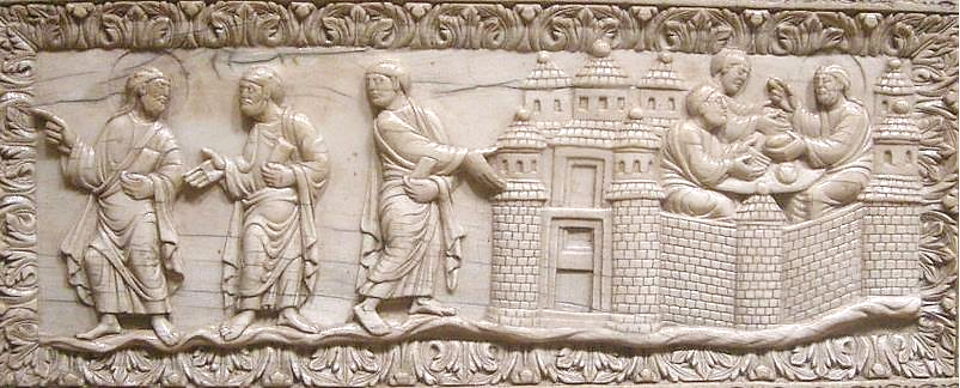
Road to Emmaus  —  Carolingian, 9th c., Cloisters Museum, New York

Sermon – Pastor Meggan Manlove

There are enough rich images and beautiful moments in this morning’s passage from Luke to fill a hundred sermons. Rather than walk us through the entire text, I am going to focus on one kernel. Perhaps because I believe the church, the larger Christian church, is in this curious liminal space, a space and time between what we have been and what God is transforming us into, the verse that stook out to me this spring is v. 32, “They asked each other, ‘Were not our hearts burning within us while he talked with us on the road and opened the Scriptures to us?’”

We all know that one of the intriguing elements of the story is the report that as soon as the two disciples recognized the risen Lord he disappeared from their sight. God’s presence is always elusive, fleeting, dancing at the edge of our awareness and perception. If we are honest, we must confess that it is never constant, steady, or predictable. The nuns in The Sound of Music sing “How can you catch a moonbeam in your hand, how do you hold a wave upon the sand?” The mystery of transcendence is always, well, transitory. God’s faithful people perceive God’s presence in fleeting moments, and then the mundane closes in again.

For this reason, we learn to treasure religious experiences in retrospect. The two in Emmaus exclaim, “Did not our hearts burn within us?” Like Moses, we usually see only the back side of God as God passes by us. With Job, another famous character in the Old Testament, we confess, “Look, he passes by me, and I do not see him; he moves on, but I do not perceive.” 

One of the secrets of a vigorous spirituality and a confident faith is learning to appreciate the importance of meeting God in the past as well as in the present. Today’s story guides us in this spiritual discipline. The men in white robes at the empty tomb told the women on Easter morning, “Remember how he told you, while he was still in Galilee…. Then they remembered his words.”

So much of what we do together in worship are acts of remembering. Sometimes remembering gets a bad reputation, and for good reasons. Think of an instance when you have romanticized someone or some event, instead of simply remembering. We see the past only with rose-colored glasses. In a similar vein, we can break the first the commandment and make an idol of the past. Then a friend or historian or stranger comes along and reminds us that the good old days were not all good.

But to remember God’s faithfulness is at the center of worship and actually at the center of the life of faith. The words I speak in the proper preface before we feast on the bread of life and cup of salvation are words of deep and long memory—from creation to the Exodus, through the lives of the prophets to Jesus’ own life, death, and resurrection, and finally God’s activity through the church empowered by the Holy Spirit. God’s faithfulness is sure.

In weekly worship, we move straight from the Words of Institution to the Lord’s Prayer. That prayer also helps us remember so very much. We remember how we ought to pray and for what. We again remember God’s gifts to us of daily bread, forgiveness, new life, healing. And sometimes we might remember the company of saints, all the people who have prayed that prayer down through history and pray it each day around the entire globe. 

What is all of this remembering good for? It helps us treasure religious experiences in retrospect. Further, remembering God’s activity throughout all of history helps us recognize God’s presence, elusive or fleeting as it might be, in our own lives. We get better at distinguishing between happy coincidences and God’s presence. We begin to live with more gratitude. And then, in worship and prayer, we give thanks for God’s real presence in our lives.

The practice of remembering God’s presence throughout history also reminds us that the experience of the presence of God is not a private gift. It is never for us alone. It is not something to be horded. Neither in the discovery of the empty tomb nor in the discovery of the fellow traveler to Emmaus is there the familiar command to go and tell, that is typical of other resurrection appearance scenes. Nevertheless, in both instances the recipients of the revelation immediately and spontaneously return from the liminal tomb to share their experience joyfully with others.

Finally, remembering God’s presence in history and in our own stories, prepares us to perceive God’s fleeting presence in real time. There is so much that can keep us from this activity. Our lives are filled with distractions, information, data, competing stories, shouting, advertising, promises of what will fulfill us. We are programmed now to skim and scan and breathe shallowly rather than to drink deeply from the water of life—Jesus Christ.

Worship, prayer, meeting our neighbors, serving those on the margins, we do all of this to remember the God of history and to prepare to perceive God’s fleeting presence in real time.

We do this, as Jesus did with those two disciples, most often around the meal of Holy Communion. The meal redefines the disciples’ understanding of Jesus. Jesus takes, blesses, breaks, and gives the bread to them (Luke 24:30), the same sequence of actions we recall from his final meal (22:19). 

The pattern also recalls Jesus’ feeding of the five thousand (9:16). Meals so characterize Jesus’ ministry that one writer concluded, “In Luke’s Gospel Jesus is either going to a meal, at a meal, or coming from a meal.” Meals will shape Christian gatherings in Acts and on to today precisely because believers recognize Jesus in the breaking of the bread (24:35). It is no wonder that in the breaking of the bread, those two disciples remembered. 

It is no surprise that we enjoy breaking bread together in spaces that are not the altar. Perceiving God in this space helps us perceive God in other meal times. But there is so much more to the Holy Communion meal. It is more than bread and wine. It is a means of God’s grace. It is an event in which we receive forgiveness and new life. As we return to this table again and again, I really do believe we build our capacity to perceive God in our other places, to perceive forgiveness, grace, and new life in daily encounters. Most often we will name it later, that was a grace moment, that was God’s love, that was God’s mercy, that was life given from God. And we give thanks.

I had such an encounter a few Thursdays ago. I have been on the board for Leap Housing for about 18 months with three men. I have enjoyed all of our meetings, but I did not know them. When the COO of the organization asked what we would like to get out of a board retreat, I said I just wanted to get to know these individuals.

So, after a two-hour meeting we headed to dinner in the Linen District—the entrepreneur Bart, COO Brian, me and two other board members. All I did was ask one man, “how did you meet Bart?” After 40 minutes, as he finished his remarkable story, I turned to the other board member and asked about his time in Idaho newspapers and politics. It was a very different story, but remarkable all the same. I was giddy and committed to living in the moment. As I walked to my car at the evening’s conclusion, I could feel my heart had been burning, as the disciples described, not from rich food, but with grace, love, hope. Like the meal of bread and wine, it was sustenance for my soul, more than enough to get me through the next week.

Prayers of Intercession

United in the hope and joy of the resurrection, let us pray for the church, the world, and all in need.

A brief silence.

Ever-present God, you make yourself known in the breaking of the bread and in the bonds of community. Reveal yourself to us in the faces of all we meet. Strengthened by your body and blood, let us boldly live out your good news. Hear us, O God.

Your mercy is great.

As we know you in the breaking of the bread, we know you in the grains of the field and the flowing waters. Care for the earth you lovingly create. Strengthen those who safeguard threatened land and water. Hear us, O God.

Your mercy is great.

You are the authority to whom we dedicate our lives (like Toyohiko Kagawa, whom we commemorate today). Help us keep the needs of those most vulnerable at the forefront of our community. Move us to care for any who are disregarded or oppressed. Hear us, O God.

Your mercy is great.

Mothering God, you feed and comfort those who hunger. Open the hearts of those who horde resources and lead them to share your abundance. We pray for anyone hungering for your comforting presence this day (especially). Hear us, O God.

Your mercy is great.

You pour out your love on those who are oppressed. Support and comfort anyone who is marginalized by gender or sexuality and those whose stories are not believed. Form this community to listen faithfully and speak honestly in our ministry together. Hear us, O God.

Your mercy is great.

Here other intercessions may be offered.

We remember with thanksgiving all your beloved saints (especially). As you have raised them to eternal life, abide with us in your promise of resurrection. Hear us, O God.

Your mercy is great.

Rejoicing in the victory of Christ’s resurrection, we lift our prayers and praise to you, almighty and eternal God; through Jesus Christ, our risen Lord.

Amen.
Posted in Sermons, Trinity Lutheran | Leave a comment

April 16, 2023

Prayer of the Day

Almighty and eternal God, the strength of those who believe and the hope of those who doubt, may we, who have not seen, have faith in you and receive the fullness of Christ’s blessing, who lives and reigns with you and the Holy Spirit, one God, now and forever.

Amen.

Acts 2:14a, 22-32

14aPeter, standing with the eleven, raised his voice and addressed [the crowd], 22“You that are Israelites, listen to what I have to say: Jesus of Nazareth, a man attested to you by God with deeds of power, wonders, and signs that God did through him among you, as you yourselves know—23this man, handed over to you according to the definite plan and foreknowledge of God, you crucified and killed by the hands of those outside the law. 24But God raised him up, having freed him from death, because it was impossible for him to be held in its power. 25For David says concerning him, 
 ‘I saw the Lord always before me,
  for he is at my right hand so that I will not be shaken;
26therefore my heart was glad, and my tongue rejoiced;
  moreover my flesh will live in hope.
27For you will not abandon my soul to Hades,
  or let your Holy One experience corruption.
28You have made known to me the ways of life;
  you will make me full of gladness with your presence.’
29“Fellow Israelites, I may say to you confidently of our ancestor David that he both died and was buried, and his tomb is with us to this day. 30Since he was a prophet, he knew that God had sworn with an oath to him that he would put one of his descendants on his throne. 31Foreseeing this, David spoke of the resurrection of the Messiah, saying, 
 ‘He was not abandoned to Hades,
  nor did his flesh experience corruption.’
32This Jesus God raised up, and of that all of us are witnesses.”

Psalm 16

1Protect me, O God, for I take ref- | uge in you;
  I have said to the Lord, “You are my Lord, my good a- | bove all other.”
2All my delight is in the godly that are | in the land,
  upon those who are noble a- | mong the people.
3But those who run after | other gods
  shall have their troubles | multiplied.
4I will not pour out drink offerings | to such gods,
  never take their names up- | on my lips. 
5O Lord, you are my portion | and my cup;
  it is you who up- | hold my lot.
6My boundaries enclose a | pleasant land;
  indeed, I have a | rich inheritance.
7I will bless the Lord who | gives me counsel;
  my heart teaches me night | after night.
8I have set the Lord al- | ways before me;
  because God is at my right hand, I shall | not be shaken. 
9My heart, therefore, is glad, and my spir- | it rejoices;
  my body also shall | rest in hope.
10For you will not abandon me | to the grave,
  nor let your holy one | see the pit.
11You will show me the | path of life;
  in your presence there is fullness of joy, and in your right hand are pleasures for- | evermore. 

1 Peter 1:3-9

3Blessed be the God and Father of our Lord Jesus Christ! By his great mercy he has given us a new birth into a living hope through the resurrection of Jesus Christ from the dead, 4and into an inheritance that is imperishable, undefiled, and unfading, kept in heaven for you, 5who are being protected by the power of God through faith for a salvation ready to be revealed in the last time. 6In this you rejoice, even if now for a little while you have had to suffer various trials, 7so that the genuineness of your faith—being more precious than gold that, though perishable, is tested by fire—may be found to result in praise and glory and honor when Jesus Christ is revealed. 8Although you have not seen him, you love him; and even though you do not see him now, you believe in him and rejoice with an indescribable and glorious joy, 9for you are receiving the outcome of your faith, the salvation of your souls.

John 20:19-31

19When it was evening on that day, the first day of the week, and the doors of the house where the disciples had met were locked for fear of the Jews, Jesus came and stood among them and said, “Peace be with you.” 20After he said this, he showed them his hands and his side. Then the disciples rejoiced when they saw the Lord. 21Jesus said to them again, “Peace be with you. As the Father has sent me, so I send you.” 22When he had said this, he breathed on them and said to them, “Receive the Holy Spirit. 23If you forgive the sins of any, they are forgiven them; if you retain the sins of any, they are retained.”

24But Thomas (who was called the Twin), one of the twelve, was not with them when Jesus came. 25So the other disciples told him, “We have seen the Lord.” But he said to them, “Unless I see the mark of the nails in his hands, and put my finger in the mark of the nails and my hand in his side, I will not believe.”
26A week later his disciples were again in the house, and Thomas was with them. Although the doors were shut, Jesus came and stood among them and said, “Peace be with you.” 27Then he said to Thomas, “Put your finger here and see my hands. Reach out your hand and put it in my side. Do not doubt but believe.” 28Thomas answered him, “My Lord and my God!” 29Jesus said to him, “Have you believed because you have seen me? Blessed are those who have not seen and yet have come to believe.”

30Now Jesus did many other signs in the presence of his disciples, which are not written in this book. 31But these are written so that you may come to believe that Jesus is the Messiah, the Son of God, and that through believing you may have life in his name.

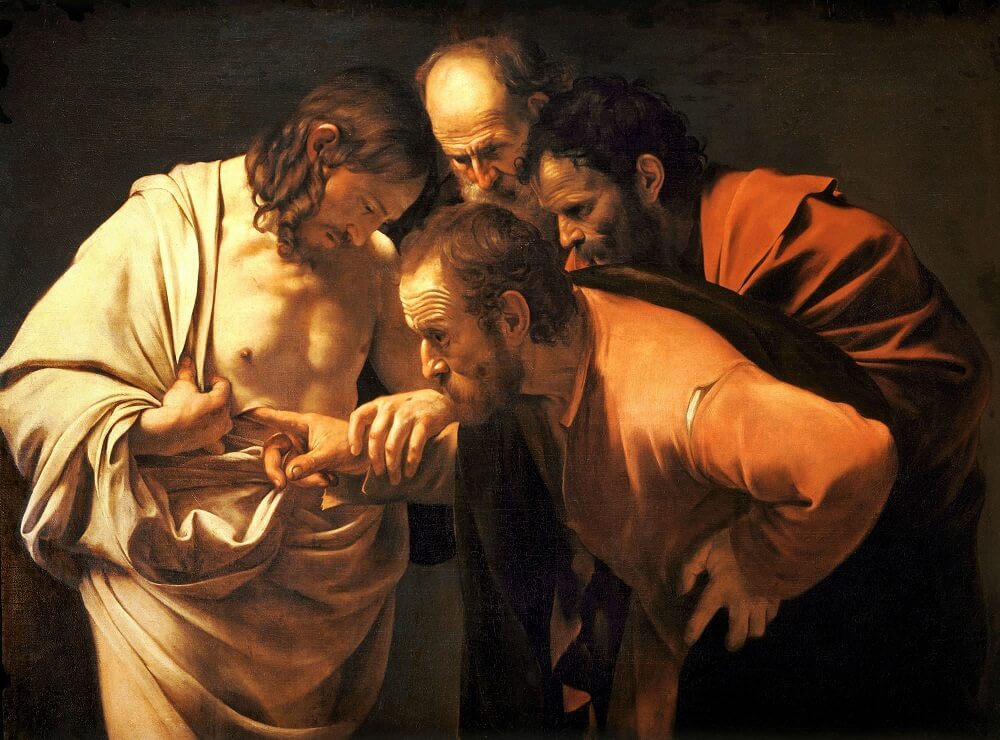
The Incredulity of Saint Thomas by Carvaggio

Sermon – Pastor Meggan Manlove

Christ is risen but Easter is not over.  We need the seven weeks of Easter to ponder the mystery of resurrection. How do we see Christ? Each of the four gospels has its own story about seeing Jesus. In Mark, no one sees the risen Christ. In Matthew, the disciples see Jesus in the obedience of worship and by doing what Jesus says- forgiving each other and living lives of compassion and mercy. In Luke, disciples walk toward Emmaus and then see Jesus in the breaking of bread. John’s gospel tells another story.

In today’s passage, the risen Christ appears to his disciples twice in a room with locked doors. In these appearances we see Jesus amid gracious acts. He offers himself so that people will believe or trust. These passages tell the story of our roots as Christians, our roots as the Body of Christ.  

First, remember that when Jesus first enters the room he speaks these holy words, “Peace be with you.” Jesus enters our hiding places, the places we run to when we are afraid. He enters with the marks of the cross. The peace he left with the disciples on the night before he was crucified is the peace he brings to disciples on the night of resurrection. 

We deeply need these words of promise. Elie Weisel, the author who survived the prison in Auschwitz, said that the opposite of faith is not doubt but anxiety. We live in an anxious world. Where are we to put our trust? Where do we go for hope?  The world is filled with uncertainty.  

We do not know what the future holds and when we speculate, we are faced with ladders to climb and barriers to go through in every stage of life, in every community. It is common to feel uneasyand distressed about what lies ahead. We question what is necessary for the future to be peaceful.  

How do we continue to put our trust in God risen from the dead, in this anxious world?  In this country there is sometimes even an implied understanding that to be a true believer one must have certain kinds of experiences, point to specific things, completely understand scripture and other matters of faith.

There is an alternative. The path between anxiety and militant certainty is faith, maybe better described as trust. And rather than being a character to mock or feel sorry for, the disciple Thomas can be our guide. I remember when I viewed my first image of Thomas standing with Jesus, when today’s text came alive for me.  In his characteristic style of strong contrasts between light and dark hues, the artist Carvagio painted Thomas looking at Jesus’ marks, on his hands and side.  There is wonderment in Thomas’ eyes. It is clear that Thomas has faith. It is this faith, rather than unbelief, that we are meant to see in Thomas.  

Thomas asks only to see what the other disciples have already seen–the marks of the crucifixion on Jesus. Thomas wants to believe and Jesus offers himself. And then Thomas gives what is the most powerful and complete confession of Jesus in the Gospel of John, “My Lord and my God.” It is quite a declaration when one considers that Caesar was considered to be and was called Lord throughout the Roman Empire.

Thomas wanted faith and Jesus’ words were not ones of judgment or reprimand. It was not with a harsh and shameful tone that Jesus said, “Put your finger here; look, here are my hands…. Do not be unbelieving anymore but believe.”  Jesus speaks with a tone of grace. 

The gospel writer John wants us to know that having seen Jesus is not a prerequisite of trusting God or of professing like Thomas, “My Lord and my God” when speaking of Jesus. When John lays out the purpose of his entire gospel he writes, “there are many other signs that Jesus worked in the sight of the disciples, but they are not recorded in this book. These are recorded so that you may believe that Jesus is the Christ, the Son of God, and that believing this you may have life through his name.”  

A relationship with Jesus is not limited to the first disciples. We do not see Jesus as the disciples did in those post-Easter appearances, but we see Jesus in our lives.

In the water of Baptism and the bread and wine of Holy Communion, you have received gifts of forgiveness and new life through Jesus.  

Another image this morning’s text brings to mind comes from the home I grew up in. Off the dining room was a wall full of artwork—photos, paintings, mosaics, carvings, mostly with ties to Christianity.  In the top right corner was a dark wooden piece with two images on it. One is a hand with a hole in the middle—a hole just large enough for a nail to have been pierced through.  The other is a loaf of bread.  

The hand with the hole in it was for the early disciples. The bread is for you and me. Having heard the promises and receiving the bread and wine, you and I have been carried out of our fear and anxiety into the world with the good news of forgiveness and abundant life. We give thanks because we have entered the mystery and received forgiveness and new life. Like Thomas we continue to confess with confidence Sunday after Sunday, “My Lord and my God.”  

The sacraments are not our only nourishment. In baptism itself we are reminded of the life we are called into and the practices that nourish us in the faith: living among God’s faithful people; participating in Holy Communion; learning the Lord’s Prayer, the Creed, and the Ten Commandments; and prayer. Tucked into the litany in a few different places is hearing the Word proclaimed in worship and reading the holy scriptures. 

This made me think of and turn to our second lesson today from First Peter. Look at that second sentence. “By God’s great mercy he has given us a new birth into a living hope through the resurrection of Jesus Christ from, and into an inheritance that is imperishable, undefiled, and unfading, kept in heaven for you, who are being protected by the power of God through faith for a salvation ready to be revealed in the last time.” Peter’s compassion and encouragement seem unstoppable. After 59 words he finally placed a period and lets us take a real breath.  The letters in our New Testament were meant to be read aloud to new Christian churches.

For the next six Sundays, the Second Reading will be from this wonderful letter of hope and identity. During Lent we learned what it meant to follow Jesus. Now we are tasked with hearing what it means to be an Easter people. Martin Luther loved this letter. First Peter holds within it the imagery of the royal priesthood from which Luther developed his crucial belief in the priesthood of all believers—the belief that each one of us, not only ordained pastors, are called to ministry in our daily lives.  

The letter is not perfect. Peter’s words about how slaves and wives, the weaker sex, are to behave cannot help but make me squirm. As we make our way through his first letter, let us take the great with the not so great, remembering that Jesus called Peter the rock of the church, even though Peter betrayed him three times.   

The epistle of First Peter addresses what came to be known as Christian Diaspora (or Dispersion) communities. The communities were located throughout four provinces of Asia Minor, which today is the country of Turkey. Right before our text begins, Peter writes, “To the exiles of the Dispersion in Pontus, Galatia, Cappadocia, Asia, and Bithynia.” These communities were disenfranchised “exiles” and aliens.  

So in this letter we come face to face with Christians vulnerable to local harassment, struggling to claim a sense of hope and identity amid the pressures of empire, poverty, slavery and displacement. We are not oppressed like those early Christians in Asia Minor. Still, the promises in the Affirmation of Baptism can be counter-cultural even today: to serve all people, following the example of Jesus, and to strive for justice and peace in all the earth. The encouragement in the letter of First Peter can help us live as a hope-filled community in Canyon County, Idaho 2023.  Listen for that hope and love this Easter Season.

Prayers of Intercession

United in the hope and joy of the resurrection, let us pray for the church, the world, and all in need.

A brief silence.

God of rebirth, the good news of your resurrection brings refreshment to a weary world. Following the women at the tomb, empower us to boldly share your radical love through our words and our work. Hear us, O God.

Your mercy is great.

As you breathed your Spirit into the disciples, breathe your spirit of healing upon all creation. Nourish the earth with sufficient rains. Strengthen us to counter the effects of pollution and destruction. Hear us, O God.

Your mercy is great.

You prepared the disciples for their ministry by calming their fears and granting them your peace. Equip our communities’ leaders (especially). Give them a spirit of peace and hearts that burn for justice, that their leadership reflects your love. Hear us, O God.

Your mercy is great.

You come among us in unexpected ways. Send us to those who hide in fear or question your love. Be a healing presence for any isolated by addiction, incarceration, mental illness, chronic pain, sickness, or grief (especially). Hear us, O God.

Your mercy is great.

As you met the disciples on the road to Emmaus, show us your presence along our journeys. Bless our doubts and questions. Provide trusting and safe relationships for all ages, to nurture our connection to you and one another. Hear us, O God.

Your mercy is great.

Here other intercessions may be offered.

Resurrecting God, you bring us to new life every day. Thank you for blessing us with companions on our faith journey, especially those who now rest in your love (especially). Strengthen us with the eternal peace of your promises. Hear us, O God.

Your mercy is great.

Rejoicing in the victory of Christ’s resurrection, we lift our prayers and praise to you, almighty and eternal God; through Jesus Christ, our risen Lord.

Amen.

Posted in Sermons, Trinity Lutheran | Leave a comment

Easter – April 9, 2023

Prayer of the Day

O God, you gave your only Son to suffer death on the cross for our redemption, and by his glorious resurrection you delivered us from the power of death. Make us die every day to sin, that we may live with him forever in the joy of the resurrection, through your Son, Jesus Christ our Lord, who lives and reigns with you and the Holy Spirit, one God, now and forever.

Amen

Acts 10:34-43

34Peter began to speak to [the people]: “I truly understand that God shows no partiality, 35but in every nation anyone who fears him and does what is right is acceptable to him. 36You know the message he sent to the people of Israel, preaching peace by Jesus Christ—he is Lord of all. 37That message spread throughout Judea, beginning in Galilee after the baptism that John announced: 38how God anointed Jesus of Nazareth with the Holy Spirit and with power; how he went about doing good and healing all who were oppressed by the devil, for God was with him. 39We are witnesses to all that he did both in Judea and in Jerusalem. They put him to death by hanging him on a tree; 40but God raised him on the third day and allowed him to appear, 41not to all the people but to us who were chosen by God as witnesses, and who ate and drank with him after he rose from the dead. 42He commanded us to preach to the people and to testify that he is the one ordained by God as judge of the living and the dead. 43All the prophets testify about him that everyone who believes in him receives forgiveness of sins through his name.”

Psalm 118:1-2, 14-24

1Give thanks to the Lord, for the | Lord is good;
  God’s mercy en- | dures forever.
2Let Israel | now declare,
  “God’s mercy en- | dures forever.”
14The Lord is my strength | and my song,
  and has become | my salvation.
15Shouts of rejoicing and salvation echo in the tents | of the righteous:
  “The right hand of the | Lord acts valiantly!
16The right hand of the Lord| is exalted!
  The right hand of the | Lord acts valiantly!”
17I shall not | die, but live,
  and declare the works | of the Lord. 
18The Lord indeed pun- | ished me sorely,
  but did not hand me o- | ver to death.
19Open for me the | gates of righteousness;
  I will enter them and give thanks | to the Lord.
20“This is the gate | of the Lord;
  here the righ- | teous may enter.”
21I give thanks to you, for you have | answered me
  and you have become | my salvation. 
22The stone that the build- | ers rejected
  has become the chief | cornerstone.
23By the Lord has | this been done;
  it is marvelous | in our eyes.
24This is the day that the | Lord has made;
  let us rejoice and be | glad in it. 

Colossians 3:1-4

1If you have been raised with Christ, seek the things that are above, where Christ is, seated at the right hand of God. 2Set your minds on things that are above, not on things that are on earth, 3for you have died, and your life is hidden with Christ in God. 4When Christ who is your life is revealed, then you also will be revealed with him in glory.

Matthew 28:1-10

1After the sabbath, as the first day of the week was dawning, Mary Magdalene and the other Mary went to see the tomb. 2And suddenly there was a great earthquake; for an angel of the Lord, descending from heaven, came and rolled back the stone and sat on it. 3His appearance was like lightning, and his clothing white as snow. 4For fear of him the guards shook and became like dead men. 5But the angel said to the women, “Do not be afraid; I know that you are looking for Jesus who was crucified. 6He is not here; for he has been raised, as he said. Come, see the place where he lay. 7Then go quickly and tell his disciples, ‘He has been raised from the dead, and indeed he is going ahead of you to Galilee; there you will see him.’ This is my message for you.” 8So they left the tomb quickly with fear and great joy, and ran to tell his disciples. 9Suddenly Jesus met them and said, “Greetings!” And they came to him, took hold of his feet, and worshiped him. 10Then Jesus said to them, “Do not be afraid; go and tell my brothers to go to Galilee; there they will see me.”

Sermon – Meggan Manlove

This is such a great resurrection scene, in large part because of verse 2. Mary Magdalene and the other Mary have gone to the tomb and suddenly there is an earthquake. An angel of the Lord descends from heaven and rolls back the stone in front of the tomb and sits on it. His appearance is like lightening, and his clothing is as white as snow. 

Confronted by the blinding light of this angel, the guards who had been posted in ensure that nothing would happen to Jesus’ body were so gripped by fear that they shook and became like dead men. Someone this week suggested we compare the men to fainting goats. 

Jesus’ resurrection already creates a life freed from the death that grips our everyday lives. This is life reborn, revealing to us how death has determined our living. And yet it is possible to remain dead, to live as dead men, as the behavior of these guards will make clear.

The guards are frightened to death. But the angel tells Mary Magdalene and the other Mary that they do not need to be afraid: “I know that you are looking for Jesus who was crucified. He is not here; for he has been raised, as he said. Come, see the place where he lay. Then go quickly and tell his disciples, ‘He has been raised from the dead, and indeed he is going ahead of you to Galilee; there you will see him.’” 

The angel’s speech contains all of the gospel. “Do not be afraid.” Jesus has made it possible to live unafraid. The disciples, followers, of Jesus are often afraid of the elites and the crowds, but Jesus has given them all they need not to be afraid. He has done so by drawing them, and us, into a way of life so compellingly true that we have no time to be afraid.

We read that Mary Magdalene and Mary left the tomb quickly with fear and great joy. The fear is that paired with joy. They leave the tomb in awe, knowing that they are now participants in the reign of God, which their teacher Jesus has spoken of so often. They fear they have as they leave the tomb is the fear that protects them from the fears that would have us deny the resurrection. Our human nature wants to create lives of security in the face of death. The joy filling the women saves them from this kind of fear.

The fear and joy they now experience is made possible by the resurrection. Mary Magdalene and Mary have seen the crucifixion; they have now seen the empty tomb. They are our first witnesses to the good news that the one crucified has been raised.

Jesus was handed over, made subject to sinners and death itself. But he has been made victorious. But the resurrection of Jesus cannot be seen. As one scholar [Hauerwas] says, we can no more see the resurrection than we can see creation. We can see only the empty tomb and the resurrected Jesus. 

The resurrection is not a resurrection of one who had lived, died, and then lived again. Jesus raised his friend Lazarus from the dead. But Lazarus was still to die. Resurrection is not the resuscitation of a corpse. Jesus is raised from the dead to be freed from death itself. He will never die again. Jesus has been raised from the dead, defeating death itself. 

Mary Magdalene and Mary rush from the tomb to tell the disciples, but suddenly, in an almost comedic encounter, Jesus meets them. It is Jesus, resurrected. It is the crucified one who is resurrected. Jesus greets them in a familiar way, and they come to him. They saw him and recognized him. They took hold of his feet. The resurrected Jesus can be touched. 

The resurrection of Jesus is not an idea. His body has been raised. The one born of Mary, the one baptized by John, the one who called the disciples, the one who delivered the Sermon on the Mount, the one who cured the lame, the blind, the deaf and mute, the one who disputed with the Pharisees and Sadducees, the one who endured humiliation by trial and cross—he has been raised.

Jesus’ bodily presence does not prevent Mary Magdalene and Mary from worshiping him. One worships only God. Yet they worship him. They had not worshiped the angel who announced Jesus’ resurrection. But they now worship Jesus, Immanuel, God with us.

That they worship Jesus marks the central activity of the new reality of the body of Christ, the church. What makes the church the church is the worship of Jesus. The worship of Jesus will take many different forms across time and space. But where the word is preached and the sacraments are enacted, we know that Jesus is present among us. By baptism and communion, we participate in Jesus’ life, death, and resurrection, making us an alternative to the world. Being the alternative is not, however, an invitation for self-righteousness. Instead, it enables us to witness, as Mary Magdalene and Mary do, to our having been given the time in a world that thinks it has no time to worship Jesus.

Jesus tells the women not to be afraid, but to go tell his brothers to go to Galilee where they will see him. Jesus’ disciples—brothers and sisters, will bring forth life. Again, we see the beginnings of the church. And Jesus is returning to Galilee, where he began his ministry. Jesus unleashes the disciples to go into the world not from Jerusalem, the center of power, but from Galilee. Galilee becomes the staging area for the disciples to go to the nations to announce the new age begun by Jesus.

For us today, as for Mary Magdalene and Mary, Jesus goes ahead of us to lead us into the world, specifically into a transformative way of life that testifies to the power of resurrection wherever we live. “Jesus is going ahead—not going away,” one scholar [Schuessler Fiorenza] said. The empty tomb does not signify absence but presence. It announces the resurrected one’s presence on the road ahead.

If Jesus is indeed going ahead, then we are asked to look for experiences of resurrection presence not only in Galilee but also in Nampa, Caldwell, Middleton, and Kuna—on all the roads of our lives. Resurrection means that Jesus, the Living One, goes ahead of us. Jesus can be found only when we experience that “he is ahead of us” and he opens up a future for us. Like Mary Magdalene and Mary, we can run to meet that liberating future. The stone has been rolled away. 

Finally, the command to go to Galilee does not erase the experience of death and violence. Resurrection comes to us first of all in our most broken and unexpected places, breaking the structures of the Roman occupation regime in Jerusalem and the structures of every regime of death in our lives today. 

Does the resurrection make us feel that the earth is shaking again this Easter morning? Are we also filled with both fear and joy? What does it look like to stop and worship Jesus, and only Jesus today? How does our worship shape us to be the body of Christ for the sake of the world? What message of new life is on our lips in this place and time?

Jesus is going ahead. He continues into the future God has in store for the creation.  In the meantime, there is only the Word, the bread, and the wine, and the promise that “you will see him.”  We walk by faith and not by sight.  We can only trust that God will one day finish the story, as God has promised.

Prayers of Intercession

The prayers are prepared locally for each occasion. The following examples may be adapted or used as appropriate.

United in the hope and joy of the resurrection, let us pray for the church, the world, and all in need.

A brief silence.

You call your church to witness to your salvation. We give thanks for (Dietrich Bonhoeffer and) all theologians, preachers, and teachers who proclaim your gospel. Equip all the baptized to share the joy of the resurrection in all we say and do. Risen Lord, in your mercy,

hear our prayer.

You bring abundant life throughout creation. The green blade rises, and all creation greets the resurrection dawn. Preserve vineyards and orchards and those who tend to them. Feed us with the fruits of creation. Risen Lord, in your mercy,

hear our prayer.

You show your steadfast love without regard to borders, barriers, or human-made divisions. Infuse your justice in every nation of the world (places of concern or conflict may be named) that all experience the peace that only you can give. Risen Lord, in your mercy,

hear our prayer.

You anointed your Son with the Holy Spirit and with power. Encourage us by his example in our ministries of healing, care, and outreach. We pray for all who are sick or hospitalized (especially) and for all health care workers who care for them. Risen Lord, in your mercy,

hear our prayer.

You have put gladness in our hearts. Inspire musicians and dancers to rejoice with songs of victory. Bless the music ministries of this congregation and all who foster our assembly’s song. Risen Lord, in your mercy,

hear our prayer.

Here other intercessions may be offered.

As you have raised Jesus from the dead, you show us your resurrection promise. With your holy ones who have sung your praise (especially), free us from fear and empower us to go and tell the good news. Risen Lord, in your mercy,

hear our prayer.

Rejoicing in the victory of Christ’s resurrection, we lift our prayers and praise to you, almighty and eternal God; through Jesus Christ, our risen Lord.

Amen.

Posted in Sermons, Trinity Lutheran | Leave a comment

Palm/Passion Sunday

Prayer of the Day

Everlasting God, in your endless love for the human race you sent our Lord Jesus Christ to take on our nature and to suffer death on the cross. In your mercy enable us to share in his obedience to your will and in the glorious victory of his resurrection, who lives and reigns with you and the Holy Spirit, one God, now and forever.

Amen.

Matthew 21:1-11

1When they had come near Jerusalem and had reached Bethphage, at the Mount of Olives, Jesus sent two disciples, 2saying to them, “Go into the village ahead of you, and immediately you will find a donkey tied, and a colt with her; untie them and bring them to me. 3If anyone says anything to you, just say this, ‘The Lord needs them.’ And he will send them immediately.” 4This took place to fulfill what had been spoken through the prophet, saying,
5“Tell the daughter of Zion,
 Look, your king is coming to you,
  humble, and mounted on a donkey,
   and on a colt, the foal of a donkey.”
6The disciples went and did as Jesus had directed them; 7they brought the donkey and the colt, and put their cloaks on them, and he sat on them. 8A very large crowd spread their cloaks on the road, and others cut branches from the trees and spread them on the road. 9The crowds that went ahead of him and that followed were shouting, 
 “Hosanna to the Son of David!
  Blessed is the one who comes in the name of the Lord!
 Hosanna in the highest heaven!”
10When he entered Jerusalem, the whole city was in turmoil, asking, “Who is this?” 11The crowds were saying, “This is the prophet Jesus from Nazareth in Galilee.”

Isaiah 50:4-9a

4The Lord God has given me
  the tongue of a teacher,
 that I may know how to sustain
  the weary with a word.
 Morning by morning he wakens—
  wakens my ear
  to listen as those who are taught.
5The Lord God has opened my ear,
  and I was not rebellious,
  I did not turn backward.
6I gave my back to those who struck me,
  and my cheeks to those who pulled out the beard;
 I did not hide my face
  from insult and spitting.

7The Lord God helps me;
  therefore I have not been disgraced;
 therefore I have set my face like flint,
  and I know that I shall not be put to shame;
  8he who vindicates me is near.
 Who will contend with me?
  Let us stand up together.
 Who are my adversaries?
  Let them confront me.
9aIt is the Lord God who helps me;
  who will declare me guilty?

Psalm 31:9-16

9Have mercy on me, O Lord, for I | am in trouble;
  my eye is consumed with sorrow, and also my throat | and my belly.
10For my life is wasted with grief, and my | years with sighing;
  my strength fails me because of affliction, and my bones | are consumed.
11I am the scorn of all my enemies, a disgrace to my neighbors, a dismay to | my acquaintances;
  when they see me in the street | they avoid me.
12Like the dead I am forgotten, | out of mind;
  I am as useless as a | broken pot. R
13For I have heard the whispering of the crowd; fear is | all around;
  they put their heads together against me; they plot to | take my life.
14But as for me, I have trusted in | you, O Lord.
  I have said, “You | are my God.
15My times are | in your hand;
  rescue me from the hand of my enemies, and from those who | persecute me.
16Let your face shine up- | on your servant;
  save me in your | steadfast love.” 

Philippians 2:5-11

5Let the same mind be in you that was in Christ Jesus,
6who, though he was in the form of God,
  did not regard equality with God
  as something to be exploited,
7but emptied himself,
  taking the form of a slave,
  being born in human likeness.
 And being found in human form,
  8he humbled himself
  and became obedient to the point of death—
  even death on a cross.

9Therefore God also highly exalted him
  and gave him the name
  that is above every name,
10so that at the name of Jesus
  every knee should bend,
  in heaven and on earth and under the earth,
11and every tongue should confess
  that Jesus Christ is Lord,
  to the glory of God the Father.

Matthew 26:14–27:66

14One of the twelve, who was called Judas Iscariot, went to the chief priests 15and said, “What will you give me if I betray him to you?” They paid him thirty pieces of silver. 16And from that moment he began to look for an opportunity to betray him.

17On the first day of Unleavened Bread the disciples came to Jesus, saying, “Where do you want us to make the preparations for you to eat the Passover?” 18He said, “Go into the city to a certain man, and say to him, ‘The Teacher says, My time is near; I will keep the Passover at your house with my disciples.’ ” 19So the disciples did as Jesus had directed them, and they prepared the Passover meal.
20When it was evening, he took his place with the twelve; 21and while they were eating, he said, “Truly I tell you, one of you will betray me.” 22And they became greatly distressed and began to say to him one after another, “Surely not I, Lord?” 23He answered, “The one who has dipped his hand into the bowl with me will betray me. 24The Son of Man goes as it is written of him, but woe to that one by whom the Son of Man is betrayed! It would have been better for that one not to have been born.” 25Judas, who betrayed him, said, “Surely not I, Rabbi?” He replied, “You have said so.”

26While they were eating, Jesus took a loaf of bread, and after blessing it he broke it, gave it to the disciples, and said, “Take, eat; this is my body.” 27Then he took a cup, and after giving thanks he gave it to them, saying, “Drink from it, all of you; 28for this is my blood of the covenant, which is poured out for many for the forgiveness of sins. 29I tell you, I will never again drink of this fruit of the vine until that day when I drink it new with you in my Father’s kingdom.”
30When they had sung the hymn, they went out to the Mount of Olives.

31Then Jesus said to them, “You will all become deserters because of me this night; for it is written, 
 ‘I will strike the shepherd,
  and the sheep of the flock will be scattered.’
32But after I am raised up, I will go ahead of you to Galilee.” 33Peter said to him, “Though all become deserters because of you, I will never desert you.” 34Jesus said to him, “Truly I tell you, this very night, before the cock crows, you will deny me three times.” 35Peter said to him, “Even though I must die with you, I will not deny you.” And so said all the disciples.

36Then Jesus went with them to a place called Gethsemane; and he said to his disciples, “Sit here while I go over there and pray.” 37He took with him Peter and the two sons of Zebedee, and began to be grieved and agitated. 38Then he said to them, “I am deeply grieved, even to death; remain here, and stay awake with me.” 39And going a little farther, he threw himself on the ground and prayed, “My Father, if it is possible, let this cup pass from me; yet not what I want but what you want.” 40Then he came to the disciples and found them sleeping; and he said to Peter, “So, could you not stay awake with me one hour? 41Stay awake and pray that you may not come into the time of trial; the spirit indeed is willing, but the flesh is weak.” 42Again he went away for the second time and prayed, “My Father, if this cannot pass unless I drink it, your will be done.” 43Again he came and found them sleeping, for their eyes were heavy. 44So leaving them again, he went away and prayed for the third time, saying the same words. 45Then he came to the disciples and said to them, “Are you still sleeping and taking your rest? See, the hour is at hand, and the Son of Man is betrayed into the hands of sinners. 46Get up, let us be going. See, my betrayer is at hand.”

47While he was still speaking, Judas, one of the twelve, arrived; with him was a large crowd with swords and clubs, from the chief priests and the elders of the people. 48Now the betrayer had given them a sign, saying, “The one I will kiss is the man; arrest him.” 49At once he came up to Jesus and said, “Greetings, Rabbi!” and kissed him. 50Jesus said to him, “Friend, do what you are here to do.” Then they came and laid hands on Jesus and arrested him. 51Suddenly, one of those with Jesus put his hand on his sword, drew it, and struck the slave of the high priest, cutting off his ear. 52Then Jesus said to him, “Put your sword back into its place; for all who take the sword will perish by the sword. 53Do you think that I cannot appeal to my Father, and he will at once send me more than twelve legions of angels? 54But how then would the scriptures be fulfilled, which say it must happen in this way?” 55At that hour Jesus said to the crowds, “Have you come out with swords and clubs to arrest me as though I were a bandit? Day after day I sat in the temple teaching, and you did not arrest me. 56But all this has taken place, so that the scriptures of the prophets may be fulfilled.” Then all the disciples deserted him and fled.

57Those who had arrested Jesus took him to Caiaphas the high priest, in whose house the scribes and the elders had gathered. 58But Peter was following him at a distance, as far as the courtyard of the high priest; and going inside, he sat with the guards in order to see how this would end. 59Now the chief priests and the whole council were looking for false testimony against Jesus so that they might put him to death, 60but they found none, though many false witnesses came forward. At last two came forward 61and said, “This fellow said, ‘I am able to destroy the temple of God and to build it in three days.’ ” 62The high priest stood up and said, “Have you no answer? What is it that they testify against you?” 63But Jesus was silent. Then the high priest said to him, “I put you under oath before the living God, tell us if you are the Messiah, the Son of God.” 64Jesus said to him, “You have said so. But I tell you, 
 From now on you will see the Son of Man
  seated at the right hand of Power
  and coming on the clouds of heaven.”
65Then the high priest tore his clothes and said, “He has blasphemed! Why do we still need witnesses? You have now heard his blasphemy. 66What is your verdict?” They answered, “He deserves death.” 67Then they spat in his face and struck him; and some slapped him, 68saying, “Prophesy to us, you Messiah! Who is it that struck you?”

69Now Peter was sitting outside in the courtyard. A servant-girl came to him and said, “You also were with Jesus the Galilean.” 70But he denied it before all of them, saying, “I do not know what you are talking about.” 71When he went out to the porch, another servant-girl saw him, and she said to the bystanders, “This man was with Jesus of Nazareth.” 72Again he denied it with an oath, “I do not know the man.” 73After a little while the bystanders came up and said to Peter, “Certainly you are also one of them, for your accent betrays you.” 74Then he began to curse, and he swore an oath, “I do not know the man!” At that moment the cock crowed. 75Then Peter remembered what Jesus had said: “Before the cock crows, you will deny me three times.” And he went out and wept bitterly.27:

1When morning came, all the chief priests and the elders of the people conferred together against Jesus in order to bring about his death. 2They bound him, led him away, and handed him over to Pilate the governor.

3When Judas, his betrayer, saw that Jesus was condemned, he repented and brought back the thirty pieces of silver to the chief priests and the elders. 4He said, “I have sinned by betraying innocent blood.” But they said, “What is that to us? See to it yourself.” 5Throwing down the pieces of silver in the temple, he departed; and he went and hanged himself. 6But the chief priests, taking the pieces of silver, said, “It is not lawful to put them into the treasury, since they are blood money.” 7After conferring together, they used them to buy the potter’s field as a place to bury foreigners. 8For this reason that field has been called the Field of Blood to this day. 9Then was fulfilled what had been spoken through the prophet Jeremiah, “And they took the thirty pieces of silver, the price of the one on whom a price had been set, on whom some of the people of Israel had set a price, 10and they gave them for the potter’s field, as the Lord commanded me.”

11Now Jesus stood before the governor; and the governor asked him, “Are you the King of the Jews?” Jesus said, “You say so.” 12But when he was accused by the chief priests and elders, he did not answer. 13Then Pilate said to him, “Do you not hear how many accusations they make against you?” 14But he gave him no answer, not even to a single charge, so that the governor was greatly amazed.

15Now at the festival the governor was accustomed to release a prisoner for the crowd, anyone whom they wanted. 16At that time they had a notorious prisoner, called Jesus Barabbas. 17So after they had gathered, Pilate said to them, “Whom do you want me to release for you, Jesus Barabbas or Jesus who is called the Messiah?” 18For he realized that it was out of jealousy that they had handed him over. 19While he was sitting on the judgment seat, his wife sent word to him, “Have nothing to do with that innocent man, for today I have suffered a great deal because of a dream about him.” 20Now the chief priests and the elders persuaded the crowds to ask for Barabbas and to have Jesus killed. 21The governor again said to them, “Which of the two do you want me to release for you?” And they said, “Barabbas.” 22Pilate said to them, “Then what should I do with Jesus who is called the Messiah?” All of them said, “Let him be crucified!” 23Then he asked, “Why, what evil has he done?” But they shouted all the more, “Let him be crucified!”

24So when Pilate saw that he could do nothing, but rather that a riot was beginning, he took some water and washed his hands before the crowd, saying, “I am innocent of this man’s blood; see to it yourselves.” 25Then the people as a whole answered, “His blood be on us and on our children!” 26So he released Barabbas for them; and after flogging Jesus, he handed him over to be crucified.

27Then the soldiers of the governor took Jesus into the governor’s headquarters, and they gathered the whole cohort around him. 28They stripped him and put a scarlet robe on him, 29and after twisting some thorns into a crown, they put it on his head. They put a reed in his right hand and knelt before him and mocked him, saying, “Hail, King of the Jews!” 30They spat on him, and took the reed and struck him on the head. 31After mocking him, they stripped him of the robe and put his own clothes on him. Then they led him away to crucify him.

32As they went out, they came upon a man from Cyrene named Simon; they compelled this man to carry his cross. 33And when they came to a place called Golgotha (which means Place of a Skull), 34they offered him wine to drink, mixed with gall; but when he tasted it, he would not drink it. 35And when they had crucified him, they divided his clothes among themselves by casting lots; 36then they sat down there and kept watch over him. 37Over his head they put the charge against him, which read, “This is Jesus, the King of the Jews.”
38Then two bandits were crucified with him, one on his right and one on his left. 39Those who passed by derided him, shaking their heads 40and saying, “You who would destroy the temple and build it in three days, save yourself! If you are the Son of God, come down from the cross.” 41In the same way the chief priests also, along with the scribes and elders, were mocking him, saying, 42“He saved others; he cannot save himself. He is the King of Israel; let him come down from the cross now, and we will believe in him. 43He trusts in God; let God deliver him now, if he wants to; for he said, ‘I am God’s Son.’ ” 44The bandits who were crucified with him also taunted him in the same way.

45From noon on, darkness came over the whole land until three in the afternoon. 46And about three o’clock Jesus cried with a loud voice, “Eli, Eli, lema sabachthani?” that is, “My God, my God, why have you forsaken me?” 47When some of the bystanders heard it, they said, “This man is calling for Elijah.” 48At once one of them ran and got a sponge, filled it with sour wine, put it on a stick, and gave it to him to drink. 49But the others said, “Wait, let us see whether Elijah will come to save him.” 50Then Jesus cried again with a loud voice and breathed his last. 51At that moment the curtain of the temple was torn in two, from top to bottom. The earth shook, and the rocks were split. 52The tombs also were opened, and many bodies of the saints who had fallen asleep were raised. 53After his resurrection they came out of the tombs and entered the holy city and appeared to many. 54Now when the centurion and those with him, who were keeping watch over Jesus, saw the earthquake and what took place, they were terrified and said, “Truly this man was God’s Son!”
55Many women were also there, looking on from a distance; they had followed Jesus from Galilee and had provided for him. 56Among them were Mary Magdalene, and Mary the mother of James and Joseph, and the mother of the sons of Zebedee.

57When it was evening, there came a rich man from Arimathea, named Joseph, who was also a disciple of Jesus. 58He went to Pilate and asked for the body of Jesus; then Pilate ordered it to be given to him. 59So Joseph took the body and wrapped it in a clean linen cloth 60and laid it in his own new tomb, which he had hewn in the rock. He then rolled a great stone to the door of the tomb and went away. 61Mary Magdalene and the other Mary were there, sitting opposite the tomb.

62The next day, that is, after the day of Preparation, the chief priests and the Pharisees gathered before Pilate 63and said, “Sir, we remember what that impostor said while he was still alive, ‘After three days I will rise again.’ 64Therefore command the tomb to be made secure until the third day; otherwise his disciples may go and steal him away, and tell the people, ‘He has been raised from the dead,’ and the last deception would be worse than the first.” 65Pilate said to them, “You have a guard of soldiers; go, make it as secure as you can.” 66So they went with the guard and made the tomb secure by sealing the stone.

Sermon – Pastor Meggan Manlove

What are we to make of the event central to today’s Passion story, Jesus’ death? We say Jesus died for our sins. What does that mean really? We are going to dive in quickly to a long interesting and important dialogue within the Christian family. 

The dominant theory of recent centuries about what happened on the cross is called penal substitutionary atonement theory. Substitutionary atonement is the theory that Christ, by his own sacrificial choice, was punished in the place of us sinners, thus satisfying the” demands of justice” so that God forgive our sins. 

This theory has become central to the faith of many, so much so that Christ’s death and what it means, has sometimes become more important than what he did in his life. If only his death mattered, then all we needed was the last three days or even three hours of Jesus’ life. 

Just pull out a Bible and rip out the first 25 chapters of Matthew’s gospel. With the theory of substitutionary atonement, salvation, the healing of individuals and the world, became a one-time transactional affair between Jesus and his Father, instead of an ongoing transformational lesson for the human soul and community for all of history. At its worst, substitutionary atonement led us to see God as a cold, brutal figure, who demands acts of violence before God can love God’s own creation.

This dominate theory is steeped in retributive justice: required punishment for wrongdoing. There are Hollywood blockbusters, books, and even some of our hymns and songs that magnify Jesus’ sufferings over his life. They all support substitutionary atonement. Again, this theory posits Jesus’ torture and crucifixion as the punishment for the sin of the whole world. It follows that so much sin would result in the greatest pain imaginable, and the most terrible death. 

But those of us gathered here know about wars, dictators, and killing fields across the globe and throughout history. We have read stories of concentration camps, rape and torture, and genocide in centuries past and in our own lifetimes. We know stories of people who have suffered greatly. And a God who would demand the same retribution as cruel dictator does not seem like a God worth following at all, in my humble opinion.

If we look at the actual scripture passage, we see that Matthew does not dwell on Jesus’ suffering and execution. Matthew knew this suffering would not end with Jesus. It still goes on today. Matthew writes that when Jesus dies, the earth shakes, rocks split, graves are opened, and the temple is torn in two. 

Maybe this is heaven’s response to the suffering and death of human beings—all of them. Our God does not demand retribution like some dictator. Our God mourns like a parent. And shouldn’t we as well? Unjust trials should cause the earth to shake. Mockery should cause rocks to break. And when the innocent are executed, our temple curtains ought to be torn in two.

Instead of payment or punishment, instead of any transaction, the cross is a dramatic demonstration of God’s outpouring love, meant to utterly shock the heart and turn it back toward trust and love of the Creator. God does not need to be paid in order to love and forgive God’s own creation for its failures. Love cannot be bought by some “necessary sacrifice.” If it could, love would not and could not work its transformative effects. This theory of the Jesus’ life, death, and resurrection protects and preserves the absolute freedom and love of God. If forgiveness and love need to be bought or paid for, then it is not authentic forgiveness or love at all, which must be a free letting go. Instead of retributive justice, what God does on the cross is what is most in God’s character, restorative justice. 

With the lens of this restorative justice love theory, the cross does several things. First, the cross reveals that we are “curved in on ourselves.”  Jesus Christ comes into a broken world. Through Jesus, sinners are forgiven; the sick are healed; the cursed become blessed; the hungry are fed; suffering is relieved; and death is transformed to life.

But healing what is broken means recognizing that things are broken. Jesus revealed not just the brokenness of individuals, but the brokenness of whole systems. An emphasis on religious rules often labels and excludes the sick and suffering, rather than healing them. The Roman Empire claimed to be source of all goodness and benefits, yet vast portions of society had no share. The systems are sin-sick and serve their own needs.

The difficult thing is that we can’t remove ourselves from sinful and broken systems that surround us. The systems are too vast, too complex, too interconnected. Most of the time we just “go along to get along.” And the hope-filled message of the cross is that Jesus shows up even here, in our broken lives and broken systems. 

 
The cross also shows that we have God’s unfailing love. Yes, we are sinful and broken people, stuck in and participating in sinful and broken systems. And yet, at the same time, we are people saved by the grace, love, and the mercy of Jesus Christ. Jesus is the love of God coming into the world for the world (John 3:16-17). At the cross we see that God’s love in Jesus Christ will not stop.  That unfailing, unstoppable love for the whole creation lives in us and makes us one in Him (John 17:11).


There is more to the story, including the empty tomb, but the story unfolds best over the next seven days. Even if Christians are not of one mind when it comes to how the cross leads to salvation, we are all are all stewards of an amazing story that continues to transform lives. This most holy of weeks is one crucial part of the long remarkable story of God and God’s beloved creation.

Prayers of Intercession

The prayers are prepared locally for each occasion. The following examples may be adapted or used as appropriate.

Sustained by God’s abundant mercy, let us pray for the church, the world, and all of creation.

A brief silence.

Save your church, O God. Enable us to boldly confess in every time and place that Jesus Christ is Lord. With the humility of a servant, equip congregations, synods, and other ministry settings to proclaim your extravagant love for all. Merciful God,

receive our prayer.

Save your creation, O God. Every living being you have made has purpose. Give us renewed appreciation of farm animals who labor in the fields, service animals who accompany their human companions, and beloved pets who live alongside us. Merciful God,

receive our prayer.

Save the peoples of the earth, O God. Restore dignity to those who are scorned and persecuted for their religious beliefs or political activism, and deliver them from the hand of their enemies. Bring peace to places where conflict runs deep (especially). Merciful God,

receive our prayer.

Save those who cry to you in any need, O God. Watch over all who are incarcerated or awaiting trial, and stand with those who are unjustly accused. Be present with those feeling isolated, lonely, or fearful (especially). Merciful God,

receive our prayer.

Save us in your love, O God. Guide the work of church musicians, pastors, choirs, readers, deacons, technicians, acolytes, and all who assist in worship. Sustain them in their leadership as they accompany congregations through this Holy Week. Merciful God,

receive our prayer.

Here other intercessions may be offered.

Save us at the last, O God. We give you thanks for your saints of old who embodied your servant love. As you came to their aid, so deliver us in times of trial, that every knee would bend in praise to you. Merciful God,

receive our prayer.

We lift our prayers to you, O God, trusting in your steadfast love and your promise to renew your whole creation; through Jesus Christ our Savior.

Amen.

Posted in Sermons, Trinity Lutheran | Leave a comment

March 26, 2023

Prayer of the Day

Almighty God, your Son came into the world to free us all from sin and death. Breathe upon us the power of your Spirit, that we may be raised to new life in Christ and serve you in righteousness all our days, through Jesus Christ, our Savior and Lord, who lives and reigns with you and the Holy Spirit, one God, now and forever.

Amen.

Ezekiel 37:1-14

1The hand of the Lord came upon me, and he brought me out by the spirit of the Lord and set me down in the middle of a valley; it was full of bones. 2He led me all around them; there were very many lying in the valley, and they were very dry. 3He said to me, “Mortal, can these bones live?” I answered, “O Lord God, you know.” 4Then he said to me, “Prophesy to these bones, and say to them: O dry bones, hear the word of the Lord. 5Thus says the Lord God to these bones: I will cause breath to enter you, and you shall live. 6I will lay sinews on you, and will cause flesh to come upon you, and cover you with skin, and put breath in you, and you shall live; and you shall know that I am the Lord.”
7So I prophesied as I had been commanded; and as I prophesied, suddenly there was a noise, a rattling, and the bones came together, bone to its bone. 8I looked, and there were sinews on them, and flesh had come upon them, and skin had covered them; but there was no breath in them. 9Then he said to me, “Prophesy to the breath, prophesy, mortal, and say to the breath: Thus says the Lord God: Come from the four winds, O breath, and breathe upon these slain, that they may live.” 10I prophesied as he commanded me, and the breath came into them, and they lived, and stood on their feet, a vast multitude.
11Then he said to me, “Mortal, these bones are the whole house of Israel. They say, ‘Our bones are dried up, and our hope is lost; we are cut off completely.’ 12Therefore prophesy, and say to them, Thus says the Lord God: I am going to open your graves, and bring you up from your graves, O my people; and I will bring you back to the land of Israel. 13And you shall know that I am the Lord, when I open your graves, and bring you up from your graves, O my people. 14I will put my spirit within you, and you shall live, and I will place you on your own soil; then you shall know that I, the Lord, have spoken and will act, says the Lord.”

Psalm 130

1Out | of the depths
  I cry to | you, O Lord;
2O Lord, | hear my voice!
  Let your ears be attentive to the voice of my | supplication.
3If you were to keep watch | over sins,
  O Lord, | who could stand?
4Yet with you | is forgiveness,
  in order that you | may be feared. 
5I wait for you, O Lord; | my soul waits;
  in your word | is my hope.
6My soul waits for the Lord more than those who keep watch | for the morning,
  more than those who keep watch | for the morning.
7O Israel, wait for the Lord, for with the Lord there is | steadfast love;
  with the Lord there is plen- | teous redemption.
8For the Lord shall | redeem Israel
  from | all their sins.

Romans 8:6-11

6To set the mind on the flesh is death, but to set the mind on the Spirit is life and peace. 7For this reason the mind that is set on the flesh is hostile to God; it does not submit to God’s law—indeed it cannot, 8and those who are in the flesh cannot please God.
9But you are not in the flesh; you are in the Spirit, since the Spirit of God dwells in you. Anyone who does not have the Spirit of Christ does not belong to him. 10But if Christ is in you, though the body is dead because of sin, the Spirit is life because of righteousness. 11If the Spirit of him who raised Jesus from the dead dwells in you, he who raised Christ from the dead will give life to your mortal bodies also through his Spirit that dwells in you.

John 11:1-45

1Now a certain man was ill, Lazarus of Bethany, the village of Mary and her sister Martha. 2Mary was the one who anointed the Lord with perfume and wiped his feet with her hair; her brother Lazarus was ill. 3So the sisters sent a message to Jesus, “Lord, he whom you love is ill.” 4But when Jesus heard it, he said, “This illness does not lead to death; rather it is for God’s glory, so that the Son of God may be glorified through it.” 5Accordingly, though Jesus loved Martha and her sister and Lazarus, 6after having heard that Lazarus was ill, he stayed two days longer in the place where he was.
7Then after this he said to the disciples, “Let us go to Judea again.” 8The disciples said to him, “Rabbi, the Jews were just now trying to stone you, and are you going there again?” 9Jesus answered, “Are there not twelve hours of daylight? Those who walk during the day do not stumble, because they see the light of this world. 10But those who walk at night stumble, because the light is not in them.” 11After saying this, he told them, “Our friend Lazarus has fallen asleep, but I am going there to awaken him.” 12The disciples said to him, “Lord, if he has fallen asleep, he will be all right.” 13Jesus, however, had been speaking about his death, but they thought that he was referring merely to sleep. 14Then Jesus told them plainly, “Lazarus is dead. 15For your sake I am glad I was not there, so that you may believe. But let us go to him.” 16Thomas, who was called the Twin, said to his fellow disciples, “Let us also go, that we may die with him.”

17When Jesus arrived, he found that Lazarus had already been in the tomb four days. 18Now Bethany was near Jerusalem, some two miles away, 19and many of the Jews had come to Martha and Mary to console them about their brother. 20When Martha heard that Jesus was coming, she went and met him, while Mary stayed at home. 21Martha said to Jesus, “Lord, if you had been here, my brother would not have died. 22But even now I know that God will give you whatever you ask of him.” 23Jesus said to her, “Your brother will rise again.” 24Martha said to him, “I know that he will rise again in the resurrection on the last day.” 25Jesus said to her, “I am the resurrection and the life. Those who believe in me, even though they die, will live, 26and everyone who lives and believes in me will never die. Do you believe this?” 27She said to him, “Yes, Lord, I believe that you are the Messiah, the Son of God, the one coming into the world.”

28When she had said this, she went back and called her sister Mary, and told her privately, “The Teacher is here and is calling for you.” 29And when she heard it, she got up quickly and went to him. 30Now Jesus had not yet come to the village, but was still at the place where Martha had met him. 31The Jews who were with her in the house, consoling her, saw Mary get up quickly and go out. They followed her because they thought that she was going to the tomb to weep there. 32When Mary came where Jesus was and saw him, she knelt at his feet and said to him, “Lord, if you had been here, my brother would not have died.” 33When Jesus saw her weeping, and the Jews who came with her also weeping, he was greatly disturbed in spirit and deeply moved. 34He said, “Where have you laid him?” They said to him, “Lord, come and see.” 35Jesus began to weep. 36So the Jews said, “See how he loved him!” 37But some of them said, “Could not he who opened the eyes of the blind man have kept this man from dying?”

38Then Jesus, again greatly disturbed, came to the tomb. It was a cave, and a stone was lying against it. 39Jesus said, “Take away the stone.” Martha, the sister of the dead man, said to him, “Lord, already there is a stench because he has been dead four days.” 40Jesus said to her, “Did I not tell you that if you believed, you would see the glory of God?” 41So they took away the stone. And Jesus looked upward and said, “Father, I thank you for having heard me. 42I knew that you always hear me, but I have said this for the sake of the crowd standing here, so that they may believe that you sent me.” 43When he had said this, he cried with a loud voice, “Lazarus, come out!” 44The dead man came out, his hands and feet bound with strips of cloth, and his face wrapped in a cloth. Jesus said to them, “Unbind him, and let him go.”

45Many of the Jews therefore, who had come with Mary and had seen what Jesus did, believed in him.

Raising of Lazarus  —  Spanish, Cloisters Museum, New York City

Sermon – Pastor Meggan Manlove

Death walks with Jesus in today’s Gospel as he moves in measured pace toward his own suffering and death.  The raising of Lazarus is the final and greatest sign of Jesus, a symbolic narrative of his victory over death at the cost of his own life.

Love and life are woven throughout the narrative. Hear again the message to Jesus from Martha and Mary, “Master, the one you love is ill.” Then we read John’s editorial comment, “Now Jesus loved Martha and her sister and Lazarus.”  No other passage in the New Testament speaks so often of Jesus’ love—and of his grief later. 

Though the story is commonly called the raising of Lazarus, the most profound moments are the conversations with Martha and Mary.  The sisters are models for disciples on their own journey following Jesus.  Martha meets Jesus and greets him with simple faith in his power as a miracle worker, “Lord if you had been here, my brother would not have died.” Yet she has deep trust that God will grant Jesus’ request. Jesus goes further and says, “Your brother will rise.” 

Jesus’ reaction, which stands at the very center of the whole story, is to speak those words that bring such consolation and hope: “I am the resurrection and life; whoever believes in me even if he [or she] dies will live, and everyone who believes in me will never die.” Jesus says to Martha, “Do you believe this?” 

Somewhat strangely, Martha’s answer has no direct connection with resurrection. She confesses Jesus in language stunningly similar to Peter’s confession in Mathew’s gospel: “You are the Messiah, the Son of God, the one who is coming into the world.” In this manner, we are told that to experience Jesus as the true life that conquers death; one must accept him as God’s anointed Son.

The story then shifts to the meeting of Mary and Jesus— moving and powerful.  Mary was home weeping but rose to greet Jesus with the other Jewish mourners. Falling down, she worships him but speaks the very same words of simple faith as Martha. Jesus does not respond immediately, but we are told that Jesus was “perturbed and deeply troubled,” strong language that expresses Jesus’ anger at death’s power and sorrow over its ravages. Jesus goes to the tomb, and—in one of the most extraordinary incidents in the New Testament—at the door of death, now the barrier between himself and one he loves, “Jesus wept,” shedding tears of loss over a loved one.

Arriving at the tomb, Jesus is again perturbed and orders the stone to be removed. Martha reappears. In the colorful words of the King James Version, she says, “Lord, by this time he stinketh,” which, like the realism of Jesus’ anger and grief, enhances the horror of death. After praying to his Father, Jesus cries in a loud voice, “Lazarus, come out.” “The dead man” emerges totally wrapped in the burial shrouds. 

The larger view includes the narrator’s later note that the raising of Lazarus didn’t please everyone. Instead, it became the best reason yet for destroying not only Jesus, but also Lazarus. How odd that Jesus would raise his friend from death only to enroll him in a brief venture that would get them both killed. Jesus might as well have shouted into that tomb, “Ready or not, here I come! Get ready for some company, Lazarus.” That’s precisely where Jesus was headed. In a few more days, Joseph of Arimathea and Nicodemus would lay Jesus in a tomb, dead as a doornail but at the same time glorified almost beyond recognition.

Lazarus will die again, but Jesus, whose burial cloths are left in the tomb, is the giver of life who will never die. Jesus offers “eternal life,” which begins with faith, or trust, now and lasts forever. “Eternal life” in John is not primarily unending life, but authentic life, or life in its fullness, abundant life.  

Thinking about what authentic, full, and new life looks like, I kept returning to the story of Rubin “Hurricane Carter,” made famous by Bob Dylan’s song and Denzel Washington’s portrayal. Rubin, a champion middleweight boxer, is imprisoned for life for murders he did not commit. After exhausting every possibility for appeal, he tells his wife that he wants her to divorce him and to move on with her life, saying, “I’m dead. Forget about me.” The Hurricane uses his prison time to read, study, and eventually write a book about his life — a book that is published and becomes a best seller, but which is then soon forgotten. 

Years later, a Black teen from the ghetto finds a copy of the Hurricane’s life story at a used book sale and buys it for a quarter. Moved by what he read, the young man, Lesera Martin, writes a letter to the prisoner, and begins a relationship and a process that eventually leads to the overturning of the conviction. 

At a pivotal moment, the Hurricane notes that it was “no accident” that Lesera had come across that book. He makes note of the boy’s name, Lesera, a form of the name Lazarus, the one raised from death. The Hurricane tells Lesera that hate had killed Rubin and buried him, forgotten, in the prison walls, but Lesera’s love had raised him and given him life once again.  

 To us, Jesus’ summons at the tomb where each of us will one day lie sounds something like this: “Come out of there, friend.  Come with me. We’re going up to Jerusalem. So much for ordinary dying from disease, accidents or plain wearing out. So much for living with the sole agenda of not dying and desperately extending our days. Let’s go instead to where we can give our lives away. Come die with me.”

Of course, this command comes not merely in some final moment in a grassy graveyard, but every day of our lives. We die every day, as each day wears us down, defeats us and brings us ever closer to the first tomb Lazarus knew. But we also die in the waters of baptism. We die with Christ.

As one scholar (Neidner) wrote, “here the story of Jesus and Lazarus becomes an allegory about baptism. Like Lazarus, the baptized also rise and respond to the call to head out for some place in space and time where we can give away our lives. We find ourselves terribly hindered, however, by the grave clothes that still bind us. We can’t walk the walk of the resurrected when we’re still bound by the old habits that the fear of dying has taught us so well.”

Thankfully, you are in a community to which Jesus can say, “Unbind him. Let him go.” These verbs don’t merely refer to a way of undressing someone from an ancient burial dress in a baptismal rite. We find them as well in several of Jesus’ directives to go out and make the forgiveness of sins and love of neighbor the new calling of the community. So now the community, the body of Christ, assists us daily in stripping off the binding remnants of the old life in death’s power.

Prayers of Intercession

Sustained by God’s abundant mercy, let us pray for the church, the world, and all of creation.

A brief silence.

You have breathed into us the breath of life. Enliven your church. Deepen our partnerships with our companion churches around the globe (specific synods, dioceses, or congregations may be named), and bless the work of missionaries who accompany them. Merciful God,

receive our prayer.

Your spirit brings life to creation. Enliven the natural world and restore ecosystems in need of healing (local natural places may be named). Uplift prophetic voices that turn us to the needs of the soil beneath our feet and the air all around. Merciful God,

receive our prayer.

You redeem the world and its peoples. Free us from systems of oppression. Unbind nations and societies from the sins of racism, sexism, and homophobia. Raise up leaders at all levels of government who work to promote the dignity of every human life. Merciful God,

receive our prayer.

You weep when we weep. Be present with those who grieve or who are troubled by illness (especially). You hear us when we call to you. Deliver us from the depths of our despair, and free us from the worries that bind us. Merciful God,

receive our prayer.

Your Spirit of life dwells in our assembly. Bless the music ministries of this congregation (specific ensembles may be named) and all who lead us in hymns of praise and thanksgiving and in songs of lament and prayer. Merciful God,

receive our prayer.

Here other intercessions may be offered.

You are the resurrection and the life. Even though we die, we will live. With thanksgiving, we remember all your saints who now live in your eternal love. Merciful God,

receive our prayer.

We lift our prayers to you, O God, trusting in your steadfast love and your promise to renew your whole creation; through Jesus Christ our Savior.

Amen.

Posted in Sermons, Trinity Lutheran | Leave a comment

March 19, 2023

Prayer of the Day

Bend your ear to our prayers, Lord Christ, and come among us. By your gracious life and death for us, bring light into the darkness of our hearts, and anoint us with your Spirit, for you live and reign with the Father and the Holy Spirit, one God, now and forever. Amen.

1 Samuel 16:1-13

1The Lord said to Samuel, “How long will you grieve over Saul? I have rejected him from being king over Israel. Fill your horn with oil and set out; I will send you to Jesse the Bethlehemite, for I have provided for myself a king among his sons.” 2Samuel said, “How can I go? If Saul hears of it, he will kill me.” And the Lord said, “Take a heifer with you, and say, ‘I have come to sacrifice to the Lord.’ 3Invite Jesse to the sacrifice, and I will show you what you shall do; and you shall anoint for me the one whom I name to you.” 4Samuel did what the Lord commanded, and came to Bethlehem. The elders of the city came to meet him trembling, and said, “Do you come peaceably?” 5He said, “Peaceably; I have come to sacrifice to the Lord; sanctify yourselves and come with me to the sacrifice.” And he sanctified Jesse and his sons and invited them to the sacrifice.
6When they came, he looked on Eliab and thought, “Surely the Lord’s anointed is now before the Lord.” 7But the Lord said to Samuel, “Do not look on his appearance or on the height of his stature, because I have rejected him; for the Lord does not see as mortals see; they look on the outward appearance, but the Lord looks on the heart.” 8Then Jesse called Abinadab, and made him pass before Samuel. He said, “Neither has the Lord chosen this one.” 9Then Jesse made Shammah pass by. And he said, “Neither has the Lord chosen this one.” 10Jesse made seven of his sons pass before Samuel, and Samuel said to Jesse, “The Lord has not chosen any of these.” 11Samuel said to Jesse, “Are all your sons here?” And he said, “There remains yet the youngest, but he is keeping the sheep.” And Samuel said to Jesse, “Send and bring him; for we will not sit down until he comes here.” 12He sent and brought him in. Now he was ruddy, and had beautiful eyes, and was handsome. The Lord said, “Rise and anoint him; for this is the one.” 13Then Samuel took the horn of oil, and anointed him in the presence of his brothers; and the spirit of the Lord came mightily upon David from that day forward. Samuel then set out and went to Ramah.

Psalm 23

1The Lord| is my shepherd;
  I shall not | be in want.
2The Lord makes me lie down | in green pastures
  and leads me be- | side still waters.
3You restore my | soul, O Lord,
  and guide me along right pathways | for your name’s sake.
4Though I walk through the valley of the shadow of death, I shall | fear no evil;
  for you are with me; your rod and your staff, they | comfort me. 
5You prepare a table before me in the presence | of my enemies;
  you anoint my head with oil, and my cup is | running over.
6Surely goodness and mercy shall follow me all the days | of my life,
  and I will dwell in the house of the | Lord forever. 

Ephesians 5:8-14

8Once you were darkness, but now in the Lord you are light. Live as children of light—9for the fruit of the light is found in all that is good and right and true. 10Try to find out what is pleasing to the Lord. 11Take no part in the unfruitful works of darkness, but instead expose them. 12For it is shameful even to mention what such people do secretly; 13but everything exposed by the light becomes visible, 14for everything that becomes visible is light. Therefore it says, 
 “Sleeper, awake!
  Rise from the dead,
 and Christ will shine on you.”

John 9:1-41

1As [Jesus] walked along, he saw a man blind from birth. 2His disciples asked him, “Rabbi, who sinned, this man or his parents, that he was born blind?” 3Jesus answered, “Neither this man nor his parents sinned; he was born blind so that God’s works might be revealed in him. 4We must work the works of him who sent me while it is day; night is coming when no one can work. 5As long as I am in the world, I am the light of the world.” 6When he had said this, he spat on the ground and made mud with the saliva and spread the mud on the man’s eyes, 7saying to him, “Go, wash in the pool of Siloam” (which means Sent). Then he went and washed and came back able to see. 8The neighbors and those who had seen him before as a beggar began to ask, “Is this not the man who used to sit and beg?” 9Some were saying, “It is he.” Others were saying, “No, but it is someone like him.” He kept saying, “I am the man.” 10But they kept asking him, “Then how were your eyes opened?” 11He answered, “The man called Jesus made mud, spread it on my eyes, and said to me, ‘Go to Siloam and wash.’ Then I went and washed and received my sight.” 12They said to him, “Where is he?” He said, “I do not know.”
13They brought to the Pharisees the man who had formerly been blind. 14Now it was a sabbath day when Jesus made the mud and opened his eyes. 15Then the Pharisees also began to ask him how he had received his sight. He said to them, “He put mud on my eyes. Then I washed, and now I see.” 16Some of the Pharisees said, “This man is not from God, for he does not observe the sabbath.” But others said, “How can a man who is a sinner perform such signs?” And they were divided. 17So they said again to the blind man, “What do you say about him? It was your eyes he opened.” He said, “He is a prophet.”
18The Jews did not believe that he had been blind and had received his sight until they called the parents of the man who had received his sight 19and asked them, “Is this your son, who you say was born blind? How then does he now see?” 20His parents answered, “We know that this is our son, and that he was born blind; 21but we do not know how it is that now he sees, nor do we know who opened his eyes. Ask him; he is of age. He will speak for himself.” 22His parents said this because they were afraid of the Jews; for the Jews had already agreed that anyone who confessed Jesus to be the Messiah would be put out of the synagogue. 23Therefore his parents said, “He is of age; ask him.”
24So for the second time they called the man who had been blind, and they said to him, “Give glory to God! We know that this man is a sinner.” 25He answered, “I do not know whether he is a sinner. One thing I do know, that though I was blind, now I see.” 26They said to him, “What did he do to you? How did he open your eyes?” 27He answered them, “I have told you already, and you would not listen. Why do you want to hear it again? Do you also want to become his disciples?” 28Then they reviled him, saying, “You are his disciple, but we are disciples of Moses. 29We know that God has spoken to Moses, but as for this man, we do not know where he comes from.” 30The man answered, “Here is an astonishing thing! You do not know where he comes from, and yet he opened my eyes. 31We know that God does not listen to sinners, but he does listen to one who worships him and obeys his will. 32Never since the world began has it been heard that anyone opened the eyes of a person born blind. 33If this man were not from God, he could do nothing.” 34They answered him, “You were born entirely in sins, and are you trying to teach us?” And they drove him out.
35Jesus heard that they had driven him out, and when he found him, he said, “Do you believe in the Son of Man?” 36He answered, “And who is he, sir? Tell me, so that I may believe in him.” 37Jesus said to him, “You have seen him, and the one speaking with you is he.” 38He said, “Lord, I believe.” And he worshiped him. 39Jesus said, “I came into this world for judgment so that those who do not see may see, and those who do see may become blind.” 40Some of the Pharisees near him heard this and said to him, “Surely we are not blind, are we?” 41Jesus said to them, “If you were blind, you would not have sin. But now that you say, ‘We see,’ your sin remains.”

Blind Man Washes in the Pool of Siloam  —  James Tissot, Brooklyn Museum, New York City

Sermon – Pastor Meggan Manlove

We turn the pages in the gospel and go from Jesus’ longest conversation recorded, his conversation with the woman at the well to his longest absence, while the man born blind talks with everyone about Jesus. 

When Jesus and his disciples first encountered the man, the disciples assumed the man’s blindness was some kind of punishment for sin. If we think this mindset went away after Jesus’ resurrection or after the Holocaust, when 10s of thousands of people with disabilities were executed, we are sorely mistaken. Disability and sin are still linked together in weird ways.

Jesus clearly rejected this idea in John 9:3, saying “Neither this man nor his parents sinned; he was born blind so that God’s works might be revealed in him.” Some people interpret this to mean the man was born blind so that Jesus could come along and perform a miracle for all to see. But this interpretation robs the man of his humanity, reducing him to a mere prop in the story.

 Even the use of the word “healing” to describe this miracle implies that there was originally something “wrong” or “broken” about this man’s blindness, which seems the opposite of what Jesus was saying in verse three. A bind pastor  [Duane Steele] commenting on this text, wrote, “I have to admit I don’t like being blind sometimes, especially when it prevents me from doing useful things like driving a car, but Jesus made it clear that blindness does not prevent us from doing God’s will.”

Healing today does not look like the ancient practice of mixing saliva and mud and rubbing it on people. True healing happens when those of us accompanying people living with disability learn to truly love and welcome them; when we realize what they think and say and do matters; when we quit assuming people living with disabilities need to be fixed to contribute to the inbreaking reign of God.

Back to our story. The religious authorities were especially suspicious because Jesus had done this sign on a Sabbath day, which they considered a violation of religious law. Some of them said, “This man is not from God.” But the man born blind said, “He is a prophet.”

The man’s own parents cowered before these powerful religious leaders, fearing the consequences of questioning the status quo, but the man born blind responded more and more boldly to each question the authorities asked. He claimed his right to connect with the leadership of his community, but they rejected him and his belief in Jesus.

The man born blind was driven out of his community as punishment for his witness. When Jesus heard about this, he welcomed him as one of the many disciples who were spreading the Good News. Once again, Jesus chose a person whom society had rejected. 

For those of us gathered here today, the story of John 9 is about paying attention to the perspectives of people who have often been ignored, including people who have been marginalized under the label “disability,” but I don’t want us to focus only there, important as it is. 

For me this story does two things at once. It help us examine the ableism so prevalent in our culture and interrogate it through our faith in a loving Jesus who welcomed all, commissioned all, brought all into the fold. This story is also about each of us who has heard the voice of the Good Shepherd.

Our Bibles have a big chapter break after Jesus says “If you were blind, you would not have sin. But now that you say, ‘We see,’ your sin remains.” But if you look at the text, Jesus simple takes a breath and continues, “Very truly, I tell you, anyone who does not enter the sheepfold by the gate but climbs in by another way is a thief and a bandit.” On he continues with his good shepherd analogy. 

Instead of having us read the gospel of John chapters 9 and 10 today, those who crafted our pairings of scripture passages gave us Psalm 23. The man born blind is going to be part of this flock, with the shepherd, and all the comfort and assurance that such belonging holds. What exactly does this particular shepherd do? 

Most important seems to be the fact that “I shall not be in want.” There is also restoration of life and continued companionship. The psalmist uses imagery which reminds people of The Good Shepherd, the Lord, has healed and saved the entire community in the past.

It is true that The Good Shepherd cares for the entire flock, but let’s be honest. What makes this metaphor so powerful is the focus of the shepherd’s care on one person; it’s intimate. The individual dimensions of trust and grace are lifted up. Our congregation, which cares a great deal about communal identity, might wonder if this intimacy is okay. It is more than okay. 

The psalm prepares us for the story of the shepherd who does leave the flock to go on a search for one lost sheep. The earliest Christian said, “The Lord is my shepherd” and understood Lord to also be the title of Jesus. In John 10:11, Jesus says directly, “I am the good shepherd.” 

In our rereading of the psalm, Jesus, as the shepherd is the one who restores our souls, leads us in the paths of righteousness, accompanies us through danger, spreads the holy supper before us in the presence of sin and death, and pursues us in his gracious love all the days of our lives.

Another author [Brueggemann] writes that “it is God’s companionship that transforms every situation. It does not mean there are no deathly valleys, no enemies.” But we are not alone. We are still the Lord’s beloved. Our relationship with the Lord is transformative. Psalm 23 knows that evil and illness and brokenness are present in the world, but they are not feared. Psalm 23 knows the isolation and shame and loneliness of the man born blind. Confidence in God is the source of new orientation.

This does not mean that we can do whatever we want, and God will take care of us. It means that when we are on the other side, we will be able to see, that the Lord was The Good Shepherd even as we walked through this dark valley. 

One scholar claimed, and I think he is right, that this psalm is essential for daily life, for how we can be faithful for life Monday-Saturday. We might think of what this psalm began to mean for the man born blind after he really knew who Jesus was and Jesus said he was the good shepherd. How did Psalm 23 speak to the man? How does it speak to us today?

In some moments, we might cling to the main metaphor, “The Lord is my shepherd.” On one day the green pastures and still waters give me rest; they come tangibly through the voice of a friend in the middle of the country who asks, “How are you? I meant, how are you really?” 

On another day you might ponder the “paths of righteousness.” Despite all the things happening in our community and the world, you might read about acts of love and mercy in Nampa and beyond, and you are able to breathe easier. 

There are other times when I rest on my comfortable sofa and hear the words, “thou anointest my head with oil; my cup runneth over” from my grandmother Jenny’s King James Bible, and I am somehow able to trust that God’s love is bigger than everything else. It is abundant and every flowing and life-giving. The love of The Good Shepherd does not get divided into pieces as though there is a finite amount. There is more than enough of this love for all the sheep, every single one. I remain a beloved child of God and so do each of you. It is true that we will face dark valleys, but it is also true that we, like the man born blind, will never be alone. 

Prayers of Intercession

Sustained by God’s abundant mercy, let us pray for the church, the world, and all of creation.

A brief silence.

Eternal God, you seal us by the Holy Spirit and mark us with the cross of Christ forever in baptism. Inspire us by your love as together we strive for justice and peace in all the earth. Merciful God,

receive our prayer.

Creating God, by your word you have made all things, and you hate nothing you have made. Teach us to perceive the beauty of the breadth of your creation, from the grandest mountain range to the smallest springtime bud. Merciful God,

receive our prayer.

Powerful God, you anoint kings and establish rulers. Guide the work of heads of state and elected officials (specific leaders may be named). Encourage them to lead with justice and to remove barriers that impede the well-being of all. Merciful God,

receive our prayer.

Shepherding God, you lead us beside still waters and restore our souls. Keep watch over those who weep; tend all who are sick and comfort those who grieve (especially). Merciful God,

receive our prayer.

God our host, you fill us at your table with more than we could ever ask. Feed us with hunger for justice. Equip the feeding ministries of this congregation and community (especially). Nourish us so we can nourish our neighbors. Merciful God,

receive our prayer.

Here other intercessions may be offered.

God of history, with thanksgiving we remember our ancestors in faith who cared for your people (especially Joseph, Guardian of Jesus). We praise you for the ways they formed the faith of others and continue to inspire us. Merciful God,

receive our prayer.

We lift our prayers to you, O God, trusting in your steadfast love and your promise to renew your whole creation; through Jesus Christ our Savior.

Amen.

Posted in Sermons, Trinity Lutheran | Leave a comment

March 12, 2023

Prayer of the Day

Merciful God, the fountain of living water, you quench our thirst and wash away our sin. Give us this water always. Bring us to drink from the well that flows with the beauty of your truth through Jesus Christ, our Savior and Lord, who lives and reigns with you and the Holy Spirit, one God, now and forever.

Amen.

Exodus 17:1-7

1From the wilderness of Sin the whole congregation of the Israelites journeyed by stages, as the Lordcommanded. They camped at Rephidim, but there was no water for the people to drink. 2The people quarreled with Moses, and said, “Give us water to drink.” Moses said to them, “Why do you quarrel with me? Why do you test the Lord?” 3But the people thirsted there for water; and the people complained against Moses and said, “Why did you bring us out of Egypt, to kill us and our children and livestock with thirst?” 4So Moses cried out to the Lord, “What shall I do with this people? They are almost ready to stone me.” 5The Lord said to Moses, “Go on ahead of the people, and take some of the elders of Israel with you; take in your hand the staff with which you struck the Nile, and go. 6I will be standing there in front of you on the rock at Horeb. Strike the rock, and water will come out of it, so that the people may drink.” Moses did so, in the sight of the elders of Israel. 7He called the place Massah and Meribah, because the Israelites quarreled and tested the Lord, saying, “Is the Lord among us or not?”

Psalm 95

1Come, let us sing | to the Lord;
  let us shout for joy to the rock of | our salvation.
2Let us come before God’s presence | with thanksgiving
  and raise a loud shout to the | Lord with psalms.
3For you, Lord, | are a great God,
  and a great ruler a- | bove all gods.
4In your hand are the caverns | of the earth;
  the heights of the hills are | also yours.
5The sea is yours, | for you made it,
  and your hands have molded | the dry land.
6Come, let us worship | and bow down,
  let us kneel before the | Lord our maker. 
7For the Lord is our God, and we are the people of God’s pasture and the sheep | of God’s hand.
  Oh, that today you would | hear God’s voice!
8“Harden | not your hearts,
  as at Meribah, as on that day at Massah | in the desert.
9There your ancestors | tested me,
  they put me to the test, though they had | seen my works.
10Forty years I loathed that gener- | ation, saying,
  ‘The heart of this people goes astray; they do not | know my ways.’
11Indeed I swore | in my anger,
  ‘They shall never come | to my rest.’ ” 

Romans 5:1-11

1Since we are justified by faith, we have peace with God through our Lord Jesus Christ, 2through whom we have obtained access to this grace in which we stand; and we boast in our hope of sharing the glory of God. 3And not only that, but we also boast in our sufferings, knowing that suffering produces endurance, 4and endurance produces character, and character produces hope, 5and hope does not disappoint us, because God’s love has been poured into our hearts through the Holy Spirit that has been given to us.
6For while we were still weak, at the right time Christ died for the ungodly. 7Indeed, rarely will anyone die for a righteous person—though perhaps for a good person someone might actually dare to die. 8But God proves his love for us in that while we still were sinners Christ died for us. 9Much more surely then, now that we have been justified by his blood, will we be saved through him from the wrath of God. 10For if while we were enemies, we were reconciled to God through the death of his Son, much more surely, having been reconciled, will we be saved by his life. 11But more than that, we even boast in God through our Lord Jesus Christ, through whom we have now received reconciliation.

John 4:5-42

5[Jesus] came to a Samaritan city called Sychar, near the plot of ground that Jacob had given to his son Joseph.6Jacob’s well was there, and Jesus, tired out by his journey, was sitting by the well. It was about noon.
7A Samaritan woman came to draw water, and Jesus said to her, “Give me a drink.” 8(His disciples had gone to the city to buy food.) 9The Samaritan woman said to him, “How is it that you, a Jew, ask a drink of me, a woman of Samaria?” (Jews do not share things in common with Samaritans.) 10Jesus answered her, “If you knew the gift of God, and who it is that is saying to you, ‘Give me a drink,’ you would have asked him, and he would have given you living water.” 11The woman said to him, “Sir, you have no bucket, and the well is deep. Where do you get that living water? 12Are you greater than our ancestor Jacob, who gave us the well, and with his sons and his flocks drank from it?” 13Jesus said to her, “Everyone who drinks of this water will be thirsty again, 14but those who drink of the water that I will give them will never be thirsty. The water that I will give will become in them a spring of water gushing up to eternal life.” 15The woman said to him, “Sir, give me this water, so that I may never be thirsty or have to keep coming here to draw water.”
16Jesus said to her, “Go, call your husband, and come back.” 17The woman answered him, “I have no husband.” Jesus said to her, “You are right in saying, ‘I have no husband’; 18for you have had five husbands, and the one you have now is not your husband. What you have said is true!” 19The woman said to him, “Sir, I see that you are a prophet. 20Our ancestors worshiped on this mountain, but you say that the place where people must worship is in Jerusalem.” 21Jesus said to her, “Woman, believe me, the hour is coming when you will worship the Father neither on this mountain nor in Jerusalem. 22You worship what you do not know; we worship what we know, for salvation is from the Jews. 23But the hour is coming, and is now here, when the true worshipers will worship the Father in spirit and truth, for the Father seeks such as these to worship him. 24God is spirit, and those who worship him must worship in spirit and truth.” 25The woman said to him, “I know that Messiah is coming” (who is called Christ). “When he comes, he will proclaim all things to us.” 26Jesus said to her, “I am he, the one who is speaking to you.”
27Just then his disciples came. They were astonished that he was speaking with a woman, but no one said, “What do you want?” or, “Why are you speaking with her?” 28Then the woman left her water jar and went back to the city. She said to the people, 29“Come and see a man who told me everything I have ever done! He cannot be the Messiah, can he?” 30They left the city and were on their way to him.
31Meanwhile the disciples were urging him, “Rabbi, eat something.” 32But he said to them, “I have food to eat that you do not know about.” 33So the disciples said to one another, “Surely no one has brought him something to eat?” 34Jesus said to them, “My food is to do the will of him who sent me and to complete his work. 35Do you not say, ‘Four months more, then comes the harvest’? But I tell you, look around you, and see how the fields are ripe for harvesting. 36The reaper is already receiving wages and is gathering fruit for eternal life, so that sower and reaper may rejoice together. 37For here the saying holds true, ‘One sows and another reaps.’ 38I sent you to reap that for which you did not labor. Others have labored, and you have entered into their labor.”
39Many Samaritans from that city believed in him because of the woman’s testimony, “He told me everything I have ever done.” 40So when the Samaritans came to him, they asked him to stay with them; and he stayed there two days. 41And many more believed because of his word. 42They said to the woman, “It is no longer because of what you said that we believe, for we have heard for ourselves, and we know that this is truly the Savior of the world.”

Christ and the Samaritan Woman  —  Henryk Siemiradzki, Lviv Art Gallery, Lviv, Ukraine

Sermon – Pastor Meggan Manlove

I have been listening to a relatively new podcast called The Planning Commission. One of the hosts led the health assessment of the city of Nampa pre-pandemic. Their episode this past week introduced me to a new phrase, though not a new concept: place making. Here’s a bit of a definition: As both an overarching idea and a hands-on approach for improving a neighborhood, city or region, placemaking inspires people to collectively reimagine and reinvent public spaces as the heart of every community. Strengthening the connection between people and the places they share, placemaking refers to a collaborative process by which we can shape our public ream in order to maximize shared value.


In today’s gospel from John, Jesus becomes the ultimate place maker and equips the woman at the well to become one as well. It is a fabulous encounter because of the role Jesus plays, but equally because of the Samaritan woman at the well.  She has gumption, personality, conversation skills, and courage. We never even learn her name.  And yet, Jesus’ conversation with her is longer than with any of his other conversations recorded in scripture.  This is an encounter worthy of our attention. It’s quite a contrast to the story that comes before it.

The Pharisee Nicodemus came to Jesus by night. To Nicodemus, Jesus pronounced, “God so loved the world that he sent his only son.” Now Jesus is walking the talk—crossing every possible boundary. He speaks to a Samaritan, who by rule did not associate with Jews. This Samaritan is a woman, another boundary.  And finally, this woman is ostracized by her own community. We know this before getting her personal background because she can’t even draw water at normal hours, when respectable townsfolk come to the well. 

What do we really know about this woman at the well?  Five times she has been either widowed or abandoned.  Likely she was infertile, or perhaps too uppity.  We will never know.  But neither does it say, even though many interpreters have delighted to assume, that she was a tramp.  

Jesus shows his knowledge of the woman’s former husbands and the man now in her life.  Notice that he does not attempt to shame or judge her.  Such judgment has been projected onto the text, but I don’t hear it.  No, instead Jesus expresses intimate knowledge of her pain—rejection, loss, vulnerability, impermanence.  He sees her, all of her, and he knows her.  

Being seen is a powerful thing.  I love that moment when you hold an infant who is looking at everything around the room, suddenly your eyes lock, you both smile, and she knows in her tiny little heart that she is loved.  But the need to be seen does not end there. 

I have witnessed people become invisible in their grief, all sorts of grief. Grieving a death, a loss of a job, the end of a relationship, the sale of a home, people disappear literally or hide in themselves. The truth is that if you live long enough you will go through some time when you believe no one on the planet truly sees you, truly knows who you are.     

To know that another human being has truly seen you, understood you, received you for who you really are, that is pure grace. It is being seen.  Most of us would do anything for it. Human beings long for communion, for deep connection. When we don’t have it, we literally waste away—from isolation, anger, depression, addiction. To use Jesus’ own image from today’s text, we find no quenching for our thirst and we dry up.

Jesus and the Samaritan woman talk with one another about water. Whether it’s clean water out of a tap that we take for granted, a spring of water in the desert, water from your water bottle on a long dusty walk, splashing into a mountain lake in the summer, water is truly life giving. That’s what makes it such a powerful image.

What’s more, the need for fresh water unifies living things. It is necessary for life. The same is true about being truly seen.  Is there anything else so necessary for the health of our souls?  That is just what Jesus does—he sees her. And I think we can confidently finish what the woman says to her townsfolk, “Come see a man who told me everything I ever did…and loved me anyway.”  

It’s quite a contrast to the main character last week. Nicodemus is a Pharisee—an insider, a leader of the Jews.  He is a man, he has a name, but he comes to Jesus by night. The woman is a Samaritan—a religious, social, and political outsider.  She is a woman, she has no name, but she meets Jesus at noon, in full daylight.  

No one introduced to these two individuals would assume that the woman at the well would be open to what Jesus has to say, for her to identify Jesus and then to converse with him.  And yet it is she who testifies to Jesus, she is the one who gives her testimony. It is so easy to make assumptions about who is and who is not ready for Jesus’ living water, so easy to think we know who or who is not thirsting to know the Good News of Jesus Christ.

What conscious or subconscious assumptions do we make about people we would talk with about our faith, invite to worship or social events?  Do we seek out only those who look like us? Are our eyes and ears open to other possibilities, people who can almost seem invisible? From whose brokenness do we turn away even though he might be the one person who most needs to be seen? What oddball has been on the outside for so long that he does not even notice his need to be seen and loved?  

The truth is that each of us here is in some way broken, odd, has felt invisible in some way. By the grace of God, we were told or shown that God sees us and loves us. Maybe it happened long ago on a grandparent’s lap or in a Sunday School classroom or around a campfire. Perhaps it took place recently in a conversation with a friend, in the solitude of a long walk, or when you came to the Table for the first time or for the first time in a long time. Maybe it happened through something we simply cannot explain.  

How do we respond to such a claim on us—of being seen by a loving God? The Samaritan woman moves outside of her religious expectations to engage Jesus in a theological debate. The woman at the well hears the actual name of God, “I am.”   The last words of the woman at the well are “He cannot be the Christ, can he?” lead her to witness to her whole town.

When I speak with friends about preaching in this space, I acknowledge the wonder and challenge I experience. I am sure it is true of most congregations, but we come, each one of us, with such diverse stories. Yes, there are of course some threads of similarity but our backgrounds, trials, celebrations, daily lives are quite varied. 

What that means on a day like today is that some of you need to hear that Jesus sees you and loves you, just as he saw that Samaritan woman with her broken family. Jesus loved her enough to journey to the cross and die. And then God defeated even death in the resurrection. Full stop. 

Others of you know this truth so well, it floods you, quenches your thirst. You need to be reminded to share that gift. “Come and See!” Those are the words with which you can begin your testimony, your story of faith. Most of you need to hear both of these things. You are seen and you are loved just the way you are. Now go tell someone else that the same is true for him. Amen.

Prayers of Intercession

Sustained by God’s abundant mercy, let us pray for the church, the world, and all of creation.

A brief silence.

We pray for your church. Bless partnerships with other Christians and inter-religious dialogue. Guide the daily work of denominational and congregational leaders. Strengthen our combined witness for the sake of the gospel, that all experience your life-giving love. Merciful God,

receive our prayer.

We pray for the universe. All creation teems with life, from the depths of the earth and seas to the skies above. Fill us with awe and reverence for the diversity and preservation of life. Merciful God,

receive our prayer.

We pray for the nations of the world. Topple the dividing walls that separate us from our neighbors. Form us into your beloved community where diversity of gender, race, language, ability, and ethnic origin is celebrated and affirmed. Merciful God,

receive our prayer.

We pray for those who suffer in mind, body, or spirit. Be present with all who are lonely, and give courage to all who are afraid. Comfort those who live with chronic illness or other sickness (especially). Give them your living water always. Merciful God,

receive our prayer.

We pray for this congregation, especially those preparing for baptism (at the Vigil of Easter/on Easter Day). Nurture their faith and pour your love into their hearts. Inspire our community by their testimony to God’s grace in their lives. Merciful God,

receive our prayer.

We give thanks for the lives of all your saints (especially Gregory the Great, whom we commemorate today). Their hope in you sustained lives of faith and service. Encourage us with the hope they shared in you. Merciful God,

receive our prayer.

We lift our prayers to you, O God, trusting in your steadfast love and your promise to renew your whole creation; through Jesus Christ our Savior.

Posted in Sermons, Trinity Lutheran | Leave a comment

March 5, 2023

Prayer of the Day

O God, our leader and guide, in the waters of baptism you bring us to new birth to live as your children. Strengthen our faith in your promises, that by your Spirit we may lift up your life to all the world through your Son, Jesus Christ, our Savior and Lord, who lives and reigns with you and the Holy Spirit, one God, now and forever.

Amen.

Genesis 12:1-4a

1The Lord said to Abram, “Go from your country and your kindred and your father’s house to the land that I will show you. 2I will make of you a great nation, and I will bless you, and make your name great, so that you will be a blessing. 3I will bless those who bless you, and the one who curses you I will curse; and in you all the families of the earth shall be blessed.”
4aSo Abram went, as the Lord had told him; and Lot went with him.

The Calling of Abraham  —  Abbey of Saint-Savin, Vienne, France

Psalm 121

1I lift up my eyes | to the hills;
  from where is my | help to come?
2My help comes | from the Lord,
  the maker of heav- | en and earth.
3The Lord will not let your | foot be moved
  nor will the one who watches over you | fall asleep.
4Behold, the keep- | er of Israel
  will neither slum- | ber nor sleep; 
5the Lord watches | over you;
  the Lord is your shade at | your right hand;
6the sun will not strike | you by day,
  nor the | moon by night.
7The Lord will preserve you | from all evil
  and will | keep your life.
8The Lord will watch over your going out and your | coming in,
  from this time forth for- | evermore. 

Romans 4:1-5, 13-17

1What then are we to say was gained by Abraham, our ancestor according to the flesh? 2For if Abraham was justified by works, he has something to boast about, but not before God. 3For what does the scripture say? “Abraham believed God, and it was reckoned to him as righteousness.” 4Now to one who works, wages are not reckoned as a gift but as something due. 5But to one who without works trusts him who justifies the ungodly, such faith is reckoned as righteousness.
13For the promise that he would inherit the world did not come to Abraham or to his descendants through the law but through the righteousness of faith. 14If it is the adherents of the law who are to be the heirs, faith is null and the promise is void. 15For the law brings wrath; but where there is no law, neither is there violation.
16For this reason it depends on faith, in order that the promise may rest on grace and be guaranteed to all his descendants, not only to the adherents of the law but also to those who share the faith of Abraham (for he is the father of all of us, 17as it is written, “I have made you the father of many nations”)—in the presence of the God in whom he believed, who gives life to the dead and calls into existence the things that do not exist.

John 3:1-17

1Now there was a Pharisee named Nicodemus, a leader of the Jews. 2He came to Jesus by night and said to him, “Rabbi, we know that you are a teacher who has come from God; for no one can do these signs that you do apart from the presence of God.” 3Jesus answered him, “Very truly, I tell you, no one can see the kingdom of God without being born from above.” 4Nicodemus said to him, “How can anyone be born after having grown old? Can one enter a second time into the mother’s womb and be born?” 5Jesus answered, “Very truly, I tell you, no one can enter the kingdom of God without being born of water and Spirit. 6What is born of the flesh is flesh, and what is born of the Spirit is spirit. 7Do not be astonished that I said to you, ‘You must be born from above.’ 8The wind blows where it chooses, and you hear the sound of it, but you do not know where it comes from or where it goes. So it is with everyone who is born of the Spirit.” 9Nicodemus said to him, “How can these things be?” 10Jesus answered him, “Are you a teacher of Israel, and yet you do not understand these things?
11“Very truly, I tell you, we speak of what we know and testify to what we have seen; yet you do not receive our testimony. 12If I have told you about earthly things and you do not believe, how can you believe if I tell you about heavenly things? 13No one has ascended into heaven except the one who descended from heaven, the Son of Man. 14And just as Moses lifted up the serpent in the wilderness, so must the Son of Man be lifted up, 15that whoever believes in him may have eternal life.
16“For God so loved the world that he gave his only Son, so that everyone who believes in him may not perish but may have eternal life.
17“Indeed, God did not send the Son into the world to condemn the world, but in order that the world might be saved through him.”

Sermon – Pastor Meggan Manlove

I was drawn to our scripture passage from Genesis, the call of Abram and Sarai, this Lent because of our emphasis on baptism. It’s true that the story of Nicodemus and Jesus carries heavy tones of baptism as well. But when I stop to consider for myself or teach a group of people about how our God is a god of covenants and promises and faithfulness, it is the story of Abraham and Sarah that I turn to first.

If you are reading along in Genesis, there is an obvious literary break at this point in the narrative. This break in the narrative distinguishes between the history of humankind and the history of Israel (the people, not the nation). 

The God who calls the world into being now makes a second call. This call is specific. The call is addressed to aged Abraham and Sarah and the purpose of the call is to fashion on alternative community in creation gone awry. As one scholar [Brueggemann] says, “It is the hope of God that in this new family all human history can be brought to the unity and harmony intended by the one who calls.” It is clear from the verses we read today that the call to Sarah and Abraham has to do not simply with the forming of Israel (the people, not the current nation), but with the re-forming of creation, the transforming of all nations.

There are two themes central to this story and central to our Lenten theme of living into our baptisms: promise and faith. Promise is God’s mode of presence in this story. The promise is God’s power and will to create a new future sharply discontinuous with the past and present. The promise is God’s resolve to form a new community shaped only by miracle and reliant only on God’s faithfulness. And then faith is the response to God’s promise. Faith is the capacity to embrace the future God announced.

We Lutheran Christians gathered in sanctuaries for worship today are not the only ones who turn to this story to remember the relationship of God’s promises and the response of faith. Our Jewish friends turn to this story with us.

On February 24 an email was sent from our presiding Bishop Elizabeth Eaton about a spike in anti-Jewish hate and that extremist groups were planning a national day of hate for the 25th, targeting Jews. If we think for a minute that anti-Jewish hate and anti-Semitism exist only in major urban areas or on the coasts, we only need remember the anti-Semitic language etched on the stones of the Anne Frank Human Rights Memorial in Boise in 2017 and swastikas that were found painted on historic Boise buildings and in the underpasses on Boise’s Greenbelt in 2021.

This is a modern issue with ancient roots. I’m particularly aware of my own responsibility to not perpetuate the problem in this moment because we are spending a year in Matthew’s gospel and much of Lent and Holy Week in John’s Gospel. It is bad readings or misinterpretations of these two gospels especially that have led the Christian church itself to be ani-Jewish and anti-Semitic. 

Too often we have easily lost track of the inter-Jewish disputes occurring in the gospels. Instead, we have read, or been told, that Jesus was rejecting all Jewish law and customs. Further, and even more damaging, the church has blamed the Jews for Jesus’ death on the cross instead of seeing Jesus’ crucifixion as Rome’s decision, Rome’s power, and Rome’s form of execution. 

Interpretations of the Apostle Paul’s letters have also been problematic at least and harmful at worst, which brings us to today’s reading from Romans. First let’s remember that Paul’s mission to the gentiles was to announce that the same relationship, the relationship Paul called faith, had become available to non-Jews through the life, death, and resurrection of Jesus. Gentiles, that’s you and me, could be part of the people of God, Israel (the people, not the nation), alongside the Jews.

As Paul worked to build up the Jesus community, the central conflict developed around this question: whether non-Jews in Jesus communities also had to live as Jews. Paul insisted they did not. He saw Abraham’s faith relationship to God as prior to circumcision and prior to the faith practices of the Torah given at Mount Sinai. 

Paul also knew that God’s saving power in the Exodus, through the Red Sea, came prior to Mount Sinai and the Torah. Paul never challenges the Torah-shaped life of Jews. He does affirm that Torah life follows God’s creation of a relationship with Israel. 

Let me put this another way. God redeemed the people of Israel from slavery in Egypt, where they had been Pharoah’s people. The revelation of the Torah came as an answer to the question, “How shall we live, now that we are God’s people?” God redeemed non-Jews, gentiles, through Jesus’ death and resurrection. Whereas Jews are guided by the spirit of God into the lifestyle of Torah, we are guided by the gifts of the Spirit into the lifestyle, or law, of love. To state it plainly, Christians are not the “new Israel” or the “true Israel.” According to Paul, when gentiles come into Christ-faith through God’s grace, they become “those who share the faith of Abraham” (Romans 4:16). We have been “grafted in” to the holy root, part of the dough that is made holy by the holiness of its first fruits (Romans 11:16-17).

Given this relationship with the Jewish people, the anti-Jewish and anti-Semitic hate in Christian history is heartbreaking. Our own Lutheran tradition bears extra pain, which the ELCA acknowledged in 1994 and again 2021through A Declaration of the ELCA to the Jewish Community.

One paragraph from the document reads, “In the spirit of … truth-telling, we who bear [Martin Luther’s] name and heritage must with pain acknowledge also Luther’s anti-Judaic diatribes and the violent recommendations of his later writings against the Jews. As did many of Luther’s own companions in the sixteenth century, we reject this violent invective, and yet more do we express our deep and abiding sorrow over its tragic effects on subsequent generations. In concert with the Lutheran World Federation, we particularly deplore the appropriation in our day of Luther’s words by modern anti-Semites for the teaching of hatred and incitement to violence toward Judaism and the Jewish people.”

It is statements like this one that actually give me hope. I have deep and abiding hope that the Holy Spirit is at work through new scholarship, through inter-faith relationships, and through individuals and groups of people who say no to anti-Semitism. The rise in anti-Semitism in the past few years has me on alert and it is surely part of the reason I preached this sermon today, and yet I can see that the Holy Spirit has been at work. In our ecumenical tradition we do not perpetuate anti-Semitism as unconsciously or consciously as we did in the past. 

Still, there is more to do. There are more ways in our families, our circles of friends, and our larger community where we can stop the spread of anti-Semitism and affirm the blessedness of the Jewish people. I invite you to ponder those small and large actions as you leave this space.

I take comfort in the fact that since the earliest chapters of Genesis, God desires a thriving and diverse creation. We read in those earlier chapters of Genesis that divine intentions are repeatedly corrupted (think the Garden of Eden, the Great Flood, the Tower of Babel). Human hearts remain perpetually wicked. However, and this is the big however that keeps repeating throughout scripture, instead of quitting, God decides on a different strategy such that “all the families of the earth shall be blessed” through Abraham.

First comes the call. God calls Sarah and Abraham to a land God will show them. The call is followed by the promise. God will make of them. God will bless them. God will magnify their name. God will bless those who bless them. Notice that the future to be received by the people Israel is no accomplishment or achievement of their own. It is a gift by the one who is able to give good gifts. 

Abraham and Sarah may not be able to conjure up these gifts, but they can receive them. They can and do concede that the initiative for life is held by this other one, by God. Abraham believed the promise. He obeyed. He asked no questions. Trusting the promise without any visible evidence is what is meant by faith, itself a gift from God.

This is the gift given to us in the waters of baptism, not by anything we do to initiate the gift. We, like our ancestors of faith, are recipients. Our church professes that baptism brings forgiveness of sins, redeems us from death and the devil, and gives eternal salvation or healing to all who trust the promise.

We follow a God of promise, a God of relationship, who has continued since the very beginning of beginnings to desire relationship with creation. God desires a thriving and diverse creation, with multiple life-giving relationships. Some days that can be a utopic vision seemingly out of reach. Today let it be the world we help create because our God is faithful, strengthening us for the work, and is always accompanying us.

Prayers of Intercession

Sustained by God’s abundant mercy, let us pray for the church, the world, and all of creation.

A brief silence.

O God, you so love your church. Raise up leaders who care for your people. Bless lay theologians, seminary and college professors, and all who are called to the ministry of teaching, that they form and inspire us for the work of the gospel. Merciful God,

receive our prayer.

O God, you so love your creation. Breathe new life into our planetary home. Guide the work of researchers, scientists, and activists who love your earth and who inspire us to care for the natural world. Merciful God,

receive our prayer.

O God, you so love the world. Uphold leaders who resist tyranny and oppression. Strengthen organizations that promote peace and harmony (especially). Direct their work to alleviate human suffering and to address its root causes. Merciful God,

receive our prayer.

O God, you so love your people. Draw near to all who live with mental illness, depression, or addiction, and accompany them in healing and recovery. Hear the cries of those who look to you in their distress (especially). Merciful God,

receive our prayer.

O God, you so love your children. Bless the young in our midst, and delight us with their joy, wonder, and curiosity. Revive our ministries with children and youth and equip us all for faithful discipleship. Merciful God,

receive our prayer.

Here other intercessions may be offered.

O God, you so love your saints. As our ancestors in the faith have been a blessing to us, so inspire us by their example of holy living to be a blessing to those who come after us. Merciful God,

receive our prayer.

We lift our prayers to you, O God, trusting in your steadfast love and your promise to renew your whole creation; through Jesus Christ our Savior.

Amen.

Posted in Sermons, Trinity Lutheran | Leave a comment

Feb. 26, 2023

Prayer of the Day

Lord God, our strength, the struggle between good and evil rages within and around us, and the devil and all the forces that defy you tempt us with empty promises. Keep us steadfast in your word, and when we fall, raise us again and restore us through your Son, Jesus Christ, our Savior and Lord, who lives and reigns with you and the Holy Spirit, one God, now and forever.

Amen.

Genesis 2:15-17; 3:1-7

15The Lord God took the man and put him in the garden of Eden to till it and keep it. 16And the Lord God commanded the man, “You may freely eat of every tree of the garden; 17but of the tree of the knowledge of good and evil you shall not eat, for in the day that you eat of it you shall die.”
3:1Now the serpent was more crafty than any other wild animal that the Lord God had made. He said to the woman, “Did God say, ‘You shall not eat from any tree in the garden’?” 2The woman said to the serpent, “We may eat of the fruit of the trees in the garden; 3but God said, ‘You shall not eat of the fruit of the tree that is in the middle of the garden, nor shall you touch it, or you shall die.’ ” 4But the serpent said to the woman, “You will not die; 5for God knows that when you eat of it your eyes will be opened, and you will be like God, knowing good and evil.” 6So when the woman saw that the tree was good for food, and that it was a delight to the eyes, and that the tree was to be desired to make one wise, she took of its fruit and ate; and she also gave some to her husband, who was with her, and he ate. 7Then the eyes of both were opened, and they knew that they were naked; and they sewed fig leaves together and made loincloths for themselves.

Psalm: Psalm 32

1Happy are they whose transgressions | are forgiven,
  and whose sin is | put away!
2Happy are they to whom the Lord im- | putes no guilt,
  and in whose spirit there | is no guile!
3While I held my tongue, my bones with- | ered away,
  because of my groaning | all day long.
4For your hand was heavy upon me | day and night;
  my moisture was dried up as in the | heat of summer. R
5Then I acknowledged my sin to you, and did not con- | ceal my guilt.
  I said, “I will confess my transgressions to the Lord.” Then you forgave me the guilt | of my sin.
6Therefore all the faithful will make their prayers to you in | time of trouble;
  when the great waters overflow, they | shall not reach them.
7You are my hiding-place; you preserve | me from trouble;
  you surround me with shouts | of deliverance.
8“I will instruct you and teach you in the way that | you should go;
  I will guide you | with my eye. R
9Do not be like horse or mule, which have no | understanding;
  who must be fitted with bit and bridle, or else they will | not stay near you.”
10Great are the tribulations | of the wicked;
  but mercy embraces those who trust | in the Lord.
11Be glad, you righteous, and rejoice | in the Lord;
  shout for joy, all who are | true of heart. R

Second Reading: Romans 5:12-19

12Just as sin came into the world through one man, and death came through sin, and so death spread to all because all have sinned—13sin was indeed in the world before the law, but sin is not reckoned when there is no law. 14Yet death exercised dominion from Adam to Moses, even over those whose sins were not like the transgression of Adam, who is a type of the one who was to come.
15But the free gift is not like the trespass. For if the many died through the one man’s trespass, much more surely have the grace of God and the free gift in the grace of the one man, Jesus Christ, abounded for the many. 16And the free gift is not like the effect of the one man’s sin. For the judgment following one trespass brought condemnation, but the free gift following many trespasses brings justification. 17If, because of the one man’s trespass, death exercised dominion through that one, much more surely will those who receive the abundance of grace and the free gift of righteousness exercise dominion in life through the one man, Jesus Christ.
18Therefore just as one man’s trespass led to condemnation for all, so one man’s act of righteousness leads to justification and life for all. 19For just as by the one man’s disobedience the many were made sinners, so by the one man’s obedience the many will be made righteous.

Gospel: Matthew 4:1-11

1Jesus was led up by the Spirit into the wilderness to be tempted by the devil. 2He fasted forty days and forty nights, and afterwards he was famished. 3The tempter came and said to him, “If you are the Son of God, command these stones to become loaves of bread.” 4But he answered, “It is written, 
 ‘One does not live by bread alone,
  but by every word that comes from the mouth of God.’ ”
5Then the devil took him to the holy city and placed him on the pinnacle of the temple, 6saying to him, “If you are the Son of God, throw yourself down; for it is written, 
 ‘He will command his angels concerning you,’
  and ‘On their hands they will bear you up,
 so that you will not dash your foot against a stone.’ ”
7Jesus said to him, “Again it is written, ‘Do not put the Lord your God to the test.’ ”
8Again, the devil took him to a very high mountain and showed him all the kingdoms of the world and their splendor; 9and he said to him, “All these I will give you, if you will fall down and worship me.” 10Jesus said to him, “Away with you, Satan! for it is written, 
 ‘Worship the Lord your God,
  and serve only him.’ ”
11Then the devil left him, and suddenly angels came and waited on him.

Pastor Meggan’s Sermon

The season of Lent emerged in the early Christian church as the final, intensive time of preparation—of instruction and formation—for people who would be baptized at Easter. Remember that during the first centuries of the Christian Church, baptism was for adults. Lent was designed to lead baptismal candidates to their baptismal waters. Preparation was long and full of instruction. As the final time of preparation, Lent was chiefly a time of Christian formation.  

We moved our baptismal font for the season in the attempt to draw new attention to the baptismal waters and promises. We will spend time during this season considering what it means to walk wet, as baptized children of God, in Nampa, Idaho in 2023. Freed by the death and resurrection of Jesus Christ, what’s next?  Nothing was required of us to come to the font, to receive the promises of forgiveness and abundant life. And yet the Sacrament of Baptism includes promises and declarations of our own which can inform our living today. All of the Old and New Testament texts assigned for the Sundays of Lent this year help us in the baptismal journey.

The question today then is why is Jesus’ encounter with the devil in the wilderness an important story for people about to be baptized into the Christian faith? Why is it an important story for Christian formation? This is our backdrop as we enter this morning’s narrative. 

Today we see and hear Jesus reacting to his own set of tensions. Alone in the wilderness, fasting for 40 days, he also is locked-in in his own way. How will he react to his conditions? What direction will his life take? How will he choose to live? In Jesus’ case, the answers to these questions will not only shape his life, but the whole of humanity.

This is not a temptation scene. This is a scene in which an appointed agent tests Jesus’ solidity. The tester is a prosecutor, not a demon. He is an inspector with official responsibilities before God. He is not a cosmic force arrayed against God.  He is not Satan; he is the satan, the inspector and tester. We might consider the book of Job in the Old Testament, and the figure of the satan that is found there—that is the character.

The first thing to notice is that Jesus is brought to the place of testing by the Holy Spirit.  That means that no matter how things finally come out, Jesus is not ambushed. He is examined. The next thing to observe is that this examination begins with a ritual weakening of the candidate. Jesus fasts for forty days and forty nights. We are told that at the end of this rigorous fast he was hungry.  This may seem obvious, but it is significant.  

Hunger is not simply a biological state.  It is an index of what it means to be a human being. Jesus, as a result of his ritual fast, has become fully alive, a human being at the most basic level, capable of the greatness and depravity that hunger brings to life. It is in this state of basic human life that the tester approaches him.

The tempter asks him to turn stones into loaves. The real test is whether Jesus will desire to leap above being a human being and claim status as a son of God. The tester is testing to see whether Jesus will expect privileges, expect the laws of nature to change so that he will have bread to eat without relying on someone to bake it, someone to grind the meal, someone to harvest the grain, someone to plant the grain. Will Jesus ask something of the world that it does not give?

Then the tester takes Jesus to the temple in Jerusalem and says, “If you are the Son of God, throw yourself down,” for angels will rescue you.  Spectators are not mentioned, but the temptation must be for Jesus to make some sensational demonstration that he is the Son of God. Jesus refuses, not because of any lack of faith in God’s power and care. He refuses because honoring God excludes every kind of manipulation, including putting God to the test.

The third test is for Jesus to rule the kingdoms of the world, to assume the role presently played by the Roman emperor. The test is to do it by surrendering to the devil’s kingship. The tester’s command challenged Jesus to accept the current state of the rebellious state of the world. With Jesus’ power, he could have it all. But Jesus will not deviate from worshiping the one true God, even for the noble-sounding purpose of taking over all the kingdoms of the world. 

In this fourth chapter of Matthew, we see Jesus’ earthly life as that of one who fully shares the weakness of our human situation. The picture of Jesus as the obedient Son of God does not abolish or compromise the image of Jesus as truly human.  Jesus is both Son of God and Son of Man.

Those preparing for baptism in the early church who asked: “Why should I believe in Jesus?” are given answers in today’s text. Jesus is a model of obedience to God.  He emerges victorious from his combat with the tester. He can safeguard and maintain his honor and avoid shame. Until his arrest, trial, and death, no one—human or spirit—succeeds in shaming him, tripping him up, or causing him to fall from his ministry. This is the consequence of unflinching obedience to God.

In our service of Baptism in 2023, the baptized, or the parents and sponsors, participate in what we call the “Profession of Faith.” The Profession begins with something we do not often discuss, a three-fold renunciation. Three-fold, the same pattern we hear this morning in Jesus’ trial with Satan. The pastor asks, “Do you renounce the devil and all the forces that defy God?…Do you renounce the powers of this world that rebel against God?…Do you renounce the ways of sin that draw you from God?” One definition for renounce is to reject.  I like combining reject with a slightly different translation, “to give up.”  

We do not renounce them of our own power, but with the power of the Holy Spirit. The message from today’s story in the wilderness is not to go and be like Jesus, renouncing the devil. Instead it’s a reminder that in baptism we are united with Christ, who can in fact reject, or give up, the powers of this world.

We are saying that, united with Christ, we give up all of those things that defy God; that we give up everything else which we serve: money, power, privilege.  We renounce them and yet we know full well that most of us will bow down to one of these in our lifetime, if not this very afternoon. So why is this part of Baptism? 

Because in the waters of Baptism our old self is drowned and we are united with Christ, and Christ truly did give up and reject the devil and the powers of this world that rebel against God. And so, we come up from the waters forgiven, free, and with new life.

Jesus’ time in the wilderness is also a prelude to his entire ministry. Jesus refuses in the wilderness to turn stones into bread, but soon he will feed thousands in the wilderness with just a few loaves and some fish (Matt 14:17-21; 15:33-38), and he will teach his disciples to pray to God for their “daily bread” (Matt 6:11).

Jesus refuses to take advantage of his relationship to God by hurling himself down from the heights of the Temple, but at the end of his earthly ministry he endures the taunts of others (Matt 27:38-44) while trusting God’s power to the end upon the heights of a Roman cross (Matt 27:46).

And Jesus turns down the devil’s offer of political leadership over the kingdoms of the world. Instead, he offers the kingdom of the heavens to all those who follow him in the way of righteousness.

All of this should have us asking: What does it look like to trust God? What are appropriate uses of authority and power that serve the world by serving God? These questions can guide our living and formation just as they guided early Christians preparing for baptism. How should we live out our faithfulness in the realities of daily life, empowered by “Emmanuel, God with us?”

Overwhelming and desolate as our wildernesses may seem, today’s gospel reminds us of something essential: Jesus has already gone ahead of us, even to the most forsaken places of the wilderness. Jesus meets us in the most difficult tests of our lives. No place is so desolate, so distant, or so challenging that Jesus has not already been there. And no temptation is so great that Jesus has not already overcome it.

Prayers of Intercession

Sustained by God’s abundant mercy, let us pray for the church, the world, and all of creation.

A brief silence.

You alone are God. Sustain your church in times of wilderness. Give vision and wisdom to bishops, their staff, and all entrusted with the ministry of administration (especially). Counsel all who faithfully lead your people into the future. Merciful God,

receive our prayer.

You create verdant gardens and expansive deserts. Tend to the needs of every living creature. Bless those who work in fields and orchards (local sources of food and food distributors may be named), that the world is nourished by the fruits of their labor. Merciful God,

receive our prayer.

You know our temptations. Sustain those who govern and legislate. Instill in them a sense of your justice and righteousness, that equity and peace would pervade all the regions and nations of the world. Merciful God,

receive our prayer.

You are a hiding place for all in distress. Draw near to exiles, and accompany all refugees and immigrants, especially children who travel alone. In times of trouble, trauma, or illness, surround your people with your steadfast love (especially). Merciful God,

receive our prayer.

You offer abundance to all. Bless the ministries of hospitality in this place. Care for those who tend to the needs of others, especially worship greeters, coffee hour hosts, and nursery attendants (other ministries of care and hospitality may be named). Merciful God,

receive our prayer.

Here other intercessions may be offered.

You alone are God. We praise you for the faithful departed in every age. Unite our prayers with theirs, until our wilderness journey is complete, and we rest in you. Merciful God,

receive our prayer.

We lift our prayers to you, O God, trusting in your steadfast love and your promise to renew your whole creation; through Jesus Christ our Savior.

Amen.


Posted in Sermons, Trinity Lutheran | Leave a comment

Lent Threads

Originally published in the Trinity, Nampa Epistle/Newsletter.

Dear Friends in Christ,

            This Epistle will be posted/printed around Ash Wednesday, the beginning of the church season of Lent. There are two threads that you can trace through Lent at Trinity this year. The first is the Sunday morning readings, which all tell us something about this God we trust and follow. Taking a cue from the early church, which used Lent as a time for baptismal preparation, Sunday worship and the sermons will hopefully help us consider what it means to “walk wet,” as Dan Erlander writes, to live as baptized children of God in the world today. What good news and what instruction can be found in the old, old stories of Jesus in the wilderness, God’s covenant with Abraham and Sarah, Jesus and the Samaritan Woman at the well, Jesus healing the man blind from birth, and the Dry Bones? Another, surely related, thread this Lent will be woven through our Midweek Night Prayer, sometimes called Compline, services. Each Wednesday in Lent we will remember and celebrate saints the church recognizes, people who have followed Jesus faithfully and whose lives can both instruct and inspire us. You will be familiar with a few of these individuals, people like Harriet Tubman, Patrick, and Jesus’ father Joseph, but others will likely be new: George Herbert, Perpetua, Hans Nielsen Hauge. If even reading this piques your interest, be sure to check out the faith formation playlist on our website (nampatrinity.org) for more. Lent is a time to go just a little deeper in the life of faith—deeper in prayer, reading scripture, serving our neighbors, and pondering what it means to faithfully follow Jesus. Blessed Lent everyone!

Pastor Meggan

Posted in Uncategorized | Leave a comment