June 11, 2023

Message for Sunday Worship at Flathead Lutheran Bible Camp’s 2023 Women’s Retreat

(Adapted from a tvprays.org reflection and my dissertation)

What is it that drives us to love our neighbors, to boldly give people a glimpse of the reign of God through congregational ministries and our daily lives? For us, the scriptural principal of agape, which Jesus uses in Mark 12:31, continues to guide us: “Love your neighbor as yourself.” Experiencing the agape of Jesus, how can we not want others to experience it? In a culture filled with options, filled with advertisements, filled with promises, we cannot assume people will experience God’s love. And we should never assume that the paid congregational staff are the only ones equipped and empowered to share the agape of Jesus. 

Laying the groundwork for what later became known as the Priesthood of All Believers, Martin Luther wrote, “For all Christians whatsoever really and truly belong to the religious class, and there is no difference among them except in so far as they do different work. That is St. Paul’s meaning, in I Corinthians 12, when he says: ‘We are all one body, yet each member bath his own work for serving others.’ This applies to us all, because we have on baptism, one gospel, one faith, and are all equally Christian” (An Appeal to the Ruling Class). 

There is another metaphor of Paul’s that I find equally helpful, and that was true before the pandemic had me utilizing the postal service at a new pace. In 2 Corinthians, Paul mentions other apostles whom he calls “super-apostles” (2 Corinthians 11:5, 12:11) and “false apostles” (2 Corinthians 11:13). 

These traveling missionaries have come to Corinth after Paul left. Now, impressed by these new apostles’ credentials, the Corinthians may be asking about Paul’s credentials. Earlier in the letter, Paul tells the Corinthians that he and Timothy do not need letters of recommendation since the Corinthians themselves are a letter recommending Paul’s ministry.

 “3Are we beginning to commend ourselves again? Surely, we do not need, as some do, letters of recommendation to you or from you, do we? 2You yourselves are our letter, written on our* hearts, to be known and read by all; 3and you show that you are a letter of Christ, prepared by us, written not with ink but with the Spirit of the living God, not on tablets of stone but on tablets of human hearts.”(2 Cor. 3:1-3)

I have always been a proponent of letter writing and still have, in various shoeboxes, the letters my parents and I wrote to one another during my many months at summer camp and my first few years in college, before email replaced letters. With all of this as background, I love the metaphor of people being the letters.

The Apostle Paul’s opponents seem to have pointed out that he did not have “letters of recommendation bearing the imperial seal in order to verify [his] identity.” Paul contrasts letters written on paper and letters written on the heart. One scholar explains that this is “a representation of Paul’s fundamental dualism of ‘letter vs. spirit’ (2 Cor. 3:6), which is consistently applied to his interpretation of the Torah (or Law) . . . this defensive rhetoric of Paul, wonderful as it may sound, turned out to be completely ineffective in the presence of people who demanded nothing other than hard proof.” The argument may not have worked on Paul’s opponents, but it absolutely worked on me.

I serve a congregation that puts more emphasis on our actions rather than our words, so to me this Scripture passage also seems to serve as a bridge to something more. Yes, our actions of growing food, providing housing, practicing hospitality, and loving our neighbors will always be paramount. But we also understand the power of language and are slowly growing our skills in telling our faith stories. 

Eventually, both our words and our actions will be the letters of recommendation for the congregation, the larger Christian church, and the triune God we worship. 

We all have the potential to be the letters of recommendation to the communities we live in and to the world, letters of Jesus’ agape. Our very human hearts are filled with the love of Jesus. That love is made known in feeding and housing people, caring for the neighbor, learning about the world we inhabit, disrupting racism, and advocating for marginalized people or the natural world.

Posted in Sermons | Leave a comment

Christian Living Spotlight Podcast-Housing

Bart Cochran was featured in Christian Living Magazine recently. This podcast is related to the magazine and was on radio live a few Saturdays ago.

Bart Cochran of LEAP Housing , and Pastor Meggan Manlove from Trinity Lutheran Church and Pastor Joe Bankard from Collister United Methodist Church share about affordable housing on excess church property. We hope you’ll listen in to this inspiring episode!

Here’s a LINK to the episode.

Posted in Housing | Leave a comment

Transition Begins

June Trinity Lutheran Epistle Column

Dear Friends in Christ, 

Writing is usually my natural and easy medium of communication, but it seems like a ridiculous exercise to try to sum up all my love and gratitude and hopes for our congregation in one simple column for the Epistle. I hope as you read this, you remember all of my other words written in this space, prayed at bedsides, shared in meetings, spoken from the pulpit: words of encouragement, compassion, wonder, inquiry, and thanksgiving. As I said in my sermon after the bishop’s election, I am so grateful to our congregation for giving me all the opportunities that helped me become the person the synod assembly elected/called to the office of bishop. There is something else I want to express my gratitude for—for helping me love and believe in the power of the good news again and again. All the ways I have grown in leadership could have led me to go run a nonprofit, which might have been fun. But I still find the good news of Jesus Christ compelling, still find the abundant love of God a message the community needs to hear, still think the story of God’s redeeming love is a story worth sharing. More than anything else, your collective willingness to keep engaging with the story of God’s love has spurred me on. For every Confirmation youth, new member class, midwinter movie participant, Monday study group student, and coffee conversation partner who wrestled with scripture, faith, discipleship in the 21stcentury, I am so incredibly grateful. And it is the God of this same story, the God who we have worshiped together, prayed to, and even cried out to in pain or anger, who will accompany us in the months and years ahead. “The Lord bless you and keep you; the Lord make his face to shine upon you and be gracious to you; the Lord lift up his countenance upon you, and give you peace.” (Numbers 6:24-26) 

Pastor Meggan 

Posted in Trinity Lutheran | Leave a comment

May 21, 2023

Prayer of the Day

O God of glory, your Son Jesus Christ suffered for us and ascended to your right hand. Unite us with Christ and each other in suffering and in joy, that all the world may be drawn into your bountiful presence, through Jesus Christ, our Savior and Lord, who lives and reigns with you and the Holy Spirit, one God, now and forever.

Amen.

Acts 1:6-14

6When [the apostles] had come together, they asked [Jesus], “Lord, is this the time when you will restore the kingdom to Israel?” 7He replied, “It is not for you to know the times or periods that the Father has set by his own authority. 8But you will receive power when the Holy Spirit has come upon you; and you will be my witnesses in Jerusalem, in all Judea and Samaria, and to the ends of the earth.” 9When he had said this, as they were watching, he was lifted up, and a cloud took him out of their sight. 10While he was going and they were gazing up toward heaven, suddenly two men in white robes stood by them. 11They said, “Men of Galilee, why do you stand looking up toward heaven? This Jesus, who has been taken up from you into heaven, will come in the same way as you saw him go into heaven.”
 12Then they returned to Jerusalem from the mount called Olivet, which is near Jerusalem, a sabbath day’s journey away. 13When they had entered the city, they went to the room upstairs where they were staying, Peter, and John, and James, and Andrew, Philip and Thomas, Bartholomew and Matthew, James son of Alphaeus, and Simon the Zealot, and Judas son of James. 14All these were constantly devoting themselves to prayer, together with certain women, including Mary the mother of Jesus, as well as his brothers.

Psalm 68:1-10, 32-35

 1Let God arise, and let God’s ene- | mies be scattered;
  let those who | hate God flee.
 2As smoke is driven away, so you should drive | them away;
  as the wax melts before the fire, so let the wicked perish at the pres- | ence of God.
 3But let the righteous be glad and rejoice | before God;
  let them also be mer- | ry and joyful.
 4Sing to God, sing praises to God’s name; exalt the one who | rides the clouds;
  I Am is that name, rejoice | before God! 
 5In your holy habita- | tion, O God,
  you are a father to orphans, defend- | er of widows;
 6you give the solitary a home and bring forth prisoners | into freedom;
  but the rebels shall live in | desert places.
 7O God, when you went forth be- | fore your people,
  when you marched | through the wilderness,
 8the earth quaked, and the skies poured down rain, at the presence of God, the | God of Sinai,
  at the presence of God, the | God of Israel.
 9You sent a bountiful | rain, O God;
  you restored your inheritance | when it languished.
 10Your people found their | home in it;
  in your goodness, O God, you have made provision | for the poor. 
 32Sing to God, O kingdoms | of the earth;
  sing praises | to the Lord.
 33You ride in the heavens, O God, in the | ancient heavens;
  you send forth your voice, your | mighty voice.
 34Ascribe pow- | er to God,
  whose majesty is over Israel; whose strength is | in the skies.
 35How wonderful you are in your holy places, O | God of Israel,
  giving strength and power to your people! | Blessed be God!

1 Peter 4:12-14; 5:6-11

12Beloved, do not be surprised at the fiery ordeal that is taking place among you to test you, as though something strange were happening to you. 13But rejoice insofar as you are sharing Christ’s sufferings, so that you may also be glad and shout for joy when his glory is revealed. 14If you are reviled for the name of Christ, you are blessed, because the spirit of glory, which is the Spirit of God, is resting on you.

 5:6Humble yourselves therefore under the mighty hand of God, so that he may exalt you in due time. 7Cast all your anxiety on him, because he cares for you. 8Discipline yourselves, keep alert. Like a roaring lion your adversary the devil prowls around, looking for someone to devour. 9Resist him, steadfast in your faith, for you know that your brothers and sisters in all the world are undergoing the same kinds of suffering. 10And after you have suffered for a little while, the God of all grace, who has called you to his eternal glory in Christ, will himself restore, support, strengthen, and establish you. 11To him be the power forever and ever. Amen.

John 17:1-11

1After Jesus had spoken these words [to his disciples], he looked up to heaven and said, “Father, the hour has come; glorify your Son so that the Son may glorify you, 2since you have given him authority over all people, to give eternal life to all whom you have given him. 3And this is eternal life, that they may know you, the only true God, and Jesus Christ whom you have sent. 4I glorified you on earth by finishing the work that you gave me to do. 5So now, Father, glorify me in your own presence with the glory that I had in your presence before the world existed.
 6“I have made your name known to those whom you gave me from the world. They were yours, and you gave them to me, and they have kept your word. 7Now they know that everything you have given me is from you; 8for the words that you gave to me I have given to them, and they have received them and know in truth that I came from you; and they have believed that you sent me. 9I am asking on their behalf; I am not asking on behalf of the world, but on behalf of those whom you gave me, because they are yours. 10All mine are yours, and yours are mine; and I have been glorified in them. 11And now I am no longer in the world, but they are in the world, and I am coming to you. Holy Father, protect them in your name that you have given me, so that they may be one, as we are one.”

Sermon – Pastor Meggan Manlove

Baptisms, Affirmation of Baptism, Last Sunday

In an almost offhanded way, it is written that Jesus appeared to his apostles for forty days after his “suffering.” But 40 is significant. We find the number forty throughout the Bible. It rained for forty days and nights while Noah and his family were safely aboard the ark. The Hebrew people wandered the Sinai wilderness for forty years. Two pillars of faith, Moses and Elijah, went into the wilderness for forty days and nights to discover the will of God. Jesus, himself, was led into the wilderness, where he was tested by the devil for forty days and nights.

Gail Ramshaw suggests that perhaps the origin of this metaphor lied in the fact that forty days exceeds the lunar pacing of 30 days. In other words, 40 is a long time. But forty is also mythically alive. It is a time pregnant with a religious future. Fort is how long we must wait for God’s intent to be realized. Forty is the delay which all humans experience. It is the legendary period of hope, the duration of either joy or sorrow that opens to emotions unknown. It often takes forty to open the door.

Maybe Christians adopted this number, this chronology, because we accepted the historicity of a literal even on the hill near Jerusalem. Or maybe it was because we know that even after the transformation of Christ’s resurrection we need to wait yet longer for his full manifestation. Today is full of mystery, mythic imagery, truth, and hope.

So back to the church year and the end of the Easter Season. The festival of Pentecost, which we will celebrate next week, is followed by ordinary time, the time of the church, the time when our sanctuary is adorned in green. The Day of Ascension was Thursday, 40 days after Easter. So, Ascension prepares us for Pentecost, the coming of the Holy Spirit.

It has been a roller coaster ride of emotions since Jesus’ friends followed Jesus into Jerusalem. They have felt hope, fear, despair, and then the unbelievable presence of Jesus. Jesus is no longer dead, but alive. But they knew he would not stay. 

“But you will receive power when the Holy Spirit comes upon you. And you will be my witnesses in Jerusalem, in Judea and Samaria and to the ends of the earth.” This is the same Spirit that rested on Jesus in his baptism. It is the same Spirit that anointed Jesus to preach good news to the poor and freedom to the oppressed. This same “power from on high” would now be given to the disciples and, by extension, to us. This is a gift from beyond us. It is not the same as “team spirit” or inner peace or anything we create on our own.

How can we speak of something we have never seen? Could the Spirit be anything we imagine? Though we cannot see the Spirit, we can see where the Spirit has been.

There’s a wonderful woodcut of the Jesus’ Ascension by Albrecht Durer. If you look closely at the picture, you can see footprints on the earth. Durer has carefully outlined Jesus’ footprints down on the level where the disciples are standing with their mouths open. Perhaps the artist was simply imagining a detail that is not in the text. Or perhaps, he is asking us, “Why do you stand looking up into heaven?”

Look at Jesus and we will see where the Spirit has been. Jesus’ feet carried him where others would not go. His feet brought him to tables surrounded by odd companions, grounded him as he children on his lap, and carried him as he questioned disparities between the wealthy and the poor. 

One scholar says the Holy Spirit “is nothing less than the mystery of God’s personal engagement with the world…the mystery of God closer to us than we are to ourselves.” This is staying power.

Listen for the Holy Spirit in the faith stories we will hear and see today. Listen for the Holy Spirit in the baptisms and affirmation of baptisms, and even leave-taking litany. It is the gift of the Holy spirit which sustains and leads each of us and the church collectively. Now let us hear how the Spirit has been at work specifically in two people’s lives.

Faith Statements by Confirmands

Prayers of Intercession

The prayers are prepared locally for each occasion. The following examples may be adapted or used as appropriate.

United in the hope and joy of the resurrection, let us pray for the church, the world, and all in need.

A brief silence.

God of harmony, as you drew your Son to your side, you draw us to you and unite us with the planet and one another. Weave your church together in a web of mutual love for the sake of the world. Hear us, O God.

Your mercy is great.

As your Spirit hovered over the waters of creation, so your Spirit hovers over all that you have made. Bless the water that sustains the planet and grant wisdom to use it wisely. Hear us, O God.

Your mercy is great.

You empower your people with the fire of your Spirit. Challenge activists and organizers, teachers and politicians, and all in leadership to speak a message of peace and justice. Hear us, O God.

Your mercy is great.

You care for all your children. Show your steadfast love to those suffering isolation, especially exiles, refugees, or prisoners. Break the chains of all held fast by systemic oppression of any kind. Comfort all who are afraid or suffering from illness (especially). Hear us, O God.

Your mercy is great.

We give thanks that humankind serves as your body in the world, stewarding your abundant gifts. Guide this congregation’s leaders as they seek your will. We pray for our staff and council (persons can be named). Hear us, O God.

Your mercy is great.

Here other intercessions may be offered.

You raise your saints to new life in Christ. We give you thanks for (Helena and) all your saints who have given us glimpses of your redeeming love. Hear us, O God.

Your mercy is great.

Rejoicing in the victory of Christ’s resurrection, we lift our prayers and praise to you, almighty and eternal God; through Jesus Christ, our risen Lord.

Amen.

Posted in Sermons | Leave a comment

May 14, 2023

Prayer of the Day

Almighty and ever-living God, you hold together all things in heaven and on earth. In your great mercy receive the prayers of all your children, and give to all the world the Spirit of your truth and peace, through Jesus Christ, our Savior and Lord, who lives and reigns with you and the Holy Spirit, one God, now and forever.

Amen.

Acts 17:22-31

22Paul stood in front of the Areopagus and said, “Athenians, I see how extremely religious you are in every way. 23For as I went through the city and looked carefully at the objects of your worship, I found among them an altar with the inscription, ‘To an unknown god.’ What therefore you worship as unknown, this I proclaim to you. 24The God who made the world and everything in it, he who is Lord of heaven and earth, does not live in shrines made by human hands, 25nor is he served by human hands, as though he needed anything, since he himself gives to all mortals life and breath and all things. 26From one ancestor he made all nations to inhabit the whole earth, and he allotted the times of their existence and the boundaries of the places where they would live, 27so that they would search for God and perhaps grope for him and find him—though indeed he is not far from each one of us. 28For ‘In him we live and move and have our being’; as even some of your own poets have said, 
 ‘For we too are his offspring.’
29Since we are God’s offspring, we ought not to think that the deity is like gold, or silver, or stone, an image formed by the art and imagination of mortals. 30While God has overlooked the times of human ignorance, now he commands all people everywhere to repent, 31because he has fixed a day on which he will have the world judged in righteousness by a man whom he has appointed, and of this he has given assurance to all by raising him from the dead.”

Psalm 66:8-20

 8Bless our | God, you peoples;
  let the sound of | praise be heard.
 9Our God has kept us a- | mong the living
  and has not allowed our | feet to slip. 
 10For you, O God, have | tested us;
  you have tried us just as sil- | ver is tried.
 11You brought us in- | to the net;
  you laid heavy burdens up- | on our backs.
 12You let people ride over our heads; we went through | fire and water,
  but you brought us out into a place | of refreshment.
 13I will enter your house | with burnt offerings
  and will pay | you my vows—
 14those that I promised | with my lips
  and spoke with my mouth when I | was in trouble.
 15I will offer you burnt offerings of fatlings with the | smoke of rams;
  I will give you ox- | en and goats. 
 16Come and listen, all you | who believe,
  and I will tell you what God has | done for me.
 17I called out to God | with my mouth,
  and praised the Lord | with my tongue.
 18If I had cherished evil | in my heart,
  the Lord would | not have heard me;
 19but in truth | God has heard me
  and has attended to the sound | of my prayer.
 20Blessed be God, who has not reject- | ed my prayer,
  nor withheld unfailing | love from me. 

1 Peter 3:13-22

13Who will harm you if you are eager to do what is good? 14But even if you do suffer for doing what is right, you are blessed. Do not fear what they fear, and do not be intimidated, 15but in your hearts sanctify Christ as Lord. Always be ready to make your defense to anyone who demands from you an accounting for the hope that is in you; 16yet do it with gentleness and reverence. Keep your conscience clear, so that, when you are maligned, those who abuse you for your good conduct in Christ may be put to shame. 17For it is better to suffer for doing good, if suffering should be God’s will, than to suffer for doing evil. 18For Christ also suffered for sins once for all, the righteous for the unrighteous, in order to bring you to God. He was put to death in the flesh, but made alive in the spirit, 19in which also he went and made a proclamation to the spirits in prison, 20who in former times did not obey, when God waited patiently in the days of Noah, during the building of the ark, in which a few, that is, eight persons, were saved through water. 21And baptism, which this prefigured, now saves you—not as a removal of dirt from the body, but as an appeal to God for a good conscience, through the resurrection of Jesus Christ, 22who has gone into heaven and is at the right hand of God, with angels, authorities, and powers made subject to him.

John 14:15-21

[Jesus said to the disciples:] 15“If you love me, you will keep my commandments. 16And I will ask the Father, and he will give you another Advocate, to be with you forever. 17This is the Spirit of truth, whom the world cannot receive, because it neither sees him nor knows him. You know him, because he abides with you, and he will be in you.
 18“I will not leave you orphaned; I am coming to you. 19In a little while the world will no longer see me, but you will see me; because I live, you also will live. 20On that day you will know that I am in my Father, and you in me, and I in you. 21They who have my commandments and keep them are those who love me; and those who love me will be loved by my Father, and I will love them and reveal myself to them.”

Sermon – Pastor Meggan Manlove

A courtroom is what I picture when Jesus promises not to leave the disciples alone.  Today we find the disciples gathered with Jesus, who is about to die. The disciples are grieving deeply because they are finally getting some sense of what is to come.  The teacher who they’ve grown to love is going to leave them.  They are afraid of being orphaned. The disciples have been traveling with Jesus every day for three years and now he is going to leave them. Their world is about to be turned upside down and their master and friend will not be with them.  In anticipation of the events to come, Jesus teaches the disciples that in fact he will remain with them, the in a different way. He loves them.  

He says he will give them an Advocate. And here I picture the loving District Attorney who has been assigned to someone, a child or adult, a victim with no one else to advocate for them. The person is alone in the world. No family or friends can be found to walk with him in the days ahead. He is so lost and so traumatized that he can not even talk. One part of the advocate’s job is to simply help this person to tell his own story—to tell others what he has seen and heard. And though it will not happen in the walls of the courtroom, the advocate will also help the individual to live again, to put one foot in front of the other when this nightmare is over.  

As Jesus explains the significance of his departure to his disciples, he points them toward the life that they will lead after his death. Jesus and the Father will be with them. They will not be left orphaned.    

Orphan must have been a powerful image that resonated with the disciples.  Earlier, Jesus’ addressed the disciples as “little children.”  They have become part of a family—a family of God. Now it seems that those family ties will be cut. But Jesus assures them that the intimacy will not undercut by Jesus’ departure. His promise to return counters any possible perception of Jesus’ death as his abandonment of his disciples.

How can the relationship continue? Jesus says, the Father “will give you another Advocate, to be with you forever. This is the Spirit of truth, whom the world cannot receive, because it neither sees him nor knows him. You know him, because he abides with you, and he will be in you.”  

If the courtroom advocate is what I first imagine when I hear our translation of Jesus’ speech, it is not the only image we should have while reading this text. It has been my experience that Lutherans do not warm to discussions about the Holy Spirit. I was perplexed by the Spirit as a child and my mother did not help my understanding when she told me the Spirit was the easiest being in the Trinity for her to grasp. She also still likes our old language—the Holy Ghost.

Part of the struggle is that there is an understanding among some Christians that you can only claim that the Spirit is present if you speak in tongues or are affected in some other physical way. We think there is a monopoly on the Spirit. We forget or are insecure about explaining the ways the Spirit at work in our lives.  

The word which is translated here as “Advocate” actually comes from a verb, “parakaleo.” Parakaleo has a wide range of meanings that include “to exhort and encourage,” “to comfort and console,” “to call upon for help,” and “to appeal.”  So, the partner noun can mean “the one who exhorts,” “the one who comforts,” “the one who helps,” and “the one who makes appeals on one’s behalf.”  In John Chapter 14 I think the word draws on the whole range of meanings in the variety of functions attributed to the Paraclete.  

The difficulty of choosing among these meanings is reflected in the various English translations–almost every translation is different when it comes to this word.  Instead of settling on one English word, it seems best to translate parakeleo as “Paraclete” as in the New Jerusalem Bible, popular with uur Roman Catholic siblings.  

There is more. Jesus does not say that he will give the disciples a Paraclete. He says he will give them “another” Paraclete. In other words, Jesus himself was also a Paraclete.  It is not simply another name for the Spirit. It is a way of describing what the Spirit does, what functions are held in common with Jesus.  To call the Paraclete the “Spirit of truth” is to identify the Paraclete as more than a true or truthful Spirit. As the Spirit of truth, the Paraclete shares in the work of Jesus, because Jesus is the truth.  

Gaining some insight into this one who exhorts, encourages, advocates, comforts, consoles, appeals, and helps is only helpful when we hear the rest of the Jesus’ speech. Intertwined with the promise of the Paraclete is another way in which the disciples and Jesus will stay connected. The heart of this discourse is love–two dimensions of the believer’s love relationship with Jesus. 

These things cannot be separate: one’s love of Jesus and the keeping of his commandments and the abiding and indwelling of the presence of God, even after Jesus’ death and departure with those who love him.  To love Jesus is to keep his commandments.  Which commandments?  The greatest ones—to love God and to love your neighbor.   

Susan Armstrong wrote in her memoir The Spiral Staircase that “the one and only test of a valid religious idea, doctrinal statement, spiritual experience, or devotional practice was that it must lead directly to practical compassion. If your understanding of the divine made you kinder, more empathetic, and impelled you to express this sympathy in concrete acts of loving-kindness, this was good theology.” Armstrong is concerned with how theology moves one to have compassion for others.

The Christian’s union with God and Jesus is possible after Jesus’ death, resurrection, and ascension. Jesus has promised his disciples that this union is so.  But it is not a private, mystical union of the believer with his or her god.  Jesus’ words consistently point to the communal nature of union and relationship with him after the end of his earthly ministry. The promises of divine presence are promises made to the community. I will give you all a Paraclete. I will not leave your community orphaned. Keep the greatest commandments—all of you.

It is this community of faith into which you will be baptized today Kristina. You were not ready to receive or make the promises when your children were baptized. But now you are ready and we are rejoicing! We already know you to be one practicing compassion for others and trying to follow Jesus’ way faithfully. The Holy Spirit will be with you on this journey, in and through this community of faith. 

Jesus does not promise another Paraclete, or his own return, to individuals, but to a community who lives in love.  God, Jesus, and the other Paraclete are inseparably interconnected with one another. This is clear in the promise of God’s sending another Paraclete in response to Jesus’ request.  

The relationship with Jesus does not depend on physical presence, but on the presence of the love of God in the life of the community.  And the love for God is present whenever those who love Jesus keep his commandments, when they continue to live out the love that Jesus showed in his own life and death. Love is the sign of fidelity to Jesus. Communion with God, Jesus, and the Paraclete suggests that the believing community in any generation, including our own, will enter into relationship with Jesus–when we open our hearts to the Spirit and show compassion to those near and far away.

Prayers of Intercession (Sundays and Seasons)

United in the hope and joy of the resurrection, let us pray for the church, the world, and all in need.

A brief silence.

God our faithful companion, you promise to never leave us and to send your Spirit to guide us in wisdom and truth. Send your people into the world to serve as mirrors that reflect and magnify your love. Hear us, O God.

Your mercy is great.

All the earth sings praises to you. Grant your care to the creatures, plants, and places that are suffering, and equip us to respond to their song. Make us agents of restoration and refreshment for all your beloved creation. Hear us, O God.

Your mercy is great.

You call all people of the world your children. Judge the nations justly, show mercy to all who are oppressed, and speak truth to power through your prophets. Hear us, O God.

Your mercy is great.

Nurturing Lord, you sent your Spirit to grant us peace. Make your presence known to those who feel abandoned or alone, and to all who are sick or grieving (especially). Hear us, O God.

Your mercy is great.

You hold us in your loving care. We pray for mothers and mother figures. Console all who long to be mothers, children estranged from their mothers, anyone grieving the death of a mother, and mothers who have lost a child. Support all for whom this day is difficult. Hear us, O God.

Your mercy is great.

Here other intercessions may be offered.

Almighty God, you give life and breath to all things. We give thanks for the apostle Matthias and all your saints (especially). Sustain us by your love until we join the saints in glory. Hear us, O God.

Your mercy is great.

Rejoicing in the victory of Christ’s resurrection, we lift our prayers and praise to you, almighty and eternal God; through Jesus Christ, our risen Lord.

Amen.

Posted in Sermons, Trinity Lutheran | Leave a comment

May 7, 2023

Prayer of the Day

Almighty God, your Son Jesus Christ is the way, the truth, and the life. Give us grace to love one another, to follow in the way of his commandments, and to share his risen life with all the world, for he lives and reigns with you and the Holy Spirit, one God, now and forever.

Amen.

Acts 7:55-60

55Filled with the Holy Spirit, [Stephen] gazed into heaven and saw the glory of God and Jesus standing at the right hand of God. 56“Look,” he said, “I see the heavens opened and the Son of Man standing at the right hand of God!” 57But they covered their ears, and with a loud shout all rushed together against him. 58Then they dragged him out of the city and began to stone him; and the witnesses laid their coats at the feet of a young man named Saul. 59While they were stoning Stephen, he prayed, “Lord Jesus, receive my spirit.” 60Then he knelt down and cried out in a loud voice, “Lord, do not hold this sin against them.” When he had said this, he died.

Psalm 31:1-5, 15-16

 1In you, O Lord, have I taken refuge; let me never be | put to shame;
  deliver me | in your righteousness.
 2Incline your | ear to me;
  make haste to de- | liver me.
 3Be my strong rock, a castle to keep me safe, for you are my crag | and my stronghold;
  for the sake of your name, lead | me and guide me.
 4Take me out of the net that they have secretly | set for me,
  for you are my tow- | er of strength. 
 5Into your hands I com- | mend my spirit,
  for you have redeemed me, O Lord, | God of truth.
 15My times are | in your hand;
  rescue me from the hand of my enemies, and from those who | persecute me.
 16Let your face shine up- | on your servant;
  save me in your | steadfast love.” 

1 Peter 2:2-10

2Like newborn infants, long for the pure, spiritual milk, so that by it you may grow into salvation—3if indeed you have tasted that the Lord is good.
 4Come to him, a living stone, though rejected by mortals yet chosen and precious in God’s sight, and 5like living stones, let yourselves be built into a spiritual house, to be a holy priesthood, to offer spiritual sacrifices acceptable to God through Jesus Christ. 6For it stands in scripture: 
 “See, I am laying in Zion a stone,
  a cornerstone chosen and precious;
 and whoever believes in him will not be put to shame.”
7To you then who believe, he is precious; but for those who do not believe, 
 “The stone that the builders rejected
  has become the very head of the corner,”
8and 
 “A stone that makes them stumble,
  and a rock that makes them fall.”
They stumble because they disobey the word, as they were destined to do.
 9But you are a chosen race, a royal priesthood, a holy nation, God’s own people, in order that you may proclaim the mighty acts of him who called you out of darkness into his marvelous light.
 10Once you were not a people,
  but now you are God’s people;
 once you had not received mercy,
  but now you have received mercy.

John 14:1-14

[Jesus said to the disciples:] 1“Do not let your hearts be troubled. Believe in God, believe also in me. 2In my Father’s house there are many dwelling places. If it were not so, would I have told you that I go to prepare a place for you? 3And if I go and prepare a place for you, I will come again and will take you to myself, so that where I am, there you may be also. 4And you know the way to the place where I am going.” 5Thomas said to him, “Lord, we do not know where you are going. How can we know the way?” 6Jesus said to him, “I am the way, and the truth, and the life. No one comes to the Father except through me. 7If you know me, you will know my Father also. From now on you do know him and have seen him.”
 8Philip said to him, “Lord, show us the Father, and we will be satisfied.” 9Jesus said to him, “Have I been with you all this time, Philip, and you still do not know me? Whoever has seen me has seen the Father. How can you say, ‘Show us the Father’? 10Do you not believe that I am in the Father and the Father is in me? The words that I say to you I do not speak on my own; but the Father who dwells in me does his works. 11Believe me that I am in the Father and the Father is in me; but if you do not, then believe me because of the works themselves. 12Very truly, I tell you, the one who believes in me will also do the works that I do and, in fact, will do greater works than these, because I am going to the Father. 13I will do whatever you ask in my name, so that the Father may be glorified in the Son. 14If in my name you ask me for anything, I will do it.”

Sermon – Pastor Meggan Manlove

The promise and good news in today’s gospel lesson is pretty life-giving and beautiful. We worship a God who truly loves us and wants to be in relationship with us. I know that many people in the world and maybe a few of you are experiencing anxiety. That anxiety may have many sources, including changes coming to the congregation but also so many other things. Whatever the source of your anxiety, know that Jesus can bear it, as is made clear in our reading from John Chapter 14.

“In my Father’s house are many dwellings,” Jesus says, using a word which means “resting place.” This passage has many interpretations. Some readers argue that Jesus’ statement that he is going to “prepare a place for you” means that he is going away, to heaven, like preparation for the Ascension. A less helpful and faithful interpretation is that Jesus is going to get a place ready for those who will be “raptured” out of their cars or houses for seven years.  There is yet another way to hear Jesus’ words. 

First, let us remember that this entire speech of Jesus’ is the testament of a leader on the eve of his death. Death is in the air. Jesus is not speaking about ascending up to heaven. He is speaking about dying. 

Just as important, Jesus does not specify where the Father’s house is located. Is it in heaven? Not necessarily, certainly not exclusively. We know this because later on, Jesus will say that he and the Father will come and make their dwelling in the believing or trusting person: “We will come and make are dwelling with them.” This is about God’s mystical dwelling in Jesus’ followers. It is in this way that the Father also “dwells” in Jesus. 

If there is one gospel that does not want us to get caught up or sidetracked by locations or chronologies, it is John’s gospel. What this most mystical gospel wants us to grasp is that this is a relational God. The Father and Jesus have an intimate relationship. Through Jesus, God desires deep relationships with the disciples, including you and me. As followers of Jesus have abiding-places in Christ, so Jesus and the Father have an abiding-place in each follower. God makes a home with us.

The “father’s house” is not so much heaven as God’s household or family on earth. We, reading scripture some 2000 years later, are already living in the mystical dwelling place in the Father’s household which Jesus has prepared for us. This passage is not about mansions in the sky, but about spiritual dwellings in Jesus. 

One scholar tells a story about a four-year-old girl who is asked by her father while boarding a plane, “Where are we going?” “To Grandma’s” the girl shouts. Not “to Pocatello” or “Seattle,” but “to Grandma’s” she says. For her, Grandma’s is a person, not a place. We find our home in those who love us, in people more than places. 

So, also, with Jesus’ words for us today. What matters is not where the rooms are geographically, but whose rooms they are. “We are going to God’s.” Our home is with God, we are told. Today we hear assurance that Jesus is preparing a place for us with God. We are going to God’s. That is all that matters in Jesus’ long address. We are going to God’s because God has already come to dwell with us in Jesus.

Sometimes it takes my breath away, that we can have a relationship with God through this Jesus. I want such a relationship for all of you; really, I want it for every human being on the planet. 

Most of you have to some extent experienced that dwelling and abiding with Jesus that we hope everyone experiences. It’s not that this love and dwelling gets rid of anxiety and fear, but it certainly makes it easier to bear. Conversations or prayer time with Jesus can be calming and restorative. Abiding with Jesus will lead to something else.

Jesus says as much in our gospel passage, “Very truly, I tell you, the one who believes in my will also do the works that I do and, in fact, will do greater works than these.” Greater, perhaps because although none of us can do what God did through Jesus’s death and resurrection, all of us together can bring a whole lot of love into our world as we care for our neighbors. 

I want to say here that if you are proud that I was elected bishop, then you ought to also take quite a bit of pride in being part of this congregation. You are, after all, the congregation that clearly grew me into the pastor this synod wanted to call as bishop. And so much of that growth was rooted in neighbor love. 

When I was asked to chair the search committee for the new Luther Heights Exec Director, the council said, “go for it,” and I had to lead my first team on Zoom. When we were approached about selling or acquiring Trinity New Hope affordable housing, we all, after lots of deliberation, voted for it unanimously, which launched me into a whole new set of learning and growing. When I proposed writing an extensive grant for my own sabbatical, a team stepped up to work with me and when were denied the first time, they said, let’s try just one more time. And we got the grant and my grant writing skills also grew. And at every Worship, Music, and Altar Guild meeting I have been reminded that not all Lutherans are afraid of trying new things, even in worship. And during the pandemic, you rallied around me and I learned how to build community online and make videos. 

In October I will meet in person with around 25 synod council members and staff. A little of my confidence in our outcomes is because of what I have been told about this group. But the bulk of my confidence comes from 12 years as your pastor—that when people are gathered together around a mission, they will do amazing things. You are my evidence that this is true. 

If Jesus gives us the clear instruction, to love our neighbor by doing the works that Jesus’ does, then this morning’s passage from First Peter paints a picture for what that might look like for a church body, including you Trinity Lutheran. Paul writes to an early Christian community and addresses them as exiles. They may be actual exiles, or they may be experiencing abuse for the new faith. 

It is of course impossible to put ourselves in their shoes. But like those early Christians, our ultimate identity is in relation to the priesthood of believers—the body of Christ—not me your pastor but all of us. The verse which precedes are reading tells us what behaviors and attitudes we should leave behind as we live into relationship with Jesus and our neighbors: “Rid yourselves, therefore, of all malice, and all guile, insincerity, envy, all slander.” That’s some pretty clear ethics.

Then First Peter weaves geological images into his message. Resurrection makes somebodies out of nobodies by making us into living stones—hewing us, shaping us, building us together into a home, into a community with others. I love that image of living stones; as living stones, who dwell with Jesus serve our neighbors.

We reside in a world dominated by greed, individualism and violence. Is there anything more radical than the way of life to which we are called? It is life overflowing with love, selflessness, mercy, and care for all those who society reject. Community, hope, a table where everyone is welcome: these continue to be counter cultural. And what of a God of love and mercy? These beliefs and way of living are not the norm. But First Peter’s imagery brings good news too, for the letter speaks of the chief corner stone.

A cornerstone is not only the stone set at the corner of two intersecting walls. It is one prepared and chosen for its exact 90-degree angle.  It is the basis for the construction of the whole building. Choosing the right corner is basic not only to the aesthetics of the building but also to its stability and longevity. I hear the chorus of the great hymn, “No storm can shake my inmost call while to that Rock I’m clinging. Since Christ is Lord of heaven and earth, how can I keep from singing?” Jesus has been, is, and always will be our rock.

And in fact, First Peter declares, “you are a chosen race, a royal priesthood, a holy nation, God’s own people, that you may declare the wonderful deeds of him who called you out of darkness into his marvelous light.” The author takes language right out of the Prophet Hosea and the Book of Exodus, scripture of the Hebrew People, and grafts this Gentile community onto the royal priesthood. Through Jesus, dwelling with God is a gift available for all people, including you and me. But that dwelling, that relationship cannot be hoarded. Those who dwell with God are to “declare the wonderful deeds of him who called you out of darkness into his marvelous light.”

Prayers of Intercession

The prayers are prepared locally for each occasion. The following examples may be adapted or used as appropriate.

United in the hope and joy of the resurrection, let us pray for the church, the world, and all in need.

A brief silence.

God of life, strengthen your church to proclaim your gospel even in times of trouble. As we remember Stephen, we give thanks for diaconal ministry. Bless all deacons and strengthen them for their bridge-building ministry between church and world. Hear us, O God.

Your mercy is great.

Creating God, you show your steadfast love through mighty waters, towering mountains, verdant fields, and arid deserts. Protect the earth’s diverse habitats from the forces of pollution, erosion, extinction, and global warming. Hear us, O God.

Your mercy is great.

Mighty God, your Spirit guides us into all truth. Give wisdom to world and local leaders and organizations as they begin, build, or renew relationships. Strengthen leaders and aid organizations in areas needing to be rebuilt following conflict, unrest, or natural disaster (especially). Hear us, O God.

Your mercy is great.

Loving God, you make your home among us. Abide with refugees, those experiencing homelessness, those fleeing war and poverty, and all who question if there is a home in your heart. We pray for all who are sick (especially). Hear us, O God.

Your mercy is great.

Assuring God, you accompany your people amid uncertainty and change. Uphold people in this community who have recently moved, changed jobs or schools, retired, or are going through transitions of any kind. Lead us in your ways. Hear us, O God.

Your mercy is great.

Here other intercessions may be offered.

Renewing God, you gather the saints at your heavenly banquet. We give you thanks for the care shown us by those who have gone before us (especially). Grant confidence and comfort for all awaiting the place you have prepared. Hear us, O God.

Your mercy is great.

Rejoicing in the victory of Christ’s resurrection, we lift our prayers and praise to you, almighty and eternal God; through Jesus Christ, our risen Lord.

Amen.

Posted in Sermons, Trinity Lutheran | 3 Comments

April 23, 2023

Prayer of the Day

O God, your Son makes himself known to all his disciples in the breaking of bread. Open the eyes of our faith, that we may see him in his redeeming work, who lives and reigns with you and the Holy Spirit, one God, now and forever.

Amen.

Acts 2:14a, 36-41

14aPeter, standing with the eleven, raised his voice and addressed [the crowd], 36“Therefore let the entire house of Israel know with certainty that God has made him both Lord and Messiah, this Jesus whom you crucified.”
 37Now when they heard this, they were cut to the heart and said to Peter and to the other apostles, “Brothers, what should we do?” 38Peter said to them, “Repent, and be baptized every one of you in the name of Jesus Christ so that your sins may be forgiven; and you will receive the gift of the Holy Spirit. 39For the promise is for you, for your children, and for all who are far away, everyone whom the Lord our God calls to him.” 40And he testified with many other arguments and exhorted them, saying, “Save yourselves from this corrupt generation.” 41So those who welcomed his message were baptized, and that day about three thousand persons were added.

Psalm 116:1-4, 12-19

I will call on the name of the Lord. (Ps. 116:13)

 1I love the Lord, who has | heard my voice,
  and listened to my | supplication,
 2for the Lord has given | ear to me
  whenev- | er I called.
 3The cords of death entangled me; the anguish of the grave | came upon me;
  I came to | grief and sorrow.
 4Then I called upon the name | of the Lord:
  “O Lord, I pray you, | save my life.” 
 12How shall I re- | pay the Lord
  for all the good things God has | done for me?
 13I will lift the cup | of salvation
  and call on the name | of the Lord.
 14I will fulfill my vows | to the Lord
  in the presence of | all God’s people.
 15Precious in your | sight, O Lord,
  is the death | of your servants.
 16O Lord, truly I | am your servant;
  I am your servant, the child of your handmaid; you have freed me | from my bonds.
 17I will offer you the sacrifice | of thanksgiving
  and call upon the name | of the Lord. 
 18I will fulfill my vows | to the Lord
  in the presence of | all God’s people,
 19in the courts of | the Lord’s house,
  in the midst of you, O Jerusalem. | Hallelujah! 

1 Peter 1:17-23

17If you invoke as Father the one who judges all people impartially according to their deeds, live in reverent fear during the time of your exile. 18You know that you were ransomed from the futile ways inherited from your ancestors, not with perishable things like silver or gold, 19but with the precious blood of Christ, like that of a lamb without defect or blemish. 20He was destined before the foundation of the world, but was revealed at the end of the ages for your sake. 21Through him you have come to trust in God, who raised him from the dead and gave him glory, so that your faith and hope are set on God.
 22Now that you have purified your souls by your obedience to the truth so that you have genuine mutual love, love one another deeply from the heart. 23You have been born anew, not of perishable but of imperishable seed, through the living and enduring word of God.

Luke 24:13-35

13Now on that same day [when Jesus had appeared to Mary Magdalene,] two [disciples] were going to a village called Emmaus, about seven miles from Jerusalem, 14and talking with each other about all these things that had happened. 15While they were talking and discussing, Jesus himself came near and went with them, 16but their eyes were kept from recognizing him. 17And he said to them, “What are you discussing with each other while you walk along?” They stood still, looking sad. 18Then one of them, whose name was Cleopas, answered him, “Are you the only stranger in Jerusalem who does not know the things that have taken place there in these days?” 19He asked them, “What things?” They replied, “The things about Jesus of Nazareth, who was a prophet mighty in deed and word before God and all the people, 20and how our chief priests and leaders handed him over to be condemned to death and crucified him. 21But we had hoped that he was the one to redeem Israel. Yes, and besides all this, it is now the third day since these things took place. 22Moreover, some women of our group astounded us. They were at the tomb early this morning, 23and when they did not find his body there, they came back and told us that they had indeed seen a vision of angels who said that he was alive. 24Some of those who were with us went to the tomb and found it just as the women had said; but they did not see him.” 25Then he said to them, “Oh, how foolish you are, and how slow of heart to believe all that the prophets have declared! 26Was it not necessary that the Messiah should suffer these things and then enter into his glory?” 27Then beginning with Moses and all the prophets, he interpreted to them the things about himself in all the scriptures.
 28As they came near the village to which they were going, he walked ahead as if he were going on. 29But they urged him strongly, saying, “Stay with us, because it is almost evening and the day is now nearly over.” So he went in to stay with them. 30When he was at the table with them, he took bread, blessed and broke it, and gave it to them. 31Then their eyes were opened, and they recognized him; and he vanished from their sight. 32They said to each other, “Were not our hearts burning within us while he was talking to us on the road, while he was opening the scriptures to us?” 33That same hour they got up and returned to Jerusalem; and they found the eleven and their companions gathered together. 34They were saying, “The Lord has risen indeed, and he has appeared to Simon!” 35Then they told what had happened on the road, and how he had been made known to them in the breaking of the bread.

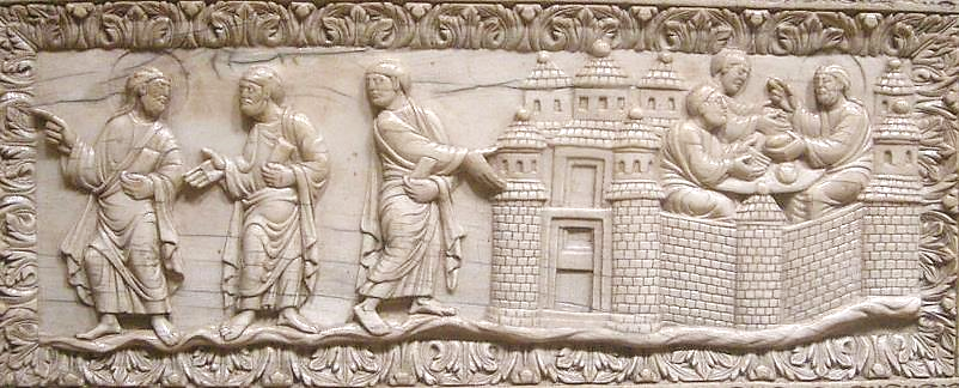
Road to Emmaus  —  Carolingian, 9th c., Cloisters Museum, New York

Sermon – Pastor Meggan Manlove

There are enough rich images and beautiful moments in this morning’s passage from Luke to fill a hundred sermons. Rather than walk us through the entire text, I am going to focus on one kernel. Perhaps because I believe the church, the larger Christian church, is in this curious liminal space, a space and time between what we have been and what God is transforming us into, the verse that stook out to me this spring is v. 32, “They asked each other, ‘Were not our hearts burning within us while he talked with us on the road and opened the Scriptures to us?’”

We all know that one of the intriguing elements of the story is the report that as soon as the two disciples recognized the risen Lord he disappeared from their sight. God’s presence is always elusive, fleeting, dancing at the edge of our awareness and perception. If we are honest, we must confess that it is never constant, steady, or predictable. The nuns in The Sound of Music sing “How can you catch a moonbeam in your hand, how do you hold a wave upon the sand?” The mystery of transcendence is always, well, transitory. God’s faithful people perceive God’s presence in fleeting moments, and then the mundane closes in again.

For this reason, we learn to treasure religious experiences in retrospect. The two in Emmaus exclaim, “Did not our hearts burn within us?” Like Moses, we usually see only the back side of God as God passes by us. With Job, another famous character in the Old Testament, we confess, “Look, he passes by me, and I do not see him; he moves on, but I do not perceive.” 

One of the secrets of a vigorous spirituality and a confident faith is learning to appreciate the importance of meeting God in the past as well as in the present. Today’s story guides us in this spiritual discipline. The men in white robes at the empty tomb told the women on Easter morning, “Remember how he told you, while he was still in Galilee…. Then they remembered his words.”

So much of what we do together in worship are acts of remembering. Sometimes remembering gets a bad reputation, and for good reasons. Think of an instance when you have romanticized someone or some event, instead of simply remembering. We see the past only with rose-colored glasses. In a similar vein, we can break the first the commandment and make an idol of the past. Then a friend or historian or stranger comes along and reminds us that the good old days were not all good.

But to remember God’s faithfulness is at the center of worship and actually at the center of the life of faith. The words I speak in the proper preface before we feast on the bread of life and cup of salvation are words of deep and long memory—from creation to the Exodus, through the lives of the prophets to Jesus’ own life, death, and resurrection, and finally God’s activity through the church empowered by the Holy Spirit. God’s faithfulness is sure.

In weekly worship, we move straight from the Words of Institution to the Lord’s Prayer. That prayer also helps us remember so very much. We remember how we ought to pray and for what. We again remember God’s gifts to us of daily bread, forgiveness, new life, healing. And sometimes we might remember the company of saints, all the people who have prayed that prayer down through history and pray it each day around the entire globe. 

What is all of this remembering good for? It helps us treasure religious experiences in retrospect. Further, remembering God’s activity throughout all of history helps us recognize God’s presence, elusive or fleeting as it might be, in our own lives. We get better at distinguishing between happy coincidences and God’s presence. We begin to live with more gratitude. And then, in worship and prayer, we give thanks for God’s real presence in our lives.

The practice of remembering God’s presence throughout history also reminds us that the experience of the presence of God is not a private gift. It is never for us alone. It is not something to be horded. Neither in the discovery of the empty tomb nor in the discovery of the fellow traveler to Emmaus is there the familiar command to go and tell, that is typical of other resurrection appearance scenes. Nevertheless, in both instances the recipients of the revelation immediately and spontaneously return from the liminal tomb to share their experience joyfully with others.

Finally, remembering God’s presence in history and in our own stories, prepares us to perceive God’s fleeting presence in real time. There is so much that can keep us from this activity. Our lives are filled with distractions, information, data, competing stories, shouting, advertising, promises of what will fulfill us. We are programmed now to skim and scan and breathe shallowly rather than to drink deeply from the water of life—Jesus Christ.

Worship, prayer, meeting our neighbors, serving those on the margins, we do all of this to remember the God of history and to prepare to perceive God’s fleeting presence in real time.

We do this, as Jesus did with those two disciples, most often around the meal of Holy Communion. The meal redefines the disciples’ understanding of Jesus. Jesus takes, blesses, breaks, and gives the bread to them (Luke 24:30), the same sequence of actions we recall from his final meal (22:19). 

The pattern also recalls Jesus’ feeding of the five thousand (9:16). Meals so characterize Jesus’ ministry that one writer concluded, “In Luke’s Gospel Jesus is either going to a meal, at a meal, or coming from a meal.” Meals will shape Christian gatherings in Acts and on to today precisely because believers recognize Jesus in the breaking of the bread (24:35). It is no wonder that in the breaking of the bread, those two disciples remembered. 

It is no surprise that we enjoy breaking bread together in spaces that are not the altar. Perceiving God in this space helps us perceive God in other meal times. But there is so much more to the Holy Communion meal. It is more than bread and wine. It is a means of God’s grace. It is an event in which we receive forgiveness and new life. As we return to this table again and again, I really do believe we build our capacity to perceive God in our other places, to perceive forgiveness, grace, and new life in daily encounters. Most often we will name it later, that was a grace moment, that was God’s love, that was God’s mercy, that was life given from God. And we give thanks.

I had such an encounter a few Thursdays ago. I have been on the board for Leap Housing for about 18 months with three men. I have enjoyed all of our meetings, but I did not know them. When the COO of the organization asked what we would like to get out of a board retreat, I said I just wanted to get to know these individuals.

So, after a two-hour meeting we headed to dinner in the Linen District—the entrepreneur Bart, COO Brian, me and two other board members. All I did was ask one man, “how did you meet Bart?” After 40 minutes, as he finished his remarkable story, I turned to the other board member and asked about his time in Idaho newspapers and politics. It was a very different story, but remarkable all the same. I was giddy and committed to living in the moment. As I walked to my car at the evening’s conclusion, I could feel my heart had been burning, as the disciples described, not from rich food, but with grace, love, hope. Like the meal of bread and wine, it was sustenance for my soul, more than enough to get me through the next week.

Prayers of Intercession

United in the hope and joy of the resurrection, let us pray for the church, the world, and all in need.

A brief silence.

Ever-present God, you make yourself known in the breaking of the bread and in the bonds of community. Reveal yourself to us in the faces of all we meet. Strengthened by your body and blood, let us boldly live out your good news. Hear us, O God.

Your mercy is great.

As we know you in the breaking of the bread, we know you in the grains of the field and the flowing waters. Care for the earth you lovingly create. Strengthen those who safeguard threatened land and water. Hear us, O God.

Your mercy is great.

You are the authority to whom we dedicate our lives (like Toyohiko Kagawa, whom we commemorate today). Help us keep the needs of those most vulnerable at the forefront of our community. Move us to care for any who are disregarded or oppressed. Hear us, O God.

Your mercy is great.

Mothering God, you feed and comfort those who hunger. Open the hearts of those who horde resources and lead them to share your abundance. We pray for anyone hungering for your comforting presence this day (especially). Hear us, O God.

Your mercy is great.

You pour out your love on those who are oppressed. Support and comfort anyone who is marginalized by gender or sexuality and those whose stories are not believed. Form this community to listen faithfully and speak honestly in our ministry together. Hear us, O God.

Your mercy is great.

Here other intercessions may be offered.

We remember with thanksgiving all your beloved saints (especially). As you have raised them to eternal life, abide with us in your promise of resurrection. Hear us, O God.

Your mercy is great.

Rejoicing in the victory of Christ’s resurrection, we lift our prayers and praise to you, almighty and eternal God; through Jesus Christ, our risen Lord.

Amen.

Posted in Sermons, Trinity Lutheran | Leave a comment

April 16, 2023

Prayer of the Day

Almighty and eternal God, the strength of those who believe and the hope of those who doubt, may we, who have not seen, have faith in you and receive the fullness of Christ’s blessing, who lives and reigns with you and the Holy Spirit, one God, now and forever.

Amen.

Acts 2:14a, 22-32

14aPeter, standing with the eleven, raised his voice and addressed [the crowd], 22“You that are Israelites, listen to what I have to say: Jesus of Nazareth, a man attested to you by God with deeds of power, wonders, and signs that God did through him among you, as you yourselves know—23this man, handed over to you according to the definite plan and foreknowledge of God, you crucified and killed by the hands of those outside the law. 24But God raised him up, having freed him from death, because it was impossible for him to be held in its power. 25For David says concerning him, 
 ‘I saw the Lord always before me,
  for he is at my right hand so that I will not be shaken;
 26therefore my heart was glad, and my tongue rejoiced;
  moreover my flesh will live in hope.
 27For you will not abandon my soul to Hades,
  or let your Holy One experience corruption.
 28You have made known to me the ways of life;
  you will make me full of gladness with your presence.’
 29“Fellow Israelites, I may say to you confidently of our ancestor David that he both died and was buried, and his tomb is with us to this day. 30Since he was a prophet, he knew that God had sworn with an oath to him that he would put one of his descendants on his throne. 31Foreseeing this, David spoke of the resurrection of the Messiah, saying, 
 ‘He was not abandoned to Hades,
  nor did his flesh experience corruption.’
32This Jesus God raised up, and of that all of us are witnesses.”

Psalm 16

 1Protect me, O God, for I take ref- | uge in you;
  I have said to the Lord, “You are my Lord, my good a- | bove all other.”
 2All my delight is in the godly that are | in the land,
  upon those who are noble a- | mong the people.
 3But those who run after | other gods
  shall have their troubles | multiplied.
 4I will not pour out drink offerings | to such gods,
  never take their names up- | on my lips. 
 5O Lord, you are my portion | and my cup;
  it is you who up- | hold my lot.
 6My boundaries enclose a | pleasant land;
  indeed, I have a | rich inheritance.
 7I will bless the Lord who | gives me counsel;
  my heart teaches me night | after night.
 8I have set the Lord al- | ways before me;
  because God is at my right hand, I shall | not be shaken. 
 9My heart, therefore, is glad, and my spir- | it rejoices;
  my body also shall | rest in hope.
 10For you will not abandon me | to the grave,
  nor let your holy one | see the pit.
 11You will show me the | path of life;
  in your presence there is fullness of joy, and in your right hand are pleasures for- | evermore. 

1 Peter 1:3-9

3Blessed be the God and Father of our Lord Jesus Christ! By his great mercy he has given us a new birth into a living hope through the resurrection of Jesus Christ from the dead, 4and into an inheritance that is imperishable, undefiled, and unfading, kept in heaven for you, 5who are being protected by the power of God through faith for a salvation ready to be revealed in the last time. 6In this you rejoice, even if now for a little while you have had to suffer various trials, 7so that the genuineness of your faith—being more precious than gold that, though perishable, is tested by fire—may be found to result in praise and glory and honor when Jesus Christ is revealed. 8Although you have not seen him, you love him; and even though you do not see him now, you believe in him and rejoice with an indescribable and glorious joy, 9for you are receiving the outcome of your faith, the salvation of your souls.

John 20:19-31

19When it was evening on that day, the first day of the week, and the doors of the house where the disciples had met were locked for fear of the Jews, Jesus came and stood among them and said, “Peace be with you.” 20After he said this, he showed them his hands and his side. Then the disciples rejoiced when they saw the Lord. 21Jesus said to them again, “Peace be with you. As the Father has sent me, so I send you.” 22When he had said this, he breathed on them and said to them, “Receive the Holy Spirit. 23If you forgive the sins of any, they are forgiven them; if you retain the sins of any, they are retained.”

 24But Thomas (who was called the Twin), one of the twelve, was not with them when Jesus came. 25So the other disciples told him, “We have seen the Lord.” But he said to them, “Unless I see the mark of the nails in his hands, and put my finger in the mark of the nails and my hand in his side, I will not believe.”
 26A week later his disciples were again in the house, and Thomas was with them. Although the doors were shut, Jesus came and stood among them and said, “Peace be with you.” 27Then he said to Thomas, “Put your finger here and see my hands. Reach out your hand and put it in my side. Do not doubt but believe.” 28Thomas answered him, “My Lord and my God!” 29Jesus said to him, “Have you believed because you have seen me? Blessed are those who have not seen and yet have come to believe.”

 30Now Jesus did many other signs in the presence of his disciples, which are not written in this book. 31But these are written so that you may come to believe that Jesus is the Messiah, the Son of God, and that through believing you may have life in his name.

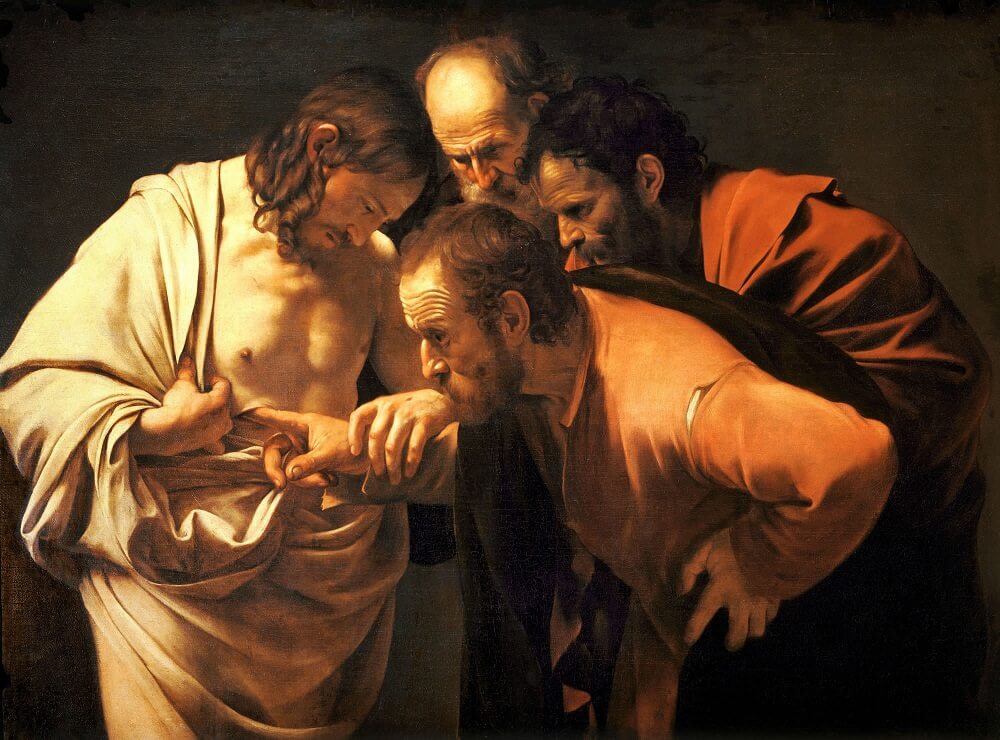
The Incredulity of Saint Thomas by Carvaggio

Sermon – Pastor Meggan Manlove

Christ is risen but Easter is not over.  We need the seven weeks of Easter to ponder the mystery of resurrection. How do we see Christ? Each of the four gospels has its own story about seeing Jesus. In Mark, no one sees the risen Christ. In Matthew, the disciples see Jesus in the obedience of worship and by doing what Jesus says- forgiving each other and living lives of compassion and mercy. In Luke, disciples walk toward Emmaus and then see Jesus in the breaking of bread. John’s gospel tells another story.

In today’s passage, the risen Christ appears to his disciples twice in a room with locked doors. In these appearances we see Jesus amid gracious acts. He offers himself so that people will believe or trust. These passages tell the story of our roots as Christians, our roots as the Body of Christ.  

First, remember that when Jesus first enters the room he speaks these holy words, “Peace be with you.” Jesus enters our hiding places, the places we run to when we are afraid. He enters with the marks of the cross. The peace he left with the disciples on the night before he was crucified is the peace he brings to disciples on the night of resurrection. 

We deeply need these words of promise. Elie Weisel, the author who survived the prison in Auschwitz, said that the opposite of faith is not doubt but anxiety. We live in an anxious world. Where are we to put our trust? Where do we go for hope?  The world is filled with uncertainty.  

We do not know what the future holds and when we speculate, we are faced with ladders to climb and barriers to go through in every stage of life, in every community. It is common to feel uneasyand distressed about what lies ahead. We question what is necessary for the future to be peaceful.  

How do we continue to put our trust in God risen from the dead, in this anxious world?  In this country there is sometimes even an implied understanding that to be a true believer one must have certain kinds of experiences, point to specific things, completely understand scripture and other matters of faith.

There is an alternative. The path between anxiety and militant certainty is faith, maybe better described as trust. And rather than being a character to mock or feel sorry for, the disciple Thomas can be our guide. I remember when I viewed my first image of Thomas standing with Jesus, when today’s text came alive for me.  In his characteristic style of strong contrasts between light and dark hues, the artist Carvagio painted Thomas looking at Jesus’ marks, on his hands and side.  There is wonderment in Thomas’ eyes. It is clear that Thomas has faith. It is this faith, rather than unbelief, that we are meant to see in Thomas.  

Thomas asks only to see what the other disciples have already seen–the marks of the crucifixion on Jesus. Thomas wants to believe and Jesus offers himself. And then Thomas gives what is the most powerful and complete confession of Jesus in the Gospel of John, “My Lord and my God.” It is quite a declaration when one considers that Caesar was considered to be and was called Lord throughout the Roman Empire.

Thomas wanted faith and Jesus’ words were not ones of judgment or reprimand. It was not with a harsh and shameful tone that Jesus said, “Put your finger here; look, here are my hands…. Do not be unbelieving anymore but believe.”  Jesus speaks with a tone of grace. 

The gospel writer John wants us to know that having seen Jesus is not a prerequisite of trusting God or of professing like Thomas, “My Lord and my God” when speaking of Jesus. When John lays out the purpose of his entire gospel he writes, “there are many other signs that Jesus worked in the sight of the disciples, but they are not recorded in this book. These are recorded so that you may believe that Jesus is the Christ, the Son of God, and that believing this you may have life through his name.”  

A relationship with Jesus is not limited to the first disciples. We do not see Jesus as the disciples did in those post-Easter appearances, but we see Jesus in our lives.

In the water of Baptism and the bread and wine of Holy Communion, you have received gifts of forgiveness and new life through Jesus.  

Another image this morning’s text brings to mind comes from the home I grew up in. Off the dining room was a wall full of artwork—photos, paintings, mosaics, carvings, mostly with ties to Christianity.  In the top right corner was a dark wooden piece with two images on it. One is a hand with a hole in the middle—a hole just large enough for a nail to have been pierced through.  The other is a loaf of bread.  

The hand with the hole in it was for the early disciples. The bread is for you and me. Having heard the promises and receiving the bread and wine, you and I have been carried out of our fear and anxiety into the world with the good news of forgiveness and abundant life. We give thanks because we have entered the mystery and received forgiveness and new life. Like Thomas we continue to confess with confidence Sunday after Sunday, “My Lord and my God.”  

The sacraments are not our only nourishment. In baptism itself we are reminded of the life we are called into and the practices that nourish us in the faith: living among God’s faithful people; participating in Holy Communion; learning the Lord’s Prayer, the Creed, and the Ten Commandments; and prayer. Tucked into the litany in a few different places is hearing the Word proclaimed in worship and reading the holy scriptures. 

This made me think of and turn to our second lesson today from First Peter. Look at that second sentence. “By God’s great mercy he has given us a new birth into a living hope through the resurrection of Jesus Christ from, and into an inheritance that is imperishable, undefiled, and unfading, kept in heaven for you, who are being protected by the power of God through faith for a salvation ready to be revealed in the last time.” Peter’s compassion and encouragement seem unstoppable. After 59 words he finally placed a period and lets us take a real breath.  The letters in our New Testament were meant to be read aloud to new Christian churches.

For the next six Sundays, the Second Reading will be from this wonderful letter of hope and identity. During Lent we learned what it meant to follow Jesus. Now we are tasked with hearing what it means to be an Easter people. Martin Luther loved this letter. First Peter holds within it the imagery of the royal priesthood from which Luther developed his crucial belief in the priesthood of all believers—the belief that each one of us, not only ordained pastors, are called to ministry in our daily lives.  

The letter is not perfect. Peter’s words about how slaves and wives, the weaker sex, are to behave cannot help but make me squirm. As we make our way through his first letter, let us take the great with the not so great, remembering that Jesus called Peter the rock of the church, even though Peter betrayed him three times.   

The epistle of First Peter addresses what came to be known as Christian Diaspora (or Dispersion) communities. The communities were located throughout four provinces of Asia Minor, which today is the country of Turkey. Right before our text begins, Peter writes, “To the exiles of the Dispersion in Pontus, Galatia, Cappadocia, Asia, and Bithynia.” These communities were disenfranchised “exiles” and aliens.  

So in this letter we come face to face with Christians vulnerable to local harassment, struggling to claim a sense of hope and identity amid the pressures of empire, poverty, slavery and displacement. We are not oppressed like those early Christians in Asia Minor. Still, the promises in the Affirmation of Baptism can be counter-cultural even today: to serve all people, following the example of Jesus, and to strive for justice and peace in all the earth. The encouragement in the letter of First Peter can help us live as a hope-filled community in Canyon County, Idaho 2023.  Listen for that hope and love this Easter Season.

Prayers of Intercession

United in the hope and joy of the resurrection, let us pray for the church, the world, and all in need.

A brief silence.

God of rebirth, the good news of your resurrection brings refreshment to a weary world. Following the women at the tomb, empower us to boldly share your radical love through our words and our work. Hear us, O God.

Your mercy is great.

As you breathed your Spirit into the disciples, breathe your spirit of healing upon all creation. Nourish the earth with sufficient rains. Strengthen us to counter the effects of pollution and destruction. Hear us, O God.

Your mercy is great.

You prepared the disciples for their ministry by calming their fears and granting them your peace. Equip our communities’ leaders (especially). Give them a spirit of peace and hearts that burn for justice, that their leadership reflects your love. Hear us, O God.

Your mercy is great.

You come among us in unexpected ways. Send us to those who hide in fear or question your love. Be a healing presence for any isolated by addiction, incarceration, mental illness, chronic pain, sickness, or grief (especially). Hear us, O God.

Your mercy is great.

As you met the disciples on the road to Emmaus, show us your presence along our journeys. Bless our doubts and questions. Provide trusting and safe relationships for all ages, to nurture our connection to you and one another. Hear us, O God.

Your mercy is great.

Here other intercessions may be offered.

Resurrecting God, you bring us to new life every day. Thank you for blessing us with companions on our faith journey, especially those who now rest in your love (especially). Strengthen us with the eternal peace of your promises. Hear us, O God.

Your mercy is great.

Rejoicing in the victory of Christ’s resurrection, we lift our prayers and praise to you, almighty and eternal God; through Jesus Christ, our risen Lord.

Amen.

Posted in Sermons, Trinity Lutheran | Leave a comment

Easter – April 9, 2023

Prayer of the Day

O God, you gave your only Son to suffer death on the cross for our redemption, and by his glorious resurrection you delivered us from the power of death. Make us die every day to sin, that we may live with him forever in the joy of the resurrection, through your Son, Jesus Christ our Lord, who lives and reigns with you and the Holy Spirit, one God, now and forever.

Amen

Acts 10:34-43

34Peter began to speak to [the people]: “I truly understand that God shows no partiality, 35but in every nation anyone who fears him and does what is right is acceptable to him. 36You know the message he sent to the people of Israel, preaching peace by Jesus Christ—he is Lord of all. 37That message spread throughout Judea, beginning in Galilee after the baptism that John announced: 38how God anointed Jesus of Nazareth with the Holy Spirit and with power; how he went about doing good and healing all who were oppressed by the devil, for God was with him. 39We are witnesses to all that he did both in Judea and in Jerusalem. They put him to death by hanging him on a tree; 40but God raised him on the third day and allowed him to appear, 41not to all the people but to us who were chosen by God as witnesses, and who ate and drank with him after he rose from the dead. 42He commanded us to preach to the people and to testify that he is the one ordained by God as judge of the living and the dead. 43All the prophets testify about him that everyone who believes in him receives forgiveness of sins through his name.”

Psalm 118:1-2, 14-24

 1Give thanks to the Lord, for the | Lord is good;
  God’s mercy en- | dures forever.
 2Let Israel | now declare,
  “God’s mercy en- | dures forever.”
 14The Lord is my strength | and my song,
  and has become | my salvation.
 15Shouts of rejoicing and salvation echo in the tents | of the righteous:
  “The right hand of the | Lord acts valiantly!
 16The right hand of the Lord| is exalted!
  The right hand of the | Lord acts valiantly!”
 17I shall not | die, but live,
  and declare the works | of the Lord. 
 18The Lord indeed pun- | ished me sorely,
  but did not hand me o- | ver to death.
 19Open for me the | gates of righteousness;
  I will enter them and give thanks | to the Lord.
 20“This is the gate | of the Lord;
  here the righ- | teous may enter.”
 21I give thanks to you, for you have | answered me
  and you have become | my salvation. 
 22The stone that the build- | ers rejected
  has become the chief | cornerstone.
 23By the Lord has | this been done;
  it is marvelous | in our eyes.
 24This is the day that the | Lord has made;
  let us rejoice and be | glad in it. 

Colossians 3:1-4

1If you have been raised with Christ, seek the things that are above, where Christ is, seated at the right hand of God. 2Set your minds on things that are above, not on things that are on earth, 3for you have died, and your life is hidden with Christ in God. 4When Christ who is your life is revealed, then you also will be revealed with him in glory.

Matthew 28:1-10

1After the sabbath, as the first day of the week was dawning, Mary Magdalene and the other Mary went to see the tomb. 2And suddenly there was a great earthquake; for an angel of the Lord, descending from heaven, came and rolled back the stone and sat on it. 3His appearance was like lightning, and his clothing white as snow. 4For fear of him the guards shook and became like dead men. 5But the angel said to the women, “Do not be afraid; I know that you are looking for Jesus who was crucified. 6He is not here; for he has been raised, as he said. Come, see the place where he lay. 7Then go quickly and tell his disciples, ‘He has been raised from the dead, and indeed he is going ahead of you to Galilee; there you will see him.’ This is my message for you.” 8So they left the tomb quickly with fear and great joy, and ran to tell his disciples. 9Suddenly Jesus met them and said, “Greetings!” And they came to him, took hold of his feet, and worshiped him. 10Then Jesus said to them, “Do not be afraid; go and tell my brothers to go to Galilee; there they will see me.”

Sermon – Meggan Manlove

This is such a great resurrection scene, in large part because of verse 2. Mary Magdalene and the other Mary have gone to the tomb and suddenly there is an earthquake. An angel of the Lord descends from heaven and rolls back the stone in front of the tomb and sits on it. His appearance is like lightening, and his clothing is as white as snow. 

Confronted by the blinding light of this angel, the guards who had been posted in ensure that nothing would happen to Jesus’ body were so gripped by fear that they shook and became like dead men. Someone this week suggested we compare the men to fainting goats. 

Jesus’ resurrection already creates a life freed from the death that grips our everyday lives. This is life reborn, revealing to us how death has determined our living. And yet it is possible to remain dead, to live as dead men, as the behavior of these guards will make clear.

The guards are frightened to death. But the angel tells Mary Magdalene and the other Mary that they do not need to be afraid: “I know that you are looking for Jesus who was crucified. He is not here; for he has been raised, as he said. Come, see the place where he lay. Then go quickly and tell his disciples, ‘He has been raised from the dead, and indeed he is going ahead of you to Galilee; there you will see him.’” 

The angel’s speech contains all of the gospel. “Do not be afraid.” Jesus has made it possible to live unafraid. The disciples, followers, of Jesus are often afraid of the elites and the crowds, but Jesus has given them all they need not to be afraid. He has done so by drawing them, and us, into a way of life so compellingly true that we have no time to be afraid.

We read that Mary Magdalene and Mary left the tomb quickly with fear and great joy. The fear is that paired with joy. They leave the tomb in awe, knowing that they are now participants in the reign of God, which their teacher Jesus has spoken of so often. They fear they have as they leave the tomb is the fear that protects them from the fears that would have us deny the resurrection. Our human nature wants to create lives of security in the face of death. The joy filling the women saves them from this kind of fear.

The fear and joy they now experience is made possible by the resurrection. Mary Magdalene and Mary have seen the crucifixion; they have now seen the empty tomb. They are our first witnesses to the good news that the one crucified has been raised.

Jesus was handed over, made subject to sinners and death itself. But he has been made victorious. But the resurrection of Jesus cannot be seen. As one scholar [Hauerwas] says, we can no more see the resurrection than we can see creation. We can see only the empty tomb and the resurrected Jesus. 

The resurrection is not a resurrection of one who had lived, died, and then lived again. Jesus raised his friend Lazarus from the dead. But Lazarus was still to die. Resurrection is not the resuscitation of a corpse. Jesus is raised from the dead to be freed from death itself. He will never die again. Jesus has been raised from the dead, defeating death itself. 

Mary Magdalene and Mary rush from the tomb to tell the disciples, but suddenly, in an almost comedic encounter, Jesus meets them. It is Jesus, resurrected. It is the crucified one who is resurrected. Jesus greets them in a familiar way, and they come to him. They saw him and recognized him. They took hold of his feet. The resurrected Jesus can be touched. 

The resurrection of Jesus is not an idea. His body has been raised. The one born of Mary, the one baptized by John, the one who called the disciples, the one who delivered the Sermon on the Mount, the one who cured the lame, the blind, the deaf and mute, the one who disputed with the Pharisees and Sadducees, the one who endured humiliation by trial and cross—he has been raised.

Jesus’ bodily presence does not prevent Mary Magdalene and Mary from worshiping him. One worships only God. Yet they worship him. They had not worshiped the angel who announced Jesus’ resurrection. But they now worship Jesus, Immanuel, God with us.

That they worship Jesus marks the central activity of the new reality of the body of Christ, the church. What makes the church the church is the worship of Jesus. The worship of Jesus will take many different forms across time and space. But where the word is preached and the sacraments are enacted, we know that Jesus is present among us. By baptism and communion, we participate in Jesus’ life, death, and resurrection, making us an alternative to the world. Being the alternative is not, however, an invitation for self-righteousness. Instead, it enables us to witness, as Mary Magdalene and Mary do, to our having been given the time in a world that thinks it has no time to worship Jesus.

Jesus tells the women not to be afraid, but to go tell his brothers to go to Galilee where they will see him. Jesus’ disciples—brothers and sisters, will bring forth life. Again, we see the beginnings of the church. And Jesus is returning to Galilee, where he began his ministry. Jesus unleashes the disciples to go into the world not from Jerusalem, the center of power, but from Galilee. Galilee becomes the staging area for the disciples to go to the nations to announce the new age begun by Jesus.

For us today, as for Mary Magdalene and Mary, Jesus goes ahead of us to lead us into the world, specifically into a transformative way of life that testifies to the power of resurrection wherever we live. “Jesus is going ahead—not going away,” one scholar [Schuessler Fiorenza] said. The empty tomb does not signify absence but presence. It announces the resurrected one’s presence on the road ahead.

If Jesus is indeed going ahead, then we are asked to look for experiences of resurrection presence not only in Galilee but also in Nampa, Caldwell, Middleton, and Kuna—on all the roads of our lives. Resurrection means that Jesus, the Living One, goes ahead of us. Jesus can be found only when we experience that “he is ahead of us” and he opens up a future for us. Like Mary Magdalene and Mary, we can run to meet that liberating future. The stone has been rolled away. 

Finally, the command to go to Galilee does not erase the experience of death and violence. Resurrection comes to us first of all in our most broken and unexpected places, breaking the structures of the Roman occupation regime in Jerusalem and the structures of every regime of death in our lives today. 

Does the resurrection make us feel that the earth is shaking again this Easter morning? Are we also filled with both fear and joy? What does it look like to stop and worship Jesus, and only Jesus today? How does our worship shape us to be the body of Christ for the sake of the world? What message of new life is on our lips in this place and time?

Jesus is going ahead. He continues into the future God has in store for the creation.  In the meantime, there is only the Word, the bread, and the wine, and the promise that “you will see him.”  We walk by faith and not by sight.  We can only trust that God will one day finish the story, as God has promised.

Prayers of Intercession

The prayers are prepared locally for each occasion. The following examples may be adapted or used as appropriate.

United in the hope and joy of the resurrection, let us pray for the church, the world, and all in need.

A brief silence.

You call your church to witness to your salvation. We give thanks for (Dietrich Bonhoeffer and) all theologians, preachers, and teachers who proclaim your gospel. Equip all the baptized to share the joy of the resurrection in all we say and do. Risen Lord, in your mercy,

hear our prayer.

You bring abundant life throughout creation. The green blade rises, and all creation greets the resurrection dawn. Preserve vineyards and orchards and those who tend to them. Feed us with the fruits of creation. Risen Lord, in your mercy,

hear our prayer.

You show your steadfast love without regard to borders, barriers, or human-made divisions. Infuse your justice in every nation of the world (places of concern or conflict may be named) that all experience the peace that only you can give. Risen Lord, in your mercy,

hear our prayer.

You anointed your Son with the Holy Spirit and with power. Encourage us by his example in our ministries of healing, care, and outreach. We pray for all who are sick or hospitalized (especially) and for all health care workers who care for them. Risen Lord, in your mercy,

hear our prayer.

You have put gladness in our hearts. Inspire musicians and dancers to rejoice with songs of victory. Bless the music ministries of this congregation and all who foster our assembly’s song. Risen Lord, in your mercy,

hear our prayer.

Here other intercessions may be offered.

As you have raised Jesus from the dead, you show us your resurrection promise. With your holy ones who have sung your praise (especially), free us from fear and empower us to go and tell the good news. Risen Lord, in your mercy,

hear our prayer.

Rejoicing in the victory of Christ’s resurrection, we lift our prayers and praise to you, almighty and eternal God; through Jesus Christ, our risen Lord.

Amen.

Posted in Sermons, Trinity Lutheran | Leave a comment

Palm/Passion Sunday

Prayer of the Day

Everlasting God, in your endless love for the human race you sent our Lord Jesus Christ to take on our nature and to suffer death on the cross. In your mercy enable us to share in his obedience to your will and in the glorious victory of his resurrection, who lives and reigns with you and the Holy Spirit, one God, now and forever.

Amen.

Matthew 21:1-11

1When they had come near Jerusalem and had reached Bethphage, at the Mount of Olives, Jesus sent two disciples, 2saying to them, “Go into the village ahead of you, and immediately you will find a donkey tied, and a colt with her; untie them and bring them to me. 3If anyone says anything to you, just say this, ‘The Lord needs them.’ And he will send them immediately.” 4This took place to fulfill what had been spoken through the prophet, saying,
 5“Tell the daughter of Zion,
 Look, your king is coming to you,
  humble, and mounted on a donkey,
   and on a colt, the foal of a donkey.”
6The disciples went and did as Jesus had directed them; 7they brought the donkey and the colt, and put their cloaks on them, and he sat on them. 8A very large crowd spread their cloaks on the road, and others cut branches from the trees and spread them on the road. 9The crowds that went ahead of him and that followed were shouting, 
 “Hosanna to the Son of David!
  Blessed is the one who comes in the name of the Lord!
 Hosanna in the highest heaven!”
10When he entered Jerusalem, the whole city was in turmoil, asking, “Who is this?” 11The crowds were saying, “This is the prophet Jesus from Nazareth in Galilee.”

Isaiah 50:4-9a

 4The Lord God has given me
  the tongue of a teacher,
 that I may know how to sustain
  the weary with a word.
 Morning by morning he wakens—
  wakens my ear
  to listen as those who are taught.
 5The Lord God has opened my ear,
  and I was not rebellious,
  I did not turn backward.
 6I gave my back to those who struck me,
  and my cheeks to those who pulled out the beard;
 I did not hide my face
  from insult and spitting.

 7The Lord God helps me;
  therefore I have not been disgraced;
 therefore I have set my face like flint,
  and I know that I shall not be put to shame;
  8he who vindicates me is near.
 Who will contend with me?
  Let us stand up together.
 Who are my adversaries?
  Let them confront me.
 9aIt is the Lord God who helps me;
  who will declare me guilty?

Psalm 31:9-16

 9Have mercy on me, O Lord, for I | am in trouble;
  my eye is consumed with sorrow, and also my throat | and my belly.
 10For my life is wasted with grief, and my | years with sighing;
  my strength fails me because of affliction, and my bones | are consumed.
 11I am the scorn of all my enemies, a disgrace to my neighbors, a dismay to | my acquaintances;
  when they see me in the street | they avoid me.
 12Like the dead I am forgotten, | out of mind;
  I am as useless as a | broken pot. R
 13For I have heard the whispering of the crowd; fear is | all around;
  they put their heads together against me; they plot to | take my life.
 14But as for me, I have trusted in | you, O Lord.
  I have said, “You | are my God.
 15My times are | in your hand;
  rescue me from the hand of my enemies, and from those who | persecute me.
 16Let your face shine up- | on your servant;
  save me in your | steadfast love.” 

Philippians 2:5-11

5Let the same mind be in you that was in Christ Jesus,
 6who, though he was in the form of God,
  did not regard equality with God
  as something to be exploited,
 7but emptied himself,
  taking the form of a slave,
  being born in human likeness.
 And being found in human form,
  8he humbled himself
  and became obedient to the point of death—
  even death on a cross.

 9Therefore God also highly exalted him
  and gave him the name
  that is above every name,
 10so that at the name of Jesus
  every knee should bend,
  in heaven and on earth and under the earth,
 11and every tongue should confess
  that Jesus Christ is Lord,
  to the glory of God the Father.

Matthew 26:14–27:66

14One of the twelve, who was called Judas Iscariot, went to the chief priests 15and said, “What will you give me if I betray him to you?” They paid him thirty pieces of silver. 16And from that moment he began to look for an opportunity to betray him.

 17On the first day of Unleavened Bread the disciples came to Jesus, saying, “Where do you want us to make the preparations for you to eat the Passover?” 18He said, “Go into the city to a certain man, and say to him, ‘The Teacher says, My time is near; I will keep the Passover at your house with my disciples.’ ” 19So the disciples did as Jesus had directed them, and they prepared the Passover meal.
 20When it was evening, he took his place with the twelve; 21and while they were eating, he said, “Truly I tell you, one of you will betray me.” 22And they became greatly distressed and began to say to him one after another, “Surely not I, Lord?” 23He answered, “The one who has dipped his hand into the bowl with me will betray me. 24The Son of Man goes as it is written of him, but woe to that one by whom the Son of Man is betrayed! It would have been better for that one not to have been born.” 25Judas, who betrayed him, said, “Surely not I, Rabbi?” He replied, “You have said so.”

 26While they were eating, Jesus took a loaf of bread, and after blessing it he broke it, gave it to the disciples, and said, “Take, eat; this is my body.” 27Then he took a cup, and after giving thanks he gave it to them, saying, “Drink from it, all of you; 28for this is my blood of the covenant, which is poured out for many for the forgiveness of sins. 29I tell you, I will never again drink of this fruit of the vine until that day when I drink it new with you in my Father’s kingdom.”
 30When they had sung the hymn, they went out to the Mount of Olives.

 31Then Jesus said to them, “You will all become deserters because of me this night; for it is written, 
 ‘I will strike the shepherd,
  and the sheep of the flock will be scattered.’
32But after I am raised up, I will go ahead of you to Galilee.” 33Peter said to him, “Though all become deserters because of you, I will never desert you.” 34Jesus said to him, “Truly I tell you, this very night, before the cock crows, you will deny me three times.” 35Peter said to him, “Even though I must die with you, I will not deny you.” And so said all the disciples.

 36Then Jesus went with them to a place called Gethsemane; and he said to his disciples, “Sit here while I go over there and pray.” 37He took with him Peter and the two sons of Zebedee, and began to be grieved and agitated. 38Then he said to them, “I am deeply grieved, even to death; remain here, and stay awake with me.” 39And going a little farther, he threw himself on the ground and prayed, “My Father, if it is possible, let this cup pass from me; yet not what I want but what you want.” 40Then he came to the disciples and found them sleeping; and he said to Peter, “So, could you not stay awake with me one hour? 41Stay awake and pray that you may not come into the time of trial; the spirit indeed is willing, but the flesh is weak.” 42Again he went away for the second time and prayed, “My Father, if this cannot pass unless I drink it, your will be done.” 43Again he came and found them sleeping, for their eyes were heavy. 44So leaving them again, he went away and prayed for the third time, saying the same words. 45Then he came to the disciples and said to them, “Are you still sleeping and taking your rest? See, the hour is at hand, and the Son of Man is betrayed into the hands of sinners. 46Get up, let us be going. See, my betrayer is at hand.”

 47While he was still speaking, Judas, one of the twelve, arrived; with him was a large crowd with swords and clubs, from the chief priests and the elders of the people. 48Now the betrayer had given them a sign, saying, “The one I will kiss is the man; arrest him.” 49At once he came up to Jesus and said, “Greetings, Rabbi!” and kissed him. 50Jesus said to him, “Friend, do what you are here to do.” Then they came and laid hands on Jesus and arrested him. 51Suddenly, one of those with Jesus put his hand on his sword, drew it, and struck the slave of the high priest, cutting off his ear. 52Then Jesus said to him, “Put your sword back into its place; for all who take the sword will perish by the sword. 53Do you think that I cannot appeal to my Father, and he will at once send me more than twelve legions of angels? 54But how then would the scriptures be fulfilled, which say it must happen in this way?” 55At that hour Jesus said to the crowds, “Have you come out with swords and clubs to arrest me as though I were a bandit? Day after day I sat in the temple teaching, and you did not arrest me. 56But all this has taken place, so that the scriptures of the prophets may be fulfilled.” Then all the disciples deserted him and fled.

 57Those who had arrested Jesus took him to Caiaphas the high priest, in whose house the scribes and the elders had gathered. 58But Peter was following him at a distance, as far as the courtyard of the high priest; and going inside, he sat with the guards in order to see how this would end. 59Now the chief priests and the whole council were looking for false testimony against Jesus so that they might put him to death, 60but they found none, though many false witnesses came forward. At last two came forward 61and said, “This fellow said, ‘I am able to destroy the temple of God and to build it in three days.’ ” 62The high priest stood up and said, “Have you no answer? What is it that they testify against you?” 63But Jesus was silent. Then the high priest said to him, “I put you under oath before the living God, tell us if you are the Messiah, the Son of God.” 64Jesus said to him, “You have said so. But I tell you, 
 From now on you will see the Son of Man
  seated at the right hand of Power
  and coming on the clouds of heaven.”
65Then the high priest tore his clothes and said, “He has blasphemed! Why do we still need witnesses? You have now heard his blasphemy. 66What is your verdict?” They answered, “He deserves death.” 67Then they spat in his face and struck him; and some slapped him, 68saying, “Prophesy to us, you Messiah! Who is it that struck you?”

 69Now Peter was sitting outside in the courtyard. A servant-girl came to him and said, “You also were with Jesus the Galilean.” 70But he denied it before all of them, saying, “I do not know what you are talking about.” 71When he went out to the porch, another servant-girl saw him, and she said to the bystanders, “This man was with Jesus of Nazareth.” 72Again he denied it with an oath, “I do not know the man.” 73After a little while the bystanders came up and said to Peter, “Certainly you are also one of them, for your accent betrays you.” 74Then he began to curse, and he swore an oath, “I do not know the man!” At that moment the cock crowed. 75Then Peter remembered what Jesus had said: “Before the cock crows, you will deny me three times.” And he went out and wept bitterly.27:

 1When morning came, all the chief priests and the elders of the people conferred together against Jesus in order to bring about his death. 2They bound him, led him away, and handed him over to Pilate the governor.

 3When Judas, his betrayer, saw that Jesus was condemned, he repented and brought back the thirty pieces of silver to the chief priests and the elders. 4He said, “I have sinned by betraying innocent blood.” But they said, “What is that to us? See to it yourself.” 5Throwing down the pieces of silver in the temple, he departed; and he went and hanged himself. 6But the chief priests, taking the pieces of silver, said, “It is not lawful to put them into the treasury, since they are blood money.” 7After conferring together, they used them to buy the potter’s field as a place to bury foreigners. 8For this reason that field has been called the Field of Blood to this day. 9Then was fulfilled what had been spoken through the prophet Jeremiah, “And they took the thirty pieces of silver, the price of the one on whom a price had been set, on whom some of the people of Israel had set a price, 10and they gave them for the potter’s field, as the Lord commanded me.”

 11Now Jesus stood before the governor; and the governor asked him, “Are you the King of the Jews?” Jesus said, “You say so.” 12But when he was accused by the chief priests and elders, he did not answer. 13Then Pilate said to him, “Do you not hear how many accusations they make against you?” 14But he gave him no answer, not even to a single charge, so that the governor was greatly amazed.

 15Now at the festival the governor was accustomed to release a prisoner for the crowd, anyone whom they wanted. 16At that time they had a notorious prisoner, called Jesus Barabbas. 17So after they had gathered, Pilate said to them, “Whom do you want me to release for you, Jesus Barabbas or Jesus who is called the Messiah?” 18For he realized that it was out of jealousy that they had handed him over. 19While he was sitting on the judgment seat, his wife sent word to him, “Have nothing to do with that innocent man, for today I have suffered a great deal because of a dream about him.” 20Now the chief priests and the elders persuaded the crowds to ask for Barabbas and to have Jesus killed. 21The governor again said to them, “Which of the two do you want me to release for you?” And they said, “Barabbas.” 22Pilate said to them, “Then what should I do with Jesus who is called the Messiah?” All of them said, “Let him be crucified!” 23Then he asked, “Why, what evil has he done?” But they shouted all the more, “Let him be crucified!”

 24So when Pilate saw that he could do nothing, but rather that a riot was beginning, he took some water and washed his hands before the crowd, saying, “I am innocent of this man’s blood; see to it yourselves.” 25Then the people as a whole answered, “His blood be on us and on our children!” 26So he released Barabbas for them; and after flogging Jesus, he handed him over to be crucified.

 27Then the soldiers of the governor took Jesus into the governor’s headquarters, and they gathered the whole cohort around him. 28They stripped him and put a scarlet robe on him, 29and after twisting some thorns into a crown, they put it on his head. They put a reed in his right hand and knelt before him and mocked him, saying, “Hail, King of the Jews!” 30They spat on him, and took the reed and struck him on the head. 31After mocking him, they stripped him of the robe and put his own clothes on him. Then they led him away to crucify him.

 32As they went out, they came upon a man from Cyrene named Simon; they compelled this man to carry his cross. 33And when they came to a place called Golgotha (which means Place of a Skull), 34they offered him wine to drink, mixed with gall; but when he tasted it, he would not drink it. 35And when they had crucified him, they divided his clothes among themselves by casting lots; 36then they sat down there and kept watch over him. 37Over his head they put the charge against him, which read, “This is Jesus, the King of the Jews.”
 38Then two bandits were crucified with him, one on his right and one on his left. 39Those who passed by derided him, shaking their heads 40and saying, “You who would destroy the temple and build it in three days, save yourself! If you are the Son of God, come down from the cross.” 41In the same way the chief priests also, along with the scribes and elders, were mocking him, saying, 42“He saved others; he cannot save himself. He is the King of Israel; let him come down from the cross now, and we will believe in him. 43He trusts in God; let God deliver him now, if he wants to; for he said, ‘I am God’s Son.’ ” 44The bandits who were crucified with him also taunted him in the same way.

 45From noon on, darkness came over the whole land until three in the afternoon. 46And about three o’clock Jesus cried with a loud voice, “Eli, Eli, lema sabachthani?” that is, “My God, my God, why have you forsaken me?” 47When some of the bystanders heard it, they said, “This man is calling for Elijah.” 48At once one of them ran and got a sponge, filled it with sour wine, put it on a stick, and gave it to him to drink. 49But the others said, “Wait, let us see whether Elijah will come to save him.” 50Then Jesus cried again with a loud voice and breathed his last. 51At that moment the curtain of the temple was torn in two, from top to bottom. The earth shook, and the rocks were split. 52The tombs also were opened, and many bodies of the saints who had fallen asleep were raised. 53After his resurrection they came out of the tombs and entered the holy city and appeared to many. 54Now when the centurion and those with him, who were keeping watch over Jesus, saw the earthquake and what took place, they were terrified and said, “Truly this man was God’s Son!”
 55Many women were also there, looking on from a distance; they had followed Jesus from Galilee and had provided for him. 56Among them were Mary Magdalene, and Mary the mother of James and Joseph, and the mother of the sons of Zebedee.

 57When it was evening, there came a rich man from Arimathea, named Joseph, who was also a disciple of Jesus. 58He went to Pilate and asked for the body of Jesus; then Pilate ordered it to be given to him. 59So Joseph took the body and wrapped it in a clean linen cloth 60and laid it in his own new tomb, which he had hewn in the rock. He then rolled a great stone to the door of the tomb and went away. 61Mary Magdalene and the other Mary were there, sitting opposite the tomb.

 62The next day, that is, after the day of Preparation, the chief priests and the Pharisees gathered before Pilate 63and said, “Sir, we remember what that impostor said while he was still alive, ‘After three days I will rise again.’ 64Therefore command the tomb to be made secure until the third day; otherwise his disciples may go and steal him away, and tell the people, ‘He has been raised from the dead,’ and the last deception would be worse than the first.” 65Pilate said to them, “You have a guard of soldiers; go, make it as secure as you can.” 66So they went with the guard and made the tomb secure by sealing the stone.

Sermon – Pastor Meggan Manlove

What are we to make of the event central to today’s Passion story, Jesus’ death? We say Jesus died for our sins. What does that mean really? We are going to dive in quickly to a long interesting and important dialogue within the Christian family. 

The dominant theory of recent centuries about what happened on the cross is called penal substitutionary atonement theory. Substitutionary atonement is the theory that Christ, by his own sacrificial choice, was punished in the place of us sinners, thus satisfying the” demands of justice” so that God forgive our sins. 

This theory has become central to the faith of many, so much so that Christ’s death and what it means, has sometimes become more important than what he did in his life. If only his death mattered, then all we needed was the last three days or even three hours of Jesus’ life. 

Just pull out a Bible and rip out the first 25 chapters of Matthew’s gospel. With the theory of substitutionary atonement, salvation, the healing of individuals and the world, became a one-time transactional affair between Jesus and his Father, instead of an ongoing transformational lesson for the human soul and community for all of history. At its worst, substitutionary atonement led us to see God as a cold, brutal figure, who demands acts of violence before God can love God’s own creation.

This dominate theory is steeped in retributive justice: required punishment for wrongdoing. There are Hollywood blockbusters, books, and even some of our hymns and songs that magnify Jesus’ sufferings over his life. They all support substitutionary atonement. Again, this theory posits Jesus’ torture and crucifixion as the punishment for the sin of the whole world. It follows that so much sin would result in the greatest pain imaginable, and the most terrible death. 

But those of us gathered here know about wars, dictators, and killing fields across the globe and throughout history. We have read stories of concentration camps, rape and torture, and genocide in centuries past and in our own lifetimes. We know stories of people who have suffered greatly. And a God who would demand the same retribution as cruel dictator does not seem like a God worth following at all, in my humble opinion.

If we look at the actual scripture passage, we see that Matthew does not dwell on Jesus’ suffering and execution. Matthew knew this suffering would not end with Jesus. It still goes on today. Matthew writes that when Jesus dies, the earth shakes, rocks split, graves are opened, and the temple is torn in two. 

Maybe this is heaven’s response to the suffering and death of human beings—all of them. Our God does not demand retribution like some dictator. Our God mourns like a parent. And shouldn’t we as well? Unjust trials should cause the earth to shake. Mockery should cause rocks to break. And when the innocent are executed, our temple curtains ought to be torn in two.

Instead of payment or punishment, instead of any transaction, the cross is a dramatic demonstration of God’s outpouring love, meant to utterly shock the heart and turn it back toward trust and love of the Creator. God does not need to be paid in order to love and forgive God’s own creation for its failures. Love cannot be bought by some “necessary sacrifice.” If it could, love would not and could not work its transformative effects. This theory of the Jesus’ life, death, and resurrection protects and preserves the absolute freedom and love of God. If forgiveness and love need to be bought or paid for, then it is not authentic forgiveness or love at all, which must be a free letting go. Instead of retributive justice, what God does on the cross is what is most in God’s character, restorative justice. 

With the lens of this restorative justice love theory, the cross does several things. First, the cross reveals that we are “curved in on ourselves.”  Jesus Christ comes into a broken world. Through Jesus, sinners are forgiven; the sick are healed; the cursed become blessed; the hungry are fed; suffering is relieved; and death is transformed to life.

But healing what is broken means recognizing that things are broken. Jesus revealed not just the brokenness of individuals, but the brokenness of whole systems. An emphasis on religious rules often labels and excludes the sick and suffering, rather than healing them. The Roman Empire claimed to be source of all goodness and benefits, yet vast portions of society had no share. The systems are sin-sick and serve their own needs.

The difficult thing is that we can’t remove ourselves from sinful and broken systems that surround us. The systems are too vast, too complex, too interconnected. Most of the time we just “go along to get along.” And the hope-filled message of the cross is that Jesus shows up even here, in our broken lives and broken systems. 

 
The cross also shows that we have God’s unfailing love. Yes, we are sinful and broken people, stuck in and participating in sinful and broken systems. And yet, at the same time, we are people saved by the grace, love, and the mercy of Jesus Christ. Jesus is the love of God coming into the world for the world (John 3:16-17). At the cross we see that God’s love in Jesus Christ will not stop.  That unfailing, unstoppable love for the whole creation lives in us and makes us one in Him (John 17:11).


There is more to the story, including the empty tomb, but the story unfolds best over the next seven days. Even if Christians are not of one mind when it comes to how the cross leads to salvation, we are all are all stewards of an amazing story that continues to transform lives. This most holy of weeks is one crucial part of the long remarkable story of God and God’s beloved creation.

Prayers of Intercession

The prayers are prepared locally for each occasion. The following examples may be adapted or used as appropriate.

Sustained by God’s abundant mercy, let us pray for the church, the world, and all of creation.

A brief silence.

Save your church, O God. Enable us to boldly confess in every time and place that Jesus Christ is Lord. With the humility of a servant, equip congregations, synods, and other ministry settings to proclaim your extravagant love for all. Merciful God,

receive our prayer.

Save your creation, O God. Every living being you have made has purpose. Give us renewed appreciation of farm animals who labor in the fields, service animals who accompany their human companions, and beloved pets who live alongside us. Merciful God,

receive our prayer.

Save the peoples of the earth, O God. Restore dignity to those who are scorned and persecuted for their religious beliefs or political activism, and deliver them from the hand of their enemies. Bring peace to places where conflict runs deep (especially). Merciful God,

receive our prayer.

Save those who cry to you in any need, O God. Watch over all who are incarcerated or awaiting trial, and stand with those who are unjustly accused. Be present with those feeling isolated, lonely, or fearful (especially). Merciful God,

receive our prayer.

Save us in your love, O God. Guide the work of church musicians, pastors, choirs, readers, deacons, technicians, acolytes, and all who assist in worship. Sustain them in their leadership as they accompany congregations through this Holy Week. Merciful God,

receive our prayer.

Here other intercessions may be offered.

Save us at the last, O God. We give you thanks for your saints of old who embodied your servant love. As you came to their aid, so deliver us in times of trial, that every knee would bend in praise to you. Merciful God,

receive our prayer.

We lift our prayers to you, O God, trusting in your steadfast love and your promise to renew your whole creation; through Jesus Christ our Savior.

Amen.

Posted in Sermons, Trinity Lutheran | Leave a comment