August 2021 Epistle/Newsletter column for Trinity Lutheran Church
Dear Friends and Members of Trinity,
I confess that I do not have anything particularly spiritual to write this month. I want to take you up one of Idaho’s high mountain peaks and give you the 12,000-foot view of Trinity this summer. We are now able to gather in person regularly and safely and it is life-giving. We also continue to offer worship online—also life-giving for people from many walks of life. The timing of being able to gather in person coincides with many of you hitting the road to see family and friends far away or explore the beauty of the natural world right here in the Mountain West. Another part of our current reality are the many members who put in multiple hours thinking, pivoting, learning, making decisions, and serving. Many faithful volunteers are now weary and worn and need some serious sabbath time before the fall. What this means is, if we are not full speed (whatever that means) until September, there are good reasons and most of those reasons have to do with rest and healing after a hard chapter of individual and communal life.
I truly believe we are living in an incredible time of creativity and recreating and transformation. Our leadership wants to be intentional about taking lessons from the pandemic with us and using new tools going forward. However, being intentional and thoughtful takes energy. So, this summer we are only doing a few things, but we hope to do them well (worship, campout, Peace Camp, Monday study group). Meanwhile, we are giving people space and time for rejuvenation. What lessons from the pandemic do you want to retain? What faith practices are you looking forward to resuming together? People at Trinity have never shied away from good questions. Let’s keep that as part of our DNA as we live into the future together, but let us also help one another rest and recover.
Gracious God, your blessed Son came down from heaven to be the true bread that gives life to the world. Give us this bread always, that he may live in us and we in him, and that, strengthened by this food, we may live as his body in the world, through Jesus Christ, our Savior and Lord.Amen.
2 Samuel 18:5-9, 15, 31-33
5[King David] ordered Joab and Abishai and Ittai, saying, “Deal gently for my sake with the young man Absalom.” And all the people heard when the king gave orders to all the commanders concerning Absalom. 6So the army went out into the field against Israel; and the battle was fought in the forest of Ephraim. 7The men of Israel were defeated there by the servants of David, and the slaughter there was great on that day, twenty thousand men. 8The battle spread over the face of all the country; and the forest claimed more victims that day than the sword. 9Absalom happened to meet the servants of David. Absalom was riding on his mule, and the mule went under the thick branches of a great oak. His head caught fast in the oak, and he was left hanging between heaven and earth, while the mule that was under him went on. 15And ten young men, Joab’s armor-bearers, surrounded Absalom and struck him, and killed him. 31Then the Cushite came; and the Cushite said, “Good tidings for my lord the king! For the Lord has vindicated you this day, delivering you from the power of all who rose up against you.” 32The king said to the Cushite, “Is it well with the young man Absalom?” The Cushite answered, “May the enemies of my lord the king, and all who rise up to do you harm, be like that young man.” 33The king was deeply moved, and went up to the chamber over the gate, and wept; and as he went, he said, “O my son Absalom, my son, my son Absalom! Would I had died instead of you, O Absalom, my son, my son!”
Psalm 130
1Out | of the depths I cry to | you, O Lord; 2O Lord, | hear my voice! Let your ears be attentive to the voice of my | supplication. 3If you were to keep watch | over sins, O Lord, | who could stand? 4Yet with you | is forgiveness, in order that you | may be feared. 5I wait for you, O Lord; | my soul waits; in your word | is my hope. 6My soul waits for the Lord more than those who keep watch | for the morning, more than those who keep watch | for the morning. 7O Israel, wait for the Lord, for with the Lord there is | steadfast love; with the Lord there is plen- | teous redemption. 8For the Lord shall | redeem Israel from | all their sins.
Ephesians 4:25–5:2
25So then, putting away falsehood, let all of us speak the truth to our neighbors, for we are members of one another. 26Be angry but do not sin; do not let the sun go down on your anger, 27and do not make room for the devil. 28Thieves must give up stealing; rather let them labor and work honestly with their own hands, so as to have something to share with the needy. 29Let no evil talk come out of your mouths, but only what is useful for building up, as there is need, so that your words may give grace to those who hear. 30And do not grieve the Holy Spirit of God, with which you were marked with a seal for the day of redemption. 31Put away from you all bitterness and wrath and anger and wrangling and slander, together with all malice, 32and be kind to one another, tenderhearted, forgiving one another, as God in Christ has forgiven you. 5:1Therefore be imitators of God, as beloved children, 2and live in love, as Christ loved us and gave himself up for us, a fragrant offering and sacrifice to God.
John 6:35, 41-51
35Jesus said to [the crowd,] “I am the bread of life. Whoever comes to me will never be hungry, and whoever believes in me will never be thirsty. 41Then the Jews began to complain about him because he said, “I am the bread that came down from heaven.” 42They were saying, “Is not this Jesus, the son of Joseph, whose father and mother we know? How can he now say, ‘I have come down from heaven’?” 43Jesus answered them, “Do not complain among yourselves. 44No one can come to me unless drawn by the Father who sent me; and I will raise that person up on the last day. 45It is written in the prophets, ‘And they shall all be taught by God.’ Everyone who has heard and learned from the Father comes to me. 46Not that anyone has seen the Father except the one who is from God; he has seen the Father. 47Very truly, I tell you, whoever believes has eternal life. 48I am the bread of life. 49Your ancestors ate the manna in the wilderness, and they died. 50This is the bread that comes down from heaven, so that one may eat of it and not die. 51I am the living bread that came down from heaven. Whoever eats of this bread will live forever; and the bread that I will give for the life of the world is my flesh.”
Sermon – Pastor Meggan Manlove
A Luther Heights counselor asked me last week, “Why do Lutheran pastors always preach on the gospel text?” I had to tell him that is not everyone’s experience. I suggested some reasons why pastors might do that and then I came to our lesson today from II Samuel. It certainly is not a happy or simple story and part of me is always a bit perplexed, wondering why so many details, many in the verses left out of the reading, are included. Nonetheless, in this particular chapter of our personal, communal, and global lives, David’s grief has much to say to us.
First, let me set up our text a bit. David’s reign has been in place for some time by now. He captured Jerusalem and made it his capital. David broke the Philistine power, united the country, brought the Ark of the Covenant to Jerusalem. Key to our passage today, David’s son Absalom killed his half-brother for violating his sister, then fled from Jerusalem. His father David later received him back. Despite David’s forgiveness Absalom tried to usurp David’s throne and forced David to flee.
Our passage begins with words that might startle us, “Deal gently for my sake with the young man Absalom.” How did these words come out of David’s mouth? David has just been catapulted from a comfortable throne into a harsh wilderness.
Only days before he was dealt the biggest shock of his life when he learned that Absalom for years and behind his back had been undermining David’s rule. Absalom plotting all these years to kill his father and take over as king! And David all the time oblivious to it. Any moment now, in this unforgiving wilderness, Absalom’s plot might succeed.
II Samuel Chapters 15-20 are best understood as the natural working out of the consequences of David’s sin against Bathsheba and Uriah. Earlier consequences had included the rape of his daughter by his son, that son’s murder by his half-brother who became totally alienated from his father as a result. The meager reconciliation between father and son did not last. Absalom’s revolt drives much of these chapters and divides the nation as much as it divides David in his conflicted roles as father and king.
The punishment that the prophet Nathan said would always be with his family proved to be accurate, as no order to treat his son Absalom gently could save him from death. This is not quite the end of David’s story, but this encounter does serve as a kind of climax to David’s family drama. I can’t help but think that David’s cries for his son include a recognition of all that his sin and subsequent punishment has put his family and his country through.
David’s actions have had collateral damage of epic proportions and this pain serves as a grave warning for any that have power and influence. Displaying the kind of self-centeredness that David displayed earlier in his rule is quite the temptation to anyone in power. Of course, one does not need to be a king or have that level of influence to cause great harm with their selfishness and shortsightedness.
David’s words of mourning rank among the saddest, most heart-rending words ever spoken: “O my son Absalom, my son, my son Absalom! Would I had died instead of you, O Absalom, my son, my son!” They are wrenched out for David’s gut when the Cushite’s words sink home: his son murdered in the forest of Ephraim. David is no stranger to death, no stranger to tears, no stranger to murder, no stranger to disappointments, no stranger to sin. But no event in his life combines all these elements with such intensity, such ferocity, as does the matter of Absalom.
This is David’s most distressed moment, and perhaps his greatest. We had watched David grieve over the deaths of Saul and Jonathan, and even his unnamed son. We have heard David grieve with eloquence, but his grief now is not an eloquent performance. It is too elemental and too desperate to be eloquent. In this moment when no friend or advisor dare intervene, David can only utter the name of his son.
David’s cry is an anguished review of all that could have been and was not, of dreams so feebly enacted, of caring so selfishly limited. The specifics of the past are much too dep and too painful to utter.
Now David in his abandon gathers all that past together in the simple, anguished acknowledgement, “My son.” Earlier, he had only been willing to say, “the young man Absalom.” Now it is not “the young man” but “my son.”
One scholar [Eugene Peterson] used the metaphor of the bitter cup to drink. Will he drink it? This is David who experienced so many blessings, entered into such exuberant joys, gave us words that we use still to express the generosity of God in our lives. For example, “My cup runneth over” from the beloved Psalm 23. Will David take in the full measure of rejection, alienation, and rebellion and experience it in the depths of his being? At this moment, immersed in the experience and betrayal and ruin, we can almost hear the words spoken a thousand years later by Jesus, “Remove this cup from me; yet, not my will but yours be done.”
The cup is not removed. David, like Jesus, drinks it to the last drop, empties the cup. He tastes the bitterness, takes in the full reality of sin-sourced suffering. He speaks the name Absalom three times. He says “my son” five times. He experiences and then expresses in his lament the tangle of love and hate, righteousness, and sin, good and evil that come to a head in Absalom.
At the farthest descent from Jerusalem, deep in the wilderness forest, David’s story most clearly anticipates the story of Jesus that extends into our stories, passion stories, stories of suffering, but suffering that neither diminishes nor destroys us, but makes us more human, prayerful and loving.
We have all grieved individually, communally, nationally, globally, this past year. Some of our grief is connected to the normal stuff of life and death, but what connects more to our scripture passage today is the grief over things we helped perpetuate.
During last weekend’s church campout, people were asked to name situations or stuff that had us feeling sorrowful, discouraged, and frustrated. Responses to the prompt included: the division of the country, a “me” mentality, grief, and “it’s made me sad to see people be anxious about certain situations instead of leaning on God.”
There is something very powerful in naming what we are grieving and lamenting. Many have named the inequity in our national health care system, laid bare by the Covid pandemic. We name veterans who die and now show caskets returning so that we recognize the cost of war on families and our country. After George Floyd’s murder, we were asked to “say the name” because naming Floyd humanizes him. Naming what grieves us is part of the truth-telling we are all called into. They are not ends in themselves, but stages of a process of transformation.
There is a form of Christian meditation on Jesus that is structured along the route from Pilate’s judgment seat where he is condemned to death, the hill, Golgotha, where he is killed on a cross to the garden tomb where he is buried…The meditation formed on the fourteen “stations of the cross,” fourteen events (some real, some imagined) that occur on the last day of his pre-resurrection life, from his condemnation to his burial, is a way of praying our way into and through suffering.
Our Christian ancestors have sometimes read this story of David’s flight from Jerusalem as an anticipation of Jesus’ route along the Via Dolorosa (the “road of sorrows”) from Pilate’s judgment seat to the cross on Golgotha, ending at the tomb. The parallels are not exact, and there are more differences than continuities.
And yet, the theme is approximate: Both David and the “Son of David” (Jesus) are rejected and leave Jerusalem accompanied by both friends who help and foes who mock; at the darkest place both utter cries of dereliction; the rejection of “David” is a revolt against God’s anointed leader, and the rejections in both instances are unsuccessful—David is returned to Jerusalem to resume his rule, and Jesus, raised from the dead, ascends to the “right hand of the Father” to rule forever.
What is challenging in this moment of time is that we are not just remembering a past event, David or Jesus’ journeys. We are living through our own journey both as individuals and as members of many communities. On any given day I am not sure at what stage we are in. Like Kubler-Ross’ five stages of grief, I assume that our journey will be a bit cyclical—naming, some clarity, prayer, transformation, more prayer, action and advocacy, new naming.
Even though we do not know the end of this story, we can trust in restoration and new life. We know that God is faithful. We have abundant stories of God bringing life out of death, hope out of despair, a path where there was only wilderness. And God hears all our cries of lament, frustration, and grief. Through the meal of simple bread and wine, through words of forgiveness and absolution, through all we receive in this time, God nourishes us for this journey we continue. The Holy Spirit is with us through friendship, worship, sabbath rest, and prayer.
Prayers of Intercession (from Sundays and Seasons)
Rooted in Christ and sustained by the Spirit, we offer our prayers for the church, the world, and all of creation.
A brief silence.For the church of Christ in all its diverse forms. For mission developers, new mission starts, and all communities of faith exploring new models of ministry for the sake of the gospel. For congregations facing difficult decisions about their future. God, in your mercy,hear our prayer.
For the health and well-being of creation. For shade trees that provide refuge from the hot summer sun. For lakes, rivers, and oceans contaminated by pollution and all who lack clean water. God, in your mercy,hear our prayer.
For those called to positions of authority in our legal system, we pray. For judges, lawyers, law clerks, and court employees who ensure the fair administration of justice. For corrections officers and prison chaplains, that they would deal mercifully with those who are incarcerated. God, in your mercy,hear our prayer.
For all who cry out to you in their affliction. For exiles, refugees, and others who face long and difficult journeys, uncertain about the future. For all who mourn the death of a loved one. For all who are sick (especially). God, in your mercy,hear our prayer.
For this assembly gathered around your table, we pray. For those among us who bake bread and prepare the vessels for our communion celebration. For those who bring the food from this table to those who are homebound or hospitalized. God, in your mercy,hear our prayer.
Here other intercessions may be offered.For those who have been raised to eternal life, we give thanks. With (Dominic, name/s, and) all the saints we praise you for the bread of life that keeps us in your love forever. God, in your mercy,hear our prayer.
We lift these and all our prayers to you, O God, confident in the promise of your saving love; through Jesus Christ our Lord.Amen.
John 14:27 “Peace I leave with you; my peace I give to you. I do not give to you as the world gives. Do not let your hearts be troubled, and do not let them be afraid.”
II Thess. 3:16 “Now may the Lord of peace himself give you peace at all times in all ways. The Lord be with all of you.”
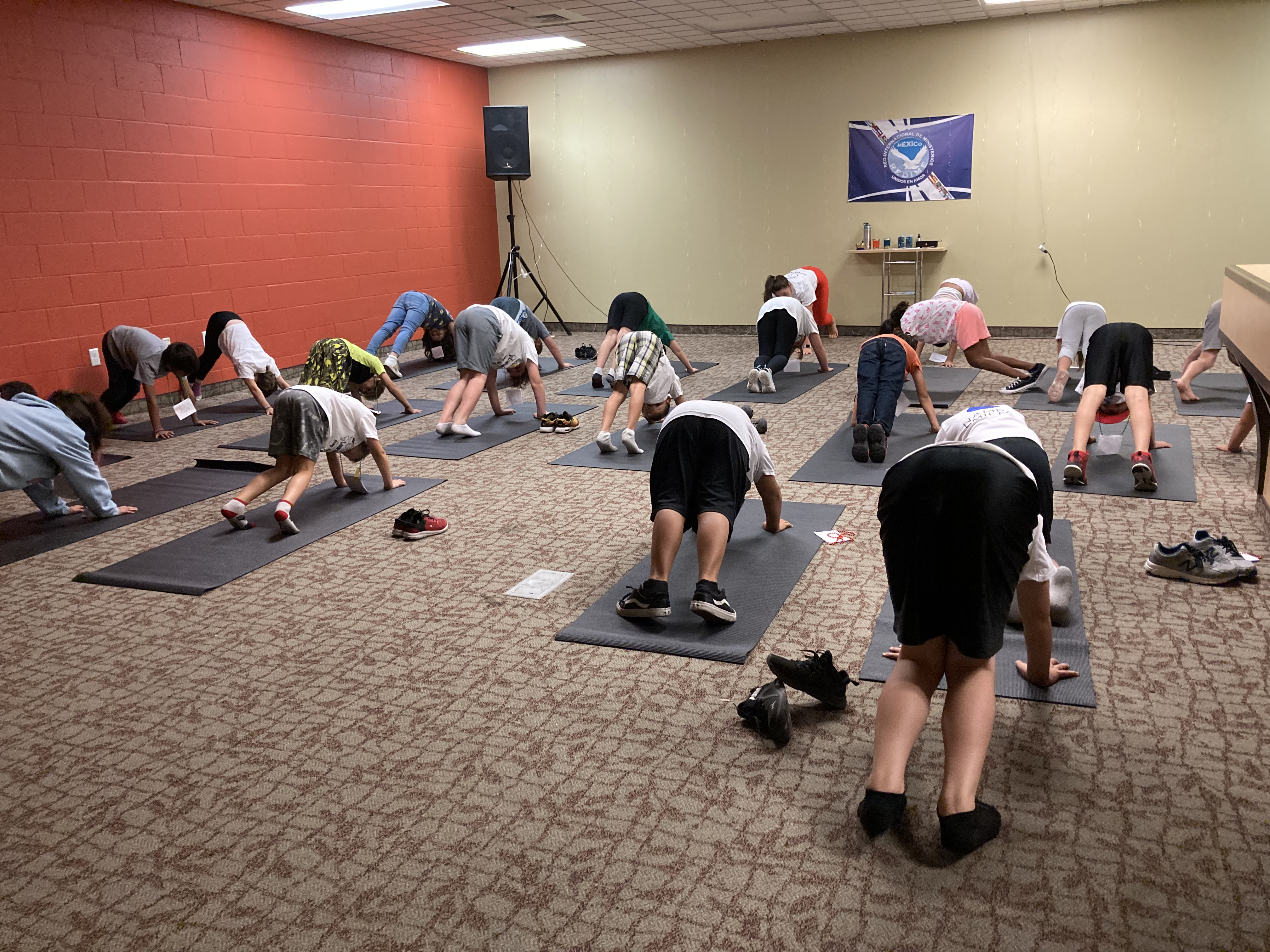
The week of July 19-22 was Learning Peace: A Camp for Kids at the Hispanic Cultural Center in Nampa. I had the honor of shepherding a group of nine-year-olds, mostly boys, for the four days. I love this role, shepherding, because it takes me back to being a camp counselor. There is nothing better than helping foster relationships and helping turn a group of individuals into a functioning group. A great deal of our bonding happened during lunch time when, after we were finished eating, every item on the table was examined for its worth in tower-building.
The other aspect of shepherding that I value so much is that I get to move through the curriculum alongside the youth. This year I was struck by how applicable every lesson was to adults. The eight and nine-year-olds started each morning in Mindfulness, which for the first two days was led by a great yoga instructor. I loved starting each day with deep-breathing and different poses, each reminding me that I am in fact an embodied human. “Why don’t I start everyday this way?” I asked myself. I am so much calmer and more centered. In Conflict Resolution, we spend the first day learning one another’s names. Again, I was reminded of how important names are and how when we learn just one little thing about someone, like the motion they chose for our name game, it changes the relationship. Individuals are humanized. Think of all the important naming that happens in scripture and the way Jesus really saw people, whether he was calling disciples or healing a stranger or offering forgiveness to the thief on the cross. Our Conflict Resolution teachers also had us play the old game of Telephone and we recalled how important good communication is to both avoid and resolve conflict. Our final class each morning was Connecting with Nature. Walks outside have been essential to my inner peace for a long time. For some of you readers an equivalent activity might be biking or gardening or camping. As we demonstrated with the help of a ball of yarn in a Connecting Nature class, we are all connected to the natural world, part of a great web. Being mindful of these connections grounds me to the natural world and to our Creator.
Peace Camp is not a utopia. There have always been challenges, struggles, conflicts, and bumps during those four days and this year was no different. I sometimes comment that the gift and beauty of the experience is that we adults, trying so hard to equip the youth to be peacemakers, are reminded each day that none of us have arrived. We are all still on the journey of learning to create peace, be peaceful, and model peacemaking. We all need practice. We are always living in the already but not yet, recipients already of the peace of Christ, but not yet living in a completely peaceful world. Thanks be to God for glimmers we get throughout of our lives of the Peaceable Kingdom.
Prayer: Gracious and holy God, lead us from death to life, from falsehood to truth. Lead us from despair to hope, from fear to trust. Lead us from hate to love, from war to peace. Let peace fill our hearts, our world, our universe; through Jesus Christ, our Savior and Lord. Amen. (ELW p. 76)
In the previous blog post, I shared research on the gifts of storytelling, mentioning the workshop held in my congregation. What follows is a detailed description of that workshop.
Scripture and Identity
On Saturday, February 15, 2020, I gathered with twelve members of my congregation at 9:00 a.m. for a continental breakfast and several icebreaker exercises. After the icebreakers, we went to the sanctuary for an Opening Prayer ritual. I read the story of Philip and the Ethiopian eunuch (Acts 8:26–40) and shared some thoughts about the power and possibilities of opening up Scripture together. I pointed to the fact that in this story from Acts, two people with different backgrounds engaged Scripture side by side and the Holy Spirit was clearly present. What exactly would happen in our time together, I could not be sure, but I expected the Spirit to be present.
Then I led the assembly in our tradition’s Affirmation of Baptism service. It was crucial to me to begin the day affirming our common baptismal identity. I was certainly going to facilitate the workshop and bring some of my own reflections, but each one of us belongs to the priesthood of all believers and is an interpreter of Scripture and of our own lives.
Intentionality
We returned to our meeting room, and I gave the group some background on what had led to our time together by summarizing my design proposal. Then we set about creating our communal covenant for the day.
I took time here to explain that we would not be solving problems that day but that if someone was triggered, we had a guest present to help. My colleague, an ELCA pastor and pastoral counselor, spent the entire day with us. She never stepped out with anyone, but it was very reassuring for me as the facilitator to know she was there if needed.
I had prepared the room with intentionality. Three rectangular tables formed a U shape. Four women in their 30s and 40s were in the middle, at the bottom of the U. To their right were four men in their 50s through 70s, and to their left were four women ages 50 and older. I sat at the open end of the U with a flip chart and a small table for books and notes.
I read the selected passages aloud and encouraged them to jot down notes about the communities Barnes and Wilkins were part of (family, work, the natural environment). They were also encouraged to listen for or imagine potential barriers to the authors’ becoming their full selves. They shared their notes and reflections with partners, two sets of partners at each of three tables, the same partners they kept for the entire day. After discussing the memoir passages, the pairs shared what the passages had evoked in them about their own self-perceptions. Put another way, I asked the participants to say in what ways the stories of Barnes and Wilkins were their stories too.
We transitioned from engaging the everyday story to engaging the Christian faith story in the Bible. The intent of phase 2 of Wimberly’s method is to link the everyday stories we have heard and our own reflections on the stories with Scripture (47-52). I introduced our biblical story for the workshop by explaining why I chose the book of Jonah, saying that it has many entry points and I had high confidence that we could engage it easily. I read aloud the version from the Spark Story Bible.
Then we focused on the Bible as a mirror, allowing the Jonah story to be a mirror of our lives. Prompts here for participants were:
Who are our family, church, and our community?
What in the Jonah story can assist us in our struggles?
What wisdom does the story provide for our lives?
What questions does the Jonah story raise about our identity?
Then each table group was given a chapter of the book of Jonah to act out. When we got to chapter 3, Jonah’s song from the belly of the fish, I read the entire chapter out loud. Next, we entered into a time of silent reflection in which we envisioned God affirming us, giving us a gift—identity, hope, comfort, a nudge.
We were then scheduled to engage Wimberly’s activity 5, “Anticipate Ongoing Response to God.” I had planned to put the participants back in their pairs for the discussion, but something unplanned happened through the acting out of the story. Our inhibitions were low, and our vulnerability was high. So, I adjusted our schedule and we talked as a large group. We talked about everything in the Jonah story that is still so easy to relate to today: Jonah’s reluctance, the group dynamics on the boat, Jonah’s transformation, Jonah’s prejudice against the Ninevites, repentance, Jonah and the bush. The conversation was dynamic and holy and made space for thoughtful reflection.
We reconvened after lunch and entered into Wimberly’s phase 3: Engage Christian Faith Stories from the American Christian Tradition (52-55). I handed out copies of Fred Rogers’s obituary and allowed participants several minutes to read it silently. We watched a video of the first five minutes of Rogers’s 2018 Commencement Address at Marquette University. In the address, Rogers talks about how we can all contribute something good to someone. I then asked the participants to turn to their partner and respond to questions like:
How is Fred’s wisdom useful in southwest Idaho today?
How does his life and message give us hope?
How does his life and message free us?
For a few people, this time of talking about Fred Rogers was the best part of the day. The pairs had fruitful discussions, and we transitioned easily into the final learning segment.
Wimberly’s phase 4 is Engage in Christian Ethical Decision Making (55-57). I asked participants to silently remember as much as they could about the Jonah story and Fred Rogers’s messages. They paired up again and shared pieces from the Jonah story or Rogers’s message that motivated them. I asked them to consider what had the potential to motivate them and Trinity Lutheran to address the negative within us and in our world.
Then I had people gather in groups of four. In these small groups, we decided on specific responses to God’s call to address something—negative self-identities we experience in ourselves or others, the marginalization of people, or any form of brokenness.
Trinity Lutheran, as a congregation, is already doing a variety of this kind of work, and so one of the unplanned but not unwelcome questions that was brought up when we came back together as a large group was, How do we talk about our congregation to other people? The suggestion I gave that was most well received was to start with personal experiences. When has the congregation been there for you, or what do you appreciate about the congregation?
You Are the Letters
We ended our day in the sanctuary with a brief closing prayer and time of sending. We used Responsive Prayer from Evangelical Lutheran Worship. The Scripture passage I read was 2 Corinthians 3:1–3, in which Paul tells the Corinthians that they are his letter of recommendation.
I have always been a proponent of letter writing and still have, in various shoeboxes, the letters my parents and I wrote to one another during my many months at summer camp and my first few years in college, before email replaced letters. With all of this as background, I love the metaphor of people being the letters.
I serve a congregation that puts more emphasis on our actions rather than our words, so to me this Scripture passage also seems to serve as a bridge to something more. Yes, our actions of growing food, providing housing, practicing hospitality, and loving our neighbors will always be paramount. But we also understand the power of language and are slowly growing our skills in telling our faith stories. Eventually, both our words and our actions will be the letters of recommendation for the congregation, the larger Christian church, and the triune God we worship.
Storytelling in Your Context
There are so many models for faith storytelling and every context has different opportunities and challenges. Most of us learned digital skills either before or during the early stages of the pandemic which open more possibilities. Be clear, as always, about your goal and do not be afraid to invite specific people to the workshop or series.
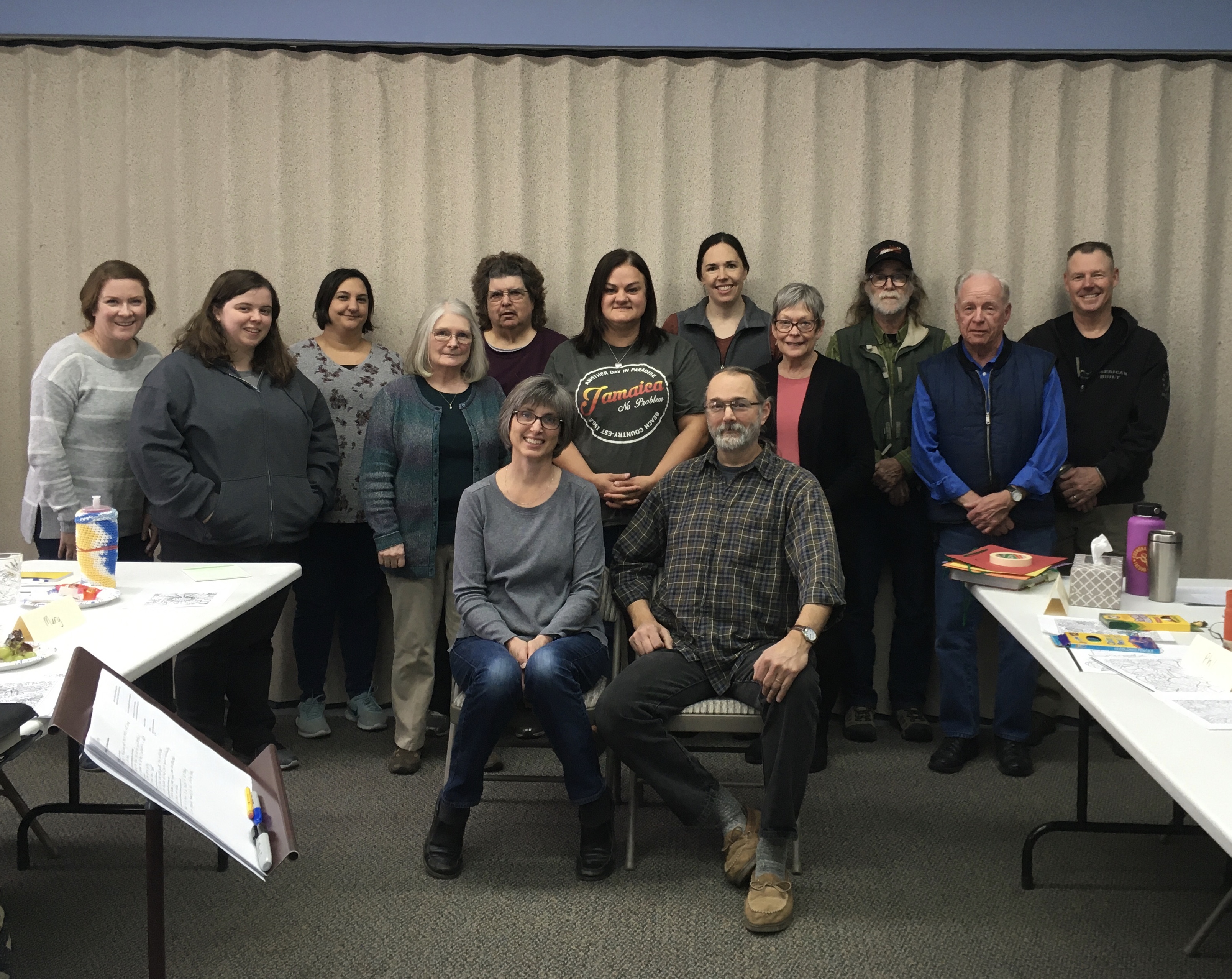
Storytelling Workshop Participants and Me – February 2020
In May 2020 I asked a parishioner to write for the new daily devotion blog created by our cluster of congregations. She passed that first time I asked her to write, but the second time I asked, she said she was ready. With each two- or three-week schedule, writers were offered the chance to pause until the next schedule was created. When I asked her in late August if she wanted to be on the next schedule, she texted back, “Yes, I can. It actually helps me.” By this time in our congregation’s journey with writing, witnessing, and storytelling, the healing power of it all did not surprise me, but healing was never my original goal.
Storytelling Culture
We began creating a storytelling culture at Trinity Lutheran in Nampa, Idaho several years ago. I was called to serve a community of faith already committed to the neighborhood. They had leased land for affordable housing and dug up the front yard for a community garden. Since I accepted the call in late 2010, we have taken the affordable housing on ourselves and partnered ecumenically to create Learning Peace: A Camp for Kids. In another context, I might be writing about vocation and discernment. Here, action was already happening, but we all needed to be better equipped to talk about our faith. Also part of our particular puzzle, we live in the Great Basin, where many other Christians and Mormons seem far more comfortable talking about their faith than we do.
For many years we have created our own Advent daily devotional, authored by Trinity’s members. Each year members have gone deeper with their storytelling. In 2019 I headed out on my sabbatical and travels included a trip to Limerick, Ireland, home to Narrative 4, a nonprofit which uses the story-exchange to foster empathy and peace. Two of the congregational renewal events during the sabbatical were storytelling events: a workshop with two pastors from the Midwest who had been trained through The Hearth out of Ashland, Oregon and a “Writing as a Spiritual Practice Workshop” led by a Boise writer and memoir instructor. These two events convinced me that people at Trinity Lutheran would give up a day for a faith formation event. In February 2020, I led twelve church members through a day-long storytelling workshop. (Read about the workshop in tomorrow’s blogpost).
The final storytelling venture I want to mention was a collaborative effort of the Treasure Valley Cluster of ten ELCA congregations near Boise. We met on Zoom March 16, 2020. We discussed how we might partner together during the pandemic and decided on three components: daily connection/devotion, online small groups, and Holy Week worship. A member of one congregation graciously volunteered her time to create tvprays.org. A retired pastor volunteered to coordinate the schedule of writers (pastors, deacons, youth minister) who would contribute to our daily devotion offering. In May we decided to invite lay members, including the Trinity member quoted above, from our congregations to contribute.
Meanwhile, my dissertation work on storytelling had led me to survey several other disciplines. What could they teach me about narrative and how could they help me to lead a group of people in faith storytelling?
Language
Underlying David White and Michael Epston’s groundbreaking work, their 1990 book Narrative Means to Therapeutic Ends, is the power of language (ix.). A second source for understanding language was Bessel van der Kolk’s The Body Keeps the Score: Brain, Mind, and Body in the Healing of Trauma. In his chapter on neuroscience, van der Kolk writes that one of the things the brain-disease model overlooks is that “language gives us the power to change ourselves and others by communicating our experiences, helping us to define what we know, and finding a common sense of meaning” (38).
To illustrate the power of language and the social science tool of text analogy, White cites the work of Edward Bruner with Native Americans. In the 1930s and 1940s, the dominant story about Native Americans “constructed the past as glorious and the future as assimilation” (10). The real consequences of this included the appropriation of territories. Then, in the 1950s a new story emerged that constructed the past as exploitation and the future as resurgence. “This new interpretation also had its real effects, including the development of a movement that confronted the dominant culture with the issue of land rights” (11). Clearly narrative has the power to be a tool for great change. Both Bruner and White admit that the text analogy and narrative also have limits because “a narrative can never encompass the full richness of our lived experience” (11).
However, the stories themselves and the telling of the stories are important. The text analogy “advances the idea that the stories or narratives that persons live through determine their interaction and organization, and that the evolution of lives and relationships occurs through the performance of such stories or narratives” (12).
Relationships
I know through experience that storytelling builds relationships. I have told stories in sermons, heard stories during pastoral care visits, and read the stories in Scripture in worship and at bedsides. Several authors I read used their own words to explain the connection between storytelling and relationships. Furthermore, their storytelling practices help foster relationships.
In her book Storytelling forSocial Justice: Connecting Narrative and the Arts in Antiracist Teaching, educator Lee Ann Bell puts words to what I have always valued about stories. She writes that “stories are one of the most powerful and personal ways that we learn about the world, passed down from generation to generation through the family and cultural groups to which we belong. As human beings we are primed to engage each other and the world through language and stories can be deeply evocative sources of knowledge and awareness” (11).
“Kitchen talk” is one of the helpful terms Bell uses. She distinguishes this “honest, straight up conversation that people have in the kitchen” from “sugar-coated living room conversation that is too polite to get to the heart of the matter” (21). In the setting of my congregation, the equivalent of that living room conversation is what I believe often happens during fellowship time. I of course do not believe that we all need to share our deepest fears and emotions during the time after worship, but sometimes I fear our conversations stay too shallow. We have, after all, just spent an hour together confessing our sins, receiving forgiveness, connecting mind and body through singing and praying together, and hearing again that we worship a God who loves us with abandon. It seems reasonable that after worship we would be moved to engage more in Bell’s kitchen talk rather than in living room talk.
In Digital Storytelling: Capturing Lives, Creating Community, Joe Lambert suggests that “we can take our deeply felt attraction to media, which has done so much to silence our own voices, and find our way back to the campfire. Through digital storytelling, we all can become storytellers again” (5). Lambert writes that story has many jobs. He focuses on its role “as the vehicle to encourage our social agency and finally, as a process by which we best make sense of our lives and our identity” (14). He adds, “What story cannot do is completely simplify the messiness of living. Story is essentially an exercise in controlled ambiguity. And given the co-constructed nature of meaning between us as storytellers, and those who are willing to listen to our words, this is story’s greatest gift” (14).
Healing and Writing Stories
David White explains that perceiving change in one’s life is crucial to experience one’s life progressing, and since “writing is ideally suited to provide for such recording, then it would appear that the written tradition is one important mechanism for the introduction of the linear conception of time, and thus for generation of meaning in our lives” (35).
Van der Kolk also affirms the writing process. He notes that when we talk with someone with whom we do not feel completely safe, “Our social editor jumps in full alert and our guard is up. Writing is different. If you ask your editor to leave you alone for a while, things will come out that you had no idea were there … You can connect those self-observing and narrative parts of your brain without worrying about the reception you’ll get” (240).
At least when dealing with traumatic memories, we might want to start by writing instead of talking. It is important to understand that the process of talking about distressing feelings can be hindered by trauma itself. Van der Kolk explains that brain scans of people with traumatic memories have revealed “how their dread persisted and could be triggered by multiple aspects of daily experience” (47). Writing to oneself might be a way to make meaning without being triggered.
Call to Action
How will you use storytelling in the next chapter of ministry? Healing, relationship building, evangelism? Remember that they are all connected.
Start by writing out a story from your own experience. There are some prompts in this blog post.
Gracious God, you have placed within the hearts of all your children a longing for your word and a hunger for your truth. Grant that we may know your Son to be the true bread of heaven and share this bread with all the world, through Jesus Christ, our Savior and Lord.Amen.
Psalm 14
1Fools say in their hearts, “There | is no God.” They are corrupt, every deed is vile; there is no one who does | any good. 2The Lord looks down from heaven up- | on us all, to see if there is anyone who is wise, who seeks | after God. 3They have all proved faithless; all alike | have turned bad; there is none who does good; | no, not one. 4Have they no knowledge, all those | evildoers who eat up my people like bread and do not call up- | on the Lord? R 5See how they trem- | ble with fear, because God is in the company | of the righteous. 6Your aim is to confound the plans of | the afflicted, but the Lord| is their refuge. 7Oh, that Israel’s deliverance would come | out of Zion! When the Lord restores the fortunes of the people, Jacob will rejoice and Israel | will be glad.
Ephesians 3:14-21
14For this reason I bow my knees before the Father, 15from whom every family in heaven and on earth takes its name. 16I pray that, according to the riches of his glory, he may grant that you may be strengthened in your inner being with power through his Spirit, 17and that Christ may dwell in your hearts through faith, as you are being rooted and grounded in love. 18I pray that you may have the power to comprehend, with all the saints, what is the breadth and length and height and depth, 19and to know the love of Christ that surpasses knowledge, so that you may be filled with all the fullness of God. 20Now to him who by the power at work within us is able to accomplish abundantly far more than all we can ask or imagine, 21to him be glory in the church and in Christ Jesus to all generations, forever and ever. Amen.
John 6:1-21
1Jesus went to the other side of the Sea of Galilee, also called the Sea of Tiberias. 2A large crowd kept following him, because they saw the signs that he was doing for the sick. 3Jesus went up the mountain and sat down there with his disciples. 4Now the Passover, the festival of the Jews, was near. 5When he looked up and saw a large crowd coming toward him, Jesus said to Philip, “Where are we to buy bread for these people to eat?” 6He said this to test him, for he himself knew what he was going to do. 7Philip answered him, “Six months’ wages would not buy enough bread for each of them to get a little.” 8One of his disciples, Andrew, Simon Peter’s brother, said to him, 9“There is a boy here who has five barley loaves and two fish. But what are they among so many people?” 10Jesus said, “Make the people sit down.” Now there was a great deal of grass in the place; so they sat down, about five thousand in all. 11Then Jesus took the loaves, and when he had given thanks, he distributed them to those who were seated; so also the fish, as much as they wanted. 12When they were satisfied, he told his disciples, “Gather up the fragments left over, so that nothing may be lost.” 13So they gathered them up, and from the fragments of the five barley loaves, left by those who had eaten, they filled twelve baskets. 14When the people saw the sign that he had done, they began to say, “This is indeed the prophet who is to come into the world.” 15When Jesus realized that they were about to come and take him by force to make him king, he withdrew again to the mountain by himself.
16When evening came, his disciples went down to the sea, 17got into a boat, and started across the sea to Capernaum. It was now dark, and Jesus had not yet come to them. 18The sea became rough because a strong wind was blowing. 19When they had rowed about three or four miles, they saw Jesus walking on the sea and coming near the boat, and they were terrified. 20But he said to them, “It is I; do not be afraid.” 21Then they wanted to take him into the boat, and immediately the boat reached the land toward which they were going.
Sermon – Pastor Meggan Manlove
The feeding of the multitude is such a gift of a scripture passage to preach on the Sunday after Peace Camp week. This is a community program Trinity has helped put on since I think 2017. Learning Peace: A Camp for Kids is a four-day camp, 9am-3pm, held at the Hispanic Cultural Center for youth ages 6-13. Morning classes this year centered on conflict resolution, mindfulness, and connecting with nature. In the afternoons we have special cultural interactive performances, play for peace games, and crafts. This year we had just under 60 kids each day.
It is week full of the abundance captured in today’s scripture passage. I always wonder if we will have enough—enough food, enough volunteers, enough activities, enough patience, enough compassion, enough determination, enough energy, enough time, enough empathy, enough organization. I never worry much because we have been through the event several times and the leadership team has built a lot of trust. Even this year, when our coordinator needed to step back for personal reasons, all the pieces got picked up. It is the week each year when I exercise plenty of human agency while simultaneously trusting the Holy Spirit to show up and provide.
Even though there were moments this year when I grumbled, I still felt some of the awe I assume the crowd experienced on the hillside in Galilee when the preacher, healer, miracle worker Jesus fed them all with a little bread and fish.
This telling of the story, told by the evangelist John, is especially powerful. This is the only miracle story told in all four gospels. That should be a clue to any reader of its importance. That Jesus has compassion, that God is a God of abundance, that caring for physical bodies is important are all part of this significant story and all tell us crucial things about God in Jesus Christ.
But just as important to the parts of the story found in all four gospels are the details that are only part of John’s telling. I have tended to not dwell on textual differences when preaching, thinking it distracts from the good news. But this morning is the exception because John’s unique details are so important to the life of faith, to discipleship today.
In John’s telling, and only in John’s telling, it is Jesus himself who distributes the food. He does not delegate or equip his disciples for the task. He gives the food away himself. Why is this significant? Because the Last Supper in John does not include an actual supper. It includes the all-important foot washing, which we remember and reenact each Maundy Thursday.
In John’s gospel, the feeding of the multitude is the Lord’s Supper moment. This is the moment when Jesus gives himself away. Jesus is intimate with the people. And he gives himself away, not in an upper room with his disciples, but in the everyday stuff of life. Remember that—he is with the crowd. He is in the midst of conversations, hunger, friendships, family drama, even the bugs and leaves and grass of the natural world.
And, in John’s telling Jesus does not use any kind of bread. He uses Barley Bread. This was the bread commonly available to the poor. One scholar wrote that it might also recall the Old Testament story of Ruth, who returns to Naomi during the barley harvest. In rabbinic interpretations, Boaz’s gift to Ruth anticipates the messianic banquet for the poor.
So, in those times when you have wondered if God is with you in the everyday, the times when we sense the Holy Spirit working but can hardly believe it, we can trust that God is in fact with us. That time this week when I was at first so tired and the next day so grateful for the kids and adults God had put in my life through Peace Camp, I thought about the story in John 6. Yes, this is our God’s M.O., God’s method of operation, to show up in the regular stuff. Furthermore, God will always care for the poor and ostracized. Ours is a God with Barley Bread.
And this brings me to what may be most wonderful and remarkable about this miracle story. One of my favorite theologians claims that “what is truly amazing is not that a seeming human could multiply loaves and fishes in so astounding a manner but that this human being could represent, but his words and deeds, such a sign of hope and healing that hundreds of needy people would follow him about and feel that their hunger for ‘the bread of life’ had been [satisfied].” Continuing to the next story, “What is truly awe-inspiring is not that someone could walk on the surface of the water without sinking, but that his presence among ordinary, insecure, and timid persons could calm their anxieties and cause them to walk where they feared to walk before.”
This is not to take away any of the awe and wonder from this most powerful and beautiful story. Nor is it meant to take away awe and wonder from the ways each of us has experienced the power of God through the Holy Spirit working through our lives. Whether we call them God-sightings, theophanies (a Greek term for the appearance of a deity), experiences of the divine, or Holy Spirit moments, I hope you are having them. God shows up in the ordinary all the time. We only have to have our senses alert, to practice each day being aware of God’s presence.
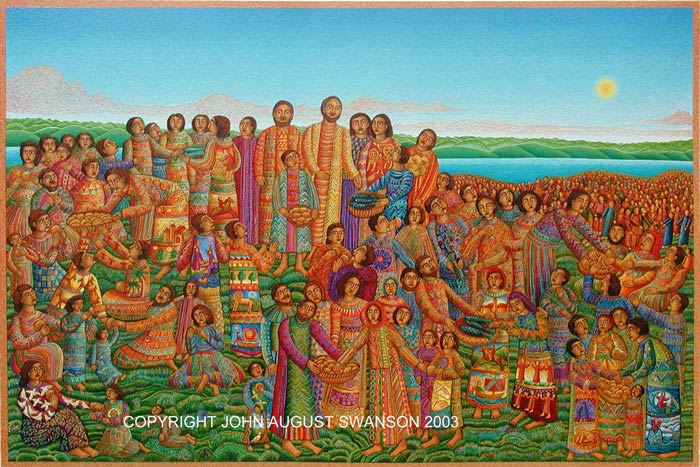
We might imagine that feeding of the multitude as this beautiful peaceful pastoral scene. And many artists have taken their turns portraying the event. But these were hungry people, probably oppressed by the Roman Empire, almost surely seeking hope. Then here comes this Jesus and he not only gives them actual barley bread. He gives them himself. He gives them, we might assume, a sense of belonging, identity as followers of him. He also gives them hope.
Healing, perhaps a more wholistic and this-world word for salvation, forgiveness and hope are the gifts received even today in the Lord’s Supper. It does not matter if you participate in the Lord’s Supper in the outdoor chapel at Luther Heights, in the living room of one of our homebound members, at your kitchen table during online worship, at the campfire during the church campout, or in this sanctuary. Jesus gives himself away once again, meeting you wherever you are, when the words are said, “broken for you” and “shed for you.” Healing and forgiveness are as real today as on that hillside thousands of years ago.
But again, the remarkable thing about this story is that Jesus’ takes the meal, what I clearly see as him instituting the Lord’s Supper, to the hillside, full of grass, caterpillars, physical and spiritual hunger, messy and thriving relationships. It is this event, this powerful story, that gives me permission to speak quite frankly about the holiness of so many of our other meals—soup suppers during Advent or Lent, potlucks, meal trains for people who or grieving or sick, the women’s luncheon, or family dinners in each of your homes. Yes, Jesus is there too, during the every-day. There, too, he is giving us hope and healing, filling us with the bread of life, himself.
Please do not ask me to explain in this sermon how the Holy Spirit does this work. The “how” is fun to talk about, but what is important is the “why.” Why did Jesus give himself away in barley bread? Why does Jesus give himself away in bread and wine at this table? Why does the Holy Spirit show up in all the ordinary meals and encounters of life? Because…God’s love is everlasting and as abundant as during that miracle of feeding the multitude. And God will use any and every opportunity to make sure we know we are beloved and are part of the kingdom of God.
Prayers of Intercession (from Sundays and Seasons)
Rooted in Christ and sustained by the Spirit, we offer our prayers for the church, the world, and all of creation.
A brief silence.We pray for the church. Bless the ministries of our neighboring congregations (especially). Empower churches throughout the world and encourage missionaries who accompany global neighbors. Kindle in us a spirit of collaboration, that all people may know your loving works. Hear us, O God.Your mercy is great.
We pray for creation. Send rain to lands experiencing drought and come to the aid of those enduring sweltering heat. Nurture wheat and barley crops grown for the nourishment of your people and conserve aquatic habitats and fish populations. Hear us, O God.Your mercy is great.
We pray for those who govern. Cast out arrogance, selfishness, and corruption and instruct those who lead to practice compassion and humility. Inspire them with a vision of the common good and a commitment to ensure that all who hunger are fed. Hear us, O God.Your mercy is great.
We pray for those bowed down by heavy burdens: those who are unemployed or underemployed, those unable to find affordable housing, and those without health insurance. Console those who grieve and hear the cries of those who call to you for healing (especially). Hear us, O God.Your mercy is great.
We pray for this assembly. Deepen our resolve to use what we have to serve those in need. When we worry that we do not have enough resources for ministry, assure us of your abundance. Hear us, O God.Your mercy is great.
Here other intercessions may be offered.We give thanks for those who have died. As you sustained them through all their days, so dwell in our hearts, that we may have the power to comprehend, with (the apostle James, name/s, and) all the saints, the love of Christ that surpasses knowledge. Hear us, O God.Your mercy is great.
We lift these and all our prayers to you, O God, confident in the promise of your saving love; through Jesus Christ our Lord.Amen.
God of the covenant, in our baptism you call us to proclaim the coming of your kingdom. Give us the courage you gave the apostles, that we may faithfully witness to your love and peace in every circumstance of life, in the name of Jesus Christ, our Savior and Lord.Amen.
2 Samuel 5:1-5, 9-10
1All the tribes of Israel came to David at Hebron, and said, “Look, we are your bone and flesh. 2For some time, while Saul was king over us, it was you who led out Israel and brought it in. The Lord said to you: It is you who shall be shepherd of my people Israel, you who shall be ruler over Israel.” 3So all the elders of Israel came to the king at Hebron; and King David made a covenant with them at Hebron before the Lord, and they anointed David king over Israel. 4David was thirty years old when he began to reign, and he reigned forty years. 5At Hebron he reigned over Judah seven years and six months; and at Jerusalem he reigned over all Israel and Judah thirty-three years. 9David occupied the stronghold, and named it the city of David. David built the city all around from the Millo inward. 10And David became greater and greater, for the Lord, the God of hosts, was with him.
The New Colussus by Emma Lazarus (the poem on the Statue of Liberty pedestal)
Not like the brazen giant of Greek fame,
With conquering limbs astride from land to land;
Here at our sea-washed, sunset gates shall stand
A mighty woman with a torch, whose flame
Is the imprisoned lightning, and her name
Mother of Exiles. From her beacon-hand
Glows world-wide welcome; her mild eyes command
The air-bridged harbor that twin cities frame.
“Keep, ancient lands, your storied pomp!” cries she
With silent lips. “Give me your tired, your poor,
Your huddled masses yearning to breathe free,
The wretched refuse of your teeming shore.
Send these, the homeless, tempest-tost to me,
I lift my lamp beside the golden door!”
2 Corinthians 12:2-10
2I know a person in Christ who fourteen years ago was caught up to the third heaven—whether in the body or out of the body I do not know; God knows. 3And I know that such a person—whether in the body or out of the body I do not know; God knows—4was caught up into Paradise and heard things that are not to be told, that no mortal is permitted to repeat. 5On behalf of such a one I will boast, but on my own behalf I will not boast, except of my weaknesses. 6But if I wish to boast, I will not be a fool, for I will be speaking the truth. But I refrain from it, so that no one may think better of me than what is seen in me or heard from me, 7even considering the exceptional character of the revelations. Therefore, to keep me from being too elated, a thorn was given me in the flesh, a messenger of Satan to torment me, to keep me from being too elated. 8Three times I appealed to the Lord about this, that it would leave me, 9but he said to me, “My grace is sufficient for you, for power is made perfect in weakness.” So, I will boast all the more gladly of my weaknesses, so that the power of Christ may dwell in me. 10Therefore I am content with weaknesses, insults, hardships, persecutions, and calamities for the sake of Christ; for whenever I am weak, then I am strong.
Mark 6:1-13
1[Jesus] came to his hometown, and his disciples followed him.2On the sabbath he began to teach in the synagogue, and many who heard him were astounded. They said, “Where did this man get all this? What is this wisdom that has been given to him? What deeds of power are being done by his hands! 3Is not this the carpenter, the son of Mary and brother of James and Joses and Judas and Simon, and are not his sisters here with us?” And they took offense at him. 4Then Jesus said to them, “Prophets are not without honor, except in their hometown, and among their own kin, and in their own house.” 5And he could do no deed of power there, except that he laid his hands on a few sick people and cured them. 6And he was amazed at their unbelief. Then he went about among the villages teaching. 7He called the twelve and began to send them out two by two, and gave them authority over the unclean spirits. 8He ordered them to take nothing for their journey except a staff; no bread, no bag, no money in their belts; 9but to wear sandals and not to put on two tunics. 10He said to them, “Wherever you enter a house, stay there until you leave the place. 11If any place will not welcome you and they refuse to hear you, as you leave, shake off the dust that is on your feet as a testimony against them.” 12So they went out and proclaimed that all should repent. 13They cast out many demons, and anointed with oil many who were sick and cured them.
Sermon – Pastor Meggan Manlove
What does it mean to be embodied? How do we get grounded? What does it mean to be from a place and space or to journey physically? These are just some of the questions I have had as I thought about physical dislocation, the last kind of dislocation described in Diana Butler Bass’ article , “Religion after Pandemic”.
Bass proposes that we are experiencing four different kinds of dislocation: temporal, historical, relational, and physical. She suggests that communities like ours need to be about the work of relocation. This includes finding what has been lost, repairing what has been broken, and re-grounding people into their own lives and communities.
As I said, this week we are focusing specifically on physical dislocation. Bass writes, “We’ve lost our sense of embodiment with others and geographical location. For millions, technology has moved ‘physicality’ into cyber-space and most of us have no idea what to do with this virtual sense of location. Without our familiar sense of being bodily in specific spaces, things like gardening, baking, sewing, and painting have emerged as ways of feeling the ground and the work of our hands. We’ve striven to maintain some sort of embodiment even amid isolation. But the disconnection between our bodies, places, and other bodies have been profound. That’s physical dislocation.”
Jesus has his own dislocation experience in our story from Mark this week when he returns to his hometown. The truth is that he does not seem too bothered by the entire affair and is as grounded as ever. It is the people in his hometown who are more dislocated. They recognize the hometown boy, “the carpenter, the son of Mary.” With those two phrases they recall with clear shame that there was no birth father involved. They are suspicious. Will they welcome Jesus’ physical self back to his hometown?
Jesus knows that his vocation will be rejected in his native region, by his relatives, and finally in his own household. He must concede that he is a prophet without honor, stripped of status and robbed of clan identity. He is disowned. He withdraws and takes up again his mission to the village circuit.
Jesus sums up the general mood: “Prophets are not without honor, except in their hometown, and among their own kin, and in their own house.” The more familiar something is, the harder it is to believe it to be holy.
We know something about this in our own time and place. Most of us have grown up with the sacraments, with the word of God read and preached, with the liturgy. We have seen countless baptisms, confessed our faith through the creeds countless times, and heard hundreds of absolutions. We take our place easily at the Lord’s Table.
During the first part of the pandemic, so much of embodied worship had to change. Good things came out of that experience, in my estimation. Chief among them was that people created, sometimes for the first time, sacred spaces in their homes. This was biblical—just look at Jesus using the very ordinary to create the means of grace, what we now call Sacraments. That faith would be practiced and taught in the home is also in line with what Reformer Martin Luther tried to do with the Small Catechism—giving parents a tool to teach the faith in every household.
And yet, people have always made pilgrimage to holy places. People have built temples, altars, synagogues, churches, temples, mosques. And those places, whether a special rock outcropping or a valley or a structure built with human hands became holy. In our tradition, physical spaces like sanctuaries can help people feel closer to God, especially because of the memories and relationships and moments of immanence and transcendence. Can we make idols of church buildings? Yes, and that is surely something to be wary of. Maybe the pandemic helped us find an equilibrium—not idolizing the things or place of worship, but we no longer take for granted this and other sacred spaces and faith practices, particularly when we practice together for the sake of our neighbor and our broken world.
Back to the story in Mark’s gospel, Jesus summons his community. Originally the community of the twelve disciples was created for two reasons: to accompany Jesus and to be sent out to preach and cast out demons. This is a simple start, just the beginning. Later, this community will reckon with a second call—to a discipleship of the cross. In such discipleship they will experience the clash between the kingdom of God and powers of the world.
We, listening in 2000 years later, are struck most by the utter dependence of the disciples upon their hospitality. They are allowed the means of travel (staff and sandals). They, like Jesus, who has just been renounced in his own “home,” are to take on the status of a sojourner in the land. The focus of the hospitality is the household. The apostles are told to “remain there until you leave that district.”
Jesus reckons with the inevitable prospect that certain places will refuse to “receive or hear” the apostles. The symbolic gesture of shaking dust from the feet implies “a witness against” these places. The vocation of hospitality is taken with deadly earnest. Households that refuse it are thereafter shunned.
I love one scholar’s suggestion about the contrast here—the similarities and differences between the marching orders for Jesus’ nonviolent campaign and the traditional strategies of other subversive movements. Like modern guerillas, for example, Jesus’ disciples are subject to the social and political perceptions of the local population. These perceptions will determine whether or not they will be “received”—always a good test of one’s “Popular base.”
Unlike normal guerillas, however, who must “eat and run,” Jesus’ followers make no effort to be covert. Where they are offered accommodation, they stay and establish a profile. And whereas a military-based movement will usually seize by force what is needed, at least in situations of acute need, Jesus forbids retaliation in the event of rejection. This makes the missionaries completely vulnerable to, and dependent upon, the hospitality extended to them. It prevents them from being able to impose their views by force.
As our physical bodies relocate this physical sanctuary, I confess having more questions than answers. What is essential to our embodied gatherings? Besides bread and wine? What is equivalent to the staff and sandals? What are the necessary tools for us to praise God, to pray, to listen, to hear the promises of God’s love and mercy? I admit being quite grateful for our sanctuary’s simplicity.
Another question, in light of Jesus’ sending out the disciples, is how do we balance rest and comfort with the call of discipleship? We know that many of us are more than tired. The word buzzing around on social media is “languishing.” I know that what many of us want, including myself, when we come to this space is comfort and peace. At the same time, we know that the call to discipleship is a call outward. In other words, while we physically relocate ourselves in this space what physical symbols are needed to remind us that this is primarily a place to be sent forth from? How do we find rest and restoration in God and in the life of intentional Christian community while being mindful of the call to love our neighbor when we leave this physical space.
The story of Jesus and his early followers, including the story today, is ultimately one of people on the move, sent forth, meeting people where they are. The breaking in of the reign of God is also about physical bodies—God embodied in Jesus but then this Jesus healing and restoring and welcoming back to community physical bodies that have been cast out or marginalized.
We are more like Jesus’ community than we think. We can sound like those people in Jesus’ hometown. But the story never ends in those broken places. God keeps calling people to embody God’s word. God chooses to touch and heal us through the ordinary physical stuff like water, bread, and wine. As we go to proclaim the good news and care for the marginalized and sick, we go with this authority. It does not look like much, but in the kingdom of God, looks can be deceiving.
Prayers of Intercession
Let us come before the triune God in prayer.
A brief silence.God of all, through the waters of baptism you claim people of all races, ethnicities, and languages as your beloved children. Sustain the baptized and increase their faith, that your gospel may be proclaimed throughout the earth. Lord, in your mercy,hear our prayer.
God of the heavens, your creating Spirit animates the universe. We give you thanks for the moon and stars, for the planets and the Milky Way Galaxy, and for all of the mysteries of the cosmos that remain unknown to us. Lord, in your mercy,hear our prayer.
God of freedom, you have liberated us from sin and death and rescue us from all forms of spiritual, social, and political oppression. Defend us from tyrants in our midst and deliver us from all forms of slavery or corruption. Direct our freedom for works of liberation and wholeness. Lord, in your mercy,hear our prayer.
God of compassion, you became vulnerable in the person of Jesus Christ in solidarity with the disempowered. Strengthen those who feel faint, give courage to those who fear, and bring wholeness to those in need (especially). Lord, in your mercy,hear our prayer.
God of holiness, you send us out into the world to proclaim your love. We pray for our outreach ministries (local ministries may be named). Equip us as we leave this place to witness and serve our neighbors. Lord, in your mercy,hear our prayer.
Here other intercessions may be offered.We give you thanks that in every time and place you call forth prophets who move us towards freedom. Thank you for those who work for human rights, community organizers, and all who strive for liberty for all. Lord, in your mercy,hear our prayer.
We lift our prayers to you, O God, trusting in your abiding grace.Amen.
I first met Nampa resident Kim Kellar my first spring here when a local LDS stake hosted a midweek Lenten soup supper and worship. Journeying with Mormons through Lent was as weird as it sounds but the conversation with Kim was great, the first of many. We later became friends through the Nampa Ministerial Association, now the Nampa Interfaith Council. He become a big supporter (emotionally and financially) of Learning Peace: A Camp for Kids. It was fun to sit down with him for this interview. Fun Fact: I was the second non-LDS person to be on the podcast.
Almighty and merciful God, we implore you to hear the prayers of your people. Be our strong defense against all harm and danger, that we may live and grow in faith and hope, through Jesus Christ, our Savior and Lord.Amen.
2 Samuel 1:1, 17-27
1After the death of Saul, when David had returned from defeating the Amalekites, David remained two days in Ziklag. 17David intoned this lamentation over Saul and his son Jonathan. 18(He ordered that The Song of the Bow be taught to the people of Judah; it is written in the Book of Jashar.) He said: 19Your glory, O Israel, lies slain upon your high places! How the mighty have fallen! 20Tell it not in Gath, proclaim it not in the streets of Ashkelon; or the daughters of the Philistines will rejoice, the daughters of the uncircumcised will exult.
21You mountains of Gilboa, let there be no dew or rain upon you, nor bounteous fields! For there the shield of the mighty was defiled, the shield of Saul, anointed with oil no more.
22From the blood of the slain, from the fat of the mighty, the bow of Jonathan did not turn back, nor the sword of Saul return empty.
23Saul and Jonathan, beloved and lovely! In life and in death they were not divided; they were swifter than eagles, they were stronger than lions.
24O daughters of Israel, weep over Saul, who clothed you with crimson, in luxury, who put ornaments of gold on your apparel.
25How the mighty have fallen in the midst of the battle!
Jonathan lies slain upon your high places. 26I am distressed for you, my brother Jonathan; greatly beloved were you to me; your love to me was wonderful, passing the love of women.
27How the mighty have fallen, and the weapons of war perished!
Psalm 130
1Out | of the depths I cry to | you, O Lord; 2O Lord, | hear my voice! Let your ears be attentive to the voice of my | supplication. 3If you were to keep watch | over sins, O Lord, | who could stand? 4Yet with you | is forgiveness, in order that you | may be feared. 5I wait for you, O Lord; | my soul waits; in your word | is my hope. 6My soul waits for the Lord more than those who keep watch | for the morning, more than those who keep watch | for the morning. 7O Israel, wait for the Lord, for with the Lord there is | steadfast love; with the Lord there is plen- | teous redemption. 8For the Lord shall | redeem Israel from | all their sins.
2 Corinthians 8:7-15
7Now as you excel in everything—in faith, in speech, in knowledge, in utmost eagerness, and in our love for you—so we want you to excel also in this generous undertaking. 8I do not say this as a command, but I am testing the genuineness of your love against the earnestness of others. 9For you know the generous act of our Lord Jesus Christ, that though he was rich, yet for your sakes he became poor, so that by his poverty you might become rich. 10And in this matter I am giving my advice: it is appropriate for you who began last year not only to do something but even to desire to do something—11now finish doing it, so that your eagerness may be matched by completing it according to your means. 12For if the eagerness is there, the gift is acceptable according to what one has—not according to what one does not have. 13I do not mean that there should be relief for others and pressure on you, but it is a question of a fair balance between 14your present abundance and their need, so that their abundance may be for your need, in order that there may be a fair balance. 15As it is written, “The one who had much did not have too much, and the one who had little did not have too little.”
Mark 5:21-43
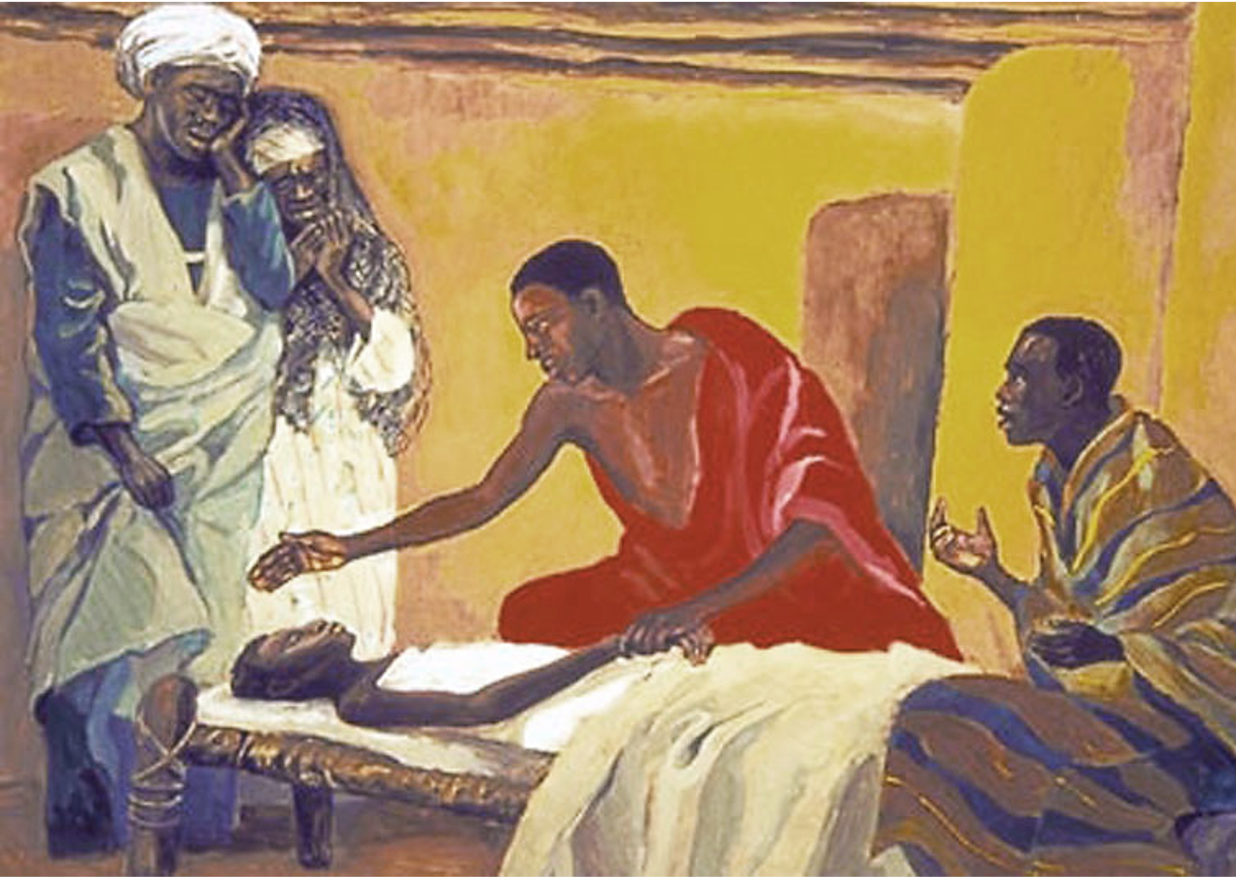
21When Jesus had crossed again in the boat to the other side, a great crowd gathered around him; and he was by the sea. 22Then one of the leaders of the synagogue named Jairus came and, when he saw him, fell at his feet 23and begged him repeatedly, “My little daughter is at the point of death. Come and lay your hands on her, so that she may be made well, and live.” 24So he went with him. And a large crowd followed him and pressed in on him. 25Now there was a woman who had been suffering from hemorrhages for twelve years. 26She had endured much under many physicians, and had spent all that she had; and she was no better, but rather grew worse. 27She had heard about Jesus, and came up behind him in the crowd and touched his cloak, 28for she said, “If I but touch his clothes, I will be made well.” 29Immediately her hemorrhage stopped; and she felt in her body that she was healed of her disease. 30Immediately aware that power had gone forth from him, Jesus turned about in the crowd and said, “Who touched my clothes?” 31And his disciples said to him, “You see the crowd pressing in on you; how can you say, ‘Who touched me?’ ” 32He looked all around to see who had done it. 33But the woman, knowing what had happened to her, came in fear and trembling, fell down before him, and told him the whole truth. 34He said to her, “Daughter, your faith has made you well; go in peace, and be healed of your disease.” 35While he was still speaking, some people came from the leader’s house to say, “Your daughter is dead. Why trouble the teacher any further?” 36But overhearing what they said, Jesus said to the leader of the synagogue, “Do not fear, only believe.” 37He allowed no one to follow him except Peter, James, and John, the brother of James. 38When they came to the house of the leader of the synagogue, he saw a commotion, people weeping and wailing loudly. 39When he had entered, he said to them, “Why do you make a commotion and weep? The child is not dead but sleeping.” 40And they laughed at him. Then he put them all outside, and took the child’s father and mother and those who were with him, and went in where the child was. 41He took her by the hand and said to her, “Talitha cum,” which means, “Little girl, get up!” 42And immediately the girl got up and began to walk about (she was twelve years of age). At this they were overcome with amazement. 43He strictly ordered them that no one should know this, and told them to give her something to eat.
Healing of the Daughter of Jairus – Jesus Mafa
Sermon – Pr Meggan Manlove
This week we return to the themes of dislocation and relocation. In her article, “Religion after Pandemic” Diana Butler Bass proposes that we are experiencing four different kinds of dislocation: temporal, historical, physical, and relational. She suggests that religious communities need to be about the work of relocation. What does she mean? Finding what has been lost, repairing what has been broken, and re-grounding people into their own lives and communities.
This week we are focusing specifically on relational dislocation. What amazing scripture passages we have: Jesus in a crowd of people but also curing and healing people through human touch, David lamenting the loss of relationship after the deaths of Saul and Jonathan, and the church at Corinth hearing that they are not alone but in relationship with many other Christian communities.
For the sake of focus, I am not going to preach on the story in Mark, but I do commend the other texts to you today, especially David’s lament and Psalm 130. If we ever needed permission from scripture to cry out to God for the deaths of loved ones, for broken relationships, for a year with limited relationships because of the pandemic, these texts give that permission for lament.
Before diving into the gospel, let’s look at what Diana Butler Bass means precisely when referring to relational dislocation. She proposes, “We’ve lost our daily habits of interactions with other humans, the expression of emotions together in community. Have you worried you won’t know how to respond when you can be with your friends without distance, with no masks? How it will feel to be in large groups again? How will work or school feel back in person, with others at the next desk or waiting on customers face-to-face, or in the first in-person meeting? What happens when plexiglass comes down, the mask is off? That’s relational dislocation.”
I will admit that I thought I had a pretty good handle on relational dislocation, until Tuesday evening. Some friends and I went to an open house in Boise for a new nonprofit organization we all support. The venue was The Bishops’ House, now near the old penitentiary. It’s a big old house with a large wrap around porch.
Two experiences stood out. Inside the house the conversation was lively, so lively that we had to stand close to one another to hear. You know that buzz in a loud, indoor, crowded setting? I could not remember the last time I had experienced it and finally I had to excuse myself and go out onto the porch. That’s where I ran into my second experience.
I ended up in a fun conversation with people from two other nonprofits I like: the literary organization The Cabin and the Idaho Community Foundation. Suddenly I was not just citizen Meggan, also child of God, I was Pastor Meggan who serves the church with the affordable housing and the garden. Did I have a business card? I could not just put my contact information in the chat. I suddenly realized how out of practice I am networking.
It was an energizing evening but when the three of us got in the car to drive back to Nampa we confessed being exhausted. That was the evening of the big windstorm, which seemed to represent what was going on in my insides after such a social few hours. And it’s not that I will now avoid such events; I simply need a bit of practice. Many of us are relationally dislocated. Some practice and intentional reflection will help us get relational relocated.
Our stories today from Mark’s gospel are all about relationships. We might say that these two incidents together help us understand each of them. They both involve women in crisis—in fact we do not know them by their names but by their needs. They were not outsiders to begin with but both are now subject to the taboos around the mysterious power of life (blood) and the even more mysterious (and seemingly unconquerable) power of death. Neither the bleeding woman nor the dead girl should be touched, at the risk of conveying their uncleanness to others.
I think a good word to describe the woman is “tired.” A flow of blood for twelve years would exhaust a person, as if her life force were draining away. On top of that would be the discomfort and, worst of all, the feeling of isolation, or relational dislocation, that comes with uncleanness and the taboos around it. And yet Jesus ignores the taboo for the sake of relationship.
He doesn’t permit this touch to stay anonymous, a passive healing on his part. He lets himself be sidetracked from hurrying to Jairus’ home long enough to find the person who has reached out to him with a touch that is more specific, more intentional, than merely jostling him in the crowd. Perhaps the crowd wanted to get near a celebrity, but this woman was reaching for her life. Jesus felt both her weariness and her deep hope. How could he simply walk away?
The other nameless and needy woman is barely a woman, just twelve years old and ready to begin her adult life. However, an unknown illness has struck her down, driving her father to extremes in his desperate search for help. He was a leader, a religious leader in the synagogue, and yet this precious child’s illness has reduced him, weakened him, lowered him to the ground in front of a traveling folk healer in a last-ditch effort to prevent the worst from happening.
It seems that desperation, drives Jairus, the synagogue leader to Jesus. Jairus’ moment of faith comes a little while later, when the news arrives of his daughter’s death. Jesus then preaches briefly: “Do not fear,” he says to the grief-besotted man, “only believe.” Fear not; only believe. Jesus’ sermon was for all of us who suffer from the human condition.
Into the midst of this comes the silent woman with the hemorrhage, without the boldness of the leader, simply hoping for one healing touch. And for Jesus, the most important thing in that moment is to face the person who has touched him, to encounter her has human being and not just as an anonymous touch. Another translation might read: “Daughter, you took a risk of faith, and now you’re healed and whole. Live well, live blessed! Be healed of your plague.”
During the delay, the synagogue leader gets the bad news that his daughter is already dead, and Jesus is no longer needed. “Don’t bother,” the messengers say, “it’s too late.” Jesus speaks quietly, personally to Jairus right then, reassuring him: “Don’t listen to them; just trust me.” When they arrive at Jairus’ home they make their way through the hired mourners. Jesus addressed them as he did the frightened, faithless disciples back in the boat, during the storm. Where is their trust?
It must have been a tender scene, in the quiet that surrounds the sorrow for a dead child, yet Jesus is once again calm and confident. He reaches down to invite the little girl to rise up and live. And the little girl gets up immediately and walks around to the amazement of all. Jesus has to be the one to remember that she might be hungry after her ordeal and tells them to feed her. He doesn’t miss the most ordinary and compassionate details.
Why does Jesus perform such miracles? The purpose is to establish Jesus’ identity: They are not stories about how to get God to do what we want, which is just another way of trying to stay in control. Instead, they are stories about who God is and how God acts, and what God is like. This is no ordinary man. This man is the son of God. Trust him. Holding on to that knowledge would sustain the early Christian community and the church today, all of us, and give us strength to meet the days to come and not lose heart.
Frederick Buchner puts us in the place of the little girl, with Jesus speaks to us, taking our hand and telling us to rise up and live: “You who believe, and you who sometimes believe and sometimes don’t believe much of anything, and you who would give almost anything to believe if only you could…’Get up,’ he says, all of you—all of you.” Jesus gives life not only to the dead, but to those of us who are “only partly alive…who much of the time live with our lives closed to the wild beauty and the miracles of things, including the wild beauty and miracle of every day we live and even of ourselves.”
Partly alive seems like an odd descriptor for life now, and yet it resonates. There are parts of me that have been dormant, out of practice, seemingly asleep. Those parts include the one accustomed to lots of hugs with friends and parishioners, the part that finds a connection point with most people I meet, the part who can handle a noisy crowd, the part who listens as someone bears their soul, and yes, the part that carries around business cards.
Reflecting on her first airplane trip since the pandemic, pastor and writer Nadia Bolz-Weber wrote, “We just haven’t had much practice yet being the us we are after having stayed home for a year. So I want to join my voice with others who are saying: gentle. Let’s be gentle with ourselves right now. But let’s also be brave….
I almost cancelled my trip, but I’m so glad I didn’t. The thing about not having much practice yet being the me I am now, is that I didn’t realize how amazing it would be to feel so open-hearted. My “bodyguard” wasn’t needed. I had lovely conversations with people I didn’t know, and enjoyed just walking around feeling grateful to be there. But I did need a lot of breaks. More time alone in a quiet room than I needed before. And that’s ok.
Nadia is right. We can be both gentle and brave as we live into relationships, old and new, today. Jesus bids, “Get up.” And at the altar he gives us something to eat, something extraordinary—his own body and blood, simply bread and wine, mercy and new life.
Prayers of Intercession (Sundays and Seasons)
Let us come before the triune God in prayer.
God of hope, the ministry of your church extends across borders, from nearby neighbors to far and distant countries. Accompany all those who labor eagerly in service of the gospel, that through your good news all might experience transformation. Lord, in your mercy,hear our prayer.
Almighty God, we give you thanks for the air we breathe, the water we drink, the land that provides our food. Guard all species of plants and animals from harsh changes in climate and empower us to protect all you have made. Lord, in your mercy,hear our prayer.
Righteous God, we pray for nations and their leaders. Give them a spirit of compassion and steer them towards a fair distribution of resources; that none among us would have too much or too little. Lord, in your mercy,hear our prayer.
God of healing, your touch has the power to make us whole. We pray for those suffering from physical or mental illness. Embrace those who are sick (especially). Surround them with your unwavering presence. Lord, in your mercy,hear our prayer.
We pray for this assembly and all those gathered together in worship. Revive our spirits, renew our relationships, and rekindle our faith, that we might experience resurrection in this community. Lord, in your mercy,hear our prayer.
Here other intercessions may be offered.We give thanks for the faithful ancestors in every age whose lives have pointed us towards you (especially). Envelop them in your love, that (with Cyril, Bishop of Alexandria, and all your saints) we may be reunited with one another in the last days. Lord, in your mercy,hear our prayer.
We lift our prayers to you, O God, trusting in your abiding grace.Amen.
A few years ago, an unexpected visitor walked into the Trinity New Hope (TNH) property manager’s office at the end of the day. A very shy and frail woman was carrying her oxygen bag. This woman shared things that had been weighing her down for many years, things that happened when she was barely an adult. The property manager assured her that she saw value in the person sitting in front of her, that the events from so long ago should not diminish the woman’s belief that she is deserving of a good home. Since the day the woman and her grandson qualified for housing at TNH, she has thrived. She helped her daughter, the mother of the grandson, leave a bad relationship and she completed the long process of officially adopting her grandson. Recently, she celebrated 15 years at her place of employment. This is the kind of story our board has heard regularly since Trinity Lutheran Church entered the world of affordable housing.
How Does a Church Get Involved with Affordable Housing?
The Trinity New Hope affordable housing story may be a bit unusual. In the 1990s the Sisters of Mercy wanted to create several affordable housing neighborhoods in Nampa. Meanwhile, Trinity Lutheran Church had been discerning what to do with excess land. A great partnership was born, but the project included struggles. Nampa’s Planning and Zoning Commission did not approve the original duplexes and insisted on single family homes. A neighborhood association formed to protest the development. But the congregation and Sisters prevailed. The church entered a fifty-year ground lease agreement with Mercy Housing and New Hope (16 three-bedroom, two-bathroom homes) was built. This was all in partnership with Idaho Housing and Finance Association (IHFA).
I began serving as pastor of Trinity Lutheran in the fall of 2010. During one Sunday worship service in the early months of 2013, four big sections of the fence separating the parking lot and the New Hope backyards fell down. Mercy’s management company tore down the rest of the fence and in the spring announced that they would not rebuild any of it. That was the start of something new in more ways than we could have imagined.
In 2014, a Mercy Housing staffer called to say Mercy had decided to leave Nampa and focus on other areas in the West. With financing from IHFA, Trinity Lutheran Church bought the houses from Mercy and created a separate nonprofit organization, Trinity New Hope. Most, though not all, board members are also members of the congregation. Our property manager’s office is in the church building. Our HUD designation is Section-42 housing.
A Multitude of Other Models
A different housing model was begun by another church across town. Grace Episcopal Church recognized a need for housing single moms pursuing some form of education. When the house next door to the church hall was put up for sale, the priest found a donor to purchase the house. The church created a nonprofit, The House Next Door. They can provide rent-free housing for up to four moms and their kids. Residents have pursued their GEDs, associate degrees, college degrees, and even a law degree. The moms practice communal living and support one another in their parenting and academic pursuits.
Collister United Methodist Church in neighboring Boise recently partnered with local nonprofit Leap Housing Solutions. Similar to what Trinity did in the 1990s, Collister has entered a long-term lease agreement with Leap. They hope to break ground this spring on two units (three-bedroom homes) on the church property.
First Baptist Church in Clarendon, Virginia worked with Arlington County to help finance a 10-story structure over its existing sanctuary. The end result is 70 units of dedicated affordable housing, which is 60 percent of the building’s 116 units. The project was not without controversy, but it also inspired other churches in the region to consider affordable housing models.
Gethsemane Lutheran Church in downtown Seattle also built up, adding a seven-story building stacked on top of two floors of church facilities. The 50 apartments in Compass Dekko Place serve individuals and families earning between 30 to 60 percent of the Area Median Income.
Spokane Urban Ministries (SUM) formed as a response to the growing need for affordable housing in the Spokane area, and reflects the combined effort between four ELCA congregations: Grace, St. Paul’s, Emmanuel, and Salem. Each church gave either a sizable financial gift or land to the project: 47 affordable apartments in West Central Spokane. In the following years, Grace closed, and St. Paul and Emmanuel merged to become All Saints Lutheran. All Saints and Salem remain active participants in the ministry of affordable housing through SUM and involve ecumenical partners in the work as well.
In Orange County, CA, Garden Grove United Methodist Church campus on Main Street built Wesley Village on unused land. This 47-unit affordable housing complex is a multi-generational affordable housing community that includes senior housing and adult day care, a Head Start center, and health services, all part of a partnership with the nonprofit community organization Jamboree Housing Corp.
Components of Good Designs
I made several assumptions while writing this piece, chief among them that readers are already aware of the housing crisis impacting many communities right now. Nonprofits addressing this issue can point you to the statistical data you might need to make your case. They can also help you both understand and explain the variety of barriers to housing faced by so many people. To this information, along with the variety of models described above, I will add a few things which can be helpful in every context.
Partnerships are clearly crucial to any venture into affordable housing. Fortunately, most regions facing an affordable housing struggle or crisis also have organizations addressing the problem with creativity and expertise. Churches do not have to do this work alone.
What we bring to the conversation is our theological lens. When I sat in conference rooms,living rooms, and the sanctuary in 2014, I talked about neighbor love and neighbor justice. I quoted Matthew 25:31-46, hoping it was okay to add housing to the list of feeding, welcoming, visiting, and clothing. I also quoted Martin Luther’s explanation to the Seventh Commandment, “We should fear and love God so that we do not take our neighbor’s money or possessions, or get them in any dishonest way, but help him to improve and protect his possessions and income.”
Reflecting over the last five years, I am struck by what a gift proximity to TNH has been to our congregation. To see the houses each time we drive into the church parking lot is significant. A few Trinity members help explain the impact it’s had over time. One member wrote, “Jesus taught that true faith is shown in feeding the hungry, clothing the naked, housing the homeless, which often involves going outside ‘our group’ of Sunday morning worshipers. We have Trinity New Hope houses on the perimeter of our parking lot where we can see the children playing in the yard. We have its business office inside our education wing. We have church members serving on its board of directors. We participate in activities that support the residents. Each time we show up at 8 S Midland (or drive by) we are reminded that faith is not just about what ‘we’ want/need but about selfless ministry to the world. Our participation makes us a more hopeful and less self-centered congregation.” A newer member reflected, “Trinity New Hope is part of why I first came to Trinity. It gives witness to the congregation’s commitment to serving the community. Trinity New Hope is one indication that TLC has a living and active faith that has real world implications (rather than being a Jesus centric social club).” A long-time member shared, “I think we’ve gained from other Christians or non-Christians for serving people with low-income housing. Kind of like putting our money (and energies) where our gospel is.”
Call to Action: Helping without Real Estate
I have tried to provide different models and tips for churches that might want to use their land for housing. However, there are other valuable ways to help solve the housing crisis. Once you know who is working on the issue in your community there are abundant ways to partner: donations, prayer, writing letters to Planning and Zoning or City Council, testifying in favor of Conditional Use Permits or other zoning changes, and writing letters to the editor. You can also raise awareness about housing issues by hosting discussions on books like Matthew Desmond’s Evicted. In fact, time spent in any of these areas might lead someone to ask, “What about that unused land in back of our building?” What step will you take today?