
Oct. 10, 2021

Prayer of the Day

Almighty and ever-living God, increase in us your gift of faith, that, forsaking what lies behind and reaching out to what lies ahead, we may follow the way of your commandments and receive the crown of everlasting joy, through Jesus Christ, our Savior and Lord.Amen.

Job 23:1-9, 16-17

1Job answered [his friend:]
 2“Today also my complaint is bitter;
  [God’s] hand is heavy despite my groaning.
 3Oh, that I knew where I might find him,
  that I might come even to his dwelling!
 4I would lay my case before him,
  and fill my mouth with arguments.
 5I would learn what he would answer me,
  and understand what he would say to me.
 6Would he contend with me in the greatness of his power?
  No; but he would give heed to me.
 7There an upright person could reason with him,
  and I should be acquitted forever by my judge.

 8“If I go forward, he is not there;
  or backward, I cannot perceive him;
 9on the left he hides, and I cannot behold him;
  I turn to the right, but I cannot see him.
 16God has made my heart faint;
  the Almighty has terrified me;
 17If only I could vanish in darkness,
  and thick darkness would cover my face!”

Psalm 22:1-15

 1My God, my God, why have you for- | saken me?
  Why so far from saving me, so far from the words | of my groaning?
 2My God, I cry out by day, but you | do not answer;
  by night, but I | find no rest.
 3Yet you are the | Holy One,
  enthroned on the prais- | es of Israel.
 4Our ancestors put their | trust in you,
  they trusted, and you | rescued them. 
 5They cried out to you and | were delivered;
  they trusted in you and were not | put to shame.
 6But as for me, I am a worm | and not human,
  scorned by all and despised | by the people.
 7All who see me laugh | me to scorn;
  they curl their lips; they | shake their heads.
 8“Trust in the Lord; let the | Lord deliver;
  let God rescue him if God so de- | lights in him.” 
 9Yet you are the one who drew me forth | from the womb,
  and kept me safe on my | mother’s breast.
 10I have been entrusted to you ever since | I was born;
  you were my God when I was still in my | mother’s womb.
 11Be not far from me, for trou- | ble is near,
  and there is no | one to help.
 12Many young bulls en- | circle me;
  strong bulls of Ba- | shan surround me. 
 13They open wide their | jaws at me,
  like a slashing and | roaring lion.
 14I am poured out like water; all my bones are | out of joint;
  my heart within my breast is | melting wax.
 15My strength is dried up like a potsherd; my tongue sticks to the roof | of my mouth;
  and you have laid me in the | dust of death.

Hebrews 4:12-16

12Indeed, the word of God is living and active, sharper than any two-edged sword, piercing until it divides soul from spirit, joints from marrow; it is able to judge the thoughts and intentions of the heart. 13And before him no creature is hidden, but all are naked and laid bare to the eyes of the one to whom we must render an account.

  14Since, then, we have a great high priest who has passed through the heavens, Jesus, the Son of God, let us hold fast to our confession. 15For we do not have a high priest who is unable to sympathize with our weaknesses, but we have one who in every respect has been tested as we are, yet without sin. 16Let us therefore approach the throne of grace with boldness, so that we may receive mercy and find grace to help in time of need.

Mark 10:17-31

17As [Jesus] was setting out on a journey, a man ran up and knelt before him, and asked him, “Good Teacher, what must I do to inherit eternal life?” 18Jesus said to him, “Why do you call me good? No one is good but God alone. 19You know the commandments: ‘You shall not murder; You shall not commit adultery; You shall not steal; You shall not bear false witness; You shall not defraud; Honor your father and mother.’ ” 20He said to him, “Teacher, I have kept all these since my youth.” 21Jesus, looking at him, loved him and said, “You lack one thing; go, sell what you own, and give the money to the poor, and you will have treasure in heaven; then come, follow me.” 22When he heard this, he was shocked and went away grieving, for he had many possessions.
  23Then Jesus looked around and said to his disciples, “How hard it will be for those who have wealth to enter the kingdom of God!” 24And the disciples were perplexed at these words. But Jesus said to them again, “Children, how hard it is to enter the kingdom of God! 25It is easier for a camel to go through the eye of a needle than for someone who is rich to enter the kingdom of God.” 26They were greatly astounded and said to one another, “Then who can be saved?” 27Jesus looked at them and said, “For mortals it is impossible, but not for God; for God all things are possible.”
  28Peter began to say to him, “Look, we have left everything and followed you.” 29Jesus said, “Truly I tell you, there is no one who has left house or brothers or sisters or mother or father or children or fields, for my sake and for the sake of the good news, 30who will not receive a hundredfold now in this age—houses, brothers and sisters, mothers and children, and fields, with persecutions—and in the age to come eternal life. 31But many who are first will be last, and the last will be first.”
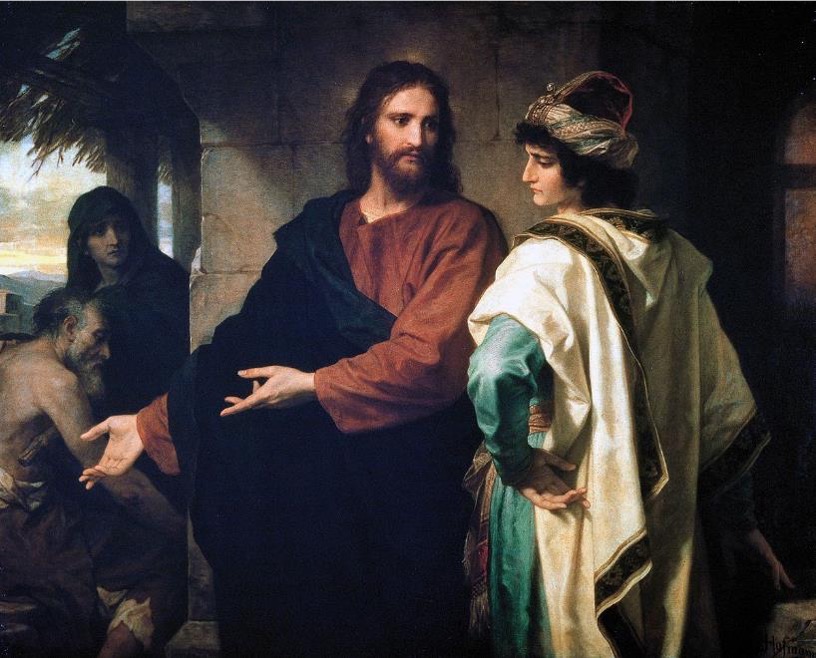
Christ and the Rich Young Ruler  —  Heinrich Hofman, Riverside Church, New York, NY

Sermon – Pr Meggan Manlove

Following Jesus is radical. It is counter cultural. His message is sometimes downright shocking. It does not get any more radical than this morning’s gospel text. Convenient as it might be, this teaching is not just for the Jeff Bezoses of the world. It is not even just for the rich. This scripture passage, which I fully admit is uncomfortable to sit with, is for all of us who are trying to be disciples, followers of Jesus. 

The passage is full of interesting and important details, which illumine the scene and give us clues about discipleship. Let’s start with the rich man himself. First, we know that he is a deeply religious man. He has kept all of the commandments. Yet he knows that there is something more. There is something about this man Jesus. He is the way to abundant life. Jesus will guide the man he supposes. The rich man wants to become a true disciple. So the man runs when he sees Jesus.

As he reaches Jesus, he kneels down. We have seen this posture before. Picture other instances when people knelt at Jesus’ feet. A leper came to Jesus, kneeled and begged for healing. Jairus, the leader of the synagogue, fell at Jesus’ feet and begged Jesus to heal his little daughter. And now here comes yet another man who believes that Jesus can give life. This man is breathing fine and does not need any physical healing. Still, he comes and kneels at Jesus’ feet and asks, “What must I do to inherit eternal life?”

“You know the commandments,” Jesus says. He lists them for the man. “Teacher,” the man says, “I have kept all these since my youth.” This man knows he is still lacking. 

The gospels more often show rather than tell us about Jesus’ love. We see Jesus’ love again and again through his actions. But here, we read specifically, “Jesus, looking at him, loved him and said, ‘You lack one thing.” Jesus’ instruction is paired with his love, even when the teaching will be difficult to hear. Keep in mind Jesus’ love for the rich man in this moment.

Jesus’ precise instructions are also significant. Jesus does not tell the rich man to burn the possessions and walk away. Instead, Jesus tells the rich man to sell the possessions and give the money to the poor. He instructs him to redistribute his wealth among the poor. Jesus calls for more than a change in the man’s bottom line. He calls for a relinquishment of his possessions for the sake of those people who are poor. What could the results of such actions be? Jesus is telling the rich man to change his relationship with the poor. At its heart, this entire passage is all about relationships.

The man is “shocked.” He cannot do what Jesus has told him. It is so radical. The costs are too great–financial, social, and political. And so the man who had run to Jesus, wanting to be a disciple, turns and walks the other way. The man goes away grieving. 

Jesus’ disciples have watched this whole encounter. After the rich man leaves, Jesus then looks at the disciples and says, “How hard it will be for those who have wealth to enter the kingdom of God! Children, how hard it is to enter the kingdom of God! It is easier for a camel to go through the eye of a needle than for someone who is rich to enter the kingdom of God.”

It is impossible for us to hear Jesus’ words as his first disciples did. In their time and place people viewed the wealthy as blessed by God. Put another way, they believed God blessed people with wealth and riches. And so, if the rich, who have seemingly been given their by God, cannot enter the kingdom of God, then who can? The disciples ask one another, as we might, “Then who can be saved?” 

This last part of our passage sometimes gets overlooked. The disciples have already renounced much of their lives, security, and identity to follow Jesus. Peter does not boast but speaks out of panic. “Look, we have left everything and followed you.” Jesus explains that he does not call people to severe simplicity. He calls people into a new community with an alternative richness. Again, Jesus points to changed relationships.

Listen to the two lists Jesus gives. “Truly I tell you, there is no one who has left house or brothers or sisters or mother or father or children or fields, for my sake and for the sake of the good news, who will not receive a hundredfold now in this age–houses, brothers and sisters, mothers and children, and fields with persecutions–and in the age to come eternal life.” 

The lists are not identical. Fathers is missing from the second list. At the very least, this is a nod to the fact that the kingdom of God is led by Jesus’ Father, the creator of the universe. This loving father has invited us all into a relationship of adoption–to be children of God. This new family might include all or part of the family you were born into, but it will certainly including new family members. It is expansive and as radical as Jesus’ vision of the reign of God.

You might be wondering [Don Juel], “Is the call to follow Jesus a call to abandon the world?  Is there no way to follow Jesus and also live in the world in such a way that one can be involved with such ordinary and essential matters as property and possessions?”

Yes, there is a way, “Jesus’ response heads off any notion that discipleship requires … abandonment of the world.  It also affords a glimpse of community life among Jesus’ followers…To those who have suffered the losses attendant upon following him, Jesus promises, not simply rewards in the life to come, but concrete rewards in this life: houses and brothers and sisters and mothers and children and lands.”  

The early Christians were not impoverished.  For the homeless there will be homes; for those who have abandoned families there will be new families.  New social units will take the place of the old.  Jesus’ words sketch a vision of a real community of believers prepared to live in this time.  Implementing the ideal is hardly ever easy.  In the end it is life giving.  The potential for community is immense.  There is strength and new life when everyone has enough.

The man whom Jesus loves cannot free himself to follow Jesus. His possessions hold him fast. His survival depends upon being freed to spend himself on his neighbor—and that means spending his money. He is unable to get himself free.  Jesus tells his disciples, “With God all things are possible.” Our own captivity might look different. It might be wealth, or the desire for wealth. We might be captive to something else, like individual freedoms or complete security or a vision of a career. 

Rather than condemning the rich man’s “sin,” Jesus confronts the man with his weakness, his captivity to possessions that prevents him from living into the full life of the reign of God. Jesus here names the “power” that holds the man captive and invites the man to step into freedom.

Although we are freed once and for all in the waters of baptism, the truth is that we struggle with captivity daily. It’s one reason we confess our sins together each week and gather at the table to receive forgiveness and new life. And, importantly, we confess not alone, but communally. And we share the bread and wine together.  

In today’s passage, Jesus promises that those who have spent themselves and suffered for the sake of the gospel will not have to wait until the age to come for full life. He promises new family, fields, homes, and friends, “a hundred-fold in this age.” God does not intend that we live solitary, empty lives. Discipleship involves discovering a new family.  

Hard as it is to swallow, I am grateful for Jesus’ vision. Before my mom and my vacation to Oregon last week I will admit to being quite weary. My heart was broken from so many things–big and small, local and global. But what was worse was that my imagination was cloudy. I was having trouble imagining, visioning. The beauty of Crater Lake, the Umpqua River, the Central Oregon Coast helped a lot to restore my imagination. 

But the beauty of the natural world is not enough. Fortunately, scripture is full of visions and dreams of what the world could look like, of what we need to watch for, of how to catch a glimpse of the reign of God breaking into the here and now. One interpretation of scripture that I’ve leaned into off and on the past year is the song “Beautiful City” from the musical Godspell. I assume that composer Stephen Schwartz had, as his inspiration, the passage from Revelation 21, in which we see the holy city.

The second verse goes, “We may not reach the ending. But we can start. Slowly but truly mending. Brick by brick. Heart by heart. Now, maybe now. We start learning how. We can build a beautiful city. Yes we can, yes, we can. We can build a beautiful city. Not a city of angels. But we can build a city of man.”

Prayers of Intercession

Made children and heirs of God’s promise, we pray for the church, the world, and all in need.

A brief silence.Uniting God, you call forth different gifts in those who follow you. Encourage us to welcome the diverse benefits and blessings of the whole church in teaching, preaching, prophecy, healing, and more. Lord, in your mercy,hear our prayer.

Nurturing God, you bring forth crops from the soil and bounty from the trees. Increase the produce of the land and bless all who toil in fields and orchards. Provide for good working conditions and keep them safe. Lord, in your mercy,hear our prayer.

Empowering God, you offer compassion for those who are overlooked or forgotten. Open the hearts of local, national, and world leaders to show such compassion and love for their neighbors. Lord, in your mercy,hear our prayer.

Sheltering God, in Jesus you travelled among us without a place to lay your head. Provide safe places to sleep and rest for those who have no place to live. Sustain ministries that offer food, clothing, and peace of mind (local ministries may be named). Lord, in your mercy,hear our prayer.

Renewing God, you bring life out of death. Help us part with those things that are no longer beneficial to us and open our hearts to see where new life is budding in this congregation. Lord, in your mercy,hear our prayer.

Here other intercessions may be offered.Eternal God, we thank you for the lives of those who have died (especially). Make us confident in your promise of salvation and support us in our own journey of faith. Lord, in your mercy,hear our prayer.

Receive these prayers, O God, and those in our hearts known only to you; through Jesus Christ our Lord.Amen.

Posted in Sermons, Trinity Lutheran | Leave a comment

Sept. 25, 2021

Prayer of the Day

Generous God, your Son gave his life that we might come to peace with you. Give us a share of your Spirit, and in all we do empower us to bear the name of Jesus Christ, our Savior and Lord.Amen.

Esther 7:1-6, 9-10; 9:20-22

1[King Ahasuerus] and Haman went in to feast with Queen Esther.2On the second day, as they were drinking wine, the king again said to Esther, “What is your petition, Queen Esther? It shall be granted you. And what is your request? Even to the half of my kingdom, it shall be fulfilled.” 3Then Queen Esther answered, “If I have won your favor, O king, and if it pleases the king, let my life be given me—that is my petition—and the lives of my people—that is my request. 4For we have been sold, I and my people, to be destroyed, to be killed, and to be annihilated. If we had been sold merely as slaves, men and women, I would have held my peace; but no enemy can compensate for this damage to the king.” 5Then King Ahasuerus said to Queen Esther, “Who is he, and where is he, who has presumed to do this?” 6Esther said, “A foe and enemy, this wicked Haman!” Then Haman was terrified before the king and the queen. 9Then Harbona, one of the eunuchs in attendance on the king, said, “Look, the very gallows that Haman has prepared for Mordecai, whose word saved the king, stands at Haman’s house, fifty cubits high.” And the king said, “Hang him on that.” 10So they hanged Haman on the gallows that he had prepared for Mordecai. Then the anger of the king abated.
 9:20Mordecai recorded these things, and sent letters to all the Jews who were in all the provinces of King Ahasuerus, both near and far, 21enjoining them that they should keep the fourteenth day of the month Adar and also the fifteenth day of the same month, year by year, 22as the days on which the Jews gained relief from their enemies, and as the month that had been turned for them from sorrow into gladness and from mourning into a holiday; that they should make them days of feasting and gladness, days for sending gifts of food to one another and presents to the poor.

Psalm 124

 1If the Lord had not been | on our side,
  let Isra- | el now say;
 2if the Lord had not been | on our side,
  when enemies rose | up against us,
 3then would they have swallowed us | up alive
  in their fierce | anger toward us;
 4then would the waters have | overwhelmed us
  and the torrent gone | over us;
 5then would the | raging waters
  have gone right | over us.
 6Blessed | be the Lord
  who has not given us over to be a prey | for their teeth. 
 7We have escaped like a bird from the snare | of the fowler;
  the snare is broken, and we | have escaped.
 8Our help is in the name | of the Lord,
  the maker of heav- | en and earth.

Mark 9:38-50

38John said to [Jesus,] “Teacher, we saw someone casting out demons in your name, and we tried to stop him, because he was not following us.” 39But Jesus said, “Do not stop him; for no one who does a deed of power in my name will be able soon afterward to speak evil of me. 40Whoever is not against us is for us. 41For truly I tell you, whoever gives you a cup of water to drink because you bear the name of Christ will by no means lose the reward.
  42“If any of you put a stumbling block before one of these little ones who believe in me, it would be better for you if a great millstone were hung around your neck and you were thrown into the sea. 43If your hand causes you to stumble, cut it off; it is better for you to enter life maimed than to have two hands and to go to hell, to the unquenchable fire. 45And if your foot causes you to stumble, cut it off; it is better for you to enter life lame than to have two feet and to be thrown into hell. 47And if your eye causes you to stumble, tear it out; it is better for you to enter the kingdom of God with one eye than to have two eyes and to be thrown into hell, 48where their worm never dies, and the fire is never quenched.
  49“For everyone will be salted with fire. 50Salt is good; but if salt has lost its saltiness, how can you season it? Have salt in yourselves, and be at peace with one another.”

Sermon – Pastor Meggan Manlove

Jesus lays things out quite clearly for his disciples. They were a bit put out because someone seemingly outside their circle was able to use one of God’s gifts. Jesus does not have a problem with the person casting out demons in his name. Nothing is supposed to stop us or the collective we from bringing in the reign of God. We don’t have to look past our Old Testament lesson to see unusual characters being instruments of God’s reign.

Esther and her cousin Mordecai were living in Susa, one of four capitals in the great Persian Empire. It was 475 years before Christ. A hundred years previously, the Jewish people have been overrun by the Chaldeans. They had been taken into exile in Babylon. Fifty years later, Babylon was conquered by the Persians and the Jews were allowed to return home. But some Jews chose to stay where they were. They had discovered something important. God did not just live in the land of Israel. God was here too. Mordecai and Esther were among the Jews who stayed.

However, living as a Jew at the heart of the Persian Empire was risky business, as the book of Esther makes clear. Straightaway we meet King Ahasuerus and we find the most powerful man in the empire to be a reckless, extravagant, and easily manipulated character. This is especially dangerous because when he passes a law, that law cannot be changed, even if it turns out to be a disaster. 

Not only do the Jews live under an unreliable monarch and an unworkable legislative system, they also have sworn enemies. One is Haman. Haman and Mordecai despise each other. When Haman rises to the post of prime minister, Mordecai riles him so much that he manipulates the king into issuing a decree that will wipe out all Jews in the Empire. We need to remember that Israel was still part of the Persian Empire at the is point. So, the king’s decree threatens to eliminate the Jews from history altogether. 

There is one faint hope for the Jews. Five years before the passing of the decree, Mordecai’s cousin Esther, without revealing her ethnic identity, had joined the king’s harem, undergoing a year-long grooming to prepare her for a one-night stand with the king. The king liked her so much that he made her his new queen. But being queen did not give Esther automatic intimacy with the king one might imagine. The king still kept his harem and no one got to address the king unless he took their fancy and he waved his golden scepter at them. 

Esther is queen, but she is still so isolated that she did not even know that the Jews were due to be exterminated in a few months’ time. Back in Chapter four, Mordecai told Esther about the catastrophic decree. “Look, Esther,” Mordecai says, “You’re the only one who can do something about this.” Esther tries to escape but Mordecai explains that being queen is not going to save her. He says, “Maybe this was exactly why you became queen. You thought it was saving yourself, but God thought it was for saving God’s people. Maybe God put you here for exactly this moment, for just such a time as this.”

In the end, Esther stops denying, stops ignoring, stops making excuses, stops running away. She realizes this moment needs more than her own strength, so she falls back on the devotional habits of her people and calls on the Jews to fast with her. She resolves that she will face up to her responsibility and go to the king. She also recognizes that she must disclose her true identity as a Jew. She takes stock of the realities of her situation. One scholar [Sam Wells] goes so far as to say that Esther becomes Christ. She is a kind of Jesus, at the right hand of God, laying down her life for the salvation of the Jews. Esther requires a mixture of courage, charm, and luck. The king issues a new decree that enables the Jews to live another day.

The story of Esther teaches us many things. One among them is that there are biblical characters who have had to hide their identity. I assume many of us have kept parts of ourselves hidden when in group settings. However, if you have LGBTQ people in your life, they may be the ones who most easily relate to Esther’s predicament. One minister wrote, “Esther’s task is to figure out how to come out in such a way that turns the king’s heart away from the slander and stereotypes he’s heard about the Jewish people, Esther’s people. Her goal must be to save all the Jews, including herself.” 

Another lesson Esther teaches its readers is the history of the Jewish festival of Purim, celebrated in late February or March. Esther also teaches that maintaining community and religious identity in foreign territory is a tricky but very important task. And the book has much to say about power, ethnic tension, and the sin of pride.

But the heart of the story lies in those words from Mordecai, which Esther took to heart, “Perhaps you have come to this place, to this moment, to these people, to this challenge, for just such a time as this.”

Just ponder Esther for a moment. Yes, she had some things. But she lacked other things. She had beauty. She had a certain kind of training. She had an ambitious and loyal cousin. She had a very powerful husband. But she did not have any power over her own life. She did not have any security in the face of those who planned to kill her and her people. And she did not have any real personal intimacy with her husband.

Think about Esther, and then think about yourself. You have some things. You lack other things. Maybe you have the gift of great intelligence. Maybe you don’t have great brains and are free of the burden of feeling you have to be clever all the time. Maybe you have good looks. Maybe you don’t have good looks and are free of the expectations good looks can bring. Maybe you have had a calm and stable family life and understand what trust and security mean. Maybe you have known none of these things. But maybe you have experienced anxiety that helps you understand the panic Esther felt. 

What makes you uniquely you? And then think about your context. Think about the number of times you have said “What Trinity needs”, or “What Canyon County needs”, or “What my family needs”, or “What the world needs”. Think about the number of times you have thought there was nothing or no one that could do anything about it.

And then feel this exasperating man Mordecai tap on your shoulder, and say “Perhaps you have been given these skills and experiences, these privileges and deprivations, so that just at this very moment you could do what no one else could do, you could be what no one else could be. God made you just as you are because he wanted someone just like you. Maybe you came to be here for just such a time as this.”

Think again about Esther. She found herself at a crucial moment — not a moment for sudden action, but a moment when she realized the rest of her life must be given for one cause that went way and above her own safety, her own privilege, her own status. You could call it a moment of conversion. And what she was converted to was a further time of preparation, of fasting, or planning, of biding her time, of waiting till it was worth taking an enormous risk and then of executing a careful plan. And perhaps most curious of all, the person who brought her face to face with her destiny was no saint but Mordecai, her stubborn, proud, scheming cousin who’d done a whole lot to put his people in this mess in the first place.

Esther listened. Without Esther there would have been no Jesus, because there would have been no Jews. The founders of Trinity listened. On All Saints Sunday, Nov. 7, we will celebrate so many people in the Christian tradition who have listened. But today is a day to celebrate the times when each of us gathered here have listened and to strengthen us to keep listening and paying attention to the tap on the shoulder. Has God put you right here, right now, for just such a time as this?

Prayers of Intercession (From Sundays and Seasons)

Made children and heirs of God’s promise, we pray for the church, the world, and all in need.

A brief silence.We pray for the church and its ministry. Bless the newly baptized and encourage them in their journey of faith. Sustain all members of the body of Christ in lives of prayer, service, and worship. Lord, in your mercy,hear our prayer.

We pray for natural wonders of your creation (local waterways, forests, and natural areas may be named). Restore damaged forests, waterways and natural habitats and lead us to be good stewards of what you have provided. Lord, in your mercy,hear our prayer.

We pray for those in authority. Give them wise minds and compassionate hearts. Strengthen in them a desire to protect the vulnerable and care for those underserved. Lord, in your mercy,hear our prayer.

We pray for those who are struggling with cancer, dementia, or any other disease. Provide them with peace and resilience for the days ahead. Sustain caregivers with energy and patience. Lord, in your mercy,hear our prayer.

We pray for the worship leaders of this congregation: musicians, readers, acolytes, and ushers (other roles may be added to reflect your context). Bless us through their ministry and grant them the passion to continue in their service. Lord, in your mercy,hear our prayer.

Here other intercessions may be offered.We give thanks for all your saints, those we have loved and known and those from every time and place. Continue to guide us by their example and reassure us of your promised salvation. Lord, in your mercy,hear our prayer.

Receive these prayers, O God, and those in our hearts known only to you; through Jesus Christ our Lord.Amen.

Posted in Sermons | Leave a comment

Rest and Healing

Newsletter/Epistle Column for August 2021

Dear Friends and Members of Trinity,

     I confess that I do not have anything particularly spiritual to write this month. I want to take you up one of Idaho’s high mountain peaks and give you the 12,000-foot view of Trinity this summer. We are now able to gather in person regularly and safely and it life-giving. We also continue to offer worship online—also life-giving for people from many walks of life. The timing of being able to gather in person coincides with many of you hitting the road to see family and friends far away or explore the beauty of the natural world right here in the Mountain West. Another part of our current reality are the many members who put in multiple hours thinking, pivoting, learning, making decisions, and serving. Many faithful volunteers are now weary and worn and need some serious sabbath time before the fall. What this means is, if we are not full speed (whatever that means) until September, there are good reasons and most of those reasons have to do with rest and healing after a hard chapter of individual and communal life. 

     I truly believe we are living in an incredible time of creativity and recreating and transformation. Our leadership wants to be intentional about taking lessons from the pandemic with us and using new tools going forward. However, being intentional and thoughtful takes energy. So, this summer we are only doing a few things, but we hope to do them well (worship, campout, Peace Camp, Monday study group). Meanwhile, we are giving people space and time for rejuvenation. What lessons from the pandemic do you want to retain? What faith practices are you looking forward to resuming together? People at Trinity have never shied away from good questions. Let’s keep that as part of our DNA as we live into the future together but let us also help one another rest and recover.

Peace,

Pastor Meggan  

Posted in Reflections, Trinity Lutheran | Leave a comment

Sept. 19, 2021

Prayer of the Day

O God, our teacher and guide, you draw us to yourself and welcome us as beloved children. Help us to lay aside all envy and selfish ambition, that we may walk in your ways of wisdom and understanding as servants of your Son, Jesus Christ, our Savior and Lord.Amen.

Psalm 54

 1Save me, O God, | by your name;
  in your might, de- | fend my cause.
 2Hear my | prayer, O God;
  give ear to the words | of my mouth.
 3For strangers have risen up against me, and the ruthless have | sought my life,
  those who have no re- | gard for God.
 4Behold, God | is my helper;
  it is the Lord who sus- | tains my life. R
 5Render evil to those who | spy on me;
  in your faithful- | ness, destroy them.
 6I will offer you a | freewill sacrifice
  and praise your name, O Lord, for | it is good.
 7For you have rescued me from | every trouble,
  and my eye looks down | on my enemies

James 3:13–4:3, 7-8a

13Who is wise and understanding among you? Show by your good life that your works are done with gentleness born of wisdom. 14But if you have bitter envy and selfish ambition in your hearts, do not be boastful and false to the truth. 15Such wisdom does not come down from above, but is earthly, unspiritual, devilish. 16For where there is envy and selfish ambition, there will also be disorder and wickedness of every kind. 17But the wisdom from above is first pure, then peaceable, gentle, willing to yield, full of mercy and good fruits, without a trace of partiality or hypocrisy. 18And a harvest of righteousness is sown in peace for those who make peace.4:

  1Those conflicts and disputes among you, where do they come from? Do they not come from your cravings that are at war within you? 2You want something and do not have it; so you commit murder. And you covet something and cannot obtain it; so you engage in disputes and conflicts. You do not have, because you do not ask. 3You ask and do not receive, because you ask wrongly, in order to spend what you get on your pleasures. 7Submit yourselves therefore to God. Resist the devil, and he will flee from you. 8aDraw near to God, and he will draw near to you.

Mark 9:30-37

30[Jesus and the disciples went on] and passed through Galilee. He did not want anyone to know it;31for he was teaching his disciples, saying to them, “The Son of Man is to be betrayed into human hands, and they will kill him, and three days after being killed, he will rise again.” 32But they did not understand what he was saying and were afraid to ask him.
  33Then they came to Capernaum; and when he was in the house he asked them, “What were you arguing about on the way?” 34But they were silent, for on the way they had argued with one another who was the greatest. 35He sat down, called the twelve, and said to them, “Whoever wants to be first must be last of all and servant of all.” 36Then he took a little child and put it among them; and taking it in his arms, he said to them, 37“Whoever welcomes one such child in my name welcomes me, and whoever welcomes me welcomes not me but the one who sent me.”

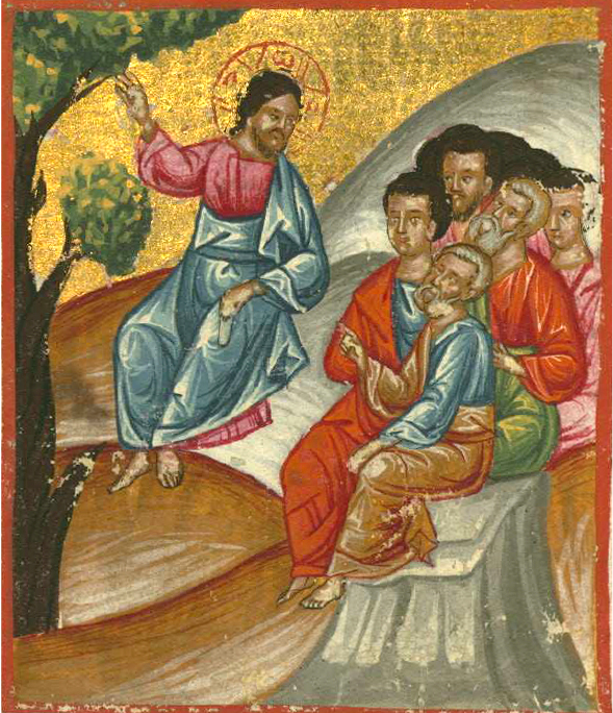
Jesus Teaches the Disciples

Ilyas Basim Khuri Bazzi Rahib
Walters Art Museum, Baltimiore, MD

Sermon – Pastor Meggan Manlove

Have you ever said to someone, “I don’t think we’re on the same page”? It’s a description of a frustrating conversation. There seem to be similar words and concepts but also a clear disconnect. Finally, you pause, and you realize you are talking about two completely different things. It happens in our passage from Mark’s gospel today. 

Simon Peter had a moment of brilliance earlier. Jesus asked his disciples “Who do you say that I am?” And Peter answered, “You are the Messiah.” He was on the same page as Jesus. And Peter’s conclusion was logical. Peter had been up on the Mountain of Transfiguration and been blinded by a radiant Jesus. Jesus had healed countless people. Jesus seemed like a savior, the Messiah. So, topping off these great moments was Peter’s confession.

On the other hand, there have been disturbing moments. Jesus speaks several times about his future suffering and death. Peter rebukes him for these unpleasant predictions. And Jesus scolds Peter for this rebuke. They are still talking about Jesus, the Messiah, but Peter’s idea of what a Messiah is, how he acts, is not in sync with Jesus. Jesus says, “The Son of Man is to be betrayed into human hands and be killed.” Jesus and the disciples are not on the same page.

Then, as they enter the town of Capernaum, Jesus turns and asks the disciples what they were arguing about. They must have been embarrassed. Their awkward silence is palpable. One writer [Eugene Peterson] calls the silence “deafening.” We have all been in that position.  

Imagine—some kids make a raucous in the basement. A parent calls down the stairs, “What’s going on down there?” The response is “Nothing, nothing!” The disciples have been discussing who among them is the greatest. Jesus has been talking about his death and they are talking about who is the greatest. Who would not be embarrassed? Of course, Jesus, like a parent, already knew what was going on.

We should not think ourselves superior to the disciples. We would probably feel similarly uncomfortable in their place. This is not an exercise in attacking their flawed ideas about discipleship. We could easily become distracted by judging ourselves greater than the disciples—more faithful, more aware, more on the same page as Jesus. Today’s stories are about how we, so many years later and with the full narrative of Jesus in mind, might follow Jesus today, in Canyon County, Idaho.

After interrupting the argument about who is the greatest, Jesus sits down like a teacher. We know this is not casual conversation. He is going to say something crucial. Jesus often uses more than words to teach his lessons. This case is not different. This time his illustration is a little child. We have several stumbling blocks to go over before we can truly understand this illustration.  

A child in our culture is deeply valued and put first in our priorities. At least we would like to think so, in spite of the number of children in poverty. We coo over babies. We cheer on kids when they sing and play. And youthfulness is glorified just about everywhere.

And artists through the ages have not helped us. Can you pull up in your memory a painting over an altar or in a church narthex portraying children? They were often, at least in the last century portrayed as pure and angelic. More importantly, there seem to be lacking in nothing. It is easy for us to sentimentalize Jesus’ action of picking up a small child and telling his followers to do likewise. It is a sweet scene—Jesus tenderly cuddles a child and appeals to the soft hearts under the tough exterior of these big rough disciples.

But that is not what is going on here. Instead of a sweet moment, the disciples are experiencing a radical up-ending of the way they think things should be.  In the time of Jesus, a child was lowest on the priority list. Children had no status. They were subject to the authority of their father. Often, they were expendable. And so Jesus gesture here is potent. 

The child that Jesus reaches out to is similar to many of the children in Charles Dickens’ novels. This does not include Tiny Tim, the star of the famous story “A Christmas Carol.” When I hear Jesus tell his disciples, “Whoever welcomes one such child in my name welcomes me,” I imagine characters like Jo from the great novel “Bleak House.” 

Dickens writes that “Jo lives in a ruinous place, known to the like of him by the name of Tom-all-Alone’s.  It is a black, dilapidated street avoided by all decent people, where the crazy houses were seized upon when their decay was far advanced by some bold vagrants who, after establishing their own possession, took to letting them out in lodgings…It must be a strange state to be like Jo!…To be hustled, and jostled, and moved on, and really to feel that it would appear to be perfectly true that I have no business, here, or there, or anywhere, and yet to be perplexed by the consideration that I am here somehow, too, and everybody overlooked me until I became the creature that I am!”  

Jo and other child characters in Dickens’ works are often referred to as urchins, small raggedly children who do their best to survive in an adult world. The root of the word comes from the Latin for hedgehog, a rather prickly unkempt-looking animal. The good news is that there are people who not only look out for Jo but who bring him into their home.

Jesus’ disciples are not there yet. This is a radical up-ending of the way they think things should be. This is not what they hope life will be like when Jesus comes into their idea of glory. They want to find their way to the top. They want to claim greatness. And he tells them to lay claim to the last and lowest place and people. When they welcome a child, they welcome him. They even welcome the one who sent him. Picture the urchin child Jo again.  

Jesus’ command makes no sense to the disciples. Welcome someone who does not have the power or ability or place to welcome them in turn? No expectation of reciprocity? No return on our investment. (There really is very little in the Jesus story that commends pure unchecked capitalism.) First, our teacher keeps talking about suffering and dying instead of victory and glory. Now we must welcome and even value small, insignificant, powerless people, the least among us?

Every generation of Christians in every geographic context gets to translate “the least among us” for our time and place. What does that look like in 2021 Canyon County? We might consider the Afghan refugees who will be coming to our state and many others. But we might also think of veterans who return and returned after unpopular wars and were shunned, with no consideration for their sacrifice or how their minds were harmed by what they experienced. Despite the progress made in understanding all sorts of mental illnesses, too many people are still ashamed to seek treatment. We think since it’s in our head, we should be able to to fix it ourselves, though no one has the same expectations for fixing a broken leg or a heart condition. We understand drug and alcohol addictions much better now than we did 100 years ago, but often people suffering from addiction are still viewed as the least among us. Who would you add the list today? Who are we being beckoned to welcome? What are the hurdles? 

One of the greatest mysteries in Mark is Jesus’ relationship with his disciples.  The conversations in Mark chapter 9 are part of a pattern. The disciples have moments of insight, but they often misunderstand Jesus, or they don’t like what he has to say.  The mystery is this—they all keep at it. The disciples keep following Jesus and he keeps teaching. The truth is no one can ever really get it.  

But the disciples are tenacious even when they don’t have a clue what Jesus is talking about. They don’t have it all clear in their heads.  But they know there is something about this Jesus. It is impossible to do anything but stay and listen to him. They keep talking with him, even when they get it wrong.

That is no small thing. We don’t like to hang out in settings where we are told over and over that we’re not getting it. But the disciples stayed. We will probably never get the paradoxes of the Christian story. Strength comes in weakness. Glory is found in the death on a rugged cross. Welcoming urchin children is like welcoming Jesus. We don’t have to understand in order to stay. Full comprehension is not required to hear the words of forgiveness or to share in the Lord’s Supper.  We stay as the disciples stayed, because we know that Jesus is the only place worth being. In him there is love and abundant life for the world.     

Prayers of Intercession (Sundays and Seasons)

Made children and heirs of God’s promise, we pray for the church, the world, and all in need.

A brief silence.God of community, we pray for the church around the world. Unite us in our love for you. Help us overcome our divisions, that we are encouraged to work together for your sake. Lord, in your mercy,hear our prayer.

God of creation, we pray for this hurting earth. Awaken in us a new desire to care for this world and empower us to support agencies, organizations, and individual efforts to heal our environment. Lord, in your mercy,hear our prayer.

God of cooperation, we pray for nations of the world embroiled in conflict (especially). Inspire leaders to listen to each other and work towards peaceful solutions to disagreements. Protect the vulnerable, especially children, who cannot find safety in their home or country. Lord, in your mercy,hear our prayer.

God of comfort, we pray for all who live with mental or physical illness. Help them find appropriate care. Bring healing and wholeness when the path forward seems bleak. Lord, in your mercy,hear our prayer.

God of compassion, we pray for the young people of this congregation. Renew in us your call to welcome the children in our midst. As they grow, strengthen their faith and our commitment to them. Lord, in your mercy,hear our prayer.

Here other intercessions may be offered.God of consolation, we give you thanks for our loved ones who have died and pray for all who grieve today (especially). Shine your grace on all your saints. Lord, in your mercy,hear our prayer.

Receive these prayers, O God, and those in our hearts known only to you; through Jesus Christ our Lord.Amen.

Posted in Sermons, Trinity Lutheran | Leave a comment

Sept. 12, 2021

Prayer of the Day

O God, through suffering and rejection you bring forth our salvation, and by the glory of the cross you transform our lives. Grant that for the sake of the gospel we may turn from the lure of evil, take up our cross, and follow your Son, Jesus Christ, our Savior and Lord.Amen.

Psalm 19

 1The heavens declare the glo- | ry of God,
  and the sky proclaims its | maker’s handiwork.
 2One day tells its tale | to another,
  and one night imparts knowledge | to another.
 3Although they have no | words or language,
  and their voices | are not heard,
 4their sound has gone out into all lands, and their message to the ends | of the world,
  where God has pitched a tent | for the sun.
 5It comes forth like a bridegroom out | of his chamber;
  it rejoices like a champion to | run its course.
 6It goes forth from the uttermost edge of the heavens and runs about to the end of | it again;
  nothing is hidden from its | burning heat. 
 7The teaching of the Lord is perfect and re- | vives the soul;
  the testimony of the Lord is sure and gives wisdom to | the simple.
 8The statutes of the Lord are just and re- | joice the heart;
  the commandment of the Lord is clear and gives light | to the eyes.
 9The fear of the Lord is clean and en- | dures forever;
  the judgments of the Lord are true and righteous | altogether.
 10More to be desired are they than gold, more than | much fine gold,
  sweeter far than honey, than honey | in the comb. 
 11By them also is your ser- | vant enlightened,
  and in keeping them there is | great reward.
 12Who can detect one’s | own offenses?
  Cleanse me from my | secret faults.
 13Above all, keep your servant from presumptuous sins; let them not get dominion | over me;
  then shall I be whole and sound, and innocent of a | great offense.
 14Let the words of my mouth and the meditation of my heart be acceptable | in your sight,
  O Lord, my strength and | my redeemer. 

James 3:1-12

1Not many of you should become teachers, my brothers and sisters, for you know that we who teach will be judged with greater strictness. 2For all of us make many mistakes. Anyone who makes no mistakes in speaking is perfect, able to keep the whole body in check with a bridle. 3If we put bits into the mouths of horses to make them obey us, we guide their whole bodies. 4Or look at ships: though they are so large that it takes strong winds to drive them, yet they are guided by a very small rudder wherever the will of the pilot directs. 5So also the tongue is a small member, yet it boasts of great exploits. 
  How great a forest is set ablaze by a small fire! 6And the tongue is a fire. The tongue is placed among our members as a world of iniquity; it stains the whole body, sets on fire the cycle of nature, and is itself set on fire by hell. 7For every species of beast and bird, of reptile and sea creature, can be tamed and has been tamed by the human species, 8but no one can tame the tongue—a restless evil, full of deadly poison. 9With it we bless the Lord and Father, and with it we curse those who are made in the likeness of God. 10From the same mouth come blessing and cursing. My brothers and sisters, this ought not to be so. 11Does a spring pour forth from the same opening both fresh and brackish water? 12Can a fig tree, my brothers and sisters, yield olives, or a grapevine figs? No more can salt water yield fresh.

Mark 8:27-38

27Jesus went on with his disciples to the villages of Caesarea Philippi; and on the way he asked his disciples, “Who do people say that I am?” 28And they answered him, “John the Baptist; and others, Elijah; and still others, one of the prophets.” 29He asked them, “But who do you say that I am?” Peter answered him, “You are the Messiah.” 30And he sternly ordered them not to tell anyone about him.

  31Then he began to teach them that the Son of Man must undergo great suffering, and be rejected by the elders, the chief priests, and the scribes, and be killed, and after three days rise again. 32He said all this quite openly. And Peter took him aside and began to rebuke him. 33But turning and looking at his disciples, he rebuked Peter and said, “Get behind me, Satan! For you are setting your mind not on divine things but on human things.”
  34He called the crowd with his disciples, and said to them, “If any want to become my followers, let them deny themselves and take up their cross and follow me. 35For those who want to save their life will lose it, and those who lose their life for my sake, and for the sake of the gospel, will save it. 36For what will it profit them to gain the whole world and forfeit their life? 37Indeed, what can they give in return for their life? 38Those who are ashamed of me and of my words in this adulterous and sinful generation, of them the Son of Man will also be ashamed when he comes in the glory of his Father with the holy angels.”

Get Thee Behind Me, Satan! – James Tissot, Brooklyn Museum, NY

Sermon – Pr Meggan Manlove

I’m not sure exactly how many times in the four Gospels Jesus tells other people to follow him, but it is more than 20. The whole question of “Who is willing to follow Jesus Christ and how does one do it?” are the defining questions of Christianity.

Jesus talks about “losing yourself for his sake” and “denying yourself.” If we take those words seriously, what will our lives look like? How will we spend our money? How will we use our money? How will we vote? What are we like on the school playground, in the classroom, in the workplace? 

What does it mean to follow Jesus in your life, and in these times? These questions come to a head in today’s reading from Mark. Jesus asks, “Who do you say that I am?” The disciple Peter gets all excited to profess that Jesus is indeed the Messiah.  

Peter soon learns that this also means Jesus must undergo great suffering, deep rejection, and ultimately death. The instant Peter learns this, he backs away. He critiques Jesus. He rebukes Jesus. The glamour of following Jesus is suddenly gone for Peter. It no longer seems like a life that he is sure he wants to undertake.  

But there is so much more to this interaction between Jesus and Peter. Jewish thinking had never before entertained the idea that the Messiah must suffer and die. Absolutely no one thought a Messiah would be crucified. This was ludicrous, they believed. If anything, the Messiah was supposed to inflict suffering, not live with it as a personal reality. And what good would a dead Messiah be anyway?

If Peter was nervous about his life in Jesus Christ imposing a certain degree of suffering and self-denial upon him, he was not alone. Most of us would choose a religion and come to believe important things deeply because we feel they are good for us. Suffering does not sound good! If you were to offer me a scathed life versus an unscathed life, I would go for the unscathed variety. 

Who would welcome the idea of suffering if there were other options available? But this is where we must suddenly get very honest about the Christian life. Christianity is not about solving problems and making life easier. If anything, following Jesus is going to complicate your life.

The late Quaker philosopher Elton Trueblood understood this complicating nature of the Christian way.  “In many areas,” he wrote, “the gospel, instead of taking away peoples’ burdens, actually adds to them.”  On a number of occasions, Trueblood told the story of John Woolman, a successful Quaker merchant in the 18th century who lived a wonderfully nice life until God convicted him one day of the offense of holding slaves.  

After that, John Woolman gave up his prosperous business.  He used his money to try and free slaves and even started wearing undyed suits to avoid relying on dye that slave labor produced.  Elton Trueblood said, “Occasionally we talk of our Christianity as something that solves problems, and there is a sense in which it does.  Long before it does so, however, it increases both the number and the intensity of problems.”

Accepting this assessment of Christianity is one of the hardest things in the world. Maybe this is why Jesus had to repeat these words, these words we hear in today’s reading: “For those who want to save their life will lose it, and those who lose their life for my sake and the Gospel, will save it.”  This is an idea that is just hard to believe. It runs counter to what we want to believe. So, Jesus is left to repeat it, hoping to get it inside of our thick heads and our pleasure-minded hearts.

Few of us sitting here will have John Woolman’s story. This being the kick-off to the programmatic year, it seems fitting to lift up some of the ways we are trying, emphasis trying, to follow Jesus. In a culture that often answers pain and grief with empty platitudes or telling us to move one, we are going to tell the truth about how hard this year has been and the weariness that so many are feeling. This will begin with our Remember and Grieve Together event September 29. 

We will continue reckoning collectively with racism–a reckoning still needed in this country and in the larger church. We are going to keep relationships center–relationships with God, with our own souls, and with the marginalized. We will continue to partner with Trinity New Hope affordable housing, finding ways to tell our story to everyone plagued with “Not in My Backyard” whenever new affordable housing developments are proposed. Our leadership does not know where this will lead, and we will keep reviewing, listening, and discerning. People might join us, and that will be great. But let’s be clear, Jesus never said, “grow the church.” Jesus said, “follow me.”

Following Jesus asks for a life that in one way or another has the cross deeply embedded in it. There is sacrifice expected. We give up our lives.  Playing it safe is no longer acceptable. Death stops being a reality to be feared. The first half of Mark’s Gospel account is about “how to live.” Jesus gives instructions of one kind or another on how we might best fashion our lives. And then, at this pivotal point right in the center of the story, Jesus makes a shift. He begins to show us “how do die.” Now that we have been given life, he demonstrates how to give it up or how to give it away. 

We can try to safe-deposit-box our lives all we want.  We can try and be very very cautious about whom we even let into our lives.  But this is not commendable living.  According to Jesus, this is dangerous living.  We will lose our soul if we’re not careful. Living a life that really matters in the name of Jesus will not allow for clutching or hoarding or playing it safe. It asks instead for a less possessive way—a way that treats life more like a precious gift to be shared than a commodity to be stored up.

When Jesus asked his disciples that day, “Who do people say that I am?” they had no trouble answering that question. It was a nice question to which they could give objective answers. But then Jesus asked, “Who do you say that I am?” Suddenly, their confidence and investment in him, and all that he was, was being tested. This was a much more difficult question to answer.  They had to answer it with their lives not just with their brains.

“Who do you say that I am?” The minute we hear this question rattling around in our heads, we have a choice. We can hold back and talk about this Jesus person whose sayings and deeds are written down in a precious ancient book. Or we can decide to open up the fullness of our lives by using the language of love.  

 In what ways do we pretend that Jesus did not really mean to follow him fully? In what ways do we try to be our own messiahs and save ourselves? On what do we stake our lives? In what do we ultimately place our trust? Our bank accounts? Achievements? Prestige? Politicians? Jesus locks every one of these escape hatches. One scholar noted that “doctrinal confusion is not the Christian’s fundamental problem. Instead, it is disobedience: our refusal to accept Christ’s authority over our lives.”

We are privileged to know everyday folks who have so internalized this quality of discipleship. We know people who in the critical moment, they know what to do, they know how to follow Jesus. Most of us may never master such integral calculus of charity. But failure in that does not need to be the enemy of our aspiration. We know the way to follow Jesus. Thanks be to God that other disciples, gathered here, walk it with us. Jesus remains in the lead.

Prayers of Intercession

Made children and heirs of God’s promise, we pray for the church, the world, and all in need.

A brief silence.Revealing God, you have made yourself known through bread and wine, water and word. Continue to nurture your church, that it is a place where your presence is experienced and shared. Lord, in your mercy,hear our prayer.

Creating God, you brought life into being and called it good. Bring new creation to lands devastated by tornadoes, hurricanes, floods, fires, and other disasters (recent destructive events may be named here). Restore forests and curb overflowing waters. Lord, in your mercy,hear our prayer.

Protecting God, you desire all people to live in peace and safety. Provide for all who are in danger. Strengthen first responders to help meet to the complex needs of others. Provide care and compassion as they face trauma themselves. Lord, in your mercy,hear our prayer.

Transforming God, you announce release to the captives and freedom to the oppressed. Break chains of discrimination and injustice. Amplify voices that go unheard and inspire us to advocate for the those who are overlooked. Lord, in your mercy,hear our prayer.

Forming God, you gather this community together. Shape our communal life, that in our prayer, praise, and worship, we honor you and encourage one another. Keep our disagreements civil and increase our joy in working together. Lord, in your mercy,hear our prayer.

Most merciful God, as we remember 9/11, bring comfort to those who mourn, relief to those who witness devastation, healing to those still suffering physical pain or emotional trauma, and reconciliation to a world in need of peace. Lord in your mercy, hear our prayer.

Redeeming God, you accompany your people through every stage of life. We give you thanks for the saints who now rest in your embrace (especially). Lord, in your mercy,hear our prayer.

Receive these prayers, O God, and those in our hearts known only to you; through Jesus Christ our Lord.Amen.

Posted in Sermons, Trinity Lutheran | Leave a comment

Sept. 5, 2021

Prayer of the Day:

Gracious God, throughout the ages you transform sickness into health and death into life. Open us to the power of your presence, and make us a people ready to proclaim your promises to the whole world, through Jesus Christ, our healer and Lord.Amen.

Proverbs 22:1-2, 8-9, 22-23

 1A good name is to be chosen rather than great riches,
  and favor is better than silver or gold.
 2The rich and the poor have this in common:
  the Lord is the maker of them all.
 8Whoever sows injustice will reap calamity,
  and the rod of anger will fail.
 9Those who are generous are blessed,
  for they share their bread with the poor.

 22Do not rob the poor because they are poor,
  or crush the afflicted at the gate;
 23for the Lord pleads their cause
  and despoils of life those who despoil them.

Charity Bazaar for Widows and Orphans (Library of Congress, D.C.)

Psalm 125

 1Those who trust in the Lord are | like Mount Zion,
  which cannot be moved, but stands | fast forever.
 2The mountains sur- | round Jerusalem;
  so you surround your people, O Lord, from this time forth for- | evermore. R
 3The scepter of the wicked shall not hold sway over the land allotted | to the just,
  so that the just shall not put their | hands to evil.
 4Show your goodness, O Lord, to those | who are good
  and to those who are | true of heart.
 5As for those who turn aside to crooked ways, the Lord will lead them away with the |evildoers;
  but peace be | upon Israel.

James 2:1-10 [11-13] 14-17

1My brothers and sisters, do you with your acts of favoritism really believe in our glorious Lord Jesus Christ? 2For if a person with gold rings and in fine clothes comes into your assembly, and if a poor person in dirty clothes also comes in, 3and if you take notice of the one wearing the fine clothes and say, “Have a seat here, please,” while to the one who is poor you say, “Stand there,” or, “Sit at my feet,” 4have you not made distinctions among yourselves, and become judges with evil thoughts? 5Listen, my beloved brothers and sisters. Has not God chosen the poor in the world to be rich in faith and to be heirs of the kingdom that he has promised to those who love him? 6But you have dishonored the poor. Is it not the rich who oppress you? Is it not they who drag you into court? 7Is it not they who blaspheme the excellent name that was invoked over you?
  8You do well if you really fulfill the royal law according to the scripture, “You shall love your neighbor as yourself.” 9But if you show partiality, you commit sin and are convicted by the law as transgressors. 10For whoever keeps the whole law but fails in one point has become accountable for all of it. [11For the one who said, “You shall not commit adultery,” also said, “You shall not murder.” Now if you do not commit adultery but if you murder, you have become a transgressor of the law. 12So speak and so act as those who are to be judged by the law of liberty. 13For judgment will be without mercy to anyone who has shown no mercy; mercy triumphs over judgment.] 
  14What good is it, my brothers and sisters, if you say you have faith but do not have works? Can faith save you? 15If a brother or sister is naked and lacks daily food, 16and one of you says to them, “Go in peace; keep warm and eat your fill,” and yet you do not supply their bodily needs, what is the good of that? 17So faith by itself, if it has no works, is dead.

Mark 7:24-37

24[Jesus] set out and went away to the region of Tyre. He entered a house and did not want anyone to know he was there. Yet he could not escape notice,25but a woman whose little daughter had an unclean spirit immediately heard about him, and she came and bowed down at his feet. 26Now the woman was a Gentile, of Syrophoenician origin. She begged him to cast the demon out of her daughter. 27He said to her, “Let the children be fed first, for it is not fair to take the children’s food and throw it to the dogs.” 28But she answered him, “Sir, even the dogs under the table eat the children’s crumbs.” 29Then he said to her, “For saying that, you may go—the demon has left your daughter.” 30So she went home, found the child lying on the bed, and the demon gone.
  31Then he returned from the region of Tyre, and went by way of Sidon towards the Sea of Galilee, in the region of the Decapolis. 32They brought to him a deaf man who had an impediment in his speech; and they begged him to lay his hand on him. 33He took him aside in private, away from the crowd, and put his fingers into his ears, and he spat and touched his tongue. 34Then looking up to heaven, he sighed and said to him, “Ephphatha,” that is, “Be opened.” 35And immediately his ears were opened, his tongue was released, and he spoke plainly. 36Then Jesus ordered them to tell no one; but the more he ordered them, the more zealously they proclaimed it. 37They were astounded beyond measure, saying, “He has done everything well; he even makes the deaf to hear and the mute to speak.”

Sermon Pastor Meggan Manlove

Whenever a person is walking through a train station in the United Kingdom, there is one phrase which they are sure to hear over the intercom or read in multiple places, “Please mind the gap.” It is a warning issued to passengers to take caution while crossing the horizontal, and occasionally vertical, spatial gap between the train door and the station platform. “Mind the gap.”

Both our reading from Proverbs and our reading from James provide reminders to mind the gap in faith, the gap between knowing something to be true and acting, between the head and heart, between knowledge and wisdom. 

Proverbs itself is a collection of essays, poems, and sayings expressing the wisdom of ancient Israel. It acknowledges that interesting as big questions are, such as the problem of evil or the meaning of life, they do not really address day to day living. Day to day living includes all sorts of smaller questions related to financial affairs, relating to friends, healthy marriage, and helping the poor.

Our passage today is addressed to those who are not poor, but rich. They have been robbing the poor or crushing the afflicted. “The gate” is the place in ancient Israel where court was held. When they have been robbed, the LORD will take up their cause.

But if cheating goes on in the court — if the widow, the orphan, and poor are not treated fairly, there is Someone watching over them. This is the LORD, who will take up their cause, like an advocate in a courtroom.

This same language appears in the book of Isaiah, Chapter 3:

13 The LORD rises to argue his case; he stands to judge the peoples.

14 The LORD enters into judgment with the elders and princes of his people:

“It is you who have devoured the vineyard, the spoil of the poor is in your houses

15 What do you mean by crushing my people by grinding the face of the poor?” says the LORD God of hosts.

Here we see the Lord in action, taking up the cause of the people, acting as their Advocate. The theme of caring for the powerless, the widow, the orphan, the poor, the stranger, the aged runs through the Bible. All of these people have something in common: they have no power in society. The widow has no husband, the orphan no parent, the poor no money, the aged has no strength. God is their advocate. We, as God’s people, are called to be their advocates as well.

Our passage from James includes the story of a well-dressed rich man who is given a best seat in the synagogue and a poor man who is not given a place at all. Here in the book of James we find the familiar triad of the powerless again: the widow and orphan and also the poor.

The theme of the essay we hear from today is that faith and partiality do not mix. That’s especially true when partiality is a reflection of the world’s way of playing favorites. James sets up a dualism that may be a lot of things, but no one can critique it for being unclear. You are a friend of the world or a friend of God. Friends of the world show a preference for the powerful and wealthy, neglecting those struggling to make a living. Friends of God suffer with those who suffer and seek an end to the causes of their suffering.

The rich are a consistent source of critique in James since the quest for wealth often results in the fraying of social bonds. One grows richer by taking advantage of someone else. And as one grows wealthier, greed and self-centeredness take hold making an individual more and more friendly with the world and less and less able to be a friend of God. 

I do not think we have anyone in the uber wealthy category at Trinity, nor is our congregation populated with national, state, or even local law makers, people who create laws and policies which make it easier or harder for wealth to accumulate among a smaller population. 

And yet, we are all part of a society and culture that seems to make an idol of money, or things money can buy. How then are we to talk about money in this space? How do we talk about it within our families? What power do we have and how can wield it for those with less power?

Rev. Dr. William J. Barber names how our morality is at stake in the economic conditions of the West. He calls the church to speak and act in ways that James would recognize as right and faithful for friends of God. Barber is a leader in the Poor People’s Campaign, which is calling out the complicated web of oppression that makes all of us sick, but most notably the poor. Barber’s is just one movement, but it is crucial one for us to learn from because it is based in the ethics of Christianity. Like James, he wants to change the status quo. He is reminding us to mind the gap between words and actions.

The moral imperatives James lines out promote equality and the beloved community. Any action that securers individual comfort and pleasure at the expense of another is wrong. The poor, the widowed, the orphaned, the sick are precisely whom the gathering must support as they struggle to flourish. Their welfare leads to the welfare of everyone, so there are no more gaps.

This can all feel like a lot, maybe especially right now. There is hope and perhaps some relief in talking about tackling poverty in the midst of community. After all, we each bring different gifts and passions to the world. If we all take on a few particular causes, that does indeed bring relief. Community also gives us some accountability. We can check in on one another–how is our prayer life, how are we doing with our relationship with God, how are we doing loving our neighbor?

Right now, the opportunities for working towards equality, for helping the poor, for closing the economic gap seem endless. You can help feed people locally or support global organizations like Bread for the World. You can call the Agency for New Americans and ask about helping Afghan families coming to the Treasure Valley or support Lutheran Immigration and Refugee Services’ global efforts. You can write a letter to city council members asking to loosen up zoning rules to make affordable housing easier to build or you can support Trinity New Hope, September’s recipient of our noisy offering. You can be a court advocate for victims of domestic abuse or donate monthly to Nampa’s Family Justice Center. Each one of us does not have to do everything. But James and the writer of Proverbs are pretty clear that minding the gap means actions must follow hearing the Word. 

Scholar Elsa Tamez writes that “Word,” for James, means the perfect law of freedom. Those who only hear the Word, without practicing it, demonstrate a lack of integrity. They deceive themselves. If it is only heard, the Word loses its power. It is only in fulfilling the Word that it takes on life and is verified as true. Yet, if those who hear it practice it steadfastly, the practice itself will be a cause for joy. It is a sign of consistency, integrity. 

He also speaks against the lack of respect for the poor and admiration of the rich. The law of freedom is a unity. You cannot fulfill one part of it and not another. In other words, if you do not commit adultery but you do show favoritism against the poor, you have transgressed the law that “you must love your neighbor as yourself.” 

James challenges us to love with consistency and integrity in our words and deeds. Throughout his letter, James refers to the good works continually spoken of in the Gospels as the liberating deeds of Jesus. They are deeds that effect justice. 

For James, faith cooperates with works. James wanted to emphasize the unity between faith and works as part of the necessary consistency in trusting, hearing, saying, and doing. We see him do this in our passage today: 14What good is it, my brothers and sisters, if you say you have faith but do not have works? Can faith save you? 15If a brother or sister is naked and lacks daily food, 16and one of you says to them, “Go in peace; keep warm and eat your fill,” and yet you do not supply their bodily needs, what is the good of that? 17So faith by itself, if it has no works, is dead.

We read a concern for integrity, consistency between words and actions. This is how he reminds his first readers and those of us listening today to mind the gap. We trust today that the Holy Spirit is moving among us still as we try together to align our words and actions each day.

Prayers of Intercession (Sundays and Seasons)

Made children and heirs of God’s promise, we pray for the church, the world, and all in need.

A brief silence.Holy One, you bring your people together in worship. Enliven your church. Guide all evangelists, preachers, prophets, and missionaries who seek to share your love through word and deed. Lord, in your mercy,hear our prayer.

You provide water for thirsty ground and sunshine to feed hungry plants. Bless all who advocate for healthy forests, unpolluted air, and clean waterways. Inspire all people to show care for the world you have made. Lord, in your mercy,hear our prayer.

You show no partiality. Increase justice in all nations. Encourage leaders and governments to work with one another for the good of our common world. (Especially as we celebrate Labor/Labour Day,) unite us in seeking the health, safety, and dignity of all. Lord, in your mercy,hear our prayer.

You accompany those who are most in need. Shelter all fleeing violence or persecution, protect any who are in danger, and sustain them through uncertain and unstable times. Lord, in your mercy,hear our prayer.

You support the work of your disciples. Continue to nurture the leadership and ministries of this congregation (especially). Lord, in your mercy,hear our prayer.

Here other intercessions may be offered.You embrace all who have died in the faith and brought them into your glorious presence. We thank you for their example and rejoice in their lives. Lord, in your mercy,hear our prayer.

Receive these prayers, O God, and those in our hearts known only to you; through Jesus Christ our Lord.Amen.

Posted in Sermons, Trinity Lutheran, Uncategorized | Leave a comment

Aug. 29, 2021

Prayer of the Day

O God our strength, without you we are weak and wayward creatures. Protect us from all dangers that attack us from the outside, and cleanse us from all evil that arises from within ourselves, that we may be preserved through your Son, Jesus Christ, our Savior and Lord.Amen.

Song of Solomon 2:8-13

 8The voice of my beloved!
  Look, he comes,
 leaping upon the mountains,
  bounding over the hills.
 9My beloved is like a gazelle
  or a young stag.
 Look, there he stands
  behind our wall,
 gazing in at the windows,
  looking through the lattice.
 10My beloved speaks and says to me:
 “Arise, my love, my fair one,
  and come away;
 11for now the winter is past,
  the rain is over and gone.
 12The flowers appear on the earth;
  the time of singing has come,
 and the voice of the turtledove
  is heard in our land.
 13The fig tree puts forth its figs,
  and the vines are in blossom;
  they give forth fragrance.
 Arise, my love, my fair one,
  and come away.”

Like Deer Leaping Mountains, Peter Koenig

Psalm 45:1-2, 6-9

 1My heart is stirring with a noble song; let me recite what I have fashioned | for the king;
  my tongue shall be the pen of a | skillful writer.
 2You are the noblest a- | mong the people;
  grace flows from your lips, because God has blessed | you forever. 
 6Your throne, O God, endures forev- | er and ever,
  a scepter of righteousness is the scepter | of your kingdom.
 7You love righteousness and | hate iniquity;
  therefore God, your God, has anointed you with the oil of gladness above | your companions.
 8All your garments are fragrant with myrrh, al- | oes, and cassia,
  and the music of strings from ivory palaces | makes you glad.
 9Kings’ daughters stand among the ladies | of the court;
  on your right hand is the queen, adorned with the | gold of Ophir. 

James 1:17-27

17Every generous act of giving, with every perfect gift, is from above, coming down from the Father of lights, with whom there is no variation or shadow due to change. 18In fulfillment of his own purpose he gave us birth by the word of truth, so that we would become a kind of first fruits of his creatures.

  19You must understand this, my beloved: let everyone be quick to listen, slow to speak, slow to anger; 20for your anger does not produce God’s righteousness. 21Therefore rid yourselves of all sordidness and rank growth of wickedness, and welcome with meekness the implanted word that has the power to save your souls.
  22But be doers of the word, and not merely hearers who deceive themselves. 23For if any are hearers of the word and not doers, they are like those who look at themselves in a mirror; 24for they look at themselves and, on going away, immediately forget what they were like. 25But those who look into the perfect law, the law of liberty, and persevere, being not hearers who forget but doers who act—they will be blessed in their doing.
  26If any think they are religious, and do not bridle their tongues but deceive their hearts, their religion is worthless. 27Religion that is pure and undefiled before God, the Father, is this: to care for orphans and widows in their distress, and to keep oneself unstained by the world.

Mark 7:1-8, 14-15, 21-23

1Now when the Pharisees and some of the scribes who had come from Jerusalem gathered around [Jesus], 2they noticed that some of his disciples were eating with defiled hands, that is, without washing them. 3(For the Pharisees, and all the Jews, do not eat unless they thoroughly wash their hands, thus observing the tradition of the elders; 4and they do not eat anything from the market unless they wash it; and there are also many other traditions that they observe, the washing of cups, pots, and bronze kettles.) 5So the Pharisees and the scribes asked him, “Why do your disciples not live according to the tradition of the elders, but eat with defiled hands?” 6He said to them, “Isaiah prophesied rightly about you hypocrites, as it is written, 
 ‘This people honors me with their lips,
  but their hearts are far from me;
 7in vain do they worship me,
  teaching human precepts as doctrines.’
8You abandon the commandment of God and hold to human tradition.”
  14Then he called the crowd again and said to them, “Listen to me, all of you, and understand: 15there is nothing outside a person that by going in can defile, but the things that come out are what defile.”
  21For it is from within, from the human heart, that evil intentions come: fornication, theft, murder, 22adultery, avarice, wickedness, deceit, licentiousness, envy, slander, pride, folly. 23All these evil things come from within, and they defile a person.”

Sermon – Pastor Meggan Manlove

I may get home and think I was crazy to preach on the Song of Songs, a more accurate name for the book. Before I moved to Nampa in 2010, I never felt a need to preach on such a text. But that was before I met people who have been hurt by the way parts of the broader church have talked about sex and the church.

Earlier this week I was on a video call with people from across the country. Two of us who grew up in the ELCA Lutheran Church, or its predecessors, agreed that we have plenty we would like to reform about the ELCA, another conversation. But we have also learned to recognize that neither of us was damaged by the church’s purity culture, like so many people we have gotten to know in the last 10 years.

So what exactly is purity culture? It is a term often used to promote a biblical view of sexual purity. The language of purity comes specifically from 1 Thessalonians 4:3-8: 3For this is the will of God, your sanctification: that you abstain from fornication; 4that each one of you knows how to control your own body in holiness and honor, 5not with lustful passion, like the Gentiles who do not know God; 6that no one wrongs or exploits a brother or sister in this matter, because the Lord is an avenger in all these things, just as we have already told you beforehand and solemnly warned you. 7For God did not call us to impurity but in holiness. 8Therefore whoever rejects this rejects not human authority but God, who also gives his Holy Spirit to you.

Taken alone, those verses are not the problem. The problem is what was built on top of those verses. Purity culture itself has a lot of claims that are not life-giving: women are responsible for men’s sexual sin, women’s bodies are something to be ashamed of, no one, but especially women, should have sexual desires, and of course sex only belongs in relationships between men and women. In addition, purity culture never addresses such helpful concepts as consent in sexual relationships. Mos importantly, the purity teachings that permeated the 1990s-2000s white evangelical churches had this common theme: a shame-based introduction to adolescence which has left deep, and I mean deep, scars through adulthood. 

Author Linda Klein puts it this way, “This theory that if we taught people about purity–which really is not an accurate way to frame it, it’s more if we shamed people into remaining pure…then they were going to have a fantastic, blissful life. They were going to be safe, they were going to be healthy, and they’re going to have awesome sex in their marriage.” (Sojourners, Mar. 7, 2019).

We might ask, how could purity come to exist alongside the Song of Songs, so clearly about the joys of loving relationship, a relationship that obviously includes physical desires? We have to understand how the Song of Songs has been interpreted throughout history. 

Pastor and theologian Nadia Boltz-Weber sums the history up this way, “since Song of Songs is a poem primarily about female sexual desire it should surprise no one that for most of its history, in the hands of male clergy, scholars, and theologians, it was not seen as such. It was read as allegory” (Shameless, 169).  

First it was read as an allegory of the love between God and Israel. Later Christians would read the same text as an allegory for Christ’s love for his church. We can trace a lot of this back to Origen, a man living in Alexandria in the 200s. Like so many people of his time, he took seriously the Platonic notion that the spirit is of a higher plane than the flesh. Combine this with the school of thought, very popular on and off through the ages, that Jesus could not himself be embodied. Yes, there were people who could not deal with the incarnation, so crucial to the Christian faith. And so, Song of Songs was transformed “into a spiritual drama, free from all carnality.” (Marvin Pope). 

It is truly bizarre that the Christian religion, based on the merging of things human and divine–a religion based on God choosing to have, of all things, a human body; a faith whose central practice is a shared meal of bread and wine, an embodied meal in which we say Jesus is truly present–could develop into such a body and pleasure-fearing religion. 

So, the allegorical reading probably allowed the book to become sacred scripture. And yet the Christian faith has at its heart an embodied divine. What then are we to do today with this secular poem about unmarried, human lovers? I think we use it to celebrate our embodied selves and to start to accept that our sexual desires are part of our embodiment. Most important, maybe the poems in Song of Songs can help us get rid of some of the shame people are carrying around as a result of the purity culture.

What all of that will look like needs to vary depending on lots of things. Are you a man, a woman, transgender? Are you single or married? Are you heterosexual, homosexual, bisexual? Are you divorced or widowed? Are you a teenager, a middle-aged adult, a senior citizen? Context matters whether we are talking about the spiritual, emotional, sexual, mental, physical journey of life. 

So now let’s turn to the poetry itself. Song of Songs is really a pretty interesting and well written series of dialogue. Even when one partner speaks at length, someone is presumed to be listening. The lovers often respond to each other and echo words in the other’s speech. Such dialogue reveals love not only as an emotion, but as the interaction and mutual influence of two equals. 

Did you catch that, “two equals.” If the ancient and more recent men doing most of the translating, teaching, and preaching needed one more reason to read the Song of Songs allegorically, it would be that the voices in the poem are equals. The couple’s relationship is strikingly egalitarian. Social constraints restrict the girl far more than the boy. Still, within the one-to-one relationship their possession is mutual. Their desires are indistinguishable, and their description of each other of much the same sort. This is, to be sure, an idealization of love, but one not devoid of roots in real experience. 

Chapter 2 verses 8-13 contains romantic lyrics sung by an unnamed young woman to her equally young “beloved.” One unique aspect of the Song of Songs, referred to earlier, is that the woman’s voice dominates the book. And, unlike some other biblical references to sexualized relationships, this book does not contain domination of the woman by her lover. That’s the egalitarianism mentioned already. This woman claims her voice, her desire, and her lover as her own, and does so proudly and poetically. 

Today’s portion of the woman’s song opens with her admiring her beloved from afar, comparing his physique to a majestic creature that can navigate any barriers to her. She watches him watching her. Her delight with him is palpable. We read “My beloved speaks and says to me: “Arise, my love, my fair one, and come away.’” We hear him beckoning her, through her voice.

Some of the most captivating poetry appears in these later verses where the woman shares the man’s words through references to springtime. We hear imagery of growth and fecundity fitting the season (flowers, turtledove, blossom, fragrance). Song of Songs’ singer uses her springtime scene to describe the wondrous newness of her relationship. We are drawn into the poetry, first recalling our joy at the return of spring each year and then move to our own experiences of new or renewed love. Remember, this is poetry, not nonfiction, not even a novel. Much is left unknown and unclear about the relationship. 

What I hope to have made clear is that physical expressions of love, sexuality, consent, and desire are not foreign to the Bible or the religious experience. They should not be off topic for this platform or for our conversations as people of faith. And they are not just topics for weddings. Today is only a start, but perhaps we as the church would be better off if we tried to create at least a little comfort in discussing these topics in our community of faith. It has to be better than relegating them to either popular culture or to the shame infused purity culture.

We follow a God who was born in human flesh–Immanuel, God with us. We worship a God who created us in God’s image–every single one of us. We trust a God who is moving among us still. The Holy Spirit keeps healing the community of creation. Might a recovery of the Song of Songs be part of that healing. Amen.

Prayers of Intercession (Sundays and Seasons)

Made children and heirs of God’s promise, we pray for the church, the world, and all in need.

We pray for the church, that it is a safe haven for all who seek your presence. Fill it with pastors, deacons, and leaders who echo your expansive and generous welcome. Lord, in your mercy,hear our prayer.

We pray for the whole of creation, that plants and animals have the habitat and resources to thrive and flourish. Inspire us to protect threatened habitats and ensure a sustainable future for generations to come. Lord, in your mercy,hear our prayer.

We pray for individuals in positions of authority (national and local leaders may be named). Raise up wise and discerning leaders in federal, state, and local governments and guide them to seek the benefit of every person. Lord, in your mercy,hear our prayer.

We pray for all who are in need. Support and encourage those who are unemployed, underemployed, or experiencing poverty. Bring food, shelter, clothes, and stability for daily life. Lord, in your mercy,hear our prayer.

We pray for this congregation, especially those beginning a new school year (students, teachers, or others may be named here). Empower teachers and school administrators. Guide students in their learning and development. Accompany parents, foster parents, and caregivers who provide encouragement and love. Lord, in your mercy,hear our prayer.

Here other intercessions may be offered.We give thanks for the faithful departed who showed us how to honor God with our heart. Inspire us by their example and renew our faith, trusting that we will be united with them in glory. Lord, in your mercy,hear our prayer.

Receive these prayers, O God, and those in our hearts known only to you; through Jesus Christ our Lord.Amen.

Posted in Sermons | Leave a comment

Aug. 22, 2021

Prayer of the Day

Holy God, your word feeds your people with life that is eternal. Direct our choices and preserve us in your truth, that, renouncing what is false and evil, we may live in you, through your Son, Jesus Christ, our Savior and Lord.Amen.

1 Kings 8:[1, 6, 10-11] 22-30, 41-43

[1Solomon assembled the elders of Israel and all the heads of the tribes, the leaders of the ancestral houses of the Israelites, before King Solomon in Jerusalem, to bring up the ark of the covenant of the Lord out of the city of David, which is Zion. 6Then the priests brought the ark of the covenant of the Lord to its place, in the inner sanctuary of the house, in the most holy place, underneath the wings of the cherubim. 10And when the priests came out of the holy place, a cloud filled the house of the Lord, 11so that the priests could not stand to minister because of the cloud; for the glory of the Lord filled the house of the Lord.] 
  22Then Solomon stood before the altar of the Lord in the presence of all the assembly of Israel, and spread out his hands to heaven.23He said, “O Lord, God of Israel, there is no God like you in heaven above or on earth beneath, keeping covenant and steadfast love for your servants who walk before you with all their heart, 24the covenant that you kept for your servant my father David as you declared to him; you promised with your mouth and have this day fulfilled with your hand. 25Therefore, O Lord, God of Israel, keep for your servant my father David that which you promised him, saying, ‘There shall never fail you a successor before me to sit on the throne of Israel, if only your children look to their way, to walk before me as you have walked before me.’ 26Therefore, O God of Israel, let your word be confirmed, which you promised to your servant my father David.
  27“But will God indeed dwell on the earth? Even heaven and the highest heaven cannot contain you, much less this house that I have built! 28Regard your servant’s prayer and his plea, O Lord my God, heeding the cry and the prayer that your servant prays to you today; 29that your eyes may be open night and day toward this house, the place of which you said, ‘My name shall be there,’ that you may heed the prayer that your servant prays toward this place. 30Hear the plea of your servant and of your people Israel when they pray toward this place; O hear in heaven your dwelling place; heed and forgive.
  41“Likewise when a foreigner, who is not of your people Israel, comes from a distant land because of your name 42—for they shall hear of your great name, your mighty hand, and your outstretched arm—when a foreigner comes and prays toward this house, 43then hear in heaven your dwelling place, and do according to all that the foreigner calls to you, so that all the peoples of the earth may know your name and fear you, as do your people Israel, and so that they may know that your name has been invoked on this house that I have built.”

Psalm 84

 1How dear to me | is your dwelling,
  O | Lord of hosts!
 2My soul has a desire and longing for the courts | of the Lord;
  my heart and my flesh rejoice in the | living God.
 3Even the sparrow has found a home, and the swallow a nest where she may | lay her young,
  by the side of your altars, O Lord of hosts, my king | and my God.
 4Happy are they who dwell | in your house!
  They will always be | praising you. 
 5Happy are the people whose strength | is in you,
  whose hearts are set on the | pilgrims’ way.
 6Those who go through the balsam valley will find it a | place of springs,
  for the early rains have covered it with | pools of water.
 7They will climb from | height to height,
  and the God of gods will be | seen in Zion.
 8Lord God of hosts, | hear my prayer;
  give ear, O | God of Jacob. 
 9Behold our defend- | er, O God;
  and look upon the face of | your anointed.
 10For one day in your courts is better than a | thousand elsewhere.
  I would rather stand at the threshold of the house of my God than dwell in the tents | of the wicked.
 11For the Lord God is both sun and shield, bestowing | grace and glory;
  no good thing will the Lord withhold from those who walk | with integrity.
 12O | Lord of hosts,
  happy are they who put their | trust in you!

Ephesians 6:10-20

10Be strong in the Lord and in the strength of his power. 11Put on the whole armor of God, so that you may be able to stand against the wiles of the devil. 12For our struggle is not against enemies of blood and flesh, but against the rulers, against the authorities, against the cosmic powers of this present darkness, against the spiritual forces of evil in the heavenly places. 13Therefore take up the whole armor of God, so that you may be able to withstand on that evil day, and having done everything, to stand firm. 14Stand therefore, and fasten the belt of truth around your waist, and put on the breastplate of righteousness. 15As shoes for your feet put on whatever will make you ready to proclaim the gospel of peace. 16With all of these, take the shield of faith, with which you will be able to quench all the flaming arrows of the evil one. 17Take the helmet of salvation, and the sword of the Spirit, which is the word of God.
  18Pray in the Spirit at all times in every prayer and supplication. To that end keep alert and always persevere in supplication for all the saints. 19Pray also for me, so that when I speak, a message may be given to me to make known with boldness the mystery of the gospel, 20for which I am an ambassador in chains. Pray that I may declare it boldly, as I must speak.

John 6:56-69

[Jesus said,] 56“Those who eat my flesh and drink my blood abide in me, and I in them. 57Just as the living Father sent me, and I live because of the Father, so whoever eats me will live because of me. 58This is the bread that came down from heaven, not like that which your ancestors ate, and they died. But the one who eats this bread will live forever.” 59He said these things while he was teaching in the synagogue at Capernaum.
  60When many of his disciples heard it, they said, “This teaching is difficult; who can accept it?” 61But Jesus, being aware that his disciples were complaining about it, said to them, “Does this offend you? 62Then what if you were to see the Son of Man ascending to where he was before? 63It is the spirit that gives life; the flesh is useless. The words that I have spoken to you are spirit and life. 64But among you there are some who do not believe.” For Jesus knew from the first who were the ones that did not believe, and who was the one that would betray him. 65And he said, “For this reason I have told you that no one can come to me unless it is granted by the Father.”
  66Because of this many of his disciples turned back and no longer went about with him. 67So Jesus asked the twelve, “Do you also wish to go away?” 68Simon Peter answered him, “Lord, to whom can we go? You have the words of eternal life. 69We have come to believe and know that you are the Holy One of God.”

Sermon – Pastor Meggan Manlove

First Kings continues the story where 2 Samuel left off. Chapters 1-2 complete the presentation of the reign of David and the succession of Solomon. Chapters 3-11 depict Solomon’s glorious reign, highlighted by the construction of the temple.

Up to the time of King David, the presence of God had been represented by the Ark of the Covenant. It had been a movable tent structure. David successfully moved the Ark to Jerusalem, where his son and successor Solomon built the magnificent Temple now housing the Ark of the Covenant.

In previous chapters it was highlighted that Solomon and the rest of the Israelites were worshipping at Canaanite worship centers. This was not ideal because people might end up worshipping Canaanite gods rather than their own God. So, Solomon in building the Temple has removed, or tried to remove, that confusion inherent in worshipping at Canaanite centers. Israel now has its own worship center at a place that the Israelite God seems to have approved. 

After completion of the building of the Temple, Solomon leads the people in a dedication ceremony. The selected portions of this long chapter focus on some significant words in one of Solomon’ sprayers. Solomon is acutely aware that God who transcends creation cannot be contained in a building no matter how magnificent the building is. He prays, “But will God indeed dwell on earth? Even heaven and the highest heaven cannot contain you, much less this house that I have built!”

This statement gets to the heart of so much of what we and many other congregations have wrestled with this year, right? We know that God cannot be contained in a building. With the Sawtooths, Whiteclouds and Lost River Ranges all within a few hours’ drive, we might relate better than most to the biblical stories where people encounter God on a mountain. 

Furthermore, this year we encouraged you all to make home altars. Some of you already had nooks in your homes with Bibles, a candle to light, perhaps some devotional books. But last year everyone was encouraged to use whatever suitable props you could find to make a space holy. Does the glory of the natural world and the possibility of creating holy spaces in the home then mean we citizens of the 21st century do not need church buildings? Yes and no.

The Temple did not take the place of God, neither is it equivalent to God. It is not to be worshipped, but God is worshipped there. This is a place where individuals and the community will find divine forgiveness. In the portion that is skipped, Solomon highlights certain occasions for prayer that include; reconciliation between neighbors, national defeat in battle, drought, famine and various plagues; war, including when a foreigner comes to pray. Anything sound familiar?

The inclusion of foreigners at the Temple is an interesting one because of the exclusive nature of Israel pronounced in the Old Testament and also because of the non-coercive nature of the inclusion. What I mean is that it is not a militant conversion of non-Israelites but an openness that welcomes foreigners in a sacred space.

Solomon’s prayer deals with some of the mystery and the paradox involved in thinking about God’s presence with us. It starts from something that is presented as objective reality: a cloud filled the house. A cloud is a common symbol of God’s presence. It is a useful symbol because it is both a sign of God’s being present but also a practical means of protecting people from the overwhelming, blinding, electrifying effect of being in in God’s presence. 

Other books in the Old Testament talk about a column of cloud accompanying the people on their journey from Egypt, about God being in a cloud or thundercloud at Mount Sinai and speaking to the people from there. That same cloud is present in the temple in such a way as to signify that God’s presence continues to accompany the people. 

We do not know how literally the story means us to take this picture. Perhaps we are to picture the priests withdrawing from the temple because they knew God was coming there, so that speaking of the cloud is a metaphor. Of this we can be sure, God certainly became present there. From here on out, Israel could know they could come to the temple court and offer their sacrifice there and know they did so before the God who was present in the sanctuary. 

Talking about the temple as a place where God will live could imply that the Israelites had unsophisticated ideas about God. However, Solomon himself later makes explicit his awareness that the idea of God’s dwelling in a house on earth is silly. Nor did the Israelites naively think that God lived in the sky. The entirety of the heavens could not contain God, Solomon comments. 

Instead of trying to figure out exactly what the temple meant to the ancient Israelites, this passage’s greatest gift may be an invitation to keep reflecting on sacred or holy spaces in our own lives, especially but not only this sanctuary.

Our leadership pondered about sacred spaces when people voiced their appreciation for seeing our sanctuary during pre-recorded or live streaming worship last year. This led to us offering times when people could come sit in the sanctuary in silence—a weekday morning and a Sunday afternoon. No one signed up. Interesting.

The yearning for the building made me just a bit nervous. Some of us have belonged to churches with different architecture, histories, and degrees of attachment to buildings. I whole-heartedly agreed with the sentiment expressed all over my social media feed, “Buildings are closed. But church is open.” 

For weeks I could not get Jay Beech’s The Church Song out of my head, “The church is not a building where people go to pray; it’s not made out of sticks and stones, it’s not made out of clay….The church, it is the people living out there lives, called, enlightened, sanctified for the work of Jesus Christ.”

Most of us know whole congregations or individuals who make idols of buildings. Besides breaking the first two of the Ten Commandments, idolizing a building is simply not healthy for our relationships with God or the life of faith. 

I thought about sacred spaces once more while cleaning up after the second Sunday worship our congregation held on our lawn. We also held an evening Lament service and an evening Pet Blessing service. In addition, several teams had meetings on the lawn. I reflected that the lawn has become a sacred space for me in 2020 and it is because I have so consistently spent time there with other bodies hearing scripture read, praying, and discerning. 

What of this space? Is the presence of God evident in our worship space? How? Is the purpose of the space clear to all who enter it? Is the nature of the God worshiped in the space evident? Put another way, what would a newcomer guess about the god we worship by looking around the sanctuary? How welcoming is our space of worship to those who feel lost, to those we consider as outsiders? Can the prayers of those who do not think, act or pray like “us” feel validated and heard? What is important in our spaces? Is it the space itself or the presence of God in it? Who or what is worshipped; God or the space itself?

Today, I am thankful the larger church has consistently had people and events to remind us that God is certainly in the everyday, which includes our homes, our workplaces, our schools, our gardens, and lawns. The ordinary can be and is sacred. 

At the same time, we are always going to need sacred places to gather with others—homes, sanctuaries, and pilgrimage sites. Instead of an either/or answer, this continues to be a time for both/and. It is a time to remember that the ordinary can be sacred space andwe should gather with other bodies in spaces (natural or built with human hands) that hold beauty or history or awe.

Prayers of Intercession (Sundays and Seasons)

The prayers are prepared locally for each occasion. The following examples may be adapted or used as appropriate.

Made children and heirs of God’s promise, we pray for the church, the world, and all in need.

A brief silence.God of courage, bless all leaders of your church. Make them ready to proclaim the gospel of peace and strengthen them to preach your loving word. Lord, in your mercy,hear our prayer.

God of creation, bless fields and orchards. Protect the land from drought and bring life-giving rain to support growth. Instruct your people in wise treatment of the world you have provided for all your creatures. Lord, in your mercy,hear our prayer.

God of community, bless all who seek justice between nations and peoples. Give guidance to bridge-builders, heal divisions, and inspire cooperation in times of crisis, disaster, and war. Lord, in your mercy,hear our prayer.

God of compassion, bless all who are in any need. Accompany all who are lonely and feeling abandoned and remind them of your abiding presence. Accompany all who are persecuted and exploited and open us to their cries. Lord, in your mercy,hear our prayer.

God of change, bless our transitions. Guide all who are embarking on new stages in life such as a new job, new school, or new community (especially). Sustain enduring friendships and kindle new relationships and interests. Lord, in your mercy,hear our prayer.

Here other intercessions may be offered.God of comfort, bless all who mourn the deaths of their beloved ones. We give you thanks for the saints who have gone before us (especially). Renew our confidence in your promise of resurrection and life in the world to come. Lord, in your mercy,hear our prayer.

Receive these prayers, O God, and those in our hearts known only to you; through Jesus Christ our Lord.Amen.

Posted in Sermons, Trinity Lutheran | Leave a comment

Surveys and New Protocols-Aug. 20 2021

email sent to church members Aug. 20, 2021

Members and Friends of Trinity

Thanks again to everyone who completed the Return to Trinity survey. Our Covid task force met earlier this week and at tonight’s meeting, council approved their recommendations, as we have since the task force was formed. The full summary is attached and we commend it to you. Adopted Recommendations: 

  1. Due to Canyon County positive test rates @ 22% (covidactnow.org), beginning August 22, 2021 we recommend requiring masks FOR ALL in addition to spacing for all indoor worship. 
  2. Small groups that are able to maintain 6 ft spacing, masks are recommended for vaccinated individuals, masks are required for unvaccinated individuals. 
  3. Sunday school participants will not require masks as we are able to accommodate spacing with our current classroom sizes.  

Please read the full summary. I admit that this is not the email I hoped to be sending in August 2021. Nonetheless, know that we are the Body of Christ moving forward together in this time. I have had church meetings Monday-Thursday evenings both last week and this week. Instead of being depleted and exhausted I am full of gratitude for the many faithful people who keep showing up to dream, discern, care for one another, and do the work of discipleship. There is so much love in action put forth by our members through Trinity Lutheran, in your various work places, and in your homes and neighborhoods. None of us is alone. We have one another and we worship a God whose love for the world is boundless.

Peace,

-Pr Meggan

Posted in Trinity Lutheran | Leave a comment

Aug. 15, 2021 (Mary, Mother of our Lord)

Prayer of the Day

Almighty God, in choosing the virgin Mary to be the mother of your Son, you made known your gracious regard for the poor, the lowly, and the despised. Grant us grace to receive your word in humility, and so to be made one with your Son, Jesus Christ our Savior and Lord, who lives and reigns with you and the Holy Spirit, one God, now and forever.Amen.

Isaiah 61:7-11

 7Because [the] shame [of God’s people] was double,
  and dishonor was proclaimed as their lot,
 therefore they shall possess a double portion;
  everlasting joy shall be theirs.

 8For I the Lord love justice,
  I hate robbery and wrongdoing;
 I will faithfully give them their recompense,
  and I will make an everlasting covenant with them.
 9Their descendants shall be known among the nations,
  and their offspring among the peoples;
 all who see them shall acknowledge
  that they are a people whom the Lord has blessed.
 10I will greatly rejoice in the Lord,
  my whole being shall exult in my God;
 for he has clothed me with the garments of salvation,
  he has covered me with the robe of righteousness,
 as a bridegroom decks himself with a garland,
  and as a bride adorns herself with her jewels.
 11For as the earth brings forth its shoots,
  and as a garden causes what is sown in it to spring up,
 so the Lord God will cause righteousness and praise
  to spring up before all the nations.

Psalm 34:1-9

 1I will bless the Lord| at all times;
  the praise of God shall ever be | in my mouth.
 2I will glory | in the Lord;
  let the lowly hear | and rejoice.
 3Proclaim with me the greatness | of the Lord;
  let us exalt God’s | name together.
 4I sought the Lord, who | answered me
  and delivered me from | all my terrors. 
 5Look upon the Lord| and be radiant,
  and let not your faces | be ashamed.
 6I called in my affliction, and | the Lord heard me
  and saved me from | all my troubles.
 7The angel of the Lord encamps around those who | fear the Lord
  and de- | livers them.
 8Taste and see that the | Lord is good;
  happy are they who take ref- | uge in God!
 9Fear the Lord, you saints | of the Lord,
  for those who fear the | Lord lack nothing. 

Galatians 4:4-7

4When the fullness of time had come, God sent his Son, born of a woman, born under the law, 5in order to redeem those who were under the law, so that we might receive adoption as children. 6And because you are children, God has sent the Spirit of his Son into our hearts, crying, “Abba! Father!” 7So you are no longer a slave but a child, and if a child then also an heir, through God.

Acrylic on canvas, 24 x 30″

Luke 1:46-55

46Mary said, 
 “My soul magnifies the Lord,
  47and my spirit rejoices in God my Savior,
 48for he has looked with favor on the lowliness of his servant.
  Surely, from now on all generations will call me blessed;
 49for the Mighty One has done great things for me,
  and holy is his name.
 50His mercy is for those who fear him
  from generation to generation.
 51He has shown strength with his arm;
  he has scattered the proud in the thoughts of their hearts.
 52He has brought down the powerful from their thrones,
  and lifted up the lowly;
 53he has filled the hungry with good things,
  and sent the rich away empty.
 54He has helped his servant Israel,
  in remembrance of his mercy,
 55according to the promise he made to our ancestors,
  to Abraham and to his descendants forever.”

Sermon – Pastor Meggan Manlove

The other day I ran across a magnifying ruler in my desk–something I picked up at a vendor table several years ago. It read, “Attorney General says, ‘read the fine print and be consumer smart.” The further I get into my 40s the more appreciative I am for such magnifying tools. They have a way of both magnifying and illuminating what was blurry or almost hidden. 

The glad song Mary sings functions in a similar way. It illumines. The song makes it possible to understand something that was there all the time but was difficult to see without an aid.  

That Luke created or preserved traditions regarding Mary was inspired, considering how infrequently she otherwise appears in the New Testament.  The gospel writer Mark skips the birth of Jesus altogether, and Mark’s Jesus seems indifferent to his mother when she shows up with his brothers.  

As for Matthew, his Mary is mute. Not a word leaves her lips. She is present, but silent as the night in a certain beloved carol. For his part, the Apostle Paul thinks it worth remarking that God’s Son was “born of a woman,” but he never bothers to mention her name. But Luke remembers her name, and his Mary does not keep silence in our churches. Luke’s Mary has something, and someone, to sing about.

In Mary’s song, which we call the Magnificat for all that she magnifies, she tells of her Savior who has “looked with favor on the lowliness of his servant.”  Lowliness.  The Greek behind our English word is not talking simply about humility, but about poverty. Mary is poor — dirt poor. She is poor and pregnant and unmarried. She is in a mess. But she sings! Why? Because Luke knows — from the vantage of the end of the narrative– that this lowly one, this wretched one, this woman, God raises up. Mary, despised and rejected by the world, is favored by God and will bring the Messiah to birth. And so, she sings.

What is more, Mary sings not just a solo aria about her own destiny. She sings a freedom song on behalf of all the faithful poor in the land. She sings a song of freedom for all who, in their poverty and their wretchedness, still believe that God will make a way where there is no way, that God will continue to be faithful.

Like John the Baptist, Mary prophesies deliverance. She prophesies about a way that is coming in the wilderness of injustice. She sings of a God who “has scattered the proud in the thoughts of their hearts”; who “has brought down the powerful from their thrones and lifted up the lowly”; who “has filled the hungry with good things, and sent the rich away empty.” She exults in the God of Abraham; she exalts the God of Jesus Christ. Here at the beginning, Mary rejoices in God’s vision — for her, and for a world turned upside down.

A day celebrating Mary, Mother of our Lord might better be celebrated as Mary, Bearer of God. It is a slight shift, but an important one. Let me first talk about the various ways the church has thought about Mary. To do that, we have to cover, of all topics, original sin. 

There are at least two different traditions about the nature of original sin. In our Lutheran heritage, we have experienced both, particularly in the words we have used in confession at the beginning of worship. Some of you might remember the old red hymnal (the SBH). Using them we confessed, “We are by nature sinful and unclean.” But now we say, “We are captive to sin and cannot free ourselves.”

Martin Luther would be more comfortable with the words we use today. If we are by nature sinful and unclean, then Mary needs to be superhuman in order to be the mother of our Lord. She found favor with God because she was a better person than we are. Indeed, she was not by nature sinful and unclean.

This idea led the Roman Catholic Church to affirm the doctrines like the Immaculate Conception (Mary was also immaculately conceived) and the Assumption of Mary (Mary did not di but was assumed into heaven). On the other hand, if we are captive to sin, it is only by grace that Mary can say, “Let it be.” Mary’s trust in God’s promise of a son, who would free us from the power of death and the devil, empowered her to become a bearer of God. With the words “Let it be,” Mary became a new Eve and a bearer of a new creation, which begins in the resurrection of Jesus Christ.

What then of the Incarnation? The Word became flesh. God comes and lives with us. Mary the Mother of our Lord, up on a pedestal, has a position that can no longer be filled because the Son of God has been born. The job has been completed. The only thing we can do with her is put her on a pedestal and honor her. 

However, Mary the Bearer of God is someone a bit different. Mary the Bearer of God becomes the first of what we all can be, how God enters our world and speaks a word of grace and mercy, forgiveness and peace, life and hope. In our own baptism into Jesus Christ, our old, captive self is drowned, and a new self rises out of the water. The new self joins Mary as a bearer of God in this new creation.

A God who becomes one of requires a new set of eyes. Instead of raising Mary on a pedestal as one who is special and near to God, Mary the Bearer of God reveals the truth that God comes down to us, all of us. An Orthodox scholar [Nicholas Zernov] put it this way, “In all the mysteries of his condescension, God approaches man from below; and man must be ready to stoop to meet him.”

Consider how this is revealed in Mary’s song. She sees herself as a lowly servant. The proud are scattered. The powerful are brought down, and the lowly are lifted up. The hungry are filled, and the rich are sent away empty. As a bearer of God, Mary rejoices in salvation, the freedom from captivity to death and the devil. As a bearer of God, Mary brings our eyes down to see God hidden in the least and lowest, the unlikely and unexpected, even in a piece of bread and a sip of wine. As a bearer of God, Mary teaches us to stoop down and reminds us that there are all kinds of job openings in the God-bearing business.

The problems of the world are overwhelming. They always have been but this latest chapter has taken everything to a new level, at least for me. We have to learn to live with this virus and love our neighbor and show kindness daily and try to make the systems we live in more just and merciful. The reign of God which Mary prophecies so clearly is still breaking in. But how can we mere mortals be part of something so big?

And yet God has always chosen the most unlikely to be God bearers. Mary Bearer of God is only one among many of the unusual and unlikely. We also are among them: imperfect David, not so good with public speaking Moses, foreigner Ruth, seeking power disciples James and John, denier Peter, and the list goes on. Some of the people who have heeded God’s call have had big stages and others are faithful in small circles and local contexts and neighborhoods. All of them echoed Mary’s, “Let it be” and then the Holy Spirit empowered them.

As you come to the Lord’s Table, you too are graced and empowered by God. Like the ordinary people God has called throughout the ages, God uses the very ordinary to strengthen and nourish. We do not understand the mechanics of the meal, but we trust that God keeps promises–that God is present and grants forgiveness and new life in ordinary bread and wine, along with the words, “given for you.” As you receive Christ’s body and blood through bread and wine, Jesus enters you to forgive your sin and makes you a new creation. As we gather together into this holy communion, you also become a bearer of God. 

Prayers of Intercession (Sundays and Seasons)

Rooted in Christ and sustained by the Spirit, we offer our prayers for the church, the world, and all of creation.

A brief silence.You have revealed your love for people overlooked and cast aside, sending your son to be born among the humble and poor. Send your church to proclaim good news to those who feel abandoned, despised, or rejected and make our congregations places of genuine welcome and hospitality. God, in your mercy,hear our prayer.

All creation longs for healing and restoration. Thwart the destruction of plant and animal habitats and amplify the voices of those who advocate for wise stewardship of the earth’s resources. God, in your mercy,hear our prayer.

We remember your promise to our ancestors and look to you for justice. Expose pride, greed, and exploitation wherever it is found and raise up humble leaders who act on behalf of those who are poor, oppressed, or in other need. God, in your mercy,hear our prayer.

Your Spirit lives in our hearts and makes us heirs of salvation. Rescue us from shame and dishonor. Lift up the lowly, fill the hungry with good things, and have mercy on those who turn to you for help (especially). God, in your mercy,hear our prayer.

Mary’s song of praise and amazement echoes through this assembly. Attend to those in this congregation expecting a child and console those struggling to conceive. Come to the aid of those enduring a difficult pregnancy and those who have experienced a miscarriage. God, in your mercy,hear our prayer.

Here other intercessions may be offered.We give thanks for the saints who have found refuge in you, O God (especially Mary, mother of Jesus). As you have delivered them from all their afflictions, so save us from all our earthly troubles until that day when we sing your praise together in heaven. God, in your mercy,hear our prayer.

We lift these and all our prayers to you, O God, confident in the promise of your saving love; through Jesus Christ our Lord.Amen.

Posted in Sermons, Trinity Lutheran | Leave a comment