Dec. 5, 2021

PRAYER OF THE DAY

Stir up our hearts, Lord God, to prepare the way of your only Son. By his coming give to all the people of the world knowledge of your salvation; through Jesus Christ, our Savior and Lord, who lives and reigns with you and the Holy Spirit, one God, now and forever.  Amen.

Malachi 3: 1-4

1See, I am sending my messenger to prepare the way before me, and the Lord whom you seek will suddenly come to his temple. The messenger of the covenant in whom you delight—indeed, he is coming, says the Lord of hosts. 2But who can endure the day of his coming, and who can stand when he appears?   For he is like a refiner’s fire and like fullers’ soap; 3he will sit as a refiner and purifier of silver, and he will purify the descendants of Levi and refine them like gold and silver, until they present offerings to the Lord in righteousness. 4Then the offering of Judah and Jerusalem will be pleasing to the Lord as in the days of old and as in former years.

Luke 1: 68-79

68Blessed are you, Lord, the God of Israel, you have come to your people and set themfree.
69You have raised up for us a mighty Savior, born of the house of your servant David. 
70Through your holy prophets, you promised of old to save us from our enemies,
71from the hands of all who hate us,
72to show mercy to our forebears, and to remember your holy covenant.

73This was the oath you swore to our father Abraham: 74to set us free from the hands of our enemies,
free to worship you without fear, 75holy and righteous before you, all the days of our life. 

76And you, child, shall be called the prophet of the Most High, for you will go before the Lord to prepare the way,
77to give God’s people knowledge of salvation by the forgiveness of their sins.
78In the tender compassion of our God the dawn from on high shall break upon us,
79to shine on those who dwell in darkness and in the shadow of death, and to guide our feet into the way of peace. 

Philippians 1: 3-11

3I thank my God every time I remember you, 4constantly praying with joy in every one of my prayers for all of you, 5because of your sharing in the gospel from the first day until now. 6I am confident of this, that the one who began a good work among you will bring it to completion by the day of Jesus Christ. 7It is right for me to think this way about all of you, because you hold me in your heart, for all of you share in God’s grace with me, both in my imprisonment and in the defense and confirmation of the gospel. 8For God is my witness, how I long for all of you with the compassion of Christ Jesus. 9And this is my prayer, that your love may overflow more and more with knowledge and full insight 10to help you to determine what is best, so that in the day of Christ you may be pure and blameless, 11having produced the harvest of righteousness that comes through Jesus Christ for the glory and praise of God.

John the Baptist, Altar of St. Catherine, Church of St. John and St. Martin, Schwabach, Germany

Luke 3:1-6

1In the fifteenth year of the reign of Emperor Tiberius, when Pontius Pilate was governor of Judea, and Herod was ruler of Galilee, and his brother Philip ruler of the region of Ituraea and Trachonitis, and Lysanias ruler of Abilene, 2during the high priesthood of Annas and Caiaphas, the word of God came to John son of Zechariah in the wilderness. 3He went into all the region around the Jordan, proclaiming a baptism of repentance for the forgiveness of sins, 4as it is written in the book of the words of the prophet Isaiah, 
 “The voice of one crying out in the wilderness:
 ‘Prepare the way of the Lord,
  make his paths straight.
 5Every valley shall be filled,
  and every mountain and hill shall be made low,
 and the crooked shall be made straight,
  and the rough ways made smooth;
 6and all flesh shall see the salvation of God.’ ”

Sermon – Pastor Meggan Manlove

God’s word comes to John in the wilderness around the Jordan River.  It is also in the wilderness of the political world: during the reigns of emperor Tiberius, governor Pilate, and “ruler” Herod.  Did you hear that?  The word of God comes to John when the people are under the thumb of the native ruler Herod, the local but foreign governor Pilate, and the final authority who sits above all, Tiberius.

This is a top-down look at the political reality of the day. This situates the word John speaks and the Messiah whose path John prepares, in very bottom-up terms.  The small, the unexpected, the apparently trivial comes as the answer—the answer to the problems of the hierarchical political structure under which it is apparently pinned. 

We are given a list of the “spiritual” or “religious” power-structure as well. Not only are Tiberius, Pilate, and Herod noted.  The high priests Annas and Caiaphas are highlighted as well. 

The word comes to John like a two-edged sword.  The word divides religion and politics and speaks directly to a wounded world.  So what is the word, which comes, interjecting itself in both the political and religious realms? 

John quotes the prophet Isaiah: Every valley shall be filled, and every mountain and hill shall be made low, and the crooked shall be made straight, and the rough ways made smooth; 6 and all flesh shall see the salvation of God.

This quotation, in Isaiah, has to do with a promise of return from Exile. God will make straight paths through the wilderness, a smooth and easy return. This is about bringing the people of Israel out of bondage in Babylon and back to the Promised Land. The path is for the people; God-made, God-led. This is the proclamation of the prophet Isaiah, made to the people. It is declarative, promising, and hopeful.

Now John, instead of Isaiah, is the one who is out in the wilderness, preparing the way of the Lord. The people are called to repentance, to return themselves to their Lord.  This is the promise of the prophet himself.  John calls for a different kind of return to God.  His message is exhortation, challenge, command.

John preaches a “baptism of repentance for the forgiveness of sins.” John’s invitation is to ritual action, ritual cleansing.  This will be symbolic of a turning from sin and a re-turning to God—this is the call for us today. The baptism that John proclaims is not to be confused with the baptism, the one baptism, which Jesus brings. John’s baptism is summed up in the daily efforts to live into the grace, which is in Christ Jesus.

The appearance and words of John the Baptist often remind me of Eustace, a character in C.S. Lewis’ Voyage of the Dawn Treader. Eustace was a monster. Literally.

He did not start out that way. He began life as a boy – an annoying boy, a lazy boy, but still a boy. When Eustace got caught up to Narnia with Lucy and Edmund, he did not know what to do. A magical land? And when they kidnapped him to with that dreadful King Caspian fellow on a voyage on that terrible boat the Dawn Treader, oh horrors! So, when the ship landed on an uncharted isle and everyone expected Eustace to work, he ran away and hid. And then he took a nap. And when he woke up, he was a dragon.

It took a change in his form to make him realize what a monster he had always been. He recognized how dreadfully he had acted. That Lucy and Edmund and Caspian and all the rest of the crew were good people who had not kidnapped him. He was the one in the wrong. But now he was a dragon…and what could be done?

Sometimes it takes something drastic to wake us up and realize what monsters we all are. I do not know anyone who has been physically transformed into a dragon. However, I do know plenty of people who have lost friends, family, homes, jobs, and more before realizing what they were doing. I can point to times in my life, some distant and some recent, when I realized what a monster I had become. The truth is, these days it seems far easier to think about all the other people who are monsters, who need God’s forgiveness. 

And it is not just individuals, though I can come up with plenty of them, but whole systems that seem utterly broken and need of God’s mending. What can be done? Eustace wept great big tears… but he was stuck as a dragon. There was nothing he could do.

But Aslan, the great lion, was another matter entirely. After some days as a dragon, Eustace saw the great lion approach him. Even as a dragon, Eustace quaked in fear. He was not afraid that the lion would eat him. He was afraid of the lion himself.

The lion led him to a deep well. Eustace wanted to bathe…but the lion told him to undress first. Oh! Maybe dragons are like lizards. They could remove their skin. So Eustace raked his skin with his claws, and it came off easily without pain. But underneath lay a hide just as terrible. Eustace took of that layer…and found another terrible coat of scales. Again, and it was as if nothing had happened. Eustace realized he could not change.

But Aslan the lion approached Eustace. In the boy’s own words:

Then the lion said – but I don’t know if it spoke – ‘You will have to let me undress you.’ I was afraid of his claws, I can tell you, but I was pretty nearly desperate now. So I just lay down on my back and let him do it. The very first tear he made was so deep that I thought he’d gone right into my heart. And when he began pulling off the skin off, it hurt worse than anything I’ve ever felt. The only thing that made me able to bear it was just the pleasure of feeling the stuff peel off…and [he] threw me into the water. It smarted like anything but only for a moment. And After that it became perfectly delicious and as soon as I started swimming and splashing I found that all the pain had gone…and then I saw why. I had turned into a boy again…After a bit the lion took me out and dressed me.”

Eustace could not shed his skin. Only Aslan could free him from the dragon he had begun. Only Aslan could cut deep enough to sever those bonds. Only Aslan could wash Eustace. Only Aslan could dress him and put to death the monster in him. 

I honestly do not know how I feel about C.S. Lewis’ metaphor, of human beings being compared to monsters. I take Genesis One pretty seriously and will tell any person struggling with self-worth that he or she was made in God’s image and that God called creation, including the person I’m talking to, good. 

And at the same time, I look around the world, around the community, I look in the mirror and I know that there are times when I have been a monster. And there will be more times. We start worship facing the baptismal font to remember that in addition to being occasional monsters, we have been reborn children of God. 

Most Sundays we confess all that we have done and what we have left undone, sins committed and sins of omission. It’s a way of shedding our skin each week. And later we come to the table for bread and wine. We receive gifts of forgiveness and nourishment for the journey. This gives us strength to forgive others, part of what we are called to do as followers of Jesus. We are baptized at the font into ministry, ministry to bring new life and one way we do that is through acts of forgiveness.

Advent may not be the church season of repentance as we experience during the Season of Lent each spring. But on this second Sunday of Advent, John the Baptizer calls our entire world to repentance. It is not simply a call to say we are sorry. It is about a new perspective. It is about getting right with God–something possible in a new way because of the one for whom we wait, the one who is already Immanuel, God with us, Jesus.

Prayers of Intercession

In this season of watching and waiting, let us pray for all people and places that yearn for God’s presence.

A brief silence.

You send messengers into the world to proclaim the day of your coming. Make our bishops, pastors, deacons, and lay preachers confident in their preaching, that their words and our lives witness to your grace. Hear us, O God.  Your mercy is great.

Send your Spirit to all living creatures that are endangered. Provide them with shelter and care, and bring us into right relationship with the earth that you create and call good. Hear us, O God.  Your mercy is great.

Send leaders to our nations, cities, schools, and businesses to work on behalf of those who have lost parents, spouses, and loved ones; immigrants; the imprisoned; those living in poverty; and all who are oppressed. Make them bold in their commitments to justice and reconciliation. Hear us, O God.  Your mercy is great.

Send your servants to care for those who suffer. Use our ministries and our lives to reach out with compassion to those who are hungry, oppressed, lonely, or ill (especially). Grant them healing and wholeness. Hear us, O God.  Your mercy is great.

Send prophets to speak difficult truths, even when they are poorly received. Embolden those who ask hard questions and challenge accepted ways. Instill in youth and elders alike a passion for pointing to Jesus in all things. Hear us, O God.  Your mercy is great.

We remember your saints, both those publicly celebrated and those more humbly remembered. Confident that your work will be completed, we live in faith until the day of your coming. Hear us, O God.  Your mercy is great.

God of new life, you come among us in the places we least expect. Receive these prayers and those of our hearts, in the name of Jesus.

Amen.
Posted in Sermons, Trinity Lutheran | Leave a comment

Nov. 28, 2021

Prayer of the Day

Stir up your power, Lord Christ, and come. By your merciful protection alert us to the threatening dangers of our sins, and redeem us for your life of justice, for you live and reign with the Father and the Holy Spirit, one God, now and forever.Amen.

Jeremiah 33:14-16

14The days are surely coming, says the Lord, when I will fulfill the promise I made to the house of Israel and the house of Judah. 15In those days and at that time I will cause a righteous Branch to spring up for David; and he shall execute justice and righteousness in the land. 16In those days Judah will be saved and Jerusalem will live in safety. And this is the name by which it will be called: “The Lord is our righteousness.”

Psalm 25:1-10

 1To | you, O Lord,
  I lift | up my soul.
 2My God, I put my trust in you; let me not be | put to shame,
  nor let my enemies triumph | over me.
 3Let none who look to you be | put to shame;
  rather let those be put to shame | who are treacherous.
 4Show me your | ways, O Lord,
  and teach | me your paths. 
 5Lead me in your | truth and teach me,
  for you are the God of my salvation; in you have I trusted all | the day long.
 6Remember, O Lord, your compas- | sion and love,
  for they are from | everlasting. 
 7Remember not the sins of my youth and | my transgressions;
  remember me according to your steadfast love and for the sake of your good- | ness, O Lord.
 8You are gracious and up- | right, O Lord;
  therefore you teach sinners | in your way.
 9You lead the low- | ly in justice
  and teach the low- | ly your way.
 10All your paths, O Lord, are steadfast | love and faithfulness
  to those who keep your covenant and your | testimonies.

1 Thessalonians 3:9-13

9How can we thank God enough for you in return for all the joy that we feel before our God because of you? 10Night and day we pray most earnestly that we may see you face to face and restore whatever is lacking in your faith.
  11Now may our God and Father himself and our Lord Jesus direct our way to you. 12And may the Lord make you increase and abound in love for one another and for all, just as we abound in love for you. 13And may he so strengthen your hearts in holiness that you may be blameless before our God and Father at the coming of our Lord Jesus with all his saints.

Luke 21:25-36

[Jesus said:] 25“There will be signs in the sun, the moon, and the stars, and on the earth distress among nations confused by the roaring of the sea and the waves. 26People will faint from fear and foreboding of what is coming upon the world, for the powers of the heavens will be shaken. 27Then they will see ‘the Son of Man coming in a cloud’ with power and great glory. 28Now when these things begin to take place, stand up and raise your heads, because your redemption is drawing near.”
  29Then he told them a parable: “Look at the fig tree and all the trees; 30as soon as they sprout leaves you can see for yourselves and know that summer is already near. 31So also, when you see these things taking place, you know that the kingdom of God is near. 32Truly I tell you, this generation will not pass away until all things have taken place. 33Heaven and earth will pass away, but my words will not pass away.
  34“Be on guard so that your hearts are not weighed down with dissipation and drunkenness and the worries of this life, and that day does not catch you unexpectedly, 35like a trap. For it will come upon all who live on the face of the whole earth. 36Be alert at all times, praying that you may have the strength to escape all these things that will take place, and to stand before the Son of Man.”

Sermon – Pastor Meggan Manlove

Advent is one of the favored seasons of the year. The bright blue, the music, the evergreen wreath, and the themes of anticipation and hope make for a great season. The overarching theme of hope is one of the primary reasons it is so fulfilling to work alongside a church like ours–to speak and live a Word of hope.

And yet, for all the delights of the Advent Season, the first Sunday of Advent could be a curious day to visit a church for the first time. After a year of natural disasters up the mountains and across the globe and distress among nations, a visitor could think, how is this book, the Bible, describing the current situation? Sometimes it feels as if the world is crashing down, and this scripture passage seems accurately descriptive. A response could either be “no thank you” or “has the world felt this way before?”

The refrain in our text from Luke’s gospel is the coming of the Son of Man. Beyond the end of time (the end of my time and the end of the whole world’s time) stands the Lord, who has come among us in the person of Jesus. Those whose lives are lived under Jesus’ Lordship can live expectantly. You can fill each day with activity that is meaningful. Why? Because you are contributing to the fulfillment of God’s purposes for human life. 

But there is more. The end of time and the end of your life holds no terror for those who know God’s love. We do not know the reality that lies beyond what we can know here today. But we do know the one, God, who determines the reality that lies beyond what we can know here and now.  That is the only way we can follow the imperative in v. 28 and stand up and raise your heads, because your redemption is drawing near. 

There were years when I stood in the pulpit and had to remind people or illustrate what might cause hopelessness, exhaustion, torment, all the things that might make a person looking for someone or something outside him or herself who could change the world, who could give hope. This year is different. 

We, who are gathered here in Nampa on the Sunday after Thanksgiving may not be under the power of the Roman Empire like Luke’s early readers. We may know that people in other parts of the world face more challenges than us. But we are all tired. It’s more than tired. It’s a social weariness the likes of which I have not experienced in my time as a pastor. It is paired with lots of grief, which adds to the weariness. And, if we are honest, we cannot see exactly where we are going. One writer (Beaumont) has described this time as one in which we have left one side of the canyon and we are on a bridge, one of those wooden plank bridges. And God is building the bridge as we walk along. But we cannot see the other side yet. 

So, it should be very good news to hear that “Heaven and earth will pass away, but my words will not pass away.” Some things are steady, even when it feels like so much is uncertain. God’s faithfulness is steadfast. That’s what grounds us.

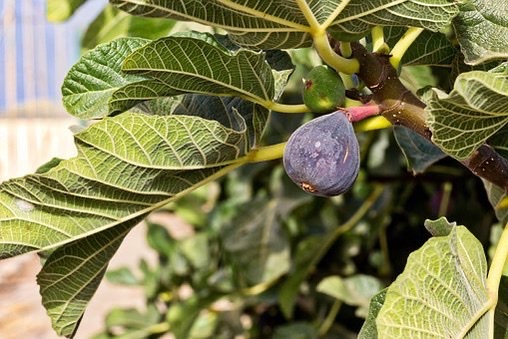
Maybe because we planted two new trees this year at Trinity, I found myself drawn to Jesus’ parable of the fig tree in a new way. Having grown up in the Black Hills surrounded by Ponderosa Pines, I did not have deciduous trees to look at daily. But up on the hill above the house I grew up, tucked behind my favorite rock formation, was a grove of Mountain Aspens. I knew spring had come to the Hills when they started to bud. There might still be a snowfall, but every year, spring came when the green came out of those branches.

That Jesus talks about a fig tree would have been significant to his audience. The fig tree is often used as a metaphor for the peace and prosperity of Israel in the Old Testament. When God promises to bring the people into a land of milk and honey, the land includes fig trees (Deut. 8:8).  In Micah we read, “nation shall not lift up sword against nation, neither shall they learn war anymore; but they shall all sit under their own vines and under their own fig trees.” 

In other words, the fig tree is no stray detail in this morning’s passage. It would be as if someone writing a short story, casually dropped in a reference to an olive branch and a cornucopia. We would know that peace and abundance were behind the images.  

Jesus says to his followers, “So also, when you see these things taking place [the leaves on the fig tree sprouting], you know that the kingdom of God is near.” And we, along with those disciples, connect abundance and peace among and within nations with the kingdom of God. 

These verses today provide encouragement when the very foundation of life seems to be shaken. What do you do when others grow faint “from fear and foreboding” and “the powers of the heavens” are shaken? These descriptions can easily evoke the distress that we feel during anxious, trying, and dangerous experiences in life. What gives you direction when earthquakes occur, loves ones are in harm’s way, your own livelihood is jeopardized, and the future is grim? 

Jesus speaks of the coming of the Son of Man. We can hear assurance that in the worst of times the Son of Man is at hand, coming “with power and glory.” The message is ultimately one of hope, “your redemption is drawing near.” God’s Word will never pass away. God is present.

The other side of this is a bit more instructional. The other side of the assurance is the instruction not to debase life through overindulgence or worry but to pray. That is part of how we actual depend on God for strength to meet life’s challenges.

What might we pray this Advent? How might we voice our dependence on God as everything accelerates in our culture toward the end of December? One suggestion is to use the tool so many of us depend on, whether we like or not: our smart phones. 

As you scroll through text messages, take a breath, and lift up in prayer to God the names attached to your messages.  Look at your last 5-10 photos and pray for the people or places captured. I am an advocate of not constantly checking the news on your phone, but if that’s where you get your news, take a pause with several headlines and pray for God’s kingdom to come.

Another option, the words of our psalm for today could be adopted by one and all during this season of hope and waiting, “Make me know your ways, O Lord; teach me your paths. Lead me in your truth, and teach me, for you are the God of my salvation; for you I wait all day long.” That is a pretty great mantra, to be repeated at the dinner table or while driving or even brushing your teeth: “Make me know your ways, O Lord; teach me your paths. Lead me in your truth.” 

A word of warning, be careful to not sentimentalize this prayer. You might get a jolt. God’s truth and God’s ways may not be what we want to hear. They might be far different than the course we had charted. Furthermore, trusting God’s revelation, trusting that God will reveal the truth to us takes some intentionality and practice. 

Fortunately for us, it does not take brilliance or superpowers or perfection. For our reassurance that God will speak to any and everyone, we only have to remember the cast of characters we will be reintroduced to in the month ahead: John the Baptizer, Elizabeth and Zacharia, Mary and Joseph, the shepherds watching their flocks. They all had very different roles to play, but they all could have prayed, “Make me know your ways, O Lord; teach me your paths. Lead me in your truth.” 

Prayers of Intercession

In this season of watching and waiting, let us pray for all people and places that yearn for God’s presence.

A brief silence.God of presence and peace, strengthen your church around the globe to proclaim the message of your love coming to the world. Open our hearts to recognize your face in all people and in all of creation. Hear us, O God.Your mercy is great.

God of mighty redwoods and microscopic plants, fields and city parks, the wind and the waves, be a healing balm to our wounded planet. May we nurture what you have lovingly created. Hear us, O God.Your mercy is great.

God of equity and compassion, bring righteousness and goodness to all peoples of the earth. Give a heart of discernment and integrity to leaders in our communities (local, state, and national government officials may be named). Hear us, O God.Your mercy is great.

God of comfort and care, be present with those who watch and wait. Come to all who await births, deaths, divorces, new unions, new jobs, retirements, healing, and life transitions of every kind (especially). Hear us, O God.Your mercy is great.

God of promises kept and new dreams awakened, shelter your people from destructive storms. We pray for those whose lives have been upended by natural disasters (especially), for the work of Lutheran Disaster Response, Lutheran World Relief, and other relief organizations. Hear us, O God.Your mercy is great.

Here other intercessions may be offered.God of companionship and community, we give you thanks for the saints who journeyed with us and now abide in you. Even in distress and uncertainty, make us confident that your promises endure forever. Hear us, O God.Your mercy is great.

God of new life, you come among us in the places we least expect. Receive these prayers and those of our hearts, in the name of Jesus.Amen.

Posted in Sermons, Trinity Lutheran, Uncategorized | Leave a comment

Nov. 21, 2021 (Reign of Christ)

Prayer of the Day

Almighty and ever-living God, you anointed your beloved Son to be priest and sovereign forever. Grant that all the people of the earth, now divided by the power of sin, may be united by the glorious and gentle rule of Jesus Christ, our Savior and Lord, who lives and reigns with you and the Holy Spirit, one God, now and forever.Amen.

Daniel 7:9-10, 13-14

 9As I watched,
 thrones were set in place,
  and an Ancient One took his throne,
 his clothing was white as snow,
  and the hair of his head like pure wool;
 his throne was fiery flames,
  and its wheels were burning fire.
 10A stream of fire issued
  and flowed out from his presence.
 A thousand thousands served him,
  and ten thousand times ten thousand stood attending him.
 The court sat in judgment,
  and the books were opened.
13As I watched in the night visions, 
 I saw one like a human being
  coming with the clouds of heaven.
 And he came to the Ancient One
  and was presented before him.
 14To him was given dominion
  and glory and kingship,
 that all peoples, nations, and languages
  should serve him.
 His dominion is an everlasting dominion
  that shall not pass away,
 and his kingship is one
  that shall never be destroyed.

Psalm 93

 1The Lord is king, robed in majesty; the Lord is robed in majesty and | armed with strength.
  The Lord has made the world so sure that it can- | not be moved.
 2Ever since the world began, your throne has | been established;
  you are from | everlasting. R
 3The waters have lifted up, O Lord, the waters have lifted | up their voice;
  the waters have lifted up their | pounding waves.
 4Mightier than the sound of many waters, mightier than the breakers | of the sea,
  mightier is the Lord who | dwells on high.
 5Your testimonies are | very sure,
  and holiness befits your house, O Lord, forever and for- | evermore.

Revelation 1:4b-8

4bGrace to you and peace from him who is and who was and who is to come, and from the seven spirits who are before his throne, 5and from Jesus Christ, the faithful witness, the firstborn of the dead, and the ruler of the kings of the earth. 
  To him who loves us and freed us from our sins by his blood, 6and made us to be a kingdom, priests serving his God and Father, to him be glory and dominion forever and ever. Amen.
 7Look! He is coming with the clouds;
  every eye will see him,
 even those who pierced him;
  and on his account all the tribes of the earth will wail.
So it is to be. Amen.
  8“I am the Alpha and the Omega,” says the Lord God, who is and who was and who is to come, the Almighty.

Christ Monogram with Alpha and Omega, Christian Catacombs-Sousse, Tunisia

John 18:33-37

33Pilate entered the headquarters again, summoned Jesus, and asked him, “Are you the King of the Jews?” 34Jesus answered, “Do you ask this on your own, or did others tell you about me?” 35Pilate replied, “I am not a Jew, am I? Your own nation and the chief priests have handed you over to me. What have you done?” 36Jesus answered, “My kingdom is not from this world. If my kingdom were from this world, my followers would be fighting to keep me from being handed over to the Jews. But as it is, my kingdom is not from here.” 37Pilate asked him, “So you are a king?” Jesus answered, “You say that I am a king. For this I was born, and for this I came into the world, to testify to the truth. Everyone who belongs to the truth listens to my voice.”

Sermon – Pastor Meggan Manlove

I have been singing the chorus to “Ride on King Jesus” in my head all week, preparing for Christ the King or reign of Christ Sunday. A few years ago the song leaders at our regional church conference led a workshop during which they taught us this gospel, in four-part harmony: “Ride on, King Jesus, No man can a hinder me, Ride on, King Jesus, ride on, No man can a-hinder me.”

Explaining what the song meant to the first people who sang it, one historian wrote, “The enslaved people had a powerful imagination that was captivated by the notion of having a king who was powerful enough that absolutely no one could “hinder” him. If Jesus could not be hindered, then they felt agency in their own lives as well, giving them hope. Some versions of this life-affirming song add, “He is the King of Kings, He is the Lord of Lords, Jesus Christ, the First and Last, no man hinders me”! This song captures the aspiration of the hearts of enslaved peoples. Jesus was born a baby, yes, but he was also a king, recalling his triumphal, un-hindered entry into Jerusalem (Eileen Guenther/CMH. “Ride On, King Jesus.” ).

I never know exactly what to do on Reign of Christ Sunday, a festival that can only be traced back to 1925. It is about the end of time which sounds gloomy and dour. But today is about imagining the world as it could be, as God intends it to be. The reign of Christ is breaking in. It is already and not yet here. Reign of Christ is about hope, the hope that enslaved people put in a King who no one could hinder, the hope we have as we wait for Jesus to be born in the manger, the hope we embrace as we imagine what Canyon County could look like for all of its residents. It is the hope that is ours when we ask what future do we imagine? We do well to listen to our various scripture passages for the day.

In Sunday School, many of us learned the story of Daniel in the Lion’s Den.  But Daniel was also a dreamer. Grand associations of kingship fill Daniel’s dream. He dreams of the ancient one riding the heavens. Daniel imagines an eternal lord receiving dominion, glory, and service. He says, “His dominion is an everlasting dominion that shall not pass away, and his kingship is one that shall never be destroyed.” The future is firmly in the hands of the one seated on the throne.

In the book of Revelation, we see a similar ruler. This one is a faithful witness of glory and power. He is “the Alpha and the Omega,” the beginning and the end, the one “who is and who was and who is to come, the Almighty.” This king is a liberator, but he is a strange one. This king challenges just about everything we associate with kingly power because the one seated on the throne is a lamb, not the first animal we connect with power and glory.

These two visions from Daniel and Revelation can make us gasp and make our hearts skip. The books of Daniel and Revelation were both written for people oppressed by the forces of empires—first the Hellenistic Empire and then the Roman Empire. Kingship and the reign of God ends up having a whole lot to do with turning things on their heads, subverting the power of empire, and bringing a new order. Daniel and Revelation are both talking about the judgment of the nations—history’s end.  

The word “end” points to the heart of Reign of Christ Sunday, and not merely because we are at the end of the church year and Advent officially begins next week. “End” means the passing away of what is. It means a transition so pronounced that we can say, “Things will never be the same.”  Facing “the end” means that we must finally recognize our attachments to what is now. This most often happens when some event or illness makes us face our mortality, but a text like today’s can have a similar effect. Ultimately, we must recognize our limitations as mortal human beings. 

In the scene today Pilate hears Jesus say, “My kingdom is not of this world.” Soon after this, Pilate sends Jesus to be crucified. According to Pilate, Jesus is guilty of treason against the Roman Empire. I do not think Pilate does this because he fails to understand Jesus. I think he sends Jesus to be crucified because he does understand Jesus. 

The reign of God was breaking through even then—through Jesus’ ministry among the people. What exactly is the reign of God? This reign of God is not just a reshuffling of this world’s power structures as they are. Jesus is not seizing the Emperor Caesar’s throne in order to replace Caesar. Jesus is not leaving Caesar or his generals in exile to plot a return to power. That would have been more than enough for Pilate to send Jesus to the cross.  But Jesus’ plan is far more radical.  Jesus is not seeking a throne in the world as it is. Jesus is inaugurating the end of this world.

To be clear, I am not talking about the destruction of the planet.  This is crucial to understand in the wake of the Left Behind series and other stories that send a similar message. Destruction of the planet does not make sense from a biblical perspective. There is a clear mantra in Genesis 1.  Each part of creation is deemed “good.” And when God made humankind God said it was “very good.” And the most famous Bible verse reminds us that God so loved the world that God sent the Son that we might have abundant and eternal life. God does not intend destruction for Creation or for humankind.

So, what do we mean when we talk about “the end of the world” in Daniel, Revelation, and the gospel?  We mean that a sharp transition is on the way.  Pilate liked the world ordered by empires. He did not like Jesus’ plan for a transition. Someone who likes the world ordered by empires will probably receive the news of the world’s end as very bad news, at least initially.  

We long for change, for daily changes and for big structural and systemic changes. Have you ever spelled out or drawn your vision for our larger community? One of my favorite writing exercises was for a poem whose title was Borrow My Vision. Borrow my vision and you will see, and I had to write all the things one could see in my picture of Canyon County as it could be. The next prompt was, “with my ears.” What sounds could we hear? Whose voices would we hear if the reign of God came fully to our region? Then “with my mouth,” “with my arms,” “with my mind,” “with my feet,” “with my heart.” Each one of us has within us a vision of the world and our locale as it could be if the reign of God was fully realized. 

This is a powerful exercise because it opens up our imaginations and helps us picture what we are working towards, not just what we might want to fight against. What are the small and large images, smells, and sounds percolating in your imagination as you dream about our region as it could be?

This week I have also been humming to myself Joy to the World, which is of course traditionally a Christmas hymn. However, it also fits today’s festival perfectly. It is so ingrained to us to imagine the Christ child while singing the first verse, but what if we imagined it as a prayer for the end of the world as it is, for Christ’s reign to come fully now, “Joy to the world, the Lord is come! Let earth receive her king; let every heart prepare him room and heaven and nature sing.” The third verse imagines the world as it could be, “No more let sin and sorrow grow nor thorns infest the ground; he comes to make his blessings flow.”

Every week we pray the Lord’s Prayer together and we ask for God’s kingdom to come. And each time two or three of us gathers, Jesus is come.  Each time we celebrate the Lord’s Supper, Christ is come—in the bread and wine, in the words “given for you for the forgiveness of sin.”  Christ is come when a baby is brought to the font and made a child of God, a member of the body of Christ, even when the infant has no idea what is happening. Every time we proclaim the Good News that the world of empires is passing away, and God’s dream for Creation is breaking through even now, Jesus is come. When we proclaim that Jesus alone is Lord, Jesus’ reign breaks through. Amen.  

Prayers of Intercession (Sundays and Seasons)

Eternal God, you hold firm amid the changes of this world. Hear us now as we pray for the church, the world, and everyone in need.

A brief silence.God, you sent your Son Jesus to testify to the truth. We pray for preachers, missionaries, evangelists, and teachers who carry your forgiveness and love to the world. Fill their words and actions with compassion and kindness so that your truth will shine. God, in your mercy,hear our prayer.

God, you sent your Son Jesus to liberate all of creation. We pray for all living things longing for the freedom to flourish, from ancient trees and wild grasses to endangered animals and rare insects. Give human beings compassionate hearts to care for them. God, in your mercy,hear our prayer.

God, you sent your Son Jesus to lead us into the way of peace. Direct the members of international alliances in choosing a nonviolent path toward the future. Give them the humility and wisdom to make just decisions to benefit all. God, in your mercy,hear our prayer.

God, you sent your Son Jesus to make us into your own people, set free to serve you. We pray for people who serve the well-being of others, especially ministries in our community (local social ministries or agencies may be named). Renew them in their work. God, in your mercy,hear our prayer.

God, you sent your Son Jesus to rule in all times and places. We pray for the friends of our congregation who are unable to join our worship in person and for all who are sick and suffering (especially). Join their prayers with ours and unite them with us in the body of Christ. God, in your mercy,hear our prayer.

Here other intercessions may be offered.God, you sent your Son Jesus to be our beginning and our ending. We give thanks for those whose lives have given us a glimpse of Jesus’ reign of justice and peace. Empower us to join their witness. God, in your mercy,hear our prayer.

God our hope and strength, we entrust to you all for whom we pray. Remain with us always, through Jesus Christ, our Savior.Amen.

Posted in Sermons, Trinity Lutheran | Leave a comment

Nov. 14, 2021

Prayer of the Day

Almighty God, your sovereign purpose brings salvation to birth. Give us faith to be steadfast amid the tumults of this world, trusting that your kingdom comes and your will is done through your Son, Jesus Christ, our Savior and Lord.Amen.

Hebrews 10:11-14 [15-18] 19-25

11Every priest stands day after day at his service, offering again and again the same sacrifices that can never take away sins. 12But when Christ had offered for all time a single sacrifice for sins, “he sat down at the right hand of God,” 13and since then has been waiting “until his enemies would be made a footstool for his feet.” 14For by a single offering he has perfected for all time those who are sanctified. [15And the Holy Spirit also testifies to us, for after saying,
 16“This is the covenant that I will make with them
  after those days, says the Lord:
 I will put my laws in their hearts,
  and I will write them on their minds,”
17he also adds, 
 “I will remember their sins and their lawless deeds no more.”
18Where there is forgiveness of these, there is no longer any offering for sin.] 

  19Therefore, my friends, since we have confidence to enter the sanctuary by the blood of Jesus, 20by the new and living way that he opened for us through the curtain (that is, through his flesh), 21and since we have a great priest over the house of God, 22let us approach with a true heart in full assurance of faith, with our hearts sprinkled clean from an evil conscience and our bodies washed with pure water. 23Let us hold fast to the confession of our hope without wavering, for he who has promised is faithful. 24And let us consider how to provoke one another to love and good deeds, 25not neglecting to meet together, as is the habit of some, but encouraging one another, and all the more as you see the Day approaching.

Mark 13:1-8

1As [Jesus] came out of the temple, one of his disciples said to him, “Look, Teacher, what large stones and what large buildings!” 2Then Jesus asked him, “Do you see these great buildings? Not one stone will be left here upon another; all will be thrown down.”
  3When he was sitting on the Mount of Olives opposite the temple, Peter, James, John, and Andrew asked him privately, 4“Tell us, when will this be, and what will be the sign that all these things are about to be accomplished?” 5Then Jesus began to say to them, “Beware that no one leads you astray. 6Many will come in my name and say, ‘I am he!’ and they will lead many astray. 7When you hear of wars and rumors of wars, do not be alarmed; this must take place, but the end is still to come. 8For nation will rise against nation, and kingdom against kingdom; there will be earthquakes in various places; there will be famines. This is but the beginning of the birth pangs.”

Sermon – Pastor Meggan Manlove

My focus this morning will be on our passage from Hebrews chapter 10, particularly those final verses that seem to say a great deal to a people experiencing in-person gathering after some time away. I must admit that I have a weird relationship to the book of Hebrews. As a whole, it would perhaps not make my top-ten list of favorite books of the Bible and yet there are a few choice passages that I absolutely love.

The book is a sermon written for a community of people who were never eyewitnesses to the ministry of Jesus. The sermon addresses a situation of malaise experienced by Christians some decades after the ministry of Jesus ended. It brings a word of encouragement to discouraged Christians. They once had a vivid sense of God’s presence and later showed bold support for others during an outburst of persecution. Yet, as time dragged on, the malaise set in. 

The author attempts to embolden them by telling of the way Jesus went through suffering into glory, making a way for others to follow. As high priest, Jesus Christ brings others into a new covenant relationship with God. People are therefore called to persevere in faith, knowing that God will be faithful.

The passage most applicable to our life together today begins with some language that may feel as distant as the Middle East: 19 Therefore, my friends,g since we have confidence to enter the sanctuary by the blood of Jesus, 20 by the new and living way that he opened for us through the curtain (that is, through his flesh), 21 and since we have a great priest over the house of God, 22 let us approach with a true heart in full assurance of faith, with our hearts sprinkled clean from an evil conscience and our bodies washed with pure water.

It helps to know that the inner chamber of Israel’s sanctuary was the holy of holies, where only the high priest was permitted to approach God. People like you and me simply would not have access to God. Yet here, the author of Hebrews invites all who have been redeemed by Christ the high priest to follow him into the presence of God in the sanctuary. 

The invitation flips everything. First the invitation does not refer to a physical movement into a holy place. Instead, the invitation is to a movement of faith. By holding firmly to the confession of faith in what Christ has done, people can approach God confidently in prayer and continue joining together with others in worship. 

It might be hard for us to imagine not having access to God through Jesus. In some ways that’s a good thing, it illustrates our familiarity with the miracle of the incarnation, God living among us. But we don’t want to fall into a type of malaise like the original hearers of Hebrews. 

The primary reason we read scripture, alone or in an assembly like this one, is to be reminded of the good news of Jesus Christ–bringer of salvation and healing for a broken world and broken people. God did not look down from a distant heaven and say, “There, there, it’s all right.” Instead, in Jesus, God entered into the full range of human suffering and tragedy.

The author of Hebrews has two interconnected goals: renew a sense of personal trust in this God of healing and wholeness and a revitalized commitment to life in community. It seems that this last chapter was a great time to nurture habits and practices in our personal trust in God. There was time and opportunity and need. 

Many of us experienced isolation, to varying degrees. In some cases, our bodies got sick. In other cases, our minds and spirits were hurting. I hope you found or rediscovered ways to connect personally with the God of healing and wholeness. The words from Hebrews were an exhortation for all of us, “let us approach with a true heart in full assurance of faith.” What is this “faith” the author speaks of? In the very next chapter we read, “Now faith is the substance of things hoped for.” Bring to God your faith/hope or your hope/faith. And never doubt God’s own faithfulness; it is the thing that gives us hope.

In this particular moment in time, we may be more appreciative than ever that the author lifts up both the need to approach God on one’s own and the necessity of community. German Lutheran Dietrich Bonhoeffer wrote about this balance in his book Life Together: “Let him who cannot be alone beware of community… Let him who is not in community beware of being alone… Each by itself has profound perils and pitfalls. One who wants fellowship without solitude plunges into the void of words and feelings, and the one who seeks solitude without fellowship perishes in the abyss of vanity, self-infatuation and despair.” 

Why is the embodied community part of the life of faith? Can’t we simply know that Christian community exists? Is actual participation necessary? When participation is possible, we would have to say yes, because that’s how Jesus set it up. Following Jesus, the Messiah, the Christ, being Christian means being part of a meal-fellowship. 

Hearing the Word and gathering at the table is central to who we are and how we are shaped. We return to the table to meet one another and to encounter the risen Christ in wine and bread. We are sent from the table for, as this morning’s author says, love and good deeds. As the author is exhorting the original readers, so the readers are to exhort one another.  

“And let us consider how to provoke one another to love and good deeds, not neglecting to meet together, as is the habit of some, but encouraging one another.” The author’s specific words are almost eerie to me, as if peering centuries ahead into America’s culture of individualism. The writer emphasizes that these practices are best cultivated within the life of the Christian community as it comes together to worship, enjoy fellowship, and provoke one another to acts of Christlike service.

Before her Affirmation of Baptism, Diane talked about how our Confirmation classes gave her an opportunity to be around other people who had the same questions, which helped her feel more comfortable asking questions about faith. Children and youth who attend Luther Heights Bible Camp share a similar sentiment, that being around other youth who are on similar faith journeys buoys them. Jason summed this up in his quote in the recent camp publication. Reflecting on the program the final night of camp he wrote, “it gave us time to slow down, realize how much we had grown, how each of us were different but had many gifts, and God’s love for us.”

Most of us have been adults for quite a while, but I would venture to bet that each of us still needs that kind of experience. That’s hopefully the chief reason we show up in assemblies like this one. Where exactly we meet is not nearly as important as what we do: hear the Word, share the meal, pray for the world, be sent out for love and good deeds.

Dorothy Day puts it this way, “We cannot love God unless we love each other, and to love we must know each other. We know [God] in the breaking of bread, and we are not alone anymore. Heaven is a banquet and life is a banquet, too, even with a crust, where there is companionship.

We have all known the long loneliness and we have learned that the only solution is love and that love comes with community.”

Thanks be to God.

Prayers of Intercession (from Sundays and Seasons)

Eternal God, you hold firm amid the changes of this world. Hear us now as we pray for the church, the world, and everyone in need.

A brief silence.God our creator, you show us the path of life. Bless faithful people everywhere with humility as they extend compassion to those who have experienced harm in religious spaces. Cultivate healthy congregations that tell of and enact your reconciling love. God, in your mercy,hear our prayer.

God our constant, you love our universe from beginning to end. As the seasons change, protect animals that migrate and hibernate. Bring them safely to a sheltered place and a more abundant season. God, in your mercy,hear our prayer.

God our ruler, you write your law on human minds and hearts. Give wisdom to all elected leaders and officials to govern with insight and compassion. Make them mindful of the well-being of all people so that your world will flourish. God, in your mercy,hear our prayer.

God our stronghold, you are present amid disaster. We pray for those affected by natural disasters (recent natural disasters may be named). Come to the aid of all survivors of earthquakes, famines, floods, hurricanes, and wildfires, and the first responders who support them. Calm their fear, supply their need, and be the solid ground beneath their feet. God, in your mercy,hear our prayer.

God our guide, you are greater than we can imagine. Surround congregations with your expansive inclusion. Be present in the midst of disagreements, differences, and questions. Unite people of diverse viewpoints in the love of Christ. God, in your mercy,hear our prayer.

Here other intercessions may be offered.God our beginning and our end, your beloved people shine like the brightness of the sky. We thank you for the lives of all who rest in your eternal mercy, from famous saints to the people we have loved (especially). Assure us of your resurrection promise. God, in your mercy,hear our prayer.

God our hope and strength, we entrust to you all for whom we pray. Remain with us always, through Jesus Christ, our Savior.Amen.

Posted in Sermons, Trinity Lutheran | Leave a comment

A Father’s Love

Originally posted on tvprays.org

“For now we see in a mirror, dimly, but then we will see face to face. Now I know only in part; then I will know fully, even as I have been fully known. And now faith, hope, and love abide, these three; and the greatest of these is love.” (1 Cor. 13:12-13). 

I realized this last year that there were many pieces of my dad that I lost before his actual death in December 2020. My dad, whose birthday was Nov. 10, used to give the best bear hugs but depending on a walker and sitting in his individual chair rather than the sofa changed the frequency with which he gave hugs. I am convinced I am a pastor, at least in part, because of singing with my dad’s beautiful baritone voice for years in the car and in the church pew. But he did not sing as much in the last few years. Everyone who met my dad talked about his laugh and that too tapered off with age. What never left was my dad’s love. One of his last good days in the residential Hospice, after mom and I decided to go home for the day, I told him I loved him. He grabbed my arm, looked me straight in the eye and said in an urgent whisper, “I love you too!” He meant it and he wanted me to hear it. Dad’s love for kids, for those experiencing homelessness, for the marginalized was also steady throughout his life, including his final days. He tried to always see with the eyes of faith and a heart full of love. He yelled at the television over injustices even in the last weeks of his life. Whenever we talked, he asked about Trinity New Hope (affordable housing) and Peace Camp–ministries serving the neighbor. Love remained even when other pieces of him faded away. So much has changed for followers of Jesus in the past 18 months–the way we gather for studies, the way we worship, the needs of our local community and the global community. What has remained steady is God’s love for the world and the imperative to love our neighbor. The incarnation is one of the greatest reminders of God’s love. Not unlike my dad making sure I heard him voice his love for me, God says “I love you so much world that I am going to come and live among you!” 

Gracious God, you came as Immanuel, God with us. You are love and for that we give thanks. Teach us to love one another. Amen.

Posted in Reflections | 1 Comment

Nov. 7, 2021, All Saints

Prayer of the Day

Almighty God, you have knit your people together in one communion in the mystical body of your Son, Jesus Christ our Lord. Grant us grace to follow your blessed saints in lives of faith and commitment, and to know the inexpressible joys you have prepared for those who love you, through Jesus Christ, our Savior and Lord, who lives and reigns with you and the Holy Spirit, one God, now and forever.Amen.

Isaiah 25:6-9

 6On this mountain the Lord of hosts will make for all peoples
  a feast of rich food, a feast of well-aged wines,
  of rich food filled with marrow, of well-aged wines strained clear.
 7And he will destroy on this mountain
  the shroud that is cast over all peoples,
  the sheet that is spread over all nations;
  8he will swallow up death forever.
 Then the Lord God will wipe away the tears from all faces,
  and the disgrace of his people he will take away from all the earth,
  for the Lord has spoken.
 9It will be said on that day,
  Lo, this is our God; we have waited for him, so that he might save us.
  This is the Lord for whom we have waited;
  let us be glad and rejoice in his salvation.

Psalm 24

 2For the Lord has founded it up- | on the seas
  and established it up- | on the rivers. 
 3Who may ascend the mountain | of the Lord,
  and who may stand in God’s | holy place?
 4Those of innocent hands and puri- | ty of heart,
  who do not swear on God’s being, nor do they pledge by | what is false.
 5They shall receive blessing | from the Lord
  and righteousness from the God of | their salvation.
 6Such is the generation of those who seek | you, O Lord,
  of those who seek your face, O | God of Jacob. 
 7Lift up your heads, O gates; and be lifted up, O ever- | lasting doors,
  that the King of glory | may come in.
 8Who is this | King of glory?
  The Lord, strong and mighty, the Lord, might- | y in battle!
 9Lift up your heads, O gates; and be lifted up, O ever- | lasting doors,
  that the King of glory | may come in.
 10Who is this | King of glory?
  Truly, the Lord of hosts is the | King of glory.

Revelation 21:1-6a

1I saw a new heaven and a new earth; for the first heaven and the first earth had passed away, and the sea was no more. 2And I saw the holy city, the new Jerusalem, coming down out of heaven from God, prepared as a bride adorned for her husband. 3And I heard a loud voice from the throne saying, 
 “See, the home of God is among mortals.
 He will dwell with them;
 they will be his peoples,
 and God himself will be with them;
 4he will wipe every tear from their eyes.
 Death will be no more;
 mourning and crying and pain will be no more,
 for the first things have passed away.”
  5And the one who was seated on the throne said, “See, I am making all things new.” Also he said, “Write this, for these words are trustworthy and true.” 6aThen he said to me, “It is done! I am the Alpha and the Omega, the beginning and the end.”

John 11:32-44

32When Mary came where Jesus was and saw him, she knelt at his feet and said to him, “Lord, if you had been here, my brother would not have died.” 33When Jesus saw her weeping, and the Jews who came with her also weeping, he was greatly disturbed in spirit and deeply moved. 34He said, “Where have you laid him?” They said to him, “Lord, come and see.” 35Jesus began to weep. 36So the Jews said, “See how he loved him!” 37But some of them said, “Could not he who opened the eyes of the blind man have kept this man from dying?”

  38Then Jesus, again greatly disturbed, came to the tomb. It was a cave, and a stone was lying against it. 39Jesus said, “Take away the stone.” Martha, the sister of the dead man, said to him, “Lord, already there is a stench because he has been dead four days.” 40Jesus said to her, “Did I not tell you that if you believed, you would see the glory of God?” 41So they took away the stone. And Jesus looked upward and said, “Father, I thank you for having heard me. 42I knew that you always hear me, but I have said this for the sake of the crowd standing here, so that they may believe that you sent me.” 43When he had said this, he cried with a loud voice, “Lazarus, come out!” 44The dead man came out, his hands and feet bound with strips of cloth, and his face wrapped in a cloth. Jesus said to them, “Unbind him, and let him go.”

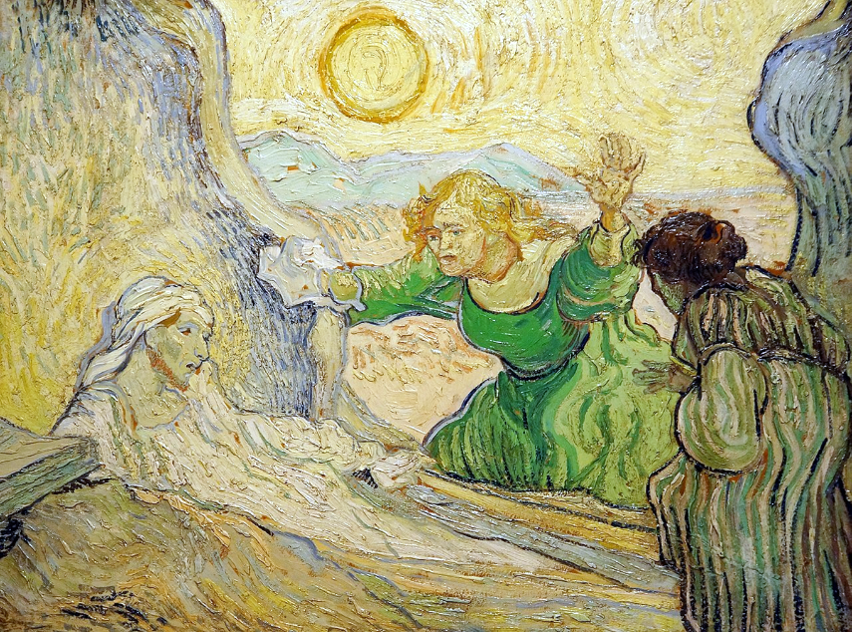
Raising of Lazarus  —  Vincent van Gogh, Van Gogh Museum, Amsterdam, Netherlands

Sermon – Pastor Meggan Manlove

Someone wise pointed out the combination of complaint and confidence in this morning’s gospel story. Mary says, “Lord, if you had been here, my brother would not have died.” In that one statement alone, we hear the complaint that Jesus was not here and the confidence that he is able to heal, to overcome death.

Mary’s words and their motivations speak volumes for what it has always meant to be a follower of Jesus. But they are especially appropriate for All Saints Sunday–when we grieve the ones who have died and simultaneously confess our faith in a God of resurrection. Complaint and confidence. These two words may also capture how we feel and what we want to express in every challenging season of life.

We were dropped into the middle of the story this morning. Lazarus has been in the tomb for four days. His death is final. Jesus did not come when he first heard that Lazarus was ill. He delayed so he could show God’s glory. In raising Lazarus, Jesus conquers death. 

Raising Lazarus from the dead was Jesus’ seventh and greatest sign. This sign was also the final straw. The decision to put Jesus to death results from his giving life to Lazarus. The village of Bethany, the scene for this text, is just east of Jerusalem. As he performs his last sign, Jesus is approaching his own death and resurrection. Raising Lazarus is the miracle, but more awesome is what is being illustrated.

Earlier in the story, Jesus said, “I am the resurrection and the life. Those who believe in me, even though they die, will live, and everyone who lives and believes in me will never die.” God has power over life and death. Today’s text from Isaiah is clear about this. “God will destroy on this mountain the shroud that is cast over all peoples, the sheet that is spread over all nations; God will swallow up death forever.” 

Jesus is one with the Father and he shares God’s power over life and death. But Jesus is not only one with God. He is fully human. Because he has so clearly identified with us, his death becomes our death. But his resurrection also becomes our resurrection. This resurrection gives us freedom to face the future in a counter-cultural way.

Today, we are again reminded that what truly gives life is Jesus himself. Jesus raised each one of us in holy baptism. In the waters of the baptismal font, we hear God speak this word of life and resurrection. Lifting us out of the waters, God frees us from death and dresses us in the royal clothing of Christ. At the table, we feast with the God who swallows up death forever. The holy meal is a foretaste of the great and promised feast where death and pain will be no more. The last word is not death, but life as a beloved child of God.

So Jesus is the giver of life. But we are the ones who unbind. Jesus tells us, as he told the onlookers by Lazarus’ tomb, unbind him. “Unbind one another,” Jesus commands us. We might be called to unbind one another from obsessing about how to take control of our lives. We might be called to help unbind so many from fear. Or maybe we are called to physically unbind people from abusive relationships or other conflicts. 

One challenge of following Jesus is discerning the specific calling to unbind. It varies by context. But wherever we are located, we have freedom, freedom to care for the world God has made. Our hope is no longer that we might escape from this world. Escaping this world is neither the goal nor the hope nor the focus. Jesus turns things on their head. Our hope is transformed. Our hope is in God’s plan of healing and reconciliation and recovery for the world.

Today we lift before God those who, during the past year were brought into the sainthood through the waters of Holy Baptism. We lift before God those who, during the past year, entered into the eternal sainthood of the Church. In Jesus, death will be no more. In Jesus, God makes a home with humankind and all creation. 

I love All Saints Sunday because we remember the giants of the faith who have gone before us and set an example. In my first internship church in Chicago we had banners up on this Sunday of modern saints, people not yet canonized by our Roman Catholic brothers and sisters but recognized as pillars: Dietrich Bonhoeffer, Mother Teresa, Martin Luther King Junior, and Oscar Romero. Every continent and country and ministry can lift up and be influenced by particular saints who create the great cloud of witnesses.

On All Saints Sunday, we also take time to remember all those who have died in the past year. We know through conversations with one another and through the prayer concerns listed in our bulletin that many of us have lost family members and friends dear to us, some listed but many are not. 

Losing people is hard and painful and life is not the same after someone we love dies. When Jesus learns that Lazarus has died, he is greatly disturbed. His world is not the same. The same is true for us, and no one should belittle another individual’s or community’s grief. It is right and good to take time to honor our grief.

Finally, All Saints Sunday reminds us that we Christians mourn death in a particular way. We grieve, to be sure. But we grieve as a people with hope. We trust that resurrection follows death. We cling to those promises made in Holy Baptism. When we place the white funeral pall over a coffin, we remember that our loved one remains clothed with Christ.

What do we pray in the midst of our collective story, our grief and our hope? I’d like to close with the prayer from our graveside committal service. Let us pray, “Holy God, holy and powerful, by the death and burial of Jesus your anointed, you have destroyed the power of death and made holy the resting places of all your people.  Keep our brother safe, whose body we now lay to rest, in the company of all your saints.  And at the last, O God, raise him up to share with all the faithful the endless joy and peace won through the glorious resurrection of Christ our Lord, who lives and reigns with you and the Holy Spirit, one God, now and forever.”

Prayers of Intercession

Eternal God, you hold firm amid the changes of this world. Hear us now as we pray for the church, the world, and everyone in need.

A brief silence.Merciful God, we give thanks for all missionaries who have brought your message of hope to new communities and wiped tears away (especially John Christian Frederick Heyer, Bartholomaeus Ziegenbalg, Ludwig Nommensen whom we commemorate today). Continue to raise up courageous missionaries to share your gospel of hope. Hear us, O God.Your mercy is great.

Creating God, we praise you for abundant harvests and the goodness of creation. Create communities of care for your earth so that all land, water, and soil will be celebrated and cherished by future generations of saints. Hear us, O God.Your mercy is great.

God of peace, we give you thanks for nations of peace that serve as a refuge for all whose homelands are afflicted with violence. Strengthen those who continue to work for peace and support all veterans who carry the scars of war. Hear us, O God.Your mercy is great.

God of healing, we give you thanks for health care workers who labor around the clock to answer cries for help. Bring wholeness to all who struggle with post-traumatic stress disorder, anxiety, depression, addiction, and all who long for healing in any way (especially). Hear us, O God.Your mercy is great.

God of justice, we praise you for the feeding ministries and for all meals that bring people together for nourishment and fellowship. Bless chefs, bakers, servers, dishwashers, communion assistants, and meal ministry coordinators. Hear us, O God.Your mercy is great.

Here other intercessions may be offered.God of the ages, we give you thanks for the saints of this congregation who have inspired, challenged, loved, and taught us (those who have died during the past year may be named). Wipe away our tears and lead us by their example until we feast together on your holy mountain. Hear us, O God.Your mercy is great.

God our protection and strength, we entrust to you all for whom we pray. Remain with us always, through Jesus Christ, our Savior.Amen.

Posted in Sermons, Trinity Lutheran | Leave a comment

Oct. 31, 2021 Reformation/Confirmation

Prayer of the Day

Almighty God, gracious Lord, we thank you that your Holy Spirit renews the church in every age. Pour out your Holy Spirit on your faithful people. Keep them steadfast in your word, protect and comfort them in times of trial, defend them against all enemies of the gospel, and bestow on the church your saving peace, through Jesus Christ, our Savior and Lord, who lives and reigns with you and the Holy Spirit, one God, now and forever.Amen.

Deuteronomy 6:1-9

[Moses said to the people,] 1Now this is the commandment—the statutes and the ordinances—that the Lord your God charged me to teach you to observe in the land that you are about to cross into and occupy, 2so that you and your children and your children’s children may fear the Lord your God all the days of your life, and keep all his decrees and his commandments that I am commanding you, so that your days may be long. 3Hear therefore, O Israel, and observe them diligently, so that it may go well with you, and so that you may multiply greatly in a land flowing with milk and honey, as the Lord, the God of your ancestors, has promised you.
  4Hear, O Israel: The Lord is our God, the Lord alone. 5You shall love the Lord your God with all your heart, and with all your soul, and with all your might. 6Keep these words that I am commanding you today in your heart. 7Recite them to your children and talk about them when you are at home and when you are away, when you lie down and when you rise. 8Bind them as a sign on your hand, fix them as an emblem on your forehead, 9and write them on the doorposts of your house and on your gates.

Psalm 119:1-8

 1Happy are they whose | way is blameless,
  who follow the teaching | of the Lord!
 2Happy are they who observe | your decrees
  and seek you with | all their hearts,
 3who never do | any wrong,
  but always walk | in your ways.
 4You laid down | your commandments,
  that we should | fully keep them. 
 5Oh, that my ways were made | so direct
  that I might | keep your statutes!
 6Then I should not be | put to shame,
  when I regard all | your commandments.
 7I will thank you with | a true heart,
  when I have learned your | righteous judgments.
 8I will | keep your statutes;
  do not utter- | ly forsake me. 

Mark 12:28-34

28One of the scribes came near and heard [Jesus and the Sadducees] disputing with one another, and seeing that [Jesus] answered them well, he asked him, “Which commandment is the first of all?” 29Jesus answered, “The first is, ‘Hear, O Israel: the Lord our God, the Lord is one; 30you shall love the Lord your God with all your heart, and with all your soul, and with all your mind, and with all your strength.’ 31The second is this, ‘You shall love your neighbor as yourself.’ There is no other commandment greater than these.” 32Then the scribe said to him, “You are right, Teacher; you have truly said that ‘he is one, and besides him there is no other’; 33and ‘to love him with all the heart, and with all the understanding, and with all the strength,’ and ‘to love one’s neighbor as oneself,’—this is much more important than all whole burnt offerings and sacrifices.” 34When Jesus saw that he answered wisely, he said to him, “You are not far from the kingdom of God.” After that no one dared to ask him any question.


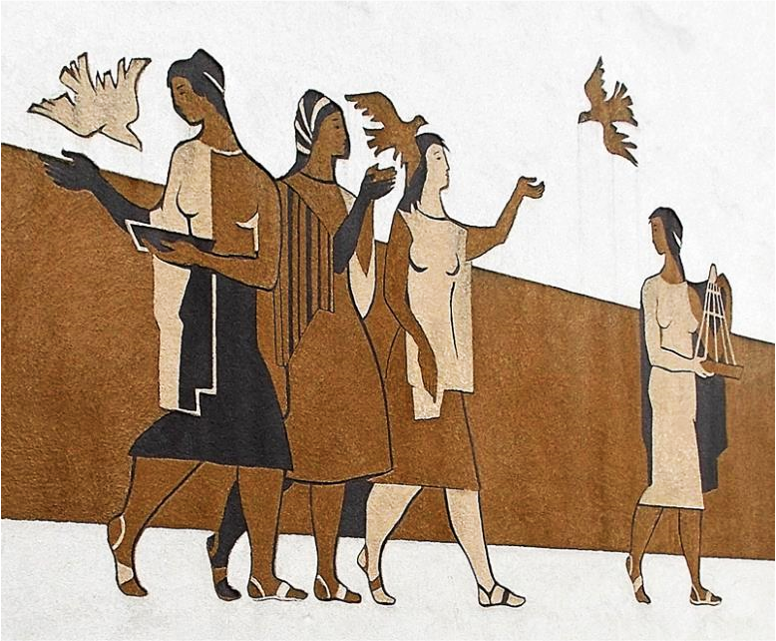
Peace  —  Andre Michnay, Oroszlány, Hungary

Sermon – Pastor Meggan Manlove

What a great gospel for a festival Sunday! This morning we will all participate as Diane affirms her baptism in the presence of this assembly. I will ask her if she intends to continue in the covenant God made with her in holy baptism, specifically to live among God’s faithful people, to hear the word of God and share in the Lord’s supper, to proclaim the good news of God in Christ through word and deed, to serve all people, following the example of Jesus, and to strive for justice and peace in all the earth. 

At the heart of these collective promises and at the heart of the Christian faith are the two great commandments that Jesus names in Mark chapter 12: Love the Lord your God and love your neighbor as yourself. These commands provide the framework for ethical thinking and actions, theological reflection, and biblical interpretation. They also guide much of our instruction and conversations in Confirmation classes. So, echoes of the two great commandments were heard in Diane’s responses just moments ago.

It should not surprise us that Jesus first quotes Deuteronomy 6, known as the Shema: Hear O Israel: The Lord is our God, the Lord alone. You shall love the Lord your God with all your heart, and with all your soul, and with all your mind.” This was central to the people’s identity and life. More surprising is Jesus quoting the verse from Leviticus.

It may help us to know that this verse is the culmination of a litany of commands prohibiting the oppression and exploitation of the weak and poor. The litany includes- leave your field for the sojourner to glean, do not steal, deal falsely, or profane God, do not oppress the neighbor, exploit the employees, or discriminate against the disabled; do not show partiality in judgment. 

The two commands Jesus names make us ask if our words and actions reflect and embody love of God and love of neighbor. When we read Scripture, we might ask whether the text inspires us to love God and neighbor. The 16th century church reformers, who we also celebrate today, knew that love of God and love of neighbor needed some specificity, needed interpretation for each time and space. 

Martin Luther’s explanations of the Ten Commandments adds a positive command, instructing us what to do after explaining what we shall not do. The explanations are surprisingly relevant today. Take for example his explanation to the 7th Commandment, you shall not steal: “We are to fear and love God, so that we neither take our neighbors’ money or property nor acquire them by using shoddy merchandise or crooked deals, but instead help them to improve and protect their property and income.” 

Or the explanation to the 8th commandment, you shall not bear false witness: “We are to fear and love God, so that we do not tell lies about our neighbors, betray or slander them, or destroy their reputations. Instead, we are to come to their defense, speak well of them, and interpret everything they do in the best possible light.”

Neighbor love has always been about both our daily interactions with individuals (co-workers, next door neighbors, strangers on the interstate) and changing the systems and networks we all live in. Yes, it absolutely matters how we treat the cashier and the relative with whom we disagree on everything. Neighbor love is also expressed in how we spend our money and time and how we vote. 

Interconnected to our love for God and love of neighbor is self-love, which Jesus’ words absolutely imply. One of my teachers [RHW] writes powerfully about this: “My faith journey has led me to understand that loving yourself is necessary to loving others. The more that I have leaned into God’s love for me, the more that I understand how revolutionary and absolutely necessary it is to love myself, without apology. And when I love myself and my God, I can love others in ways that I didn’t even know were possible.” 

I, Meggan, think it is no accident that Jesus commands us to love our neighbors as ourselves. If there is not deep, authentic, self-love, it’s nearly impossible to truly love our neighbors. 

We are called back, once again, to the heart of faith for the sake of the kingdom of God. Jesus’ words to the questioning scribe offer a sharp critique of the teachings of the scribes, who have been guardians of the religious establishment. At every turn the scribes have opposed Jesus with questions about his authority and the source of his power. 

Jesus has demonstrated that the scribes are on the wrong side of the work of God. But in today’s story, a scribe stands in solidarity with Jesus. The scribe shares Jesus’ anguish over a temple cult that has lost its soul and purpose, its moral authority, its heart for renewal, and can no longer hear, discern ore respond to God’s voice. 

Martin Luther and the other reformers were not Christ come again. They were flawed human beings. And yet their legacy of reforming the church is one worth celebrating. Maybe it is their very imperfections that give us hope today–hope that we who follow in their footsteps can reform the church once again, help bring the larger church back to these two crucial commands. 

Instead of pointing fingers at who is getting it wrong, we can show love and acceptance to people who have been hurt by the church. Instead of fighting over all that might divide us we can come together over neighbor-love practices that most of us agree on, such as food access, affordable housing, child poverty, saving the planet, and sharing the good news about a God who first loves us with abundance.

Today we celebrate this good news. In the ministry of Jesus, the proclamation of the good news is accompanied by the casting out of demons and the healing of many who are sick. It is the good news of God that does not command, coerce, or mandate love, but rather evokes worship, love and obedience. 

The story of love is not complete until we see the cross of Jesus and power of God wielded there. The Gospel presents us with love, worship, and discipleship. It invites us to anticipate that the scribe will experience the full life of love of God, neighbor, and self when love embraces him. In joyful response, we follow where only love can lead.

Prayers of Intercession (adapted from Sundays and Seasons by Mary Braudrick)

Made children and heirs of God’s promise, we pray for the church, the world, and all in need. (A brief silence)

God of true might and redemptive mercy, We pray for all who long for a word of truth and long for the radical grace that flows from the cross. Inspire congregations to freely and boldly proclaim your love for all people, with persistence and hope. Lord, in your mercy, hear our prayer.God of new beginnings, 

We pray for your creation, for mountains, rivers, streams, cities, homesteads and neighborhoods. Write on our hearts a new love and care for creation. Give us the will to curb wasteful habits. May we hold accountable those people who have not cared enough and have damaged the earth. May we do our part to restore it. Lord in your mercy, hear our prayer.

God, the giver of life, You intend for humans to live together in peace. In these days of grief over gun violence, we pray for your presence among us. We remember before you the victims in the recent shooting in our community: Jo Acker and Roberto Padilla Arguelles. Bring comfort to their families whose lives are forever changed. Grant healing and wholeness to the survivors who were wounded or traumatized. Each name you know. May your mercy be upon the one who fired the weapon and also died; whose name you also know. Console his family with your grace. We commend them ALL to your steadfast love. Lord in your mercy,Hear our prayer.

God of compassion,We give you thanks for the first responders, for police officers, firefighters, EMTs and all who offer compassionate aid in situations of tragedy.  Give them courage, sound judgement, safety and support as they risk their lives for others. Lord in your mercy, Hear our prayer. 

God of justice, We pray for all who aspire to public office and for all who will vote on Tuesday at local polling places. May we see clearly our civic duty to vote as appropriate. Pour wisdom and understanding upon all who govern so that communities of justice and peace may thrive. Lord in your mercy, Hear our prayer.

God of righteousness, We pray for all who, in these present days, seek to grow in faith and love of you. We give you thanks for all the saints and reformers who have gone before us who dwell in your holy habitation. Give us courage through their example to challenge unjust systems and work toward life-giving reformation. Lord in your mercy, Hear our prayer. 

God of peace, By your mercy, make us instruments of your peace. Receive these earnest, spoken prayers, O God, and those in our hearts known only to you; through Jesus Christ our Lord. Amen. 

Posted in Sermons, Trinity Lutheran | Leave a comment

Grief and Hope

Originally published on tvprays.org

Psalm 13 (from Evangelical Lutheran Worship)

1How long, O Lord? Will you forget me forever?

How long will you hide your face from me?

2How long shall I have perplexity in my mind, and grief in my heart, day after day?

How long shall my enemy triumph over me?

3Look upon me and answer me, O Lord my God;

give light to my eyes, lest I sleep in death;

4lest my enemy say, “I have defeated you,”

and my foes rejoice that I have fallen.

5But I trust in your unfailing love;

my heart is joyful because of your saving help.

6I will sing to the Lord,

who has dealt with me richly. 

I keep toggling back and forth between grief and hope. Whether it is the news about Afghanistan or Covid, the death of a friend, another forest fire or hurricane, another diagnosis for someone I care about, I am pulled into grief. The psalmist’s cry becomes my own, “How long, O Lord?” The grief somehow opens my memories and I remember every other death, evacuation, and conflict.  Memory is powerful. Sometimes a song brings me to tears. Music and memory combined are very powerful. The tears are at once exhausting and cathartic. Dreams also tend to be a common place for me to work out grief and memory. I wake up crying and feel sad but also restored. It is healthy to acknowledge our grief, whether it manifests as sadness, anger, or bewilderment. We also need rituals or totems or conversations to help us move through the grief. I am grateful for the funeral liturgy, for grief support groups, for conversations, and for certain psalms that remind me that people have been naming their grief with language for centuries. 

I have found pauses for laughter and joy through good stories, read in books or watched on screen. But the moments of deep hope creep in primarily through relationships or listening as people I admire wrestle with our present condition. Sitting around a campfire with a friend on a clear evening reminds me I am not alone. Praying the prayers of intercession with my congregation has grounded me and given me hope in ways I cannot explain. Helping with monthly food distribution connects me to the community and lets me see the results of a few hours of labor–so satisfying and hopeful. Walking around my neighborhood or along the Nampa greenbelt reminds me that time marches on; one season changes to the next. There is much to grieve, but the language of faith reminds me of resurrection hope. There is also much to be learned from these last chapters, whether the past 18 months or the past 20 years. Hope is found in conversation partners, some are in my congregation and some I will never meet, I just eavesdrop thanks to webinars and podcasts. There are so many people who really do want transformation and justice and restoration and healing for their communities and world. There is hope that something new is being born. My deepest hope comes from the well of faith, sometimes my own and sometimes the faith of another human. Memory is powerful once again–memories of and stories about God who is faithful, who keeps showing up with grace and mercy for the entire world. The psalmist’s words become my own again, “I trust in your unfailing love.”

Prayer: Keep watch, dear Lord, with those who work or watch or weep, and give your angels charge over those who sleep. Tend the sick, give rest to the weary, bless the dying, soothe the suffering, comfort the afflicted, shield the joyous; and all for your love’s sake. Amen. (ELW p. 74)

Posted in Reflections | 3 Comments

Oct. 24, 2021

Prayer of the Day

Eternal light, shine in our hearts. Eternal wisdom, scatter the darkness of our ignorance. Eternal compassion, have mercy on us. Turn us to seek your face, and enable us to reflect your goodness, through Jesus Christ, our Savior and Lord.Amen.

Job 42:1-6, 10-17

1Job answered the Lord:
 2“I know that you can do all things,
  and that no purpose of yours can be thwarted.
 3‘Who is this that hides counsel without knowledge?’
 Therefore I have uttered what I did not understand,
  things too wonderful for me, which I did not know.
 4‘Hear, and I will speak;
  I will question you, and you declare to me.’
 5I had heard of you by the hearing of the ear,
  but now my eye sees you;
 6therefore I despise myself,
  and repent in dust and ashes.”
  10And the Lord restored the fortunes of Job when he had prayed for his friends; and the Lord gave Job twice as much as he had before. 11Then there came to him all his brothers and sisters and all who had known him before, and they ate bread with him in his house; they showed him sympathy and comforted him for all the evil that the Lordhad brought upon him; and each of them gave him a piece of money and a gold ring. 12The Lord blessed the latter days of Job more than his beginning; and he had fourteen thousand sheep, six thousand camels, a thousand yoke of oxen, and a thousand donkeys. 13He also had seven sons and three daughters. 14He named the first Jemimah, the second Keziah, and the third Keren-happuch. 15In all the land there were no women so beautiful as Job’s daughters; and their father gave them an inheritance along with their brothers. 16After this Job lived one hundred and forty years, and saw his children, and his children’s children, four generations. 17And Job died, old and full of days.

Psalm 34:1-8 [19-22]

 1I will bless the Lord| at all times;
  the praise of God shall ever be | in my mouth.
 2I will glory | in the Lord;
  let the lowly hear | and rejoice.
 3Proclaim with me the greatness | of the Lord;
  let us exalt God’s | name together.
 4I sought the Lord, who | answered me
  and delivered me from | all my terrors. 
 5Look upon the Lord| and be radiant,
  and let not your faces | be ashamed.
 6I called in my affliction, and | the Lord heard me
  and saved me from | all my troubles.
 7The angel of the Lord encamps around those who | fear the Lord
  and de- | livers them.
 8Taste and see that the | Lord is good;
  happy are they who take ref- | uge in God! 
 19Many are the troubles | of the righteous,
  but the Lord delivers them from | every one.
 20God will keep safe | all their bones;
  not one of them | shall be broken.
 21Evil will bring death | to the wicked
  and those who hate the righteous | will be punished.
 22O Lord, you redeem the life | of your servants,
  and those who put their trust in you will | not be punished. 

Hebrews 7:23-28

23The former priests were many in number, because they were prevented by death from continuing in office; 24but he holds his priesthood permanently, because he continues forever. 25Consequently he is able for all time to save those who approach God through him, since he always lives to make intercession for them.
  26For it was fitting that we should have such a high priest, holy, blameless, undefiled, separated from sinners, and exalted above the heavens. 27Unlike the other high priests, he has no need to offer sacrifices day after day, first for his own sins, and then for those of the people; this he did once for all when he offered himself. 28For the law appoints as high priests those who are subject to weakness, but the word of the oath, which came later than the law, appoints a Son who has been made perfect forever.

Mark 10:46-52

46As [Jesus] and his disciples and a large crowd were leaving Jericho, Bartimaeus son of Timaeus, a blind beggar, was sitting by the roadside. 47When he heard that it was Jesus of Nazareth, he began to shout out and say, “Jesus, Son of David, have mercy on me!” 48Many sternly ordered him to be quiet, but he cried out even more loudly, “Son of David, have mercy on me!” 49Jesus stood still and said, “Call him here.” And they called the blind man, saying to him, “Take heart; get up, he is calling you.” 50So throwing off his cloak, he sprang up and came to Jesus. 51Then Jesus said to him, “What do you want me to do for you?” The blind man said to him, “My teacher, let me see again.” 52Jesus said to him, “Go; your faith has made you well.” Immediately he regained his sight and followed him on the way.

Lord, That I Might See! – Matyas Church, Budapest, Hungary

Sermon – Pr Meggan Manlove

Jesus continues on the way in today’s gospel text. He and the disciples reach Jericho. Jerusalem is next, but not before one last encounter. There is so much in this vignette that reaches back into earlier parts of the Jesus’ story. The goal all along has been a changed perspective. At the beginning of the gospel narrative we heard Jesus say, “The time if fulfilled, and the kingdom of God has come near; repent and believe in the good news.” 

The call to repentance was a call for a changed perspective. At the very beginning of the pandemic, our first devotion on tvprays.org was titled, “The Rules of Perspective.” My colleague wrote, “Perspectives shift with the incarnation. In Jesus, we are given an additional point of perspective. In art, the two-point perspective gives an object the appearance of being three-dimensional. The incarnation is God embodied, flesh and bone, birth, death, and beyond. God in 3-D.”

Along with calling people to repentance, Jesus has been asking people to follow him. Repent and follow are the overwhelming verbs, and they are completely interwoven and interrelated. When both commands are followed, a changed perspective comes naturally.

Following Jesus is always supposed to include a particular way of seeing, a particular perspective. I do not believe it is the only good perspective in the world. Other religions and philosophies have similar and complementary perspective. However, we gathered here continue to be compelled the way of seeing that comes with being a follower of Jesus. Ultimately, we find it life-giving and life-affirming. It is life-giving for we individuals and for the collective, the world, the cosmos.

This particular perspective or lens is one that, in Jesus’ words, includes servanthood, where the one who wishes to be first among you must be slave of all, where little children set the example for receiving the kingdom of God, where power is manifest by dying on a cross, where the last are first and the first are last.

The disciples, those closest to Jesus in proximity, have struggled with this new perspective, this lens of faith. There have, to be sure, been a few moments of incredible insight. There were times when they truly got it. And they are not alone in their blurred vision. Other would-be-followers of Jesus have struggled as well.

For example, a rich man came to Jesus asking what he must do to inherit eternal life. Jesus told him he lacked one thing, “go, sell what you own, and give the money to the poor, and you will have treasure in heaven; then come, follow me.” The man went away grieving, for he had many possessions. 

The man could not adopt the new perspective. Jesus’ instructions, Jesus’ way of life, was not going to leave the rich young man destitute. Jesus’ command had been to redistribute the wealth, for the good of the collective, so everyone, including the man himself, could truly flourish. We do not hear the rest of that rich man’s story. Maybe in the end he changed his mind. We also never learn exactly what hindered him.

We know better what hinders our own inability to change perspective, to adopt fully and completely the lens of faith. Chiefly, we are overwhelmed by fear. Fear dominates the headlines we read. It drives the advertisements on television, on the internet, on the radio. Fear seeps into daily conversations and interactions. Yes, fear can be good when teaching a child to look both ways before crossing the street, but that’s not what I’m talking about.

It is not just illness or technology or natural disasters we are told to fear. Often, we are encouraged to fear other people. In my lifetime, the litany of people to fear has highlighted: communists, gay people, black people (especially black men), immigrants, and Muslims. The fear about these groups of people has been a driving force for all sorts of messaging. Messaging about fear drives policies, marketing, elections, and now algorithms in cyber space that we can hardly comprehend.  

Sometimes even the gospel itself becomes a tool in this fear-dominant culture, as in “confess that Jesus is Lord, or you are going to hell.” Well-intentioned as that message is, it is not true to the good news. It is not life-giving. 

The perspective of faith and trust in Jesus is not in fact dominated by fear. The lens of faith is shaped instead by hope, abundance, belonging, and promises that are irrevocable, “You are a child of God. Now and always” and “God’s grace and mercy know no limits.”

Blind Bartimaeus has some of this perspective, even without physically seeing Jesus. He shouts out, “Jesus, Son of David, have mercy on me.” He foreshadows Jesus’ own passion with the title Son of David, Israel’s great king. Jesus will accept that he is the anointed one. Jesus has a kingship, be it a surprising one. So Bartimaeus perceives something correctly at the beginning. 

The great hope in today’s gospel story comes soon after Bartimaeus shouts to Jesus. Like the rich man, Bartimaeus encounters Jesus “on the way.” The rich man could not liquidate his fortune. But poor Bartimaeus throws away his garment, his sole element of livelihood. Beggars spread out their cloaks to receive alms. The one on the bottom of the social scale does not even wait for a call, springing up and “following Jesus on the way.” 

The story immediately precedes Jesus’ final entry into Jerusalem, where he will be put on trial by those in power. And here is Bartimaeus, following Jesus on the way. The poor join in the final assault on the current order, and the rich have walked away. The first have become last and the last first. Bartimaeus shows us that it is possible to follow Jesus. Can we see like he does? Can we adopt his perspective?

His response to Jesus is quite a contrast to Jesus’ disciples’ James and John. Upon their approach, Jesus had asked James and John, “What do you want me to do for you?” He responds to Bartimaeus with the same words. The disciples wished for status and privilege. Bartimaeus wished simply for his “vision.” The status and privilege Jesus cannot grant. The vision he can. It is Bartimaeus who is told to “take courage.” And it is Bartimaeus who follows.

A favorite commentator wrote, “The narrative discourse of hope is now clear in this last discipleship/healing episode. Only in the disciples struggles against the internal demons that render us deaf or mute, only if we renounce our thirst for power–in a word, only if we recognize our blindness and see true vision–then can the discipleship adventure carry on.”

We also are on the way. We are invited each day to be followers of Jesus. Sometimes this means calling him teacher, another title Bartimaeus used for Jesus. We recognize that our vision gets blurry. We need refreshers in precisely what it means to follow Jesus on the way. We gain insight by praying, reading the old old story found in holy scripture, worshiping with other followers.

This story provides deep and abiding hope because Bartimaeus does follow Jesus, even throwing off his cloak as he runs. “Let me see again,” he asks Jesus. Whatever is broken in our lives, individually, as a community, as a global community that is more and more interconnected, isn’t our prayer the same, “Let me see again, Jesus.” 

Let us see abundance of loaves and fishes. Let us see those on the margins we would rather ignore. Let me see the love that neighbors are showing neighbors. Let us see God’s love and mercy for each one of us. Let us see the power of God wielded in ways that astound the empires and kingdoms of this world. Let us see how God is in relationship with us and how we could be in relationship with one another. Amen.

Prayers of Intercession (Sundays and Seasons)

Set free from sin and death and nourished by the word of truth, we join in prayer for all of God’s creation.

A brief silence.Risen One, we give you thanks for congregations and ministries throughout the world that serve as centers of prayer and action. Empower missionaries, teachers, healers, evangelists, and all who are sent to share your song of joy. Hear us, O God.Your mercy is great.

Holy One, we give you thanks for generous land that produces abundant harvests. Strengthen and protect all soils, from rooftop gardens to prairie farmlands, to patio planters to fertile valleys, and bless all who lovingly tend them. Hear us, O God.Your mercy is great.

Ruling One, we give you thanks for leaders of nations who work to build up the common good. Strengthen efforts of reconciliation among all nations (especially), that peace extends in every direction. Hear us, O God.Your mercy is great.

Healing One, we give you thanks for all who labor for the health of others. Comfort and strengthen all who struggle with chronic pain. Send healing and relief to all who are sick (especially). Hear us, O God.Your mercy is great.

Providing One, we give you thanks for all who provide for others. Inspire generosity in your people, so that we carry out the work of making disciples of all nations. Hear us, O God.Your mercy is great.

Here other intercessions may be offered.Living One, we give you thanks for the saints who have increased our faith. Give us courage to follow in hope until you gather us all around your table of abundance. Hear us, O God.Your mercy is great.

Confident that you hear us, O God, we boldly place our prayers into your hands; through Jesus Christ, our truth and life.Amen.

Posted in Sermons, Trinity Lutheran | Leave a comment

Oct. 17, 2021

Prayer of the Day

Sovereign God, you turn your greatness into goodness for all the peoples on earth. Shape us into willing servants of your kingdom, and make us desire always and only your will, through Jesus Christ, our Savior and Lord.Amen

Job 38:1-7 [34-41]

1The Lord answered Job out of the whirlwind:
 2“Who is this that darkens counsel by words without knowledge?
 3Gird up your loins like a man,
  I will question you, and you shall declare to me.

 4“Where were you when I laid the foundation of the earth?
  Tell me, if you have understanding.
 5Who determined its measurements—surely you know!
  Or who stretched the line upon it?
 6On what were its bases sunk,
  or who laid its cornerstone
 7when the morning stars sang together
  and all the heavenly beings shouted for joy?

 34“Can you lift up your voice to the clouds,
  so that a flood of waters may cover you?
 35Can you send forth lightnings, so that they may go
  and say to you, ‘Here we are’?
 36Who has put wisdom in the inward parts,
  or given understanding to the mind?
 37Who has the wisdom to number the clouds?
  Or who can tilt the waterskins of the heavens,
 38when the dust runs into a mass
  and the clods cling together?

 39“Can you hunt the prey for the lion,
  or satisfy the appetite of the young lions,
 40when they crouch in their dens,
  or lie in wait in their covert?
 41Who provides for the raven its prey,
  when its young ones cry to God,
  and wander about for lack of food?”

Psalm 104:1-9, 24, 35b

 1Bless the Lord, O my soul; O Lord my God, you are | very great!
  You are clothed with majes- | ty and splendor.
 2You wrap yourself with light as | with a cloak
  and stretch out the heavens | like a tent.
 3You lay the beams of your chambers in the wa- | ters above;
  you make the clouds your chariot; you ride on the wings | of the wind.
 4You make the | winds your messengers
  and flames of | fire your servants. 
 5You set the earth upon | its foundations,
  so that from now until forever it shall nev- | er be moved.
 6You covered it with the deep as | with a garment;
  the waters stood a- | bove the mountains. 
 7At your rebuke the | waters fled,
  scattered by your | voice of thunder.
 8They went up into the mountains and descended down | to the valleys,
  to the place where | you assigned them.
 9You set the limits that they | should not pass;
  never shall they return to cover the | earth again.
 24How manifold are your | works, O Lord!
  In wisdom you have made them all; the earth is full | of your creatures.
 35bBless the Lord, | O my soul.
  Hal- | lelujah! 

Hebrews 5:1-10

1Every high priest chosen from among mortals is put in charge of things pertaining to God on their behalf, to offer gifts and sacrifices for sins. 2He is able to deal gently with the ignorant and wayward, since he himself is subject to weakness; 3and because of this he must offer sacrifice for his own sins as well as for those of the people. 4And one does not presume to take this honor, but takes it only when called by God, just as Aaron was.
  5So also Christ did not glorify himself in becoming a high priest, but was appointed by the one who said to him, 
 “You are my Son,
  today I have begotten you”;
6as he says also in another place, 
 “You are a priest forever,
  according to the order of Melchizedek.”
  7In the days of his flesh, Jesus offered up prayers and supplications, with loud cries and tears, to the one who was able to save him from death, and he was heard because of his reverent submission. 8Although he was a Son, he learned obedience through what he suffered; 9and having been made perfect, he became the source of eternal salvation for all who obey him, 10having been designated by God a high priest according to the order of Melchizedek.

Mark 10:35-45

35James and John, the sons of Zebedee, came forward to him and said to him, “Teacher, we want you to do for us whatever we ask of you.” 36And he said to them, “What is it you want me to do for you?” 37And they said to him, “Grant us to sit, one at your right hand and one at your left, in your glory.” 38But Jesus said to them, “You do not know what you are asking. Are you able to drink the cup that I drink, or be baptized with the baptism that I am baptized with?” 39They replied, “We are able.” Then Jesus said to them, “The cup that I drink you will drink; and with the baptism with which I am baptized, you will be baptized; 40but to sit at my right hand or at my left is not mine to grant, but it is for those for whom it has been prepared.”
  41When the ten heard this, they began to be angry with James and John. 42So Jesus called them and said to them, “You know that among the Gentiles those whom they recognize as their rulers lord it over them, and their great ones are tyrants over them. 43But it is not so among you; but whoever wishes to become great among you must be your servant, 44and whoever wishes to be first among you must be slave of all. 45For the Son of Man came not to be served but to serve, and to give his life a ransom for many.”

Sermon – Meggan Manlove

It is easy to be hard on James and John in this morning’s scripture passage. Jesus has just predicted his death for the third time, the most detailed description, and they ask about being seated at his right and left hand, in Jesus’ glory. What are they thinking?

The truth is that this is not strange behavior, even or maybe especially for revolutionaries. Remember, that’s what they believe they are witnessing–a revolution, a change in power, and they are not completely wrong. It’s just that Jesus’ way of turning the world upside down is not what they anticipate, even when he has just spelled it out for them.

Consider those jockeying for power shortly after this country’s revolution. If you have seen Hamiltonon stage or on the screen, picture everyone in the first act. They may have their differences, but they are all so passionate about the revolution, being finished as colonies and continuing the American experiment. Act One ends with Alexander Hamilton and Aaron Burr both on stage singing to their newborn babies: “You will come of age with our young nation. We’ll bleed and fight for you. We’ll make it right for you. If we lay a strong enough foundation. We’ll pass it on to you, we’ll give the world to you.” There seems to be so much unity.

Alas, Act Two is all about Hamilton, Burr, and Thomas Jefferson jockeying for power. There is palpable tension between their love for the new nation, the vision for what could be, and who is going to leave the greatest legacy, or as the song goes, “who’s gonna be in the room where it happens.”

We could think it’s just revolutionaries like James and John and the Founding Fathers who get caught up in the desire for glory. On careful reflection, this passage hits a little close to home. I remember the first year Trinity New Hope affordable housing participated in the Avenues for Hope campaign, a state-wide online fundraiser for nonprofits involved in housing and homelessness. Prize money is given to organizations who have the most dollars or most unique donors statewide and by region. 

There were a few days towards the end of that first campaign that Trinity New Hope was neck and neck with a nonprofit from Boise, for third place in our region. Getting third would have meant another $1000. I got just a little obsessed with the glory of third price. I finally laid back on my pillow and decided it was ridiculous. We were all working to impact housing and homelessness after all! It was a strong reminder of the allure of glory.

James and John are not the only disciples enticed by visions of their own glory or of a triumphant reign. The other ten disciples fume over the brothers’ bid to be the most prominent. Jesus corrects their vision by holding up the conventions of the Roman Empire’s political authorities as negative examples. They regularly “overpower” and “tyrannize” others. They rely on coercion and control to maintain their dominance.  

Earlier in Mark we read the story of John the Baptizer’s death. In John’s case, the authorities’ self-interest, and self-protection trump justice to ensure John’s death. Jesus’ trial will display a similar kind of strong-armed political theater.

In absolute contrast, greatness among Jesus’ followers is measured by their ability to live as servants. That life will probably also include suffering oppression at the hands of those who wield power. Jesus will embody weakness in his trial and death. He will affirm the promise of his glorification and at the same time relinquish the power to prevail over others.

Jesus says, “For the Son of Man came not to be served but to serve, and to give his life a ransom for many.” Jesus’ death will be an example for such a way of living. His death will exemplify a radical rejection of authority and privilege. What makes the rejection so radical is the identity of the one who does it. It is Jesus, God’s own uniquely authorized agent.
 

 Consider all that that one word means—ransom.  Jesus’ mention of a “ransom” means that his death will be more than just an inspiring example or a martyr’s tragic protest against an unjust system. The word suggests that his death does something; it secures a release. “Ransom” does not mean a specific type of payment, as this passage has often been interpreted.

Jesus is talking with his disciples about power and servanthood. A ransom is a liberation created by divine strength, not by payment. Jesus declares that God, through Jesus’ death, will free people from oppression and captivity to another power. How this happens is a bit of a mystery, but the liberation is no less real.

Discipleship will finally mean more trouble, not less. Following Jesus is likely to be disruptive. True discipleship is characterized by a costly pouring out of one’s life for another. It may be an aging parent, a difficult spouse, a special child, another member of the Christian fellowship who has unusual needs, or any person whose situation calls for neighborly service at personal cost. Jesus came to serve and to give his life. His followers are also called to servanthood.

There are disciples all through the Christian family album, past and present. As archbishop in San Salvador in the 1970s, Oscar Romero spoke out against social injustice and violence amid the escalating conflict between the military government and the insurgents that led to the Salvadoran Civil War. He was again and again the voice advocating for the poor, those caught between the violence. 

In 1980, Romero was shot by an assassin while celebrating mass. This made him a martyr, but Romero would have been the first to profess that he was not the or any messiah. Jesus was the one and only savior. It was only Jesus, the son of God, whose death could do something–provide liberation.

This notion is crystalized in words often attributed to Romero, “We may never see the end results, but that is the difference between the master builder and the worker. We are workers, not master builders, ministers not messiahs. We are prophets of a future not our own.”

This afternoon, some of us are participating in the Crop Hunger Walk in Caldwell. Every October, we remember the workers or ministers who left us this legacy. Have you ever wondered what that CROP in CROP Walk stands for? 

CROP began in 1947 under the wing of Church World Services. CROP was an acronym for the Christian Rural Overseas Program. Its primary mission was to help Midwest farm families share their grain with hungry neighbors in post-World War II Europe and Asia.

On October 17, 1969, a thousand people in Bismark, North Dakota, walked in what may have been the first-ever CROP Hunger Walk. They raised $25,000 to help stop hunger. Several other CROP Hunger Walks occurred soon after. Before long, there were hundreds of Walks each year in communities across the United States.

Today, 25% of the funds raised stay in each Walk’s community. The other funds help provide food and water and resources that empower people to meet their own needs—seeds, tools, wells and water systems, technical training, and micro-enterprise loans. In sum, this afternoon we continue a legacy born out of the compassion of Midwest farmers who knew they had been blessed.  

They had made it through the Great Depression. They had surely rationed food so that soldiers overseas would have enough to eat. Coming out the other side of both the Depression and the war, they decided to share their abundance with hungry people across the Atlantic and Pacific Oceans. They were prophets of a future not their own.

I think they had some idea of the reign of God Jesus Christ wanted to usher in.  They glimpsed a different kind of glory—self-sacrifice and unconditional love, even for those who they had never met in person. I doubt they were glorified by society then. Surely they would not be today.

Might we be inspired by those farmers, committing their grain to hungry people across the globe.  In every generation, in every place, discipleship takes on new specific forms.  

For us, as in past generations, it will mean a change in our worldview and the values ingrained in us. But we contemporary followers of Jesus hear the same call, and the same offer, that our ancestors did long ago. We are set free from the powers of this world by a God who lay in a manger and died on a cross. We trust the promise that we will never walk alone.

Prayers of Intercession (from Sundays and Seasons)

Set free from sin and death and nourished by the word of truth, we join in prayer for all of God’s creation.

A brief silence.Holy One, for the gift of the church handed down through the ages and for all who carry on the servant ministry of Jesus, we praise you. Send your Holy Spirit upon all who are discerning calls to ministry in its many forms and equip them with your gifts. Hear us, O God.Your mercy is great.

Creating One, for the lush and abundant habitat you provide for all your creatures, we praise you. Provide healing for the earth so that waterfowl, reptiles, wild horses, dolphins, and all living things flourish as you intend. Hear us, O God.Your mercy is great.

Suffering One, for all who work toward peace and who lead nations with a servant’s heart, we praise you. Bring justice for all who suffer violence, persecution, discrimination, hunger, poverty, and homelessness, and create places of refuge for all people. Hear us, O God.Your mercy is great.

Merciful One, for all who do the work of healing in mind, body, and spirit, we praise you. Surround and comfort all who struggle with depression, anxiety, cancer, diabetes, dementia, or any illness (especially), that all may be healed. Hear us, O God.Your mercy is great.

Sustaining One, for all who volunteer for the vitality of this congregation, we praise you. Strengthen and encourage greeters, ushers, office volunteers, bakers, counters, committee and group leaders, teachers, students, evangelists, singers, builders, nurturers, and all who serve with generous hearts. Hear us, O God.Your mercy is great.

Here other intercessions may be offered.Risen One, we thank you for those who have shaped your church and shared your gospel. Through the witness of your saints (especially Ignatius, Bishop of Antioch), continue to inspire us with hope until we all are gathered at your eternal feast. Hear us, O God.Your mercy is great.

Confident that you hear us, O God, we boldly place our prayers into your hands; through Jesus Christ, our truth and life.Amen.

Posted in Uncategorized | Leave a comment