Sunday School for you youth remained cancelled due to the pandemic for winter and spring 2021. We did have a wonderful Tuesday evening (Holy Week) with families decorating Easter Eggs and then delivering baskets to members. We had Games and Crafts on the Lawn for families in early June. Sunday School in person did resume this fall. Thanks to Amanda, Tammy, and Larry for teaching our kids/youth. Kick-off Sunday School was intergenerational, and we plan to use that model two more times this schoolyear.
Sunday Adult Forum met online for a few months early in the year and then took an extended break due worship logistics. In the fall we read Bill White’s In Over Our Heads: Meditations on Grace and then we spent a few weeks on the Advent Conspiracy.
Monday Morning Study Group read/studied the following: Mark’s Gospel, Rozella White’s Love Big: The Power of Revolutionary Relationships to Heal the World, 1st and 2nd Samuel, Bishop Michael Curry’s Love is the Way, and Richard Rohr’s The Universal Christ.
Confirmation Co-op utilized Zoom meeting and Google Classroom for winter and spring 2021. We had one in-person event at Hope in early May to finish the year. This fall Confirmation Co-op has included Trinity, Hope, Immanuel, Redeemer, and King of Glory Lutheran Churches. We were excited to attend the fall retreat at Luther Heights, but it was cancelled due to the Jakes Gulch Fire. We have been able to meet monthly in person. Diane Irunkunda affirmed her baptism Reformation Sunday.
Luther Heights Bible Camp
Seven youth attended summer camp, including the new Leader in Training program. Cathy Winwood served on staff and Pastor Meggan helped with staff training and served one week as a resource pastor. A few more members enjoyed retreats in the fall before the camp was evacuated.
Learning Peace: A Camp for Kids
A number of volunteers from Trinity helped staff Learning Peace: A Camp for Kids July 19-22 at the Hispanic Cultural Center (ages 6-13). We had around 80 campers. Next year’s camp will be a bit earlier in the summer: June 27-30.
Senior High Youth
We are getting ready for the ELCA Youth Gathering in Minneapolis, MN July 24-28. Last spring and this summer we had information sessions and we held a garage sale fundraiser. We had Getting Ready sessions at Pastor Meggan’s home in October and December, with three more scheduled for 2022.
The audit committee met several times from April to September and submitted their report to the council at the regular meeting in September. Overall, the books were in order and no major issues were found. The data entry errors that were found were corrected and procedures were put in place to provide confirmation for each transaction.
The committee recommended that the QuickBooks program should be updated regularly, starting now, so the Treasurer has the latest version to work with. As our Treasurer (Lloyd Kellar) is retiring from his position, we also recommended that the council review the Standard Operating Procedures for the financial officers and update them as needed for the current responsibilities for those who are taking on the treasurer’s duties.
The committee also recommended that an audit be conducted annually so the function of the committee becomes routine. It will help simplify the process for both the financial officers and the audit committee.
Tami Robinson
12-30-2021
COMMUNICATIONS
During the past two years, relevant communication has never been more important for our congregation. Between our monthly newsletters, bulletins, emails, monthly congregational mailings, Zoom, and YouTube, we have tried to cover all of our bases in keeping everyone apprised of the goings-on at Trinity. Sometimes it seems that we are inundated with information and that it may seem repetitive, but more information is always better than less during times like these. Maintaining the free flow of information is the primary objective of the Communications team.
Lord God, source of every blessing, you showed forth your glory and led many to faith by the works of your Son, who brought gladness and salvation to his people. Transform us by the Spirit of his love, that we may find our life together in him, Jesus Christ, our Savior and Lord.Amen.
Isaiah 62:1-5
1For Zion’s sake I will not keep silent, and for Jerusalem’s sake I will not rest, until her vindication shines out like the dawn, and her salvation like a burning torch. 2The nations shall see your vindication, and all the kings your glory; and you shall be called by a new name that the mouth of the Lord will give. 3You shall be a crown of beauty in the hand of the Lord, and a royal diadem in the hand of your God. 4You shall no more be termed Forsaken, and your land shall no more be termed Desolate; but you shall be called My Delight Is in Her, and your land Married; for the Lord delights in you, and your land shall be married. 5For as a young man marries a young woman, so shall your builder marry you, and as the bridegroom rejoices over the bride, so shall your God rejoice over you.
Psalm 36:5-10
5Your love, O Lord, reaches | to the heavens, and your faithfulness | to the clouds. 6Your righteousness is like the strong mountains, your justice like | the great deep; you save humankind and ani- | mals, O Lord. R 7How priceless is your | love, O God! All people take refuge under the shadow | of your wings. 8They feast upon the abundance | of your house; you give them drink from the river of | your delights. 9For with you is the | well of life, and in your light | we see light. 10Continue your lovingkindness to | those who know you, and your favor to those who are | true of heart.
1 Corinthians 12:1-11
1Now concerning spiritual gifts, brothers and sisters, I do not want you to be uninformed. 2You know that when you were pagans, you were enticed and led astray to idols that could not speak. 3Therefore I want you to understand that no one speaking by the Spirit of God ever says “Let Jesus be cursed!” and no one can say “Jesus is Lord” except by the Holy Spirit. 4Now there are varieties of gifts, but the same Spirit; 5and there are varieties of services, but the same Lord; 6and there are varieties of activities, but it is the same God who activates all of them in everyone. 7To each is given the manifestation of the Spirit for the common good. 8To one is given through the Spirit the utterance of wisdom, and to another the utterance of knowledge according to the same Spirit, 9to another faith by the same Spirit, to another gifts of healing by the one Spirit, 10to another the working of miracles, to another prophecy, to another the discernment of spirits, to another various kinds of tongues, to another the interpretation of tongues. 11All these are activated by one and the same Spirit, who allots to each one individually just as the Spirit chooses.
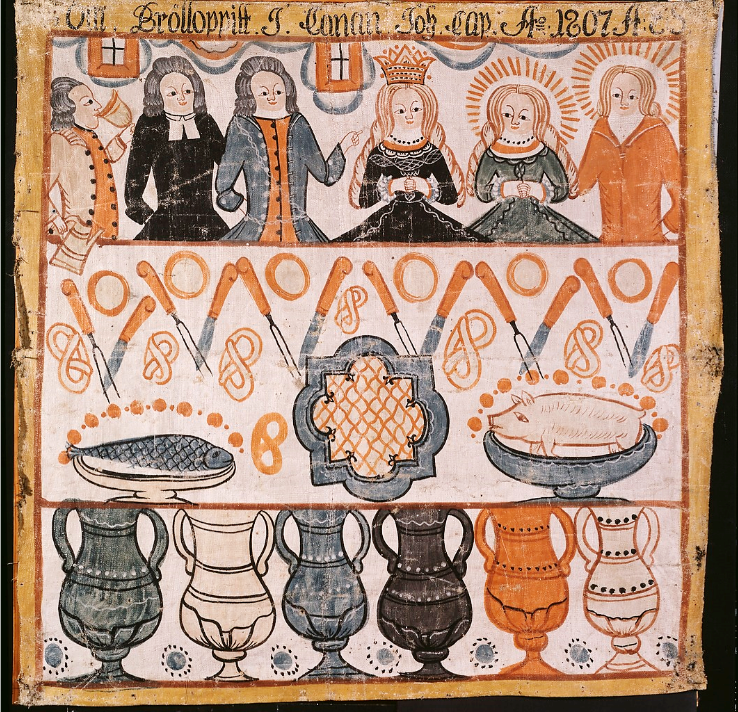
Wedding at Cana, Father Georges Sager, Keur Moussa Abbey, Keur Moussa, Senegal
John 2:1-11
1On the third day there was a wedding in Cana of Galilee, and the mother of Jesus was there. 2Jesus and his disciples had also been invited to the wedding. 3When the wine gave out, the mother of Jesus said to him, “They have no wine.” 4And Jesus said to her, “Woman, what concern is that to you and to me? My hour has not yet come.” 5His mother said to the servants, “Do whatever he tells you.” 6Now standing there were six stone water jars for the Jewish rites of purification, each holding twenty or thirty gallons. 7Jesus said to them, “Fill the jars with water.” And they filled them up to the brim. 8He said to them, “Now draw some out, and take it to the chief steward.” So they took it. 9When the steward tasted the water that had become wine, and did not know where it came from (though the servants who had drawn the water knew), the steward called the bridegroom 10and said to him, “Everyone serves the good wine first, and then the inferior wine after the guests have become drunk. But you have kept the good wine until now.” 11Jesus did this, the first of his signs, in Cana of Galilee, and revealed his glory; and his disciples believed in him.
The Marriage in Cana, Anders Ericsson, Nationalmuseum, Stockholm, Sweden
Sermon – Pastor Meggan Manlove
Christmas decorations have come down. Maybe people are always sad about how that changes the mood of a house, but I seem to have heard about the sadness more this year. Of course, we cannot have a festival like Christmas every day of every month of the year. Or we could but then we would have to call them something else. The joy around Christmas can in fact be part of our daily lives. That is clear in our text today. I love that Jesus’ first sign is not a healing, not an exorcism. There’s a problem with wedding festivities–an event already full of joy and celebration. What’s more, Jesus uses what was quite commonplace in first century Palestine-wine.
One scholar reminds us that the image of wine at a feast echoes “Wisdom’s Feast in the Old Testament. Jewish prophetic literature uses the marriage metaphor for God’s covenant with Israel, and the abundance of wine figures as an image of restoration in the culmination of all things. The abundance of wine and saving the good wine for last draws upon this imagery of hope for the end of time that is paired with hopes for a messiah.”
When the prophet Isaiah speaks of God’s promise to bring justice to all in the restoration of the Kingdom of Israel, he issues the invitation to enjoy wine without price. The invitation is accompanied by a declaration from God. God says that the word that goes out from Gods’ mouth will not return empty but will accomplish God’s purposes.
In today’s text, wine continues to provide an epiphany. “Epiphany,” from the Greek word epiphaneia, means to manifest, show forth, or make clear. Epiphanies have a consistent role in the Judean-Christian tradition. God has revealed God’s self in a wide array of ways throughout the centuries. God wants us to know God because God loves us and wants to be in relationship with us. To recognize and know God through Jesus Christ is central to today’s gospel text.
God’s people have consistently needed to see God manifested in order to believe. So it is with today’s story. The wine has run out at a wedding banquet. The celebration could turn dry just like the wine did. What better way to show our own state of affairs than the image of wine running out? Watching the news and scrolling headlines for a week is enough to make one’s faith waver. Then there are all the ways our individual daily lives tire us. We cannot see God in ourselves or the people we interact with or even the natural world. Weariness blurs our senses and God does not seem to be present any how or anywhere. And yet God does keep showing up, made manifest.
God’s glory has manifested itself in many media and miracles from the natural world. In today’s story, God is revealed through wine—gallons of it. Jesus told the servants to fill six stone jars to the brim with water. The servants then took some of the wine to the chief steward who, after tasting it, called the bridegroom and said “Everyone serves the good wine first, and then the inferior wine after the guests have become drunk. But you have kept the good wine until now.” The miracle revealed God’s glory.
The chief steward does not recognize Jesus as the source of the good wine. Or did he? We do not know what he thought. In the end, it is the servants who get a glimpse of Jesus’ glory. This first sign of Jesus’ glory is revealed to just a few. And it is not who we would expect. We might expect the groom or the bride to play a key role here, noticing how Jesus has saved their family from present and future shame. We might expect important guests to have inside information about where this good and abundant wine came from. But instead, it is the servants who get a peek at Jesus’ glory.
For those of us who have the canon of scripture, who might be familiar with the rest of the story, this is actually in God’s character. Again and again, God reveals Godself to the ordinary and the lowly and the marginalized–shepherds in the field, tax collectors, pharisees who come to him at night, a thief on the cross. God comes through the common and unexpected.
That is partially what the Apostle Paul addresses in his letter to the Corinthians, our marvelous second lesson this morning. It is helpful to remember that Paul’s letter to Corinth is primarily about the common needs of the Christian community. Here is one criticism Paul lodges against the Corinthian congregation: their inability to live out the essential claim of a community founded in the Gospel of Jesus. The life, death, and resurrection of Jesus unite every congregation of followers. Unity is for the sake of God’s mission in the world and for the building up of that particular community.
For Paul, spirituality involves the ongoing reality and work of the Holy Spirit in the lives of Jesus’ followers. The problem in Corinth is that some spiritual elitists have really messed this up. They have regarded their gifts of the Spirit as making them superior to other members of the Community. Paul presents the proper and improper use of spiritual gifts. He emphasizes unified divine action. This empowers diverse human activity for the common good—the benefit of everyone.
For me, the pairing of the Wedding of Cana text and the Corinthian passage on Spiritual Gifts is a brilliant one. God’s abundance of delicious wine, the vision of the festive wedding banquet, becomes accessible to all communities. God has also given us an abundance of spiritual gifts, enough to build life-giving communities wherever we are.
Paul tells us that “there are varieties of gifts, but the same Spirit.” He emphasizes both gifts and their origin, which is the Spirit. While there are many gifts, there is the same Spirit. The Spirit does not give only one kind of gift to all. The world needs diverse gifts and related works: “The utterance of wisdom,” “The utterance of knowledge,” “Faith,” “gifts of healing,” “the working of miracles,” “prophecy,” “the discernment of spirits.” But all these varieties of gifts come from the same Spirit, however diverse and different they may be.
Paul would contend that the Spirit does not promote excessive individualism or elitism because those do not benefit the common good. In other words, they do not build up the whole community—whether that community be Trinity Lutheran, Nampa, or the United States. Gifts are not meant to be used for self-promotion or selfish reasons. Spiritual gifts must be used for strengthening the community by taking care of the weak and the despised in society.
One pastor wrote, “Spiritual gifts are not for us, and therefore it is essential that we discern them and use them. Spiritual gifts are given by the Holy Spirit, they are a way that the Holy Spirit flows through us into the world that God loves. By exercising our gifts, we put ourselves at the disposal of the Great Almighty to be used as God wishes. Nothing could be more humble. And God will use you. In fact, this is how God has designed us, with the capacity to know and love God and with unique gifts that God uses to bless the world and build up the church.”
What this means is that all of us have to recognize other kinds of gifts in ourselves and one other. Then we are called to cooperate with one another for the common good. Martin Luther King Jr Weekend always makes me think of the great cloud of witnesses who all worked for the common good in their own way, people like Gandhi, Mother Teresa of Calcutta, Salvadoran Jesuit Bishop Oscar Romero, Catholic Worker founder Dorothy Day, and yes Martin Luther King Jr. himself.
As we remember the contributions of these individuals, we do well to remember that none of them existed in vacuum. Each of the people I named had other people in their lives who supported, balanced, and strengthened them. I take great comfort in this, in knowing that my gifts are paired with your gifts for this big kingdom work we are called into as followers of Jesus Christ.
It is simply too overwhelming on my own and yet the call is too important to dismiss. That the God of abundance, who turned water into wine and fed the multitude of 5,0000, has given us an abundance of gifts, can give us great hope. It also might give us courage and even a little tenacity, that in the face of so much brokenness, we can put one foot in front of the other, arm in arm, and actually bring some healing and wholeness to the world.
Today we give thanks for God in flesh made manifest, manifested by a star to magi in the east, manifest in the Jordan River at his baptism, turning water into wine at Cana in Galilee, giving us the great cloud of witnesses who have gone before us, helping us discern our own spiritual gifts for life today, using ordinary things like bread and wine still to nourish and sustain us.
Prayers of Intercession
The prayers are prepared locally for each occasion. The following examples may be adapted or used as appropriate.
The Spirit of the Lord is poured out upon us in abundance; so we are bold to pray for the church, the world, and all that God has made.
A brief silence.By your Spirit, activate within your church gifts of faith, healing, and prophecy. Unite those who profess your name across congregations, denominations, and geographic boundaries. Open our hearts to recognize and celebrate surprising miracles. God of grace,hear our prayer.
Your creation reflects your generosity. Bless farmers, migrant farmworkers, orchard-keepers, ranchers, and all who tend the abundance of the land. Protect food and water sources from destruction, that all can eat and drink and be satisfied. God of grace,hear our prayer.
By your Spirit, grant wisdom, knowledge, and discernment to those who hold leadership positions at any level. Direct policymakers toward compassionate decisions that build up safe and just communities. Lead all authorities in seeking and serving the common good. God of grace,hear our prayer.
As Jesus provided generously in a moment of need, provide generous gifts of healing for those in need this day (especially). Provide abundantly for all who are hungry or thirsty, all seeking shelter, and all who seek peace. God of grace,hear our prayer.
You see us for who we are and you delight in us. Embrace those struggling with self-worth, wrestling with self-identity, or facing significant life transition. Remind us that nothing can separate us from your love. God of grace,hear our prayer.
Here other intercessions may be offered.You bless us through the spiritual gifts of the saints who have gone before us. We give thanks for the life of Martin Luther King Jr. and all who have modeled the way of courageous faith (especially). God of grace,hear our prayer.
Since we have such great hope in your promises, O God, we lift these and all of our prayers to you in confidence and faith; through Jesus Christ our Savior.Amen.
Worship and Music and Altar Guild work together throughout the liturgical year planning ways to integrate our worship services and worship space to allow members to fully experience God’s word.
What a blessing. As I sit down to reflect on the past year, we have just finished celebrating the second Sunday of Christmas. Members of altar guild met today and took down the Christmas tree and other decorations to transition to Epiphany. As I left the sanctuary, the Wise Men had traveled across the room to join Joseph, Mary and Jesus. To think, one year ago, we couldn’t meet in person and the sanctuary was empty.
Thank you to the Covid task force that assisted Council and all of our committees to find safe ways to continue to worship and learn safe protocols to slowly move our services back indoors. We are still providing space with empty pew rows and requiring masks during worship. We have also added all the liturgical components back into service as well as singing. Candles, offering and communion may look a little different, but these important parts of our service are treasured after not having them for so long.
In the midst of traditions, we always look for ways to include and acknowledge other special events. Ashes on the Go brought visiting neighbors from the community and continues to grow each year. A mix of indoor and outdoor worship carried us into summer where we returned to the sanctuary full time just in time for the heat of summer. Gospel and Growth committee hosted a special service “Remember and Grieve” which was recorded and watched over 40 times after it premiered. Our Pet Blessing included visiting members of the community, both 2 and 4 legged. Expanded Advent brought glimpses of blue into the sanctuary and the return of midweek Advent soup suppers. This all led up to our first “Longest Night” service with hot cider and firepits out on our patio.
A special thank you to the AV team (and Bryce Quarve) for all of the time, training, and expertise learning to use our new sound system. This has allowed us to continue to live stream worship services including our Mid Week Advent Holden Evening Prayer so friends both near and far can join us in spirit, if not in person. It has also allowed us to record and stream outdoor worship services. Last but not least, thank you to Di Seba who serves as our online greeter for these services.
Here is hoping we continue to move forward towards our previous traditions. Even if not quite as quickly as many of us would like. This may mean finding a new normal or trying some new things . . . but for Trinity, this is what we do best.
The Community Garden has experienced some problems this year with fungus/blight, interference with a large tree obstructing sunlight and poor turnout of workers. They harvested 990 pounds and are looking at some reorganization items.
CROP Walk: Submitted by Steve VanAtter
The Canyon County Crop Walk was an actual event this year. It raised $7,019 which went to the Wilder Food Bank, Nampa Seventh Day Adventist and to the Caldwell Salvation Army Food Bank. Thanks for your on-going contributions and participation.
Equal Exchange Coffee & Chocolate Sales: Submitted by Renee VanAtter
Over the past Covid year, a few members took advantage of ‘home delivery’ of Equal Exchange products. Selling coffee after church services started up in June. Christmas sales were slow. Thanks for supporting farmers so they can make a living wage for their families and support people to get loans to start their own businesses. Thanks for your purchases.
Food Pantry: Submitted by Joyce Becht
We have a very well stocked pantry despite the fact we did not do any monthly food collections which we paired with Bible verses the previous year. The pandemic has not slowed our collections. We are so grateful for any in-kind donations as well as guidance from the Kellars and VanAtters who shop for the pantry for needed items, keep monthly inventory, and check expiration dates on all our supplies. Pastor Meggan uses these resources to help low-income families. Many thanks for helping to feed others in these desperate times.
Food Preservation Classes: Submitted by Sarah Henthorn
No classes were offered due to the pandemic. There was no way to properly provide social distancing.
Noisy Offerings: Submitted by Joyce Becht
Thank you so very much for your ASTOUNDING contributions during the pandemic! We had our third largest total since we started doing Noisy Offerings in 2015. We had a tremendous total of $2,759.20! Such gracious, giving hearts you have. Thanks so much for your phenomenal support. We always welcome your input as we continue to explore new programs along with our old favorites for the new year.
Service Projects: Submitted by Joyce Becht
Souper Bowl of Caring. February 7th you filled our baskets with cans of soup and other food which was added to our Food Pantry. Thanks for thinking of others…”Feed my sheep”.
God’s Work, Our Hands. September 12th we honored the hard-working staff at West Middle School by supplying treats for the staff. Our Sunday School children as well as members of the congregation wrote thank you notes to all the individual staff. The staff was so appreciative and consider us their neighborhood ally. We continue to keep them and the students in our thoughts and prayers.
Gloves/Hats/Mittens/Socks. On November 28th were collected for the women and children at the Valley Women and Children’s Shelter and for the men at The Lighthouse Mission for Men which was restarted again late in the fall. They all appreciate your very loving and warm donations.
Thanksgiving Food Boxes. x 6 November 21st and Christmas Food Boxes x 6 December 19th. Again your donations of gift cards were superb! Thanks for plucking the items from the turkey feathers and picking ornaments from the Christmas trees to donate items for the food boxes. Steve and Renee VanAtter and Tim McHugh shopped for needed items. Thanks to all the volunteers who participated in filling the boxes after services and helped deliver them. We are so thankful for these willing volunteers.
Thrivent Project for Trinity New Hope. Totes x 16 December 12th. The VanAtters applied for a Thrivent money card which they used to purchase fruit and granola bars which filled our totes along with Advent Devotionals and Christmas cards ad information about Trinity’s Advent and Christmas services. Church in Community purchased the totes which were embroidered by Elizabeth Schnabel. She volunteered her time and did beautiful designs. We posted them on the walls for all to see. We so appreciate her handiwork. Our great volunteers helped assemble and deliver the goodie bags after church services. We are so blessed with our volunteers and their gift of time and talents..
Sharing the Trinity Lutheran Church Annual Report online bit by bit was so well received last year, that we thought we would try it again. Between now and our Annual Meeting Jan. 30, I will post a number of reports here on my blog. We hope you enjoy learning about the life and ministry of Trinity Lutheran, Nampa.
GOSPEL AND GROWTH
Gospel and Growth team’s role is to facilitate a focus on the gospel and to encourage growth at Trinity Lutheran. Our thanks to all who participated in our four major projects in 2021.
God’s Global Barnyard spanned Ash Wednesday (2/17) to Pentecost (5/23). This was a fundraiser plus much, much more. We invited people into solidarity with those in need across the globe, into greater awareness of care for creation and local agriculture, and into joyfully gathering together in person. Cardboard collection boxes were distributed. We held “events” highlighting the different farm animals ELCA World Hunger provides through gifts like ours. March was Bee Month, with an informational station at the St Patrick’s Day open sanctuary. At outdoor worship on 3/28, Beth Rasgorshek spoke about pollinators, and we gave away bee-themed door prizes. April was Pig Month, with an outdoor social event called S’wine Swap. People brought Idaho agricultural products to the swap table, leaving with items that other people had brought. We played Barnyard Bingo trivia, gave door prizes, and everyone took home bee-friendly plant starts. May was Goat Month, with the finale outdoors on Pentecost Sunday; the collection boxes were turned in. Our thanks to the Kelly family for bringing 3 baby goats for us to enjoy, plus homemade caramels made from goat milk. Prizes were given to those bringing the heaviest boxes, the most artistically decorated boxes, plus some random door prizes. Over the several months we collected checks, paper money, PayPal donations, and 35# of coins (which went rogue in Lloyd Kellar’s car on the way to the bank!) for a grand total of $1,893.51 – thisdespite having no indoor worship services!!! That’s nearly double what we collected in 2015 when the cause was hyped each Sunday during worship inside the sanctuary. As a way to visualize what our gifts have done, you could say that we gave 3 cows, 1 fish farm, 2 goats, 1 pig, & 13 chickens OR 1013 chicks & 44 honeybee colonies OR 63 pigs & 3 chicks. Such generosity!
Church CampOut was held July 30 – August 1 at the Ward property in Donnelley. It was attended by 29 campers of all ages from 11 households, plus 4 human guests and a doe who joined our Saturday night worship around the campfire. This worship was recorded and posted to YouTube, and watched by nearly 60 people. https://bit.ly/TLCCampout21
Remember and Grieve Together on September 29th was a time to acknowledge and grieve the people and pets who have died, and to note other losses that bring us sorrow. People brought photographs and “reminder objects”; these were displayed on tables in the loft area. There was also a basket to collect our hand-written lists of other things we grieve. The sanctuary was open to “drop ins” before and after the brief service of readings and prayers. That service was later posted to YouTube https://bit.ly/RemGrieve21If you have not yet watched it, please set aside some quiet time to do so.
Advent Daily Devotional Booklet has been an annual Trinity project for nearly a decade, with church members and friends writing in their own unique voices, sharing thoughts about Christmas and Advent. This year we had 28 entries. We printed 116 regular-sized hard copies of the booklet, 3 large print, and posted it to the church website so people could read it on their devices, including those living in other states. Thanks to Mary Braudrick for the lovely cover art, and to Pastor Meggan for reading the devotion for each day on Facebook. One reader (who is not a member) commented, “I love hearing the people’s stories……..it is people that seem to be just writing from their heart. So for me it is really comforting to read, because it helps hearing about what other people are going through, too.”
Almighty God, you anointed Jesus at his baptism with the Holy Spirit and revealed him as your beloved Son. Keep all who are born of water and the Spirit faithful in your service, that we may rejoice to be called children of God, through Jesus Christ, our Savior and Lord, who lives and reigns with you and the Holy Spirit, one God, now and forever.Amen.
Isaiah 43:1-7
1But now thus says the Lord, he who created you, O Jacob, he who formed you, O Israel: Do not fear, for I have redeemed you; I have called you by name, you are mine. 2When you pass through the waters, I will be with you; and through the rivers, they shall not overwhelm you; when you walk through fire you shall not be burned, and the flame shall not consume you. 3For I am the Lord your God, the Holy One of Israel, your Savior. I give Egypt as your ransom, Ethiopia and Seba in exchange for you. 4Because you are precious in my sight, and honored, and I love you, I give people in return for you, nations in exchange for your life. 5Do not fear, for I am with you; I will bring your offspring from the east, and from the west I will gather you; 6I will say to the north, “Give them up,” and to the south, “Do not withhold; bring my sons from far away and my daughters from the end of the earth— 7everyone who is called by my name, whom I created for my glory, whom I formed and made.”
Psalm 29
1Ascribe to the | Lord, you gods, ascribe to the Lord glo- | ry and strength. 2Ascribe to the Lord the glory | due God’s name; worship the Lord in the beau- | ty of holiness. 3The voice of the Lord is upon the waters; the God of | glory thunders; the Lord is upon the | mighty waters. 4The voice of the Lord is a pow- | erful voice; the voice of the Lord is a | voice of splendor. 5The voice of the Lord breaks the | cedar trees; the Lord breaks the ce- | dars of Lebanon; 6the Lord makes Lebanon skip | like a calf, and Mount Hermon like a | young wild ox. 7The voice | of the Lord bursts forth in | lightning flashes. 8The voice of the Lord| shakes the wilderness; the Lord shakes the wilder- | ness of Kadesh. 9The voice of the Lord makes the oak trees writhe and strips the | forests bare. And in the temple of the Lord all are | crying, “Glory!” 10The Lord sits enthroned a- | bove the flood; the Lord sits enthroned as king for- | evermore. 11O Lord, give strength | to your people; give them, O Lord, the bless- | ings of peace.
Acts 8:14-17
14Now when the apostles at Jerusalem heard that Samaria had accepted the word of God, they sent Peter and John to them. 15The two went down and prayed for them that they might receive the Holy Spirit 16(for as yet the Spirit had not come upon any of them; they had only been baptized in the name of the Lord Jesus). 17Then Peter and John laid their hands on them, and they received the Holy Spirit.
Luke 3:15-17, 21-22
15As the people were filled with expectation, and all were questioning in their hearts concerning John, whether he might be the Messiah, 16John answered all of them by saying, “I baptize you with water; but one who is more powerful than I is coming; I am not worthy to untie the thong of his sandals. He will baptize you with the Holy Spirit and fire. 17His winnowing fork is in his hand, to clear his threshing floor and to gather the wheat into his granary; but the chaff he will burn with unquenchable fire.”
21Now when all the people were baptized, and when Jesus also had been baptized and was praying, the heaven was opened, 22and the Holy Spirit descended upon him in bodily form like a dove. And a voice came from heaven, “You are my Son, the Beloved; with you I am well pleased.”
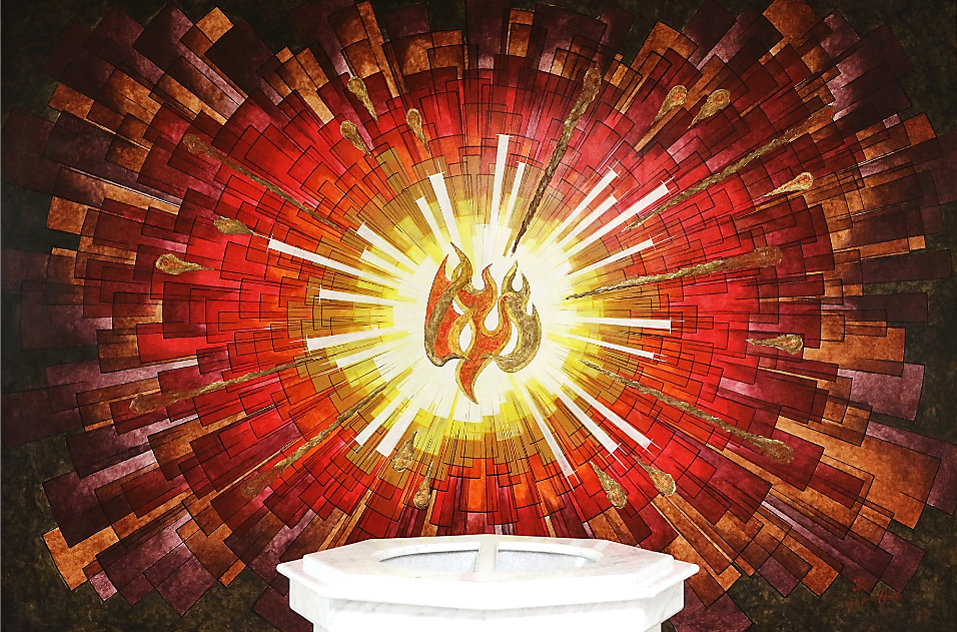
The Holy Spirit and Fire with Baptismal Fong – Church in Mexicali, Mexico
Sermon – Pastor Meggan Manlove
It seems a bit out of season to ponder and speak about the Holy Spirit the second Sunday of January. Shouldn’t we wait for Pentecost in the spring when the Holy Spirit descends upon all those gathered in Jerusalem? But the Holy Spirit shows up in several of our scripture passages today. Furthermore, I have been pouring over all the annual reports submitted over the past few weeks and am keenly aware of the Spirit’s activity and presence among our congregation.
In our gospel reading we hear that after Jesus had been baptized and was praying, “the heaven was opened, and the Holy Spirit descended upon him in bodily form like a dove.” Many of us can conjure up portrayals of this scene from children’s bibles or art hung on walls of churches or museums.
It’s hard to say exactly what happened in this moment, but there is no doubt that the Holy Spirit empowered Jesus. That’s the same Holy Spirit that came upon all of us in the sacrament of baptism. For Jesus, it is going to empower him for ministry–for teaching, healing, and performing signs and miracles.
If we were to pull together various baptism passages from the New Testament, a clear picture would start to emerge. Jesus’ baptism and the baptism of Jesus’ followers bear a striking resemblance. Baptism by water is assumed or supposed to be accompanied by baptism of the Holy Spirit.
There is more. Baptism is how God’s family is demarcated on the earth. It starts with Jesus as the son, receiving the Spirit. And it expands to everyone who receives the Spirit of adoption as God’s children. Baptism is about belonging to God and belonging to a community. Baptism is about following Jesus. Because of this, baptism is also about receiving the Holy Spirit.
What in the world are we to make, then, of our story from Acts Chapter 8, in which people do not receive the Holy Spirit when they are baptized? It’s only after the apostles came from Jerusalem, prayed, and laid on their hands, that they receive the Spirit.
The Spirit shows up in unique way in the books of Acts. The dramatic arrival of the Holy Spirit in the book of Acts happens when the gospel breaks through a new geographical or sociological barrier. In other words, Acts does not show that the Spirit comes dramatically and tangibly on each individual when they come into the community.
Instead, the Holy Spirit serves as proof that the gospel has reached a new group of people. It starts with Jerusalem at Pentecost. In this morning’s story the Spirit comes to the people of Samaria. Next, we see a dramatic arrival to the Gentiles.
Let’s get some deeper perspective on our particular story from Acts. First, the Samaritans were among the last people that many Judean and Galilean Jews would have wanted to socialize with, let alone share good news with.
From the Jews’ perspective the Samaritans were descendants of Hebrews from the ancient Northern Kingdom of Israel. Long ago they had married people from other nations and therefore forfeited God’s blessing. They made false claims to the identity “the people of God.” As far as the Samaritans were concerned, however, they were the true descendants of Abraham.
However, and thanks be to God, the deep legacy of enmity appears not to be stumbling block for Philip. He simply goes to Samaria, delivers people from illness and demonic power, and tells everyone that Jesus is the Christ. As a result, the Samaritans go all in.
Philip, it should be noted, was not one of the twelve apostles. Still, no one seems concerned about he validity of his actions. And yet there is something peculiar about what happens when he is with the Samaritans. They do not receive the Holy Spirit even though they are baptized in Jesus’ name. So the apostles Peter and John make the journey northward, pray for the Samaritans, lay their hands on them, and the Holy Spirit arrives.
One scholar points out that a lot of people today are uncomfortable with this story, with the idea that certain church leaders and not others might be empowered with the ability to dictate exactly where God’s Spirit may or may not go. No where else in Acts is there a suggestion that one’s baptism needs an extra apostolic jolt in order to become complete. What explains this anomaly?
Maybe it’s simply because this is Samaria. If anyone might seem unqualified or unworthy to join the young church of Jesus Christ, it’s probably the Samaritans. The Samaritans’ receptivity to the good news and the willingness of God to dwell within Samaritan people would have flabbergasted many Jews’ notions of who this new church was for.
This and this alone is why it is crucial for apostles from Jerusalem to come to Samaria. They must experience in person the new thing that God is doing. God does not need Peter and John to come and grant their approval. Instead, Peter and John need to come so they, as representatives of the Jerusalem church, can know that Judeans, Galileans, and Samaritans all possess the same Holy Spirit. They are all included together in a new, diverse community centered in Jesus Christ.
God has no plans to build a special “Samaritan church” and a separate church for Jews. Peter and John are so convinced of this that when they finally journey back to Jerusalem, they do not ruth. Instead, they proclaim the good news to many villages of the Samaritans.
Willie James Jennings asks, “Could it be that God waited for Peter and John so that they could watch the intimate event? Here and now these disciples, especially Peter, will see a love that extends into the world. They will watch as God stretches forth divine desire over the Samaritans. They must see again the Spirit descend and sense afresh the divine embrace of flesh. Disciples of Jesus must be convinced not only of God’s love for the world but also God’s desire for people, especially peoples we have been taught not to desire.”
I serve a congregation full of people willing to reach out to people I would often not desire. I for one am grateful to be among people willing to ask, who are the people outside our faith community God wants us to welcome, include, and commit ourselves to? Who are the strangers in your personal lives God is calling you to personally welcome?
We too were once the people outside the faith community, or our ancestors were. Correct me if I’m wrong after worship but although some of us may have Jewish friends and in-laws, none of us traces our DNA to the Jewish community of 1st century Palestine.
Acts well maps Jesus’ commission in Acts. 1:8. “You will be my witnesses in Jerusalem, in all Judea and Samaria, and to the ends of the earth.” Most if not all of us qualify, or our ancestors qualified, as those people from the “ends of the earth.” Though Christianity has held center stage for many years in this country, at one time our people were grafted into the family of God. I find that a humbling and ultimately helpful perspective which these stories from Acts helps foster.
At the same time, I assume that each of us has felt on the outside at some point, either personally or as part of an ostracized group. My nephew and his wife Leigh came and stayed with my mom and I in Oakland around New Year’s. Leigh has had a big medical year and part of it included a genetic test to see if she had the same heart condition has her sisters. The test confirmed it and Leigh had surgery but what struck me in her telling was her complete conviction until the test results came back that was not a blood relative of her family. She felt totally loved and cared for but like she did not belong, almost as if she had been adopted and never told.
When have you felt that way? In your family of origin or the family you married into? After a separation or divorce? Maybe you felt that way in a new workplace or neighborhood? Maybe you felt that way as you or a loved one struggled with addiction? I wonder how many people have lived with depression in the last few years who felt that they were the only ones experiencing it.
Digging into these memories can be painful and we need to take care with ourselves for what they might trigger. And yet, they are part of helping us create empathy, helping us see with clear lenses who the strangers are today who God is calling us to welcome. And collectively, we can continue to ask who are the people outside our faith community God wants us to welcome, include, and commit ourselves to?
It does not mean that they will join our congregation. It does not necessarily mean that we will remain static–often relationships with the strangers transform everyone involved. It simply means sharing the love and sense of beloved community which was one day extended to us.
Prayers of Intercession (Sundays and Seasons)
The Spirit of the Lord is poured out upon us in abundance; so we are bold to pray for the church, the world, and all that God has made.
A brief silence.By the Holy Spirit, you gather your church and send it out in mission to share the good news of Jesus. Inspire your faithful people to be fervent in prayer and service, that all people know they are precious in God’s sight. God of grace,hear our prayer.
You reveal your love and power through water and the Spirit. Guard rivers, seas, and all bodies of water from destruction and pollution. Secure access to clean water for all, and protect the land from drought and flood. God of grace,hear our prayer.
Establish among the nations the blessings of peace. Raise up leaders who will protect vulnerable people in their care. Strengthen advocates who risk reputation or retaliation for the sake of mercy and justice. God of grace,hear our prayer.
You protect us through the fires and troubled waters of this life. Assure us that we will not be cut off from you by illness or despair, anxiety or pain, confusion or weakness. Comfort all who are in need (especially). God of grace,hear our prayer.
We are joined in baptism to Christ and to one another. Bless those who are newly baptized and those who are preparing for baptism. Help us to be faithful in fellowship, worship, evangelism, service, and justice-seeking. God of grace,hear our prayer.
Here other intercessions may be offered.You created each of your saints for your glory. We give thanks for those you have called by name into your eternal embrace (especially). Comfort us in grief and release us from fear. God of grace,hear our prayer.
Since we have such great hope in your promises, O God, we lift these and all of our prayers to you in confidence and faith; through Jesus Christ our Savior.Amen.
Shine into our hearts the light of your wisdom, O God, and open our minds to the knowledge of your word, that in all things we may think and act according to your good will and may live continually in the light of your Son, Jesus Christ, who lives and reigns with you and the Holy Spirit, one God, now and forever.Amen.
1 Samuel 2:18-20, 26
18Samuel was ministering before the Lord, a boy wearing a linen ephod. 19His mother used to make for him a little robe and take it to him each year, when she went up with her husband to offer the yearly sacrifice. 20Then Eli would bless Elkanah and his wife, and say, “May the Lord repay you with children by this woman for the gift that she made to the Lord”; and then they would return to their home. 26Now the boy Samuel continued to grow both in stature and in favor with the Lord and with the people.
Psalm 148
1Hallelujah! Praise the Lord| from the heavens; praise God | in the heights. 2Praise the Lord, | all you angels; sing praise, all you | hosts of heaven. 3Praise the Lord, | sun and moon; sing praise, all you | shining stars. 4Praise the Lord, heav- | en of heavens, and you waters a- | bove the heavens. 5Let them praise the name | of the Lord, who commanded, and they | were created, 6who made them stand fast forev- | er and ever, giving them a law that shall not | pass away. 7Praise the Lord| from the earth, you sea monsters | and all deeps; 8fire and hail, | snow and fog, tempestuous wind, do- | ing God’s will; 9mountains | and all hills, fruit trees | and all cedars; 10wild beasts | and all cattle, creeping things and | flying birds; 11sovereigns of the earth | and all peoples, princes and all rulers | of the world; 12young | men and maidens, old and | young together. 13Let them praise the name | of the Lord, whose name only is exalted, whose splendor is over | earth and heaven. 14The Lord has raised up strength for the people and praise for all | faithful servants, the children of Israel, a people who are near the Lord. | Hallelujah!
Colossians 3:12-17
12As God’s chosen ones, holy and beloved, clothe yourselves with compassion, kindness, humility, meekness, and patience. 13Bear with one another and, if anyone has a complaint against another, forgive each other; just as the Lord has forgiven you, so you also must forgive. 14Above all, clothe yourselves with love, which binds everything together in perfect harmony. 15And let the peace of Christ rule in your hearts, to which indeed you were called in the one body. And be thankful. 16Let the word of Christ dwell in you richly; teach and admonish one another in all wisdom; and with gratitude in your hearts sing psalms, hymns, and spiritual songs to God. 17And whatever you do, in word or deed, do everything in the name of the Lord Jesus, giving thanks to God the Father through him.
Luke 2:41-52
41Now every year [Jesus’] parents went to Jerusalem for the festival of the Passover. 42And when he was twelve years old, they went up as usual for the festival. 43When the festival was ended and they started to return, the boy Jesus stayed behind in Jerusalem, but his parents did not know it. 44Assuming that he was in the group of travelers, they went a day’s journey. Then they started to look for him among their relatives and friends. 45When they did not find him, they returned to Jerusalem to search for him. 46After three days they found him in the temple, sitting among the teachers, listening to them and asking them questions. 47And all who heard him were amazed at his understanding and his answers. 48When his parents saw him they were astonished; and his mother said to him, “Child, why have you treated us like this? Look, your father and I have been searching for you in great anxiety.” 49He said to them, “Why were you searching for me? Did you not know that I must be in my Father’s house?” 50But they did not understand what he said to them. 51Then he went down with them and came to Nazareth, and was obedient to them. His mother treasured all these things in her heart. 52And Jesus increased in wisdom and in years, and in divine and human favor.
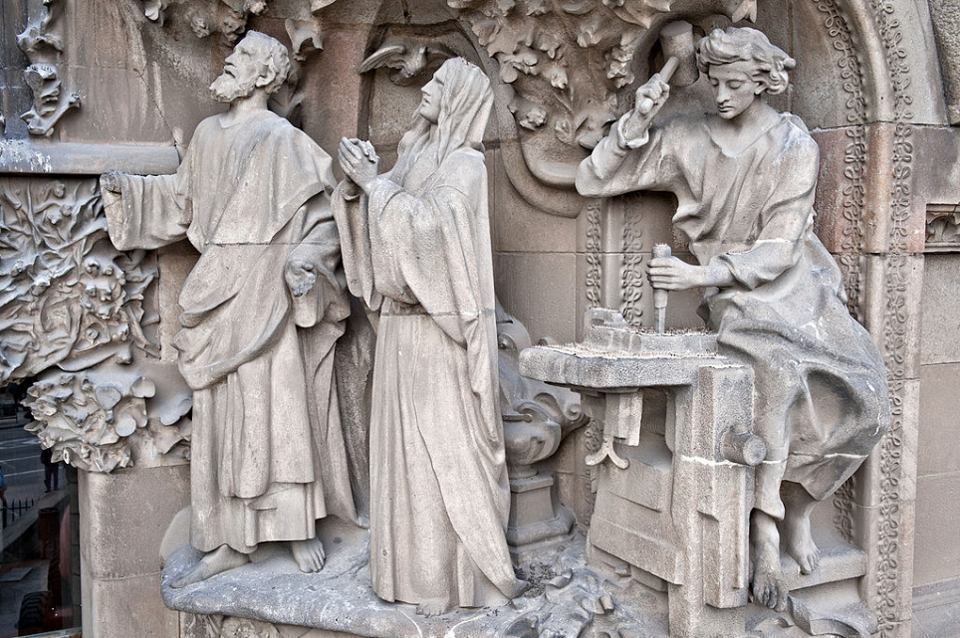
Joseph, Mary, and Jesus as a Carpenter – Sagrada Familia, Barcelona, Spain
Sermon – Pastor Meggan Manlove
Who among us had not lived through or heard a story of parents losing a child and later, after a long search, finally finding them? I cannot remember how old I was, but I was still in elementary school so maybe I was 7 or 8. I was with my mom at Wild West World in Custer, South Dakota, my hometown. West World was a small sort of amusement park with rides behind what was then the Chief Hotel and Restaurant.
In her capacity as Chamber of Commerce director, my mother was deep in conversation with someone important and I was having none of it. I left her and the other person on the boardwalk and defiantly walked away. Of course, when I returned, she was not where I had left her.
I have never revisited this incident with my mom but if her terror and not being able to find me matched my own, it was awful. Time felt like hours instead of minutes, until we finally saw each other and fell into a big hug. My actions were as far from Jesus’ as can be. However, I assume my mom, and any parent who has lost a child, can resonate at least a bit with Mary and Joseph. Their reaction to their twelve-year-old son seems completely reasonable and downright human.
Today we continue to rejoice in the birth of Jesus, the coming of the Messiah, of Immanuel, God with us. And yet, this morning’s gospel story invites us to already begin learning more about who Jesus is. For example, up to this point in the gospel, the child has been named Jesus and designated as holy, but only in this morning’s passage does he appear as God’s son.
Tension is also introduced at this early stage. On the one hand we know already that Jesus’ earthly parents Mary and Joseph are exemplary in their piety. There is no doubt that Jesus is reared in a household that sided with the purpose of God. This pious Jewish family pilgrimages to Jerusalem to celebrate the Passover, not surprising.
So, Jesus is being raised in a pious environment. And yet, his commitment to God’s purpose transcends that piety and that environment. Jesus does not stick by his parents’ side but goes on his own to his Father’s house, to the temple. In this case at least, acting on behalf of God’s aim places Jesus’ behavior in opposition to his parents’ expectations. This is not the last time that Jesus’ behavior will go against traditional authority. This morning it’s his parents; later it will be religious and political authorities.
And there is more turning and foreshadowing in today’s passage. As our story opens, Mary and Joseph are the subjects of the action. But as it unfolds Jesus takes on an active role, for the very first time in Luke’s gospel. In fact, as the scene closes, Jesus goes to Nazareth accompanied by his parents, the text reads. In other words, he has become the subject, the main actor.
The pivot happens in verse 49 in which Jesus responds to his mother, “Why were you searching for me? Did you not know that I must be in my Father’s house?” This verse is the center and the nexus of this morning’s story.
Here is that tension again. The story makes clear that it is a good thing to keep the Passover. However, the sort of pious environment to which Jesus has become accustomed at home serves and must serve the more fundamental purpose of God. Not even familial claims take precedent over aligning oneself decisively on the side of God’s purpose.
This story also makes clear that Jesus’ recognition of his identity as God’s Son does not begin at his baptism, something I had never noticed before. It is already present here in the temple when he is still a child. Jesus was fully human, but he was also fully aware that God was his Father. Jesus finds his own identity by affirming this relationship.
The public ministry of Jesus remains in the future. But the occasion of his remarkable interchange in the temple provides us with a foreshadowing of what is to come. For the present, he will return with his parents to Nazareth.
If we can relate most easily to the fear of the parents at the beginning of the story, that may be a hint to return to his parents at the end. They, like us, are the onlookers, trying to interpret the event and understand Jesus more deeply.
Throughout the season of Advent and then on Christmas Eve we had very clear signs of what is ahead in the gospel. There was John the Baptist calling us to repent, to have a new perspective. There was Mary’s song in which she sang of God’s mighty acts, or God’s bringing down the mighty and lifting up the lowly. There was the baby wrapped in bands of cloth and laid in a feeding trough. And there was the light in the darkness, the heavenly host bringing the news to the lowly shepherds.
And between Christmas Eve and the child Jesus leaving his parents, infant Jesus was presented in the temple and the priest Simeon sang, “my own eyes have seen your salvation, which you have prepared in the presence of all peoples, a light for revelation to the Gentiles and for the glory to your people Israel.”
The stage has been set for Jesus to usher in something new, fully in God’s character. Today Jesus starts to own all of his identity–Jesus, Son of Man, Son of God, teacher, Savior. Again, just imagine Mary and Joseph, witnesses to his birth, dedication in the temple, and now this morning’s scene in the temple with the teachers.
We read that “Mary treasured all these things in her heart.” This phrase is reminiscent of her response to the birth of Jesus and the visit of the shepherds earlier. We might also recall Mary being perplexed and pondering when the angel Gabriel first visited her or when mute Zechariah wrote that his son should be named John; the whole neighborhood talked about these things and “All who heard them pondered.”
As with those events, we are invited to respond in kind. Might we put aside hasty conclusions? Instead, could we maintain an openness to the course the narrative will take? There are many questions that remain as Jesus’ birth and childhood conclude. What shape will God’s redemption take? How will it be accomplished? What will the human response be to God’s purposes? And, to bring this a little closer to home, what might redemption and healing and abundant life look like in Canyon County in 2022? What difference does Jesus make for us and the neighbors and strangers in our midst today? Like Mary, we might be served well to ponder such things.
Pondering is not a verb that is used often or an action that is nurtured widely among adults today. I think it is something of a mix of experiencing wonder and curiosity. I imagine Mary being overwhelmed both by the birth of Jesus and by watching him in the temple. This wonder surely inspired in her the wish to understand. And this led her to be curious.
To quote Brene Brown again, as I did Christmas Eve, “Choosing to be curious is choosing to be vulnerable because it requires us to surrender to uncertainty. We have to ask questions, admit to not knowing, risk being told that we shouldn’t be asking, and, sometimes make discoveries that lead to discomfort.”
Choosing to be curious about Jesus and curious about following Jesus is a pretty good intention for the first Sunday after Christmas, on the precipice of a new calendar year. We cannot predict what our pondering, wondering, curiosity about Jesus, Immanuel, Son of God might lead to, and it could look different for each of us.
It might be trying to see Jesus in every stranger we encounter. It might mean reading the gospels or all of scripture with new lenses. It might be experiencing the natural world here in Idaho with new eyes, ears, and empathy. And this pondering, wondering, and curiosity could certainly lead to some discomfort. That’s okay. The Holy Spirit will walk with us, prodding us and encouraging us along the way.
Prayers of Intercession (Sundays and Seasons)
Joining our voices with the heavenly host and Christians throughout time and space, let us pray for the church, the world, and all in need.
A brief silence.You come to us in gatherings of your church across the globe. Unite us with those who celebrate your birth even when they are weighed down by grief, loss, poverty, hunger, or injustice. Hear us O God. Your mercy is great.
You come to us in the diverse splendor of the universe. Grant us the humility to trust our place in the network of creation, that we live in service to you and the natural world. Hear us O God. Your mercy is great.
You come to us through relationships of many kinds: families, friendships, communities, and nations. Guide us in these relationships, that we recognize the Christ child in one another and show your love to those most vulnerable. Hear us O God. Your mercy is great.
You come to us through people whom the world forgets. Poor shepherds and an imprisoned Paul announced your good news. Send your Spirit to all who are imprisoned, struggling with addiction, unwell, or in any need this day (especially). Hear us O God. Your mercy is great.
You come to us in acts of justice and forgiveness. Open our hearts to forgive one another, without permitting injustice. Supply us with the wisdom to be clothed with love, binding all things together in perfect harmony. Hear us O God. Your mercy is great.
Here other intercessions may be offered.You come to us through those who have died yet live with you forever (especially). We give thanks for Stephen, deacon and martyr, who gave his life to tell the story of your love. Hear us O God. Your mercy is great.
Rejoicing in your Word made flesh among us, we commend these prayers to you, confident of your grace and love made known to us in Jesus Christ, our Savior.Amen.
Almighty God, you made this holy night shine with the brightness of the true Light. Grant that here on earth we may walk in the light of Jesus’ presence and in the last day wake to the brightness of his glory; through your Son, Jesus Christ our Lord, who lives and reigns with you and the Holy Spirit, one God, now and forever.Amen.
Isaiah 9:2-7
2The people who walked in darkness have seen a great light; those who lived in a land of deep darkness— on them light has shined. 3You have multiplied the nation, you have increased its joy; they rejoice before you as with joy at the harvest, as people exult when dividing plunder. 4For the yoke of their burden, and the bar across their shoulders, the rod of their oppressor, you have broken as on the day of Midian. 5For all the boots of the tramping warriors and all the garments rolled in blood shall be burned as fuel for the fire. 6For a child has been born for us, a son given to us; authority rests upon his shoulders; and he is named Wonderful Counselor, Mighty God, Everlasting Father, Prince of Peace. 7His authority shall grow continually, and there shall be endless peace for the throne of David and his kingdom. He will establish and uphold it with justice and with righteousness from this time onward and forevermore. The zeal of the Lord of hosts will do this.
Psalm 96
1Sing to the LORD a new song; sing to the LORD, all the earth. 2Sing to the LORD, bless the name of the LORD; proclaim God’s salvation from day to day.
3Declare God’s glory among the nations and God’s wonders among all peoples. 4For great is the LORD and greatly to be praised, more to be feared than all gods.
5As for all the gods of the nations, they are but idols; but you, O LORD, have made the heavens. 6Majesty and magnificence are in your presence; power and splendor are in your sanctuary.
7Ascribe to the LORD, you families of the peoples, ascribe to the LORD honor and power. 8Ascribe to the LORD the honor due the holy name; bring offerings and enter the courts of the LORD.
9Worship the LORD in the beauty of holiness; tremble before the LORD, all the earth. 10Tell it out among the nations: “The LORD is king! The one who made the world so firm that it cannot be moved will judge the peoples with equity.”
11Let the heavens rejoice, and let the earth be glad; let the sea thunder and all that is in it; let the field be joyful and all that is therein. 12Then shall all the trees of the wood shout for joy at your coming, O LORD, for you come to judge the earth.
13You will judge the world with righteousness and the peoples with your truth.
Titus 2:11-14
11The grace of God has appeared, bringing salvation to all, 12training us to renounce impiety and worldly passions, and in the present age to live lives that are self-controlled, upright, and godly, 13while we wait for the blessed hope and the manifestation of the glory of our great God and Savior, Jesus Christ. 14He it is who gave himself for us that he might redeem us from all iniquity and purify for himself a people of his own who are zealous for good deeds.
Luke 2:1-14
1In those days a decree went out from Emperor Augustus that all the world should be registered. 2This was the first registration and was taken while Quirinius was governor of Syria. 3All went to their own towns to be registered. 4Joseph also went from the town of Nazareth in Galilee to Judea, to the city of David called Bethlehem, because he was descended from the house and family of David. 5He went to be registered with Mary, to whom he was engaged and who was expecting a child. 6While they were there, the time came for her to deliver her child. 7And she gave birth to her firstborn son and wrapped him in bands of cloth, and laid him in a manger, because there was no place for them in the inn. 8In that region there were shepherds living in the fields, keeping watch over their flock by night. 9Then an angel of the Lord stood before them, and the glory of the Lord shone around them, and they were terrified. 10But the angel said to them, “Do not be afraid; for see—I am bringing you good news of great joy for all the people: 11to you is born this day in the city of David a Savior, who is the Messiah, the Lord. 12This will be a sign for you: you will find a child wrapped in bands of cloth and lying in a manger.” 13And suddenly there was with the angel a multitude of the heavenly host, praising God and saying, 14“Glory to God in the highest heaven, and on earth peace among those whom he favors!”
Shepherds – John August Swanson
Sermon – Pastor Meggan Manlove
The angel’s message to the shepherds is for us as well, gathered so many years later, “Do not be afraid, for see–I am bringing you good news of great joy for all the people; to you is born this day in the city of David a Savior, who is the Messiah, the Lord.” It’s that one word “joy” that has stood out so prominently to me this year.
But first, how, and why did we get here? Why is the Messiah born in this way and what difference does it make that some shepherds are the first to receive the news? Jesus’ mother sang about a reordering in her song, “God has brought down the powerful from their thrones and lifted up the lowly (or the poor).” What God has done before, God seems to be doing again.
Our storyteller had taken great pains to set the world stage. Mary and Joseph go up to Bethlehem because the emperor has ordered it to be so. Instead of being born in a palace, Jesus is born in an overcrowded inn and first placed in a feeding trough. The new king is wrapped in swaddling cloths. This is a strange beginning.
We now know who the world powers are and yet the angel, the messenger from God, does not bring the good news to those men. The scene shifts to outlying fields where shepherds are watching their flocks. Away from kings and governors, even away from Mary, comes brilliant and overpowering light. One angel brings a clear message, and it is soon followed by a chorus of messengers from God. There is light come to lighten the shepherds’ darkness.
One writer summed up our scene poetically, “Heaven and earth meet in obscure places, not in the halls of power. Shepherds and angels. A birth in the city of King David, but far from a royal residence. And that birth, that joy is for all people, just as the census was said to have been…The light came in those dark fields and that dim room in Bethlehem because God longs has always longed, for us to know and love God.”
“Do not be afraid, for see–I am bringing you good news of great joy for all the people.” In her new book, Atlas of the Heart, Brene Brown explores 87 different emotions and experiences that define what it means to be human. I love how she defines joy, “an intense feeling of deep spiritual connection, pleasure, and appreciation.” I imagine that joy is not only what the angel promised, but it is what the shepherds experienced. It is what we might, in the midst of this broken world, experience tonight as we hear the story of Jesus’ birth once again.
Another scholar explains that people find experiences of joy difficult to articulate. The very nature of joy pushes the boundaries of our ability to communicate about lived experiences with spoken language. So sometimes when we experience joy we do a happy dance in our living room, we turn to music that can express far more than mere words, we take a blessed moment to simply savor the joy filled experience. Occasionally we might weep tears of joy.
Brene Brown tells the following story about her daughter Ellen, then in first grade. “We played hooky one afternoon and spent the day at Hermann Park. At one point we were on a paddleboat in the middle of a pond when I realized she had stopped pedaling and was sitting perfectly still in her seat. Her head was tilted back, and her eyes were closed. The sun was shining on her uplifted face, and she had a quiet smile on her face. I was so struck by her beauty and her vulnerability and the joy on her face that I could barely catch my breath. I watched for a full minute, but when she didn’t move, I got a little nervous. ‘Ellie? Is everything okay, sweetie?’ Her smile widened and she opened her eyes. She looked at me and said, ‘I’m fine, Mama. I was just making a picture memory.’ I had never heard of a picture memory, but I liked the sound of it. ‘What’s that mean?’ ‘Oh, a picture memory is as picture I take in my mind when I’m really, really happy. I close my eyes and take a picture, so when I’m feeling sad or scared or lonely, I can look at my picture memories.’” Brown concludes, “She used the word ‘happy,’ as we often do, but there’s no question that I was witnessing joy, the swirl of deep spiritual connection, pleasure, and appreciation.”
Someone proposed that we do not lose ourselves while experiencing joy, we become more truly ourselves. Colors seem brighter, physical movements feel freer, smiling happens involuntarily. We become more truly ourselves. On this joy-filled night, what would it mean for whole world to become more truly ourselves?
God has come to earth in human form, the incarnation, Immanuel, God with us. That in itself is good news. But there is more. Divine power looks like a baby wrapped in bands of cloth and laid in a trough. It is entirely in God’s character, God’s preferential treatment of the poor, God’s solidarity with those on the margins. It should maybe not surprise us, except that it is so otherworldly. It is certainly good news of great joy for all the people.
On this holy night, we might do well to create a picture memory together–the infant Jesus in the trough wrapped in bands of cloth, the angel, all the heavenly hosts, the lowly shepherds kneeling, and most of all the light breaking into the darkness. God wants joy for us and found an incredible way to deliver it. God sign is surprising, but it is God’s sure way of showing us that God’s favor is for all people, in whatever darkness we seem to exist.
Prayers of Intercession (Sundays and Seasons)
Joining our voices with the heavenly host and Christians throughout time and space, let us pray for the church, the world, and all in need.
A brief silence.Love proclaims that a Savior has been born to us! Inspire your church throughout the world to proclaim the good news of Jesus’ birth to all who seek salvation, hope, and new life. Merciful God, receive our prayer.
Love whispers to a weary world that the time for rest and restoration has come. Maintain healthy cycles of wake and sleep for all creatures. Where light pollution disrupts natural rhythms, encourage new practices. Merciful God, receive our prayer.
Love cries to a warring world that the time for peace is at hand. Direct those in power who make decisions on behalf of others, that they nurture and sustain all that is healthy, good, and holy. Merciful God, receive our prayer.
Love sings through the wails of a newborn baby. Respond to all who cry out in pain, despair, or need this night (especially). Bring comfort to those for whom separation, grief, or loss makes the Christmas season especially difficult. Merciful God, receive our prayer.
Love murmurs words of comfort to a newborn child and exhausted parents. Bless new and expectant parents or caregivers, especially those who are alone or afraid this night. Pour out your love upon families of every kind. Merciful God, receive our prayer.
Here other intercessions may be offered.God’s ever-present love is proclaimed through the faithful who came before us. We give you thanks for Mary, John the baptizer, Elizabeth his mother, Joseph the dreamer, and all who point toward your love (especially). Merciful God, receive our prayer.
Rejoicing in your Word made flesh among us, we commend these prayers to you, confident of your grace and love made known to us in Jesus Christ, our Savior. Amen.
Stir up your power, Lord Christ, and come. With your abundant grace and might, free us from the sin that binds us, that we may receive you in joy and serve you always, for you live and reign with the Father and the Holy Spirit, one God, now and forever. Amen.
Micah 5:2-5a
2But you, O Bethlehem of Ephrathah, who are one of the little clans of Judah, from you shall come forth for me one who is to rule in Israel, whose origin is from of old, from ancient days. 3Therefore he shall give them up until the time when she who is in labor has brought forth; then the rest of his kindred shall return to the people of Israel. 4And he shall stand and feed his flock in the strength of the Lord, in the majesty of the name of the Lord his God. And they shall live secure, for now he shall be great to the ends of the earth; 5aand he shall be the one of peace.
Luke 1:39-55
39In those days Mary set out and went with haste to a Judean town in the hill country, 40where she entered the house of Zechariah and greeted Elizabeth. 41When Elizabeth heard Mary’s greeting, the child leaped in her womb. And Elizabeth was filled with the Holy Spirit 42and exclaimed with a loud cry, “Blessed are you among women, and blessed is the fruit of your womb. 43And why has this happened to me, that the mother of my Lord comes to me? 44For as soon as I heard the sound of your greeting, the child in my womb leaped for joy. 45And blessed is she who believed that there would be a fulfillment of what was spoken to her by the Lord.” 46And Mary said, “My soul magnifies the Lord, 47and my spirit rejoices in God my Savior, 48for he has looked with favor on the lowliness of his servant. Surely, from now on all generations will call me blessed; 49for the Mighty One has done great things for me, and holy is his name. 50His mercy is for those who fear him from generation to generation. 51He has shown strength with his arm; he has scattered the proud in the thoughts of their hearts. 52He has brought down the powerful from their thrones, and lifted up the lowly; 53he has filled the hungry with good things, and sent the rich away empty. 54He has helped his servant Israel, in remembrance of his mercy, 55according to the promise he made to our ancestors, to Abraham and to his descendants forever.”
Visitation, Church of El Sitio, El Sitio, El Salvador
Sermon – Pastor Meggan Manlove
Last week’s wonderful Christmas Pageant ended with Mary’s Magnificat, so named because she magnifies God. Diane recited the words beautifully. We have sung the words this morning and you heard me read them, putting the song in its narrative context. But even with the repetition, there is a lot packed into those ten scripture verses.
What’s more, it is hard to know where to place oneself in this song about the reordering of power and resources and wealth. We, gathered in this space, do not represent the top 1% in this country. We are a somewhat economically diverse congregation. Some of us have lost jobs. Many of us have walked alongside people who are not paid what they should be paid. All of us have seen the inequity in our economic, healthcare, education, and other systems. The inequity has been laid bare in our region and country recently and in years past. In other words, we have been, or we have walked closely alongside the lowly, the hungry.
And yet, by the world’s standards, most of us are well off. Whether looking to various developing countries across the globe or to the poorest counties in these United States, we are in contrast the rich, the powerful, the proud. We have such luxuries as shelter, clean water, food, electricity, and plumbing. And most of us also have such luxuries as emotional support, friends, and some leisure.
Back to my original question, where do we see ourselves in Mary’s song? How do we at Trinity Lutheran, in Nampa, Idaho at the close of 2021 hear or sing this song? It is natural to hear, and sing is with an individual perspective. Mary herself begins the song that way, “My soul magnifies the Lord…for he has looked with favor on the lowliness of his servant.”
She talks about herself only so long as it takes every English teacher to approve. Did you ever have a teacher implore you, “show me in your writing, don’t tell. Show me.” Mary does not just tell us about God, she shows us with her own body–the poor, young woman. It is this poor, young woman who the creator of all has chosen to carry God with us, Immanuel, Jesus.
But Mary herself does not stay individual or personal for long. Although Mary begins with the very personal, she quickly moves to the collective. And there is the invitation for we who listen and sing her song 2000 years later. Certainly this song is about me, but more importantly it is about us, us the congregation, us the larger Christian church.
Mary is singing specifically about her people, Israel, God’s chosen people. She sings not just of herself, the lowly one, but all the lowly, all the poor. She sings not just of a reordering for her own life, but for all of Israel, the corporate, the collective. But in singing about all the lowly, all the hungry, all the poor, she invites into her song more than Israel. In just a few lines, she has made this a global song for all the lowly poor.
It is so much, this call for systems to be overturned, for a basic leveling, enough for all. Perhaps the very best news in Mary’s song is the main actor. It is not Mary, not her cousin Elizabeth, not Joseph, not even us. The subject of the verbs of powerful action is in every case God.
And though God is certainly doing something new in the birth of Jesus, Immanuel, it is not out of God’s character. Mary’s song has echoes from her own ancestors’ songs sung throughout what we call the Old Testament: Moses and Miriam after the Exodus, Deborah, and mostly of all Hannah, the mother of Samuel. These echoes are significant for the way they so clearly extend the activity of God celebrated by Mary far back into the past. Mary’s song is continuous with the old old story of God’s love for all creation.
So, let’s be clear here, Mary’s song is not a revolutionary call to human action but a celebration of God’s action. God’s dramatic work is against those who would take power into their own hands, according to Mary’s song.
On the other hand, the story of God’s redemption is not God’s story only. Through his gracious initiative, God seeks out other actors, partners like Mary, who will share in God’s work. Mary’s song cannot be defined as a clarion call to revolutionary activity, then. And yet, there’s always an “and yet,” Mary’s song does solicit from its audience outside the narrative, from us, a similar choice.
So, the good news is that God is faithful, and God continues to act. We tend to think of the Holy Spirit showing up first at Pentecost, but that was the Spirit given to the church. Remember that the Spirit of God moved over the waters at the beginning of creation. Already in Luke Chapter 1 an angel has promised Mary that the Holy Spirit will come upon her. We give thanks for the good news that the Holy Spirit has and continues to act.
Is there actually any hope for us if we are in fact the collective rulers? Absolutely. God’s triumph over those who oppose him is itself a redemptive act, placing his opponents in a position whereby they might elect to join God’s project. One commentator suggested, “God flings the proud of heart to the earth, in the hope that they will be…delivered from their ridiculous vaunting and flaunting, to become free and obedient children of God and brothers and sisters to others.”
The other not so good news is that all of this happens in the Holy Spirit’s own time, and sometimes it takes longer than our human hearts would desire. But Mary’s song is speaking of big systems and structures that cannot always be toppled overnight. But occasionally we can look back and really see the Holy Spirit’s action.
That was my experience this week. Trinity New Hope affordable housing is in the middle of our annual online multi-week fundraising campaign, which always makes me pause and think, if not sing like Mary, of our ancestors. I cannot help but reflect on the ancestors of our faith, some gone and some of you still with us, who were part of this congregation when we first leased a portion of our land to Mercy Housing. That was in the mid-1990s. The houses were built, and they just sat there, occupied by different people for 25 years.
Meanwhile, I was growing up in South Dakota with a father who talked pretty regularly about Millard Fuller, the father of Habitat for Humanity. My father helped found the Black Hills Habitat for Humanity Chapter. And I went to a college that sent hundreds of students, including myself, every year on Habitat for Humanity Spring Break Trips. I did not speak the language of affordable housing when I took the call to Trinity, but that housing was a basic human right had been drilled into me from an early age.
This winter I was asked to serve on the Leap Housing Board. Why? Because Leap thinks a premiere way to solve the housing crisis in the Treasure Valley is to use access church land and they want someone who can tell the story. The staff and board saw this congregation as a key to changing the culture of our housing, changing the conversation from Not in My Backyard to Yes in God’s Backyard.
So, this Wednesday, when I attended my first Leap board meeting, I was singing and praying with Mary, “according to the promise he made to our ancestors.” We’re talking over 30 years, which feels like forever in my lifetime. But what a gift, to have a glimpse of what the Holy Spirit can do, of how God is the actor, but we are in fact invited to partner.
What song will we sing next? As a congregation? As the larger Christian Church? I am not sure exactly, but Mary’s song can help us again. Her words are clear. The invitation is not in code. God’s vision for the world, spelled out in the Magnificat, is consistent with songs of the ancestors, with Moses and Miriam and Deborah and Hannah. On this fourth Sunday of Advent as we physically wait for the world to turn, for the days to get longer, we can hope and trust that the Holy Spirit is still active. With hearts open, we can join the song.
Prayers of Intercession (Sundays and Seasons)
In this season of watching and waiting, let us pray for all people and places that yearn for God’s presence.
A brief silence.Nurturing God, you give us life and care for our every need. Use the church’s gifts and ministries for your service, bringing your word to all who seek your transforming grace. Hear us, O God.Your mercy is great.
Creator God, you proclaim your boundless love for all that you have made. Renew barren lands, polluted waters, and melting ice caps. Make us servants of your creation that brings forth abundant life. Hear us, O God.Your mercy is great.
Righteous God, you bring down the mighty and lift up the lowly. Strengthen those who seek justice. Bless the work of community organizers, activists, journalists, and all who call our attention to imbalances of power. Hear us, O God.Your mercy is great.
Compassionate God, you proclaim your love and mercy. Show your lovingkindness to teen parents and those who are pregnant. Comfort any struggling with infertility and those who await test results, are in treatment and hospice care, and others in need (especially). Hear us, O God.Your mercy is great.
Gracious God, you fill the hungry with good things. Bless the feeding ministries of this congregation and community. Guide us to share your bounty with those who hunger or live in poverty. Hear us, O God.Your mercy is great.
Here other intercessions may be offered.Faithful God, you stir up the hearts of those who love you. We give you thanks for those who, like Mary, were courageous in their witness (especially). Give us such courage until that day when you fulfill all things. Hear us, O God.Your mercy is great.
God of new life, you come among us in the places we least expect. Receive these prayers and those of our hearts, in the name of Jesus.Amen.