
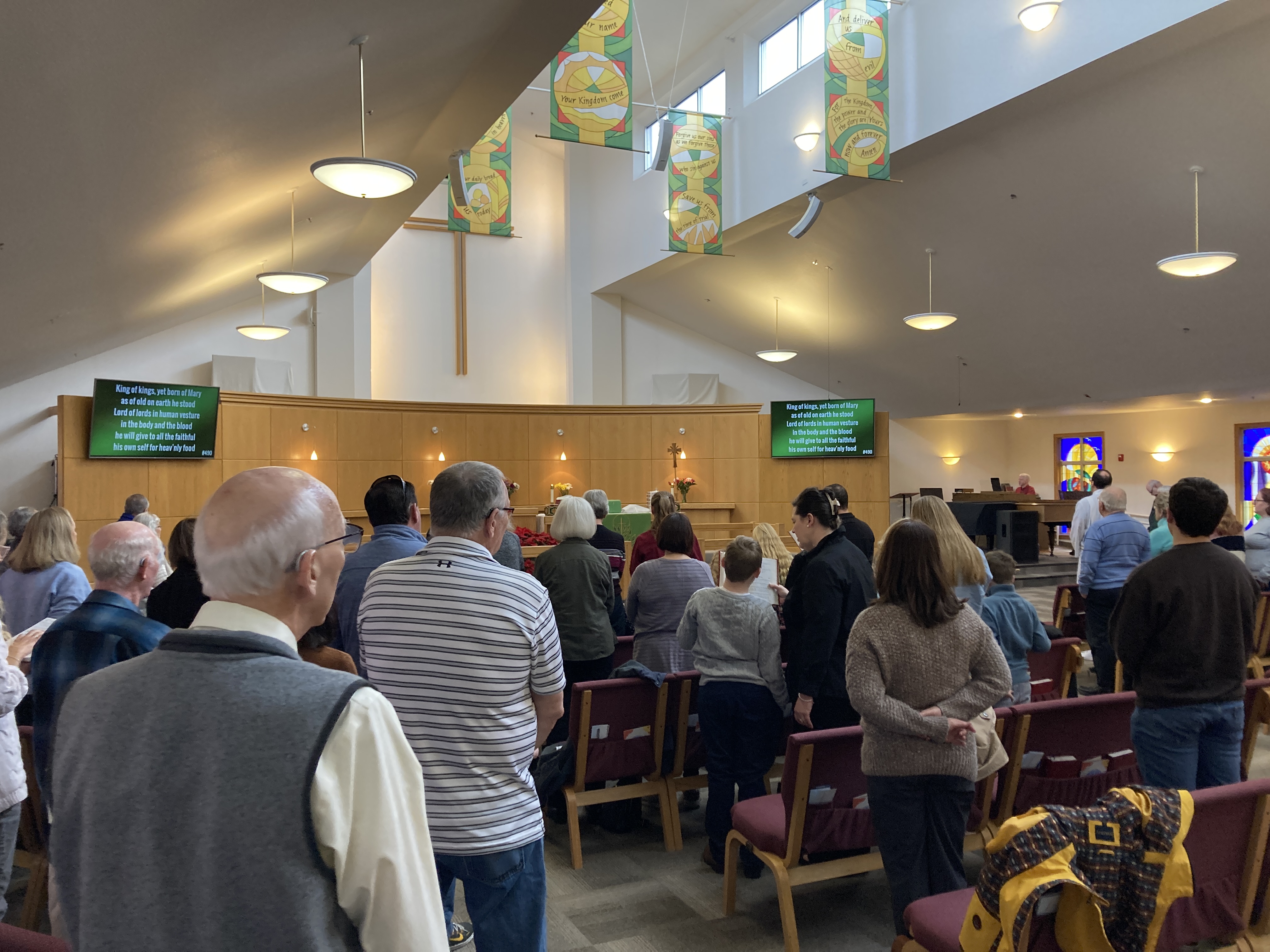
It was so good to be with SoV in Boise, about 11 months after Pastor Dave’s heart attack and the Sunday following when I was there to preside and give some comfort. There was wonderful energy this morning and Dave has made a great recovery!
Luke 4:21-30
This morning, we find Jesus is in his hometown of Nazareth. His homecoming seems to be a mixed bag. He brings hometown loyalties into question. Jesus has just preached the first sermon of his ministry. It is based on a text from Isaiah: “The Spirit of the Lord is upon me…to bring good news to the poor…to proclaim release to the captives and recovery of sight to the blind, to let the oppressed go free, to proclaim the year of the Lord’s favor.” The sermon is one of the shortest every recorded: “Today this scripture has been fulfilled in your hearing.”
At first glance, the reviews of the congregation at Nazareth were positive. We read “All spoke well of him and were amazed at the gracious words that came from his mouth.” But what started out as the world’s shortest sermon turned into a dialogue. The crowd began to question and wonder.
And their objections have to do with hometown loyalties. Who is Jesus rooting for? His quote from Isaiah is full of good news. But the good news extends far beyond the hometown.
One theologian [Justo Gonzales] proposed a rewriting of Jesus’ words this way, “One can imagine, in our day, a young man who becomes a famous athlete and signs a contract for millions of dollars. He then returns to his hometown, and all come to receive him and hear what he has to say. The town band goes out to greet him. The local papers praise him. The town gathers at the stadium for a welcome ceremony. Everybody is excited.
Some say: “It is difficult to believe that this is Joe, who grew up next door.” When Joe finally comes to the speaker’s stand, all are eager to hear what he has to say. They know that he has talked of ht eneed for better schools and clinics, and that he has supported such institutions elsewhere. Now Joe stands up and says: “Do not think that because I grew up in Smallville you will receive any special favors from me. Actually, I have decided to support the school in Eastville, and the clinic in Northville.” There will be a chilled silence. Soon shock will turn to anger, and anger to hostility. “Who does he think he is? We don’t need him! Run him out of town!”
Jesus continues by quoting other Scripture passages that reveal God’s expansive grace. Does he select the stories of the fathers and mothers of the Jewish faith—Abraham and Sarah, Isaac, Jacob, Joseph. No. Jesus’ quotes scripture which reveals God’s grace toward the Gentiles. In 1 Kings, it was a Gentile woman to whom Elijah provided the never-failing oil and flour. And in 2 Kings, it was the Gentile Naaman whom Elisha healed of leprosy.
This was too much. Why couldn’t Jesus speak promises for the hometown? The anger of the crowd is so great that they seek to destroy Jesus—to do away with him by hurling him off a cliff.
Already in Jesus’ ministry we see rejection. Sometimes we think the rejection of Jesus comes only in the final weeks, on the way to the cross. But here it is at his first sermon. Throughout Jesus’ entire ministry, the good news is proclaimed, rejected, and proclaimed again—to a wider and wider circle—even to the ends of the earth. And if we look closely enough, we see ourselves in this text. In the center of this rejection story, we find ourselves, our culture, our society—people who like to know who is in and who is out, who is welcome and who is not.
We are part way through the Season after Epiphany, a season in which we celebrate the manifestation of God. We celebrate how Jesus is made known, revealed to us as God’s Messiah. But something else is revealed in this season. In this text, we, too, are made known. And we, like the congregation in Nazareth, are revealed to be a people who like to draw lines in the sand—people with a persistent “we-they” mind-set.
Even outside the world of hometown rivalries, we like to divide our world into home teams and out of town rivals, into us and them, friends and enemies. We can easily turn all of life into a competition—who is better than whom. We see this profoundly as the excluded become empowered and then turn around to exclude others. I say this as a white woman who knows the early feminist movement left out women of color.
It is all too human to want the world to be neatly divided into insiders and outsiders. And we would just as soon that God were on our side. Sometimes we would like to peg God with a certain nationality, a political party, an income level. But further ahead we will read especially about the impartiality of God. When Peter preached about the inclusion of both Jews and Gentiles through Christ, he proclaimed, “I truly understand that God shows no partiality” (Acts 10:34). Literally, this reads: “God makes no distinction between faces.” God does not differentiate between peoples.
God is not interested in faces. God is interested in hearts. Not beautiful hearts, not pure hearts, not even perfect hearts, but hearts that know their need of God—hearts that “are restless until they find their rest in God,” who know with the psalmist that only God can create clean hearts.
Recognizing our need will transform our relationships with others. This is what will help to erase the lines we draw between others and ourselves. We are all in the same boat—lost without God—saved not because of our own merit, not because we are pure on the inside, but solely by the grace of God. When it comes to redemption, we are all on the outside—all sinful and unclean. We are only saved by the God who crosses all lines, who breaks boundaries, who becomes human in Jesus to create new and clean hearts within us.
In this Epiphany season, we see Jesus, God’s Son, full of grace, and we see ourselves, so deeply in need of that grace. We see the Jesus who welcomes us all. No matter who we are, there are times when we feel like an outsider, a stranger, on the outside looking in. It is only the radical welcome of Christ that welcomes us fully and completely. The rejection at Nazareth will lead one day to the ultimate rejection at Golgotha, yet God will be at work in that event to bring life out of death. And in Christ’s death and resurrection, the welcome extended to us will be as lavish as Jesus’ words to a dying criminal: “Today you will be with me in Paradise.”
When my father picked me up from grade school, he did not ask about what I learned. He didn’t ask what my favorite subject had been. The very first thing he asked nearly every day was, “How were things on the playground?” He knew how important that part of the day was to my formation as a person. On the playground my classmates and I were learning how to interact with one another. Already we were discovering who was in and who was out. It was clear at an early age that there were people who should be left alone, others who should be included, and still others who called the shots.
But my parents also took me to a place so radically different than the grade school playground—the table where bread and wine were given freely. There everyone in town was welcome to feast on the bread of life and the cup of healing, to receive forgiveness and new life. We left that table nourished to slowly transform the playgrounds of our lives, only by the grace of God.


