
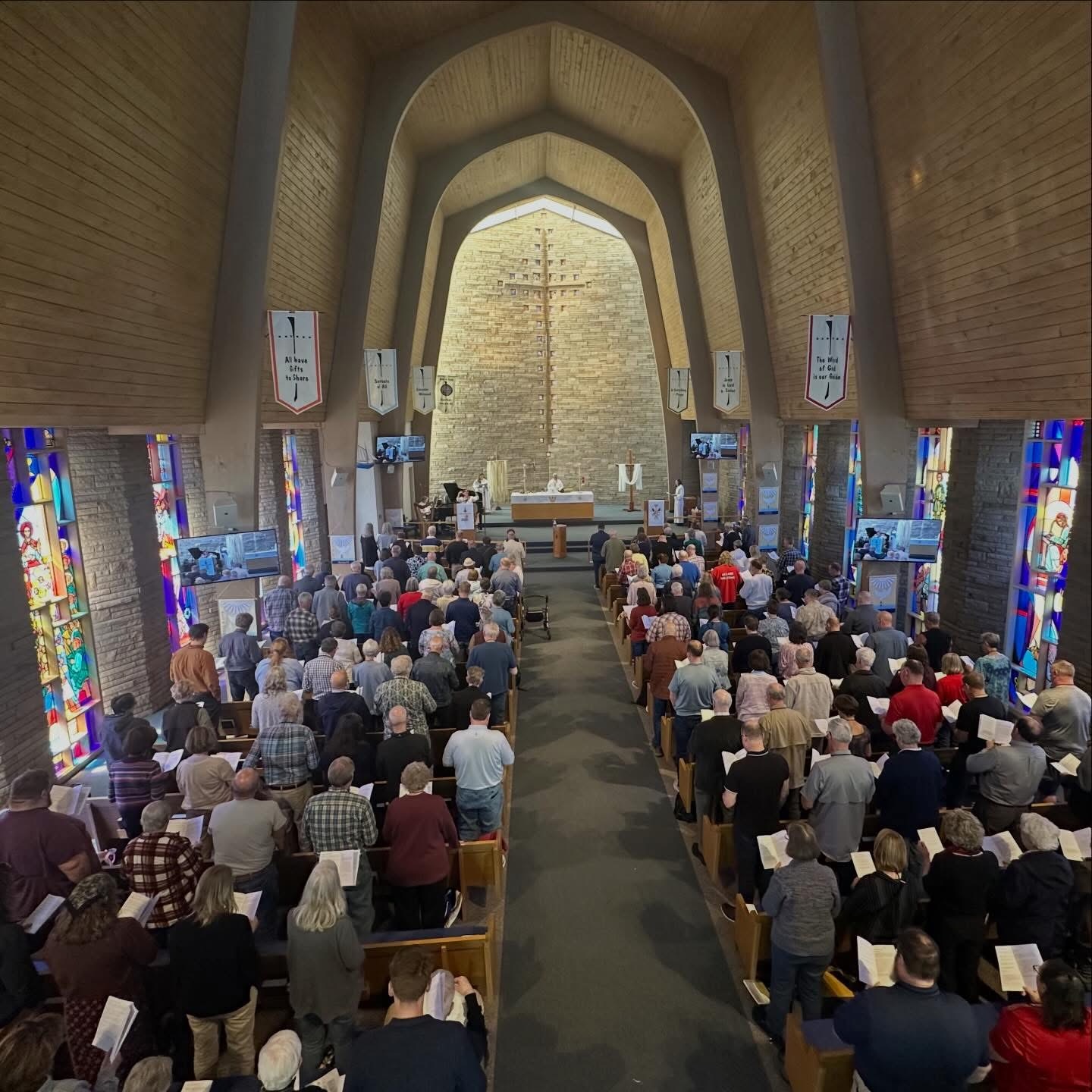
Sermon for Opening Worship at Synod Assembly
April 24, 2026
Synod Assembly – First Kennewick
John14:23-29
As we listen in on Jesus’ final address to his disciples before his death, we hear about mutual love between Jesus, the Father (you might think Mother), and the Advocate. Jesus is clear that he is going to leave. He will no longer walk with his disciples as he has. But they will never ever be alone, so deep is God’s love. Jesus promises them peace. “Peace, I leave with you; my peace I give to you. I do not give to you as the world gives.”
In the Old Testament (or Hebrew Bible), Peace was a leave-taking address, a version of “see you later.” But Jesus is not simply saying farewell to his disciples with this promise of peace. According to a favorite scholar, in the context of his coming death, the verb “to leave” takes on the meaning of a bequest. A bequest, I love that. Earlier, he promised to not leave his followers orphaned. Now his promise of peace backs up his earlier promise. The disciples will not be orphans—they will not be alone—because they will live in the peace of Jesus.
This peace is not the world’s peace. In other words, it is neither the false promise of security nor the end of conflict. The peace that Jesus gives is his peace, a peace that derives from the heart of Jesus’ life. The peace of Jesus is “the all-embracing sphere of his life, his love, his joy” (O’Day).
The first time I thought about any of this with what we might call the lens of faith; I was in the Boundary Waters Canoe Area Wilderness of northern Minnesota, a magical place of lakes and rivers and forests. The specific evening I’m thinking of was actually north in Ontario’s version—the Quetico.
I was there for my third canoe trip. I was 16 years old, with a group of girls my age and one college-age counselor. I felt deep peace on these canoe trips, like I could be truest self. And I love the Northwoods—the forest, the lakes, the rivers, moose, beaver, the paddle pulling you through the water. And the call of the loon at night when you are settled for the evening. To experience all that in community was a profound way to experience God’s love and peace.
Our canoe trip was through a YMCA camp, and as one evening conversation progressed, I realized I was the only one who claimed to be a person of faith, a follower of Jesus specifically. And as I realized this, I sat not in any judgment, but in deep wonder and thanksgiving. Who did these sister campers praise for this amazing wilderness? Who did they pray to? To whom did they attribute the peace of the rivers and the peace in my own heart.
I was living these lines from father’s favorite Wendell Berry’s poem:
I come into the peace of wild things
who do not tax their lives with forethought
of grief. I come into the presence of still water.
And I feel above me the day-blind stars
waiting with their light. For a time
I rest in the grace of the world, and am free.
I tell this story because I think many of us in the Northwest Intermountain Synod experience God’s love and peace with others in the natural world together, so much so that our churches have hiking guilds, outdoor worship, summer campouts. And we are not pantheists, as some would accuse us being. We simply take the First Article of the Creed seriously. And our very lives tell us that we experience peace when we are in God’s beautiful creation. As Lutheran theologian and campus pastor Joseph Sittler said once, “nature is a theater of grace.”
“Peace, I leave with you; my peace I give to you. I do not give to you as the world gives.” The promise of Jesus’ peace is not an occasion for complacency, however. Jesus is not simply telling the disciples not to worry. He is calling them, and us, to find strength to face the new circumstances in which Jesus’ departure places them. You leaders gathered here this weekend are anything but complacent.
And as your bishop these past three years, I have seen you, so many of you, share Jesus’ bequest of peace in your larger communities. I have seen you bring the gift of Jesus’ peace (his own love and joy) to immigrant neighbors who are deeply afraid of being deported. I have watched you provide holy spaces for those who are experiencing food insecurity—feeding them with flavorful food but also with the gift of seeing in each of them the very face of Jesus. You have sat in solidarity with our transgender siblings as others dehumanize them. And during what some have named a loneliness pandemic, when we are more connected than ever online but yet so alone, you have provided places of belonging, not country club memberships, but the deep belonging shaped by prayer, storytelling, the sacraments, and abundant love. Thank you.
And there is more. Because Jesus’ deep peace is for you too. Sometimes I worry that the leaders of the church are so busy peacemaking, so driven by the world’s injustices, so committed to making sure everyone else has a share of Jesus’ peace, that we don’t think we deserve Jesus’ gift of peace ourselves. Maybe cognitively, in our heads, we have read enough good theology, sat in on enough Bible Studies, participated in ample worship services that we understand the gift of peace in our heads. And yet, we have not let the gift of peace drop down into our hearts. What is the anecdote?
Our worship informs us. Today we began with Thanksgiving for Baptism. Last fall, we held three rural ecumenical gatherings across the synod. We called them United at the Font: Partnering for the Future. We talked about what unites us across denominations. We named the realities of our local contexts. And we ended each gathering with Affirmation of Baptism by the Assembly. We remembered that wherever we are, at whatever stage of life, no matter what reign of God work we have left undone, as the old Confession states, that we remain beloved children of God. Jesus’ gift of his peace is for us, for you through the baptismal covenant.
When you do not feel the peace of Christ, remember your baptism. I have to imagine that’s what was happening to John of Patmos when he had his vision.
He seamlessly incorporated water into his own vision of the transformed world which lay beyond the suffering and evil of the present age. Today we read: “Then the angel[a] showed me the river of the water of life, bright as crystal, flowing from the throne of God and of the Lamb 2 through the middle of the street of the city. On either side of the river is the tree of life[b] with its twelve kinds of fruit, producing its fruit each month, and the leaves of the tree are for the healing of the nations.”
This is a weekend for learning and relationship building and experiencing deep peace–Peace at the Now. You have peace because you have been united with Christ and sealed by the Holy Spirit. You have all you need and you worship the God who is the source of living water.


