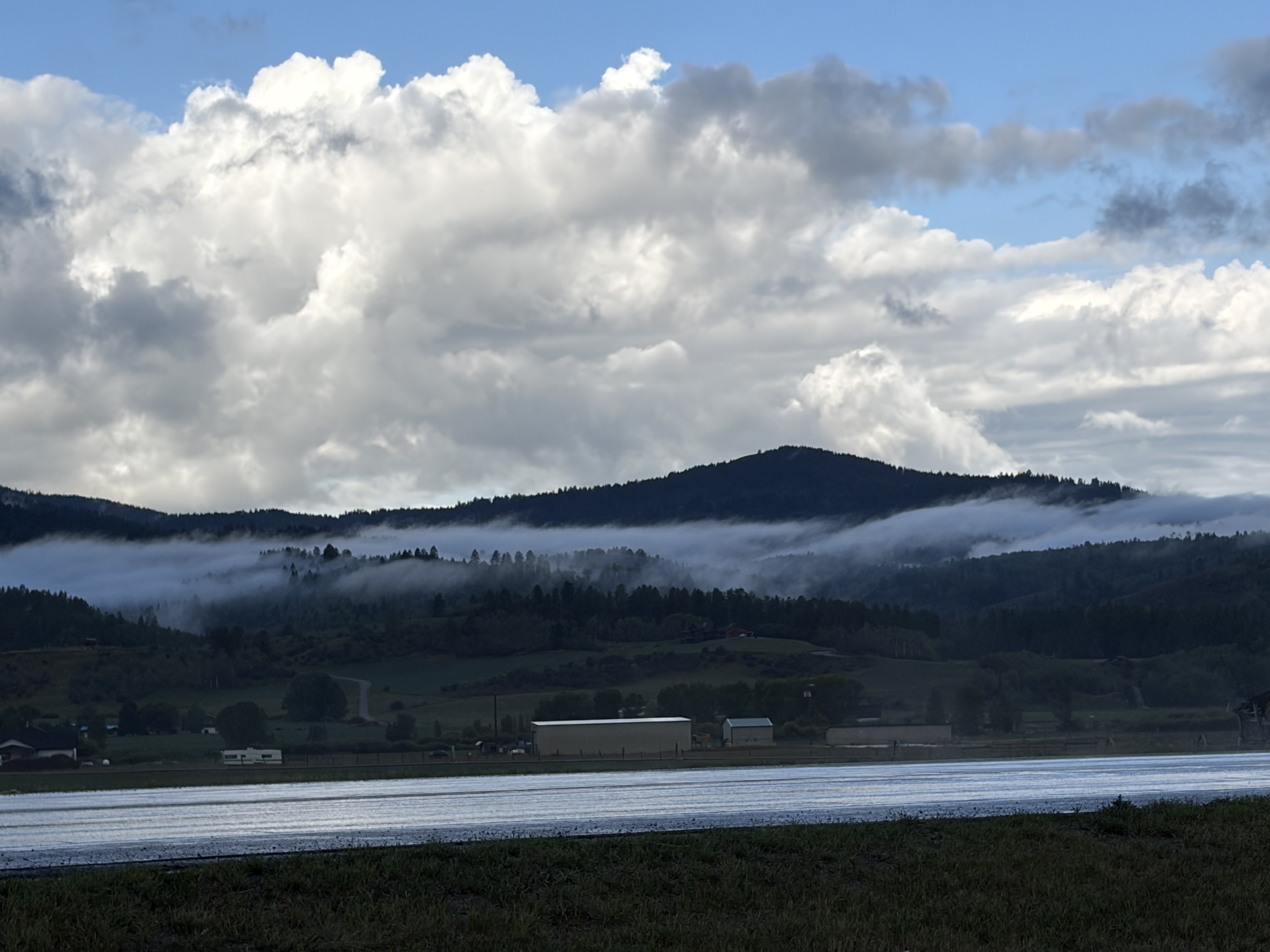
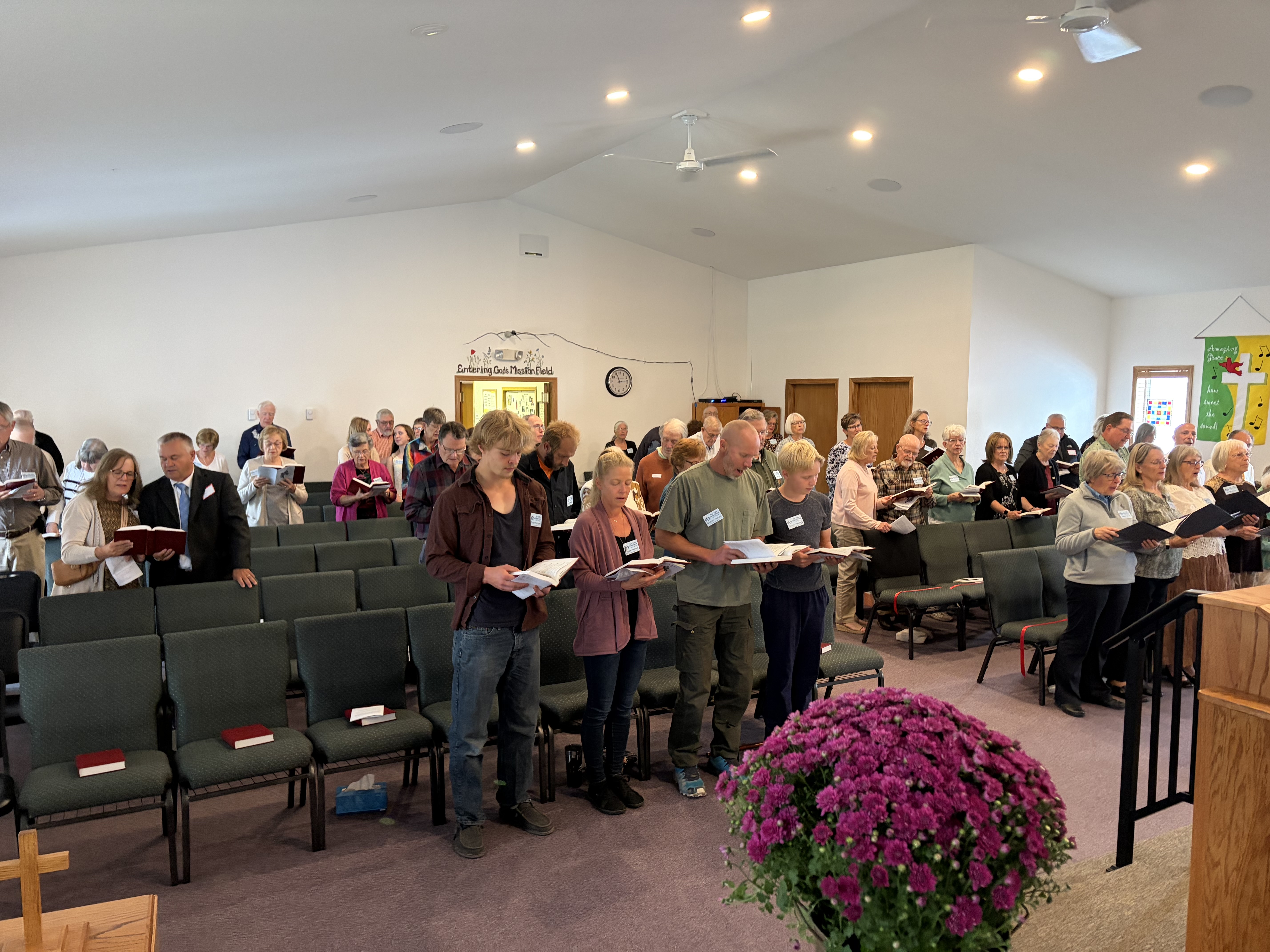
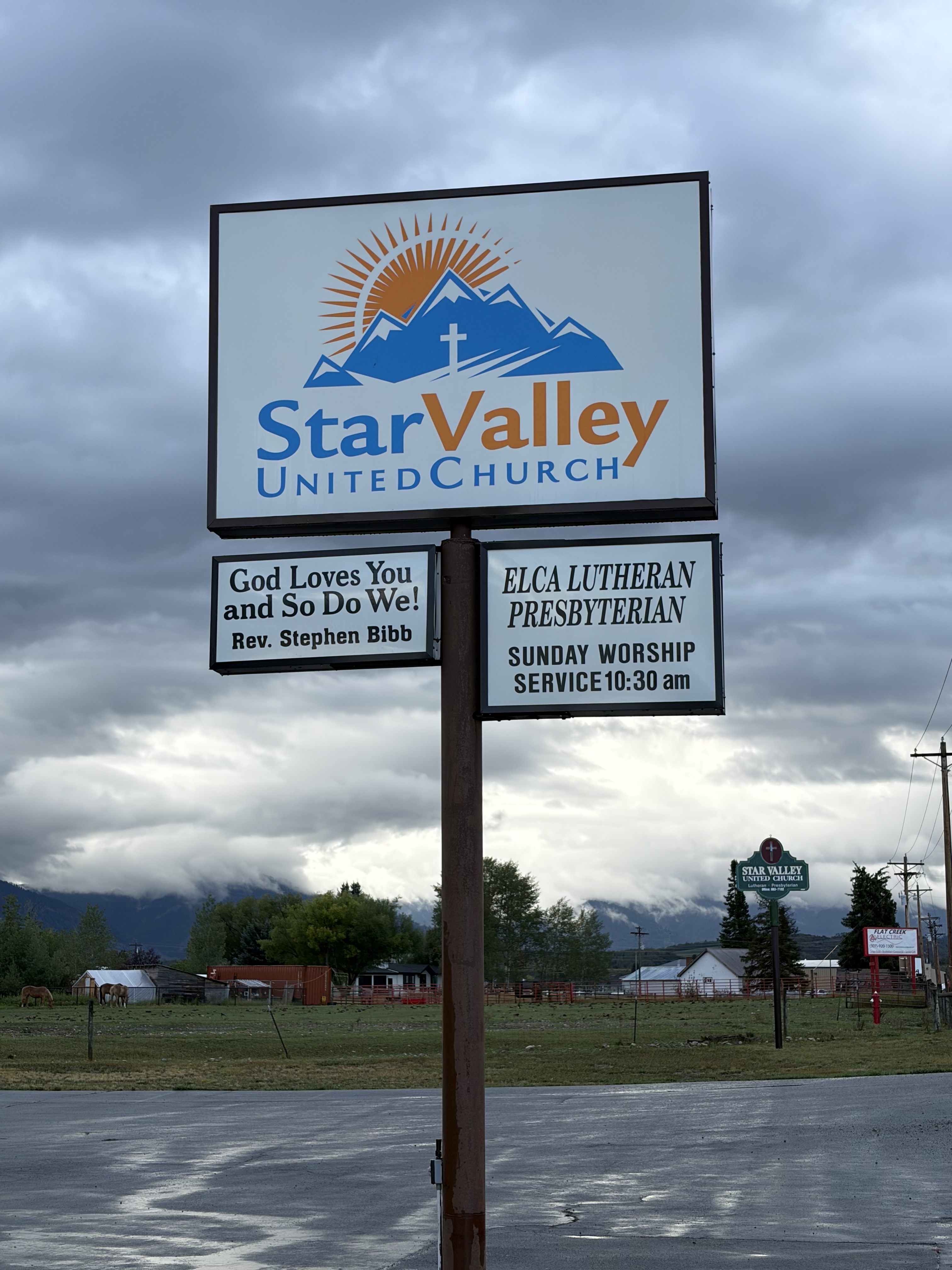
This congregation started as a joint, PCUSA and ELCA Congregation just over 25 years ago. Long ago, the building was a church but for many years, including when Star Valley United started, it was an office building. A gift from a member who died allowed the church to build a platform, purchase a baby grand piano, and uncover the vaulted ceiling. It was an honor to preach this morning for the rededication service. Wyoming PresbyterJeromey Howard presided at the table. The congregation is currently served by Methodist Pastor, Stephen Bibb. We woke up to rain but after worship and a potluck, the sun came out and I got in a little hike before hitting the road.
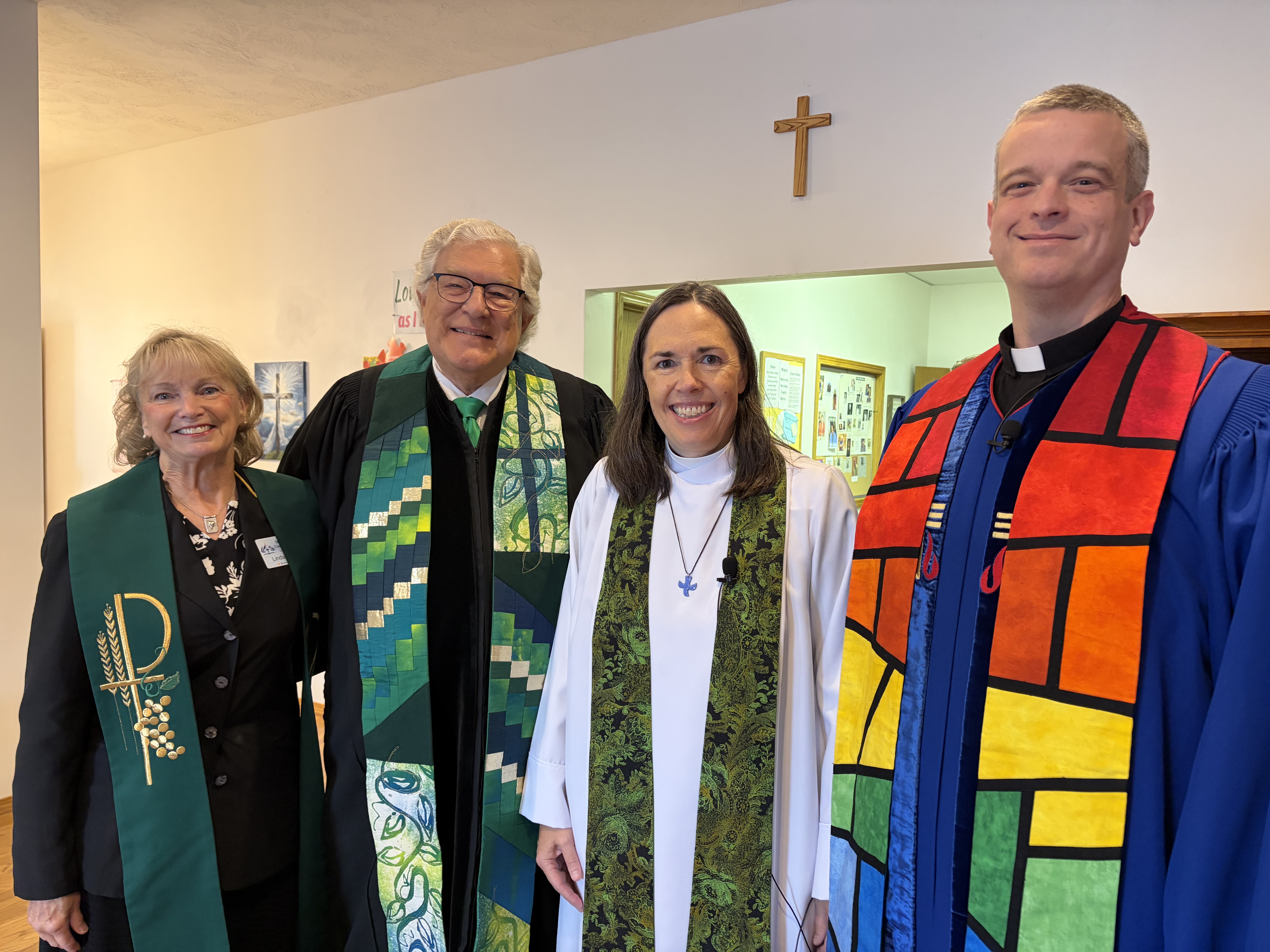
Saturday night Pastor Tim Stadem (who serves Shepherd of the Mountains in Jackson) drove down to Alpine and we caught up over dinner. On Sunday night I stopped in Pocatello and had dinner with Cluster Dean Pastor Wayne Shipman and his wife Janet (Wayne serves our churches in Pocatello and Blackfoot). The Holy Spirit is working through the congregations of the Upper Snake River Cluster.
Matt. 16:21-28
Grace and peace to you from God our father and the Lord Jesus Christ.
It is wonderful to be with you all today, Star Valley United Church, along with Executive Presbyter Jeromey. I am delighted to finally be here on Sunday in person to bring greetings from the entire Northwest Intermountain Synod (around 85 ministry sites from here to Chelan, WA). Thank you for continuing to share the gospel of Jesus Christ in this beautiful place.
What a text we have from Matthew this morning. We know the command well, “take up your cross.” We have heard those words many times, but what do they mean? German Lutheran pastor and teacher Dietrich Bonhoeffer used the phrase “the cost of discipleship.” He was building on Jesus’ own words, “If any want to become my followers, let them deny themselves and take up their cross and follow me. For those who want to save their life will lose it, and those who lose their life for my sake will find it.”
This whole exchange started with Jesus’ prediction of his own suffering. Peter’s rebuke of Jesus may seem reasoned. How can we see Jesus as anything more than a failed messiah? He is a messiah, yes; but one that will suffer and be killed. Nothing could be further from the hope and expectation of God’s people than for its long-awaited leader to go directly to the place where he would be in the most danger and there be tortured and killed. Jesus includes a strong word of hope: “…and on the third day be raised.”
This is so far beyond human comprehension that the disciples miss it, and Peter jumps in to rebuke him. One minute Peter is praised and promised to be the “rock” upon which Jesus will build his church, then chastised in the next. The rock becomes the stumbling block. Peter was a Jew and could not fathom a Messiah who would give up his life just at the moment when he should be seizing leadership. Peter still speaks for us.
There may be witnesses and indications all around us that Jesus is the Messiah. We still set our minds readily on human things and miss the Easter promise of resurrection and life. It is so much easier to imagine a Jesus who was a great moral leader, a teacher, even a miracle worker, than to comprehend that he could draw all humankind to himself in one great self-giving embrace. We know this magnificent hope, but we still function on an all too human level. It is our default setting.
The problem is we are poor at cross bearing. The disciples wouldn’t have thought themselves any better. They had seen ominous wooden crosses prepared for crucifixions and they knew how life-crushing they were. For them, the thought of carrying a cross was a life and death matter. In the end, many of them did die because they followed the Messiah. For us, to bear a cross is a metaphorical idea.
No one really expects to die in the process. But, even to deny ourselves seems too much to ask. We aren’t much good at that either. Here is both the challenge and the good news in this text: If we follow Jesus, we will be seriously called to bear certain crosses and lose hold of our lifestyle, if not our life. Yet, in all our weakness and human mindedness, it is Jesus’ own death on the cross that enables us to do what we cannot. Only Jesus can free us. Only the Messiah can bring about new life.
Here, I think the Apostle Paul’s words from our Romans reading are helpful. It’s helpful to know that earlier in this letter, Paul wrote, “God shows his love for us in that while we were sinners, Christ died for us.” Romans 8:35-39 famously assures readers that “nothing in all creation can separate us from the love of God in Christ Jesus our Lord” (verse 39). Surrounded and upheld by this undeserved and steadfast love, then, the community of Jesus Christ practices love. “Let love be genuine,” Paul says in Romans 12:9a, and then he spends the rest of the chapter describing sincere, non-hypocritical love in various spheres of the Christian life. “Hate what is evil, hold fast to what is good; love one another with mutual affection…contribute to the needs of the saints; extend hospitality to the strangers.” Receiving the love and mercy of Jesus Christ we are free to give our lives away.
On August 15, the church remembered Father Kolbe, a Franciscan priest, born Raymond Kolbe. After spending some time working in Asia, he returned in 1936 to his native Poland. There he supervised a friary that came to house thousands of Polish war refugees, mostly Jews. The Nazis were watching, however, and he was arrested. Confined in Auschwitz, Kolbe gave generously of his meager resources and finally volunteered to be starved to death in place of another man who was a husband and father. After two weeks, he was executed by a lethal injection. In Kolbe’s writings, we find these words that he lived, “A single act of love makes the soul return to life.” A single act of sacrificial love changes everything for those who bear witness to this love. Kolbe’s faithfulness, while still in the last century, may seem too far away.
I have, perhaps like some of you, been reading a great deal these last few days about a very different icon, but one who took following Jesus quite seriously, the one and only Dolly Parton. She grew up steeped in Christian Scripture and hymns with a congregation as her first audience. The bathed-in-the-blood granddaughter of a Pentecostal preacher who “preached so plain a child could understand” did not particularly like going to church.
She called herself a Jezebel, yet woke up every morning at 3 A.M. to pray and, often, ask God two questions: “How can you use me?” and “What can I do today?” One reporter mused, “Unlike most of us who ask questions like that, it seems like she really heeded the answer.” Indeed, from acts of kindness to everyone she worked with, to her generosity to her home community, to her literacy work, Parton’s faith quietly guided her. Was it costly? It might not seem so reading most of the tributes. But when you look at her decisions in the 1970s and 80s and again in the last decade, I think her commitments to everything that was fair, good, generous, and kind were costly to her. Yet, her understanding of God’s love compelled her to see all people as beloved and to be quietly and abundantly generous.
Over twenty-five years ago, in this valley bordered by mountains steeper than the Tennessee hills of Parton’s childhood, Christians from the ecumenical movement started gathering to be reminded of the truth that only Jesus frees us, that only this one Jesus Christ is the Messiah whose life, death, and resurrection give new life. For over twenty-five years worship has been shaped by this truth confessed by churches born from the Reformation—that we are saved by God’s grace apart from works.
Worship here has been centered on Word and Sacrament—hearing the gospel of Jesus Christ proclaimed, receiving God’s grace and mercy through the sacraments of the Baptism and Holy Communion. Nourished in the space, made sacred by God’s promises and ordinary things like water, bread, and wine, you and those who’ve come before you have been sent forth to share God’s love as followers of Jesus. Christian faith proclaims resurrection. We gather around the Living Christ, hidden yet revealed through bread, wine, water and the word. Resurrection begets hope in the face of guaranteed failure.
God’s power is revealed not in walks through the porticos of power, but through the dusty alleys of weakness and misery. That is where Jesus walked. That is where he leads you to walk. That is where he strengthens you to bear the burdens of discipleship. It is his burden we take upon our shoulders. It is his strength that bears the weight. We do nothing on our own, but he can do much through us. Without him, Peter was no rock, but a stumbling block. With him, Peter was foundation for the church. With him, you have everything you need to know God’s love and to share it with others.