
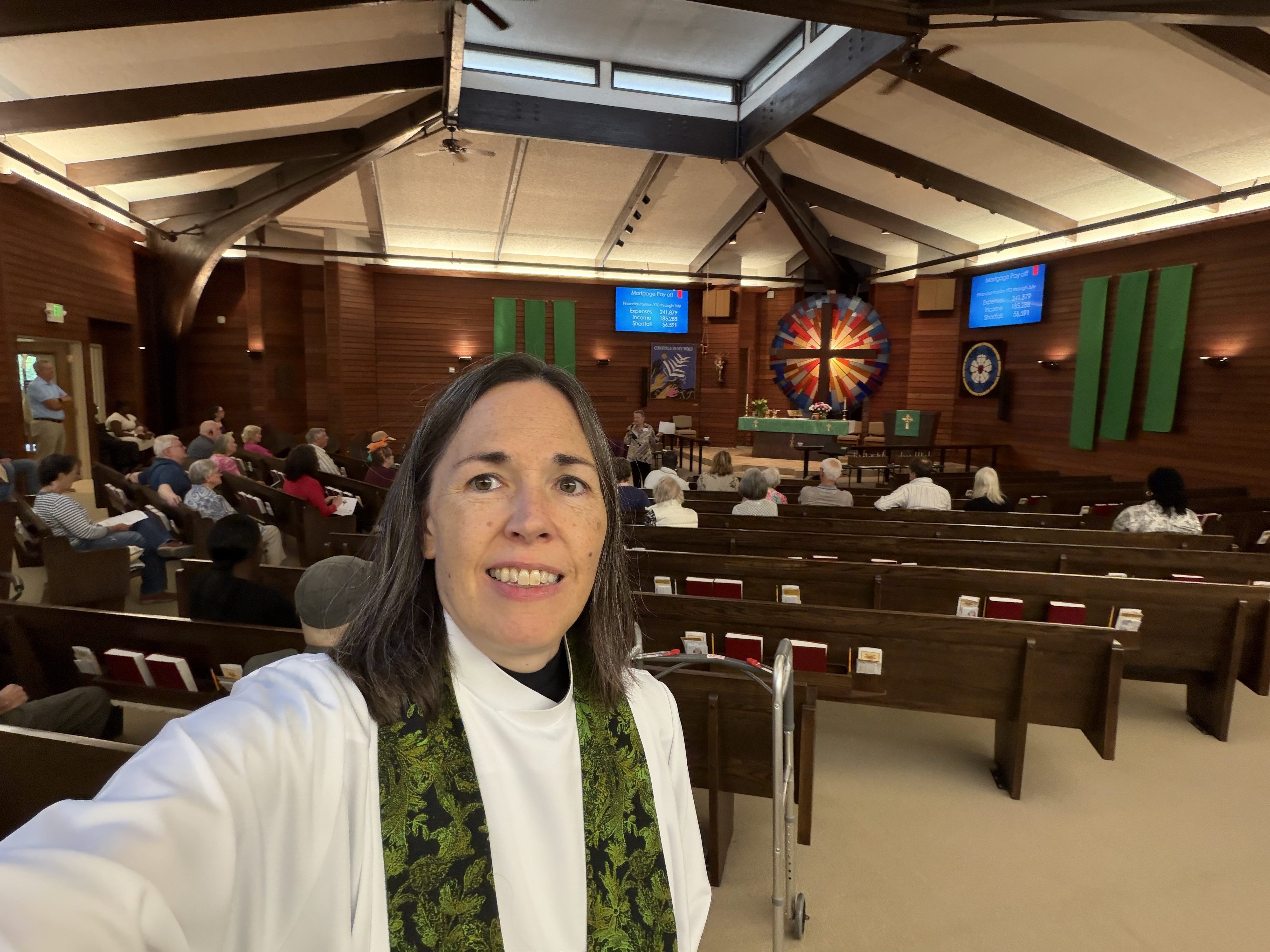
It was wonderful to be with the saints of King Of Glory Lutheran Church in Boise this morning for Feast of creation in Christ Sunday. KOG was served by interim pastor Mark Galbraith who just took another interim in California. Pastor John Hergert will soon be here as the bridge Pastor as the congregation continues through the call process. I stayed for a special meeting after worship during which they voted to pay off their mortgage. Musician KJ fit contemporary Christian music to each piece of the traditional liturgy. Loved it!
Genesis 1:1-2:2 and John 1:1-5
I used to love having Confirmation Class students (7th and 8th graders) act out the story from Genesis One. I imagine that has been done many times at King of Glory during the Easter Vigil. The flick of the switch lit up the sanctuary on the first day. Students were sprayed with water bottles on the second. Later we stepped outside to see the stars and moon. On and on we went through the ancient story of creation. Our attempt to recreate the creation narrative illustrated the wonder of the event. It also showed the intricacies of the creation–the care taken. As the story was enacted we were always reminded of God’s blessing–God saw that it was good.
The thread woven through this text is that God and God’s creation are bound together in a distinctive and delicate way. This is the foundation for everything that follows in the Bible. It is the deepest premise from which good news is possible. God and God’s creation are bound together by the powerful, gracious movement of God towards that creation. The binding which is established by God is difficult to comprehend. It will not be explained or analyzed. It can only be affirmed and confessed. “We believe in God the Father, Creator of Heaven and Earth.”
The text announces the deepest mystery: God wills and will have a faithful relation with the earth. The creation narrative invites us to celebrate that reality. The binding is irreversible. God has decided it. The connection cannot be nullified. This binding relationship is illustrated throughout scripture. It is this binding relationship that we examine every time we enter the rite of Confession and Forgiveness. We ask where in our lives have we bent this relationship. We try to mend our ways.
The eldest of my two half-brothers lived outside of Ely, Minnesota, on the edge of the Boundary Waters Canoe Area Wilderness–that expanse of land and lakes covering Northeastern Minnesota. Mike worked for the Superior National Forest. For many years he spent his summers out on the lakes enforcing laws and maintaining portages and campsites. He always took a volunteer with him. I fell in love with the Boundary Waters as twelve-year-old and so I went along as a volunteer for a week during one of my college summers. I was along to help paddle the canoe and help with maintenance –mostly clearing trees that had fallen across portages or into the middle of campsites and cleaning up litter. Mike died in 2007 but a few weeks ago my adult nephew was home in Ely and texted me a photo of myself during that trip.
I enjoyed the physical labor of using hand saws, but watching my brother interact with groups of campers was a true joy. We pulled our canoe into campsites and Mike would check that there were not too many people traveling together. He eyed the campsite for bottles and cans–which are not allowed in the Wilderness. Then he would inquire about the group’s route and how things were going. If they were breaking any laws or if he had any suspicions about their practices, he would take extra time to visit. Mike was a pro at talking about the fragileness of the lakes and land and why the laws were in place. He was a true caretaker of the Boundary Waters. He wanted people to enjoy the lakes as much as possible, but he did not want campers leaving traces of themselves all over the Wilderness. He loved the region and he tended to it however he could.
We need to be about that tending. The whole creation that God so wonderfully made is aching. The land itself has been harmed and so has the human family. I know you can think of examples of this brokenness both near and far. The world needs tending. We need such tending also. When we recognize this need and turn to God we are never turned away. Remember, the relationship is binding. Where there is confession there is always forgiveness and new life.
But tending to the natural world and to other human beings also requires more than confession. It requires repentance, a new perspective. The great poet and farmer Wendell Berry died this past week, and he was a master of calling us to see the world and our place in it with new eyes, to have a new perspective. Here’s just one of 100 quotes you can read that will keep you pondering for days:
“We have lived by the assumption that what was good for us would be good for the world. … We have been wrong. We must change our lives, so that it will be possible to live by the contrary assumption that what is good for the world will be good for us. . . We must recover the sense of the majesty of the creation and the ability to be worshipful in its presence. For it is only on the condition of humility and reverence before the world that our species will be able to remain in it” (The Long-Legged House).
This year’s inaugural Feast of Creation of Christ can be traced back to 1989 when the ecumenical patriarch of Constantinople issued an invitation to “the whole Christian world” to join the Orthodox in observing September 1-known in the Eastern church as the Feast of the Indication—as a day of prayer for creation.
Over time, this day of prayer was adopted by various churches and ecumenical groups as a Creation Day, along with a companion Season of Creation spanning September and early October. Why September 1? It has origins in the civic calendar of ancient Rome as a harvest festival, considered the beginning of the agricultural year, and the Orthodox feast commemorates the beginning of God’s creation and of Christ’s ministry as well.
In the Genesis 1 story of creation, the chaos becomes a world surging with the mystery of God’s gracious, empowering speech. Again and again “God said” and something good was created. The good news is that life in God’s well-ordered world can be joyous and grateful response. The good news found here is that there are beginnings. There are not simply repetitions, moving pieces around, or copying. There are beginnings, and they are wrought by the speech of God which evokes among us a new world.
We discern this good news in Jesus of Nazareth. In John’s prologue, we read “In the beginning was the Word, and the Word was with God, and the Word was God. He was in the beginning with God. All things came into being through him, and without him not one thing came into being.” And in his second letter to the church at Corinth, the Apostle Paul writes “So if anyone is in Christ, there is a new creation: everything old has passed away; see, everything has become new.” (5:17).
Through Jesus Christ, God’s powerful speech is still being spoken. Through the Holy Spirit, God’s powerful wind is still blowing. At the first creation, the Spirit of God moved over the waters bringing order from chaos, and creation began with the coming of light into the darkness. In the cross and resurrection of Christ the new creation begins. Creation is continued in each Baptism. We are baptized into Christ’s death and resurrection and every day we are called to remember this baptism–this new life. Wendell Berry ends one of his most famous poems with the command for us to “Practice Resurrection.” Joined to Christ’s death and resurrection, we are free to love our neighbor, whether the fox, the pine in the forest, the mushroom, or our human companions.
As God has spoken this text of blessing to us through creation, so we may say it back to God. We must listen to the text, but it does not stay in our ears. It leaps to our lips. Old Testament scholar Walter Brueggemann says this proclamation of thanks becomes a doxology. When I think of doxology I first think of table graces.
Brueggemann says table graces are brief Sabbaths when we live by gift and know that we are strangely sustained, nurtured, and nourished. It will be worthwhile to make a visible link between the overpowering miracle of creation and the daily reality of food. It has been more than a cliche, then, when the church has prayed through the generations: ‘Come dear Lord Jesus, be our guest, and may these gifts to us be blessed.’” Might we think of this doxology as part of our feast of creation vocabulary. When we see the goodness of God’s creation and the goodness of God we return to God and invite God into our lives, that the gifts God has given us will be blessed once again by their creator.


