Ash Wednesday -2023

Joel 2:1-2, 12-17

1Blow the trumpet in Zion;
  sound the alarm on my holy mountain!
 Let all the inhabitants of the land tremble,
  for the day of the Lord is coming, it is near—
2a day of darkness and gloom,
  a day of clouds and thick darkness!
 Like blackness spread upon the mountains
  a great and powerful army comes;
 their like has never been from of old,
  nor will be again after them
  in ages to come.

12Yet even now, says the Lord,
  return to me with all your heart,
 with fasting, with weeping, and with mourning;
  13rend your hearts and not your clothing.
 Return to the Lord, your God,
  for he is gracious and merciful,
 slow to anger, and abounding in steadfast love,
  and relents from punishing.
14Who knows whether he will not turn and relent,
  and leave a blessing behind him,
 a grain offering and a drink offering
  for the Lord, your God?

15Blow the trumpet in Zion;
  sanctify a fast;
 call a solemn assembly;
  16gather the people.
 Sanctify the congregation;
  assemble the aged;
 gather the children,
  even infants at the breast.
 Let the bridegroom leave his room,
  and the bride her canopy.

17Between the vestibule and the altar
  let the priests, the ministers of the Lord, weep.
 Let them say, “Spare your people, O Lord,
  and do not make your heritage a mockery,
  a byword among the nations.
 Why should it be said among the peoples,
  ‘Where is their God?’ ”

Sermon – Pastor Meggan Manlove

Today’s Old Testament lesson comes from one of the shortest books of the Bible. Taken from the second of its three chapters, the prophet Joel speaks of the blessing that is possible for Israel, if only they would repent. Considering the blessings that come with repentance, we might think that the people would eagerly, without hesitation, run to God’s open invitation for penitence. But despite its potential for blessing, the Israelites of old resist repentance with every ounce of their being.

Why? Why are people so reluctant to repent when they know that blessings are waiting? Well, repentance necessitates recognition and admission of guilt, of having done wrong, of being sorry for the hurt one caused another. Individually or collectively, people would rather live in denial than have a contrite spirit, admit they are mistaken, and say “I’m sorry. I was wrong. Please forgive me.” And if sin is about being separated from God, who wants to admit that? 

Joel is among the biblical prophets who repeatedly, to no avail, encouraged Israel to turn to God and leave its faults and failures, its sins, behind. We are not confident about the context that this particular prophet lived during. What we can be sure of is that he writes to warn Israel that communal sin has consequences.

I confess that I am coming to Ash Wednesday this year informed by a discussion series I led on Brian McLaren’s book, Do I Stay Christian? Although in the second half of the book McLaren gives compelling reasons for being Christian, the first half is disheartening to say the least. It is a blunt retelling of systemic sins in the name of Christianity. Readers are reminded of them all: Christians killing non-Christians in the name of religion, Christians killing Christians in the name of religion, slavery, colonization, the destruction of indigenous cultures in the name of relgions, upholding patriarchy leading to the harm of countless women, and anti-Semitism.

These sins are not limited to one geography or centuries past. I will never forget the way my heart broke when I watched the news about the Unite the Right rally in Charlottesville in the summer of 2017. The participants claimed to follow the same Jesus we do. How is that possible and, more importantly, what is our responsibility and what can actually be done?

First, we belong to a long tradition of repenting for the collective sins of our ancestors. The Lutheran Church has made specific public apologies for Martin Luther’s anti-Semitism. More recently, we have apologized for being complacent in the doctrine of discovery, a belief system which displaced thousands of Native Americans across the United States. 

There is justifiable criticism for apologies that are not followed by concrete actions. However, when action follows, then formal and public repentance can be a powerful step towards reconciliation with our neighbors and with God. It is always a good time to repent, but I am thankful for a liturgical season that calls us to take the practice of repentance particularly seriously for a period of time.

So let us return to our Old Testament text. Joel uses the image of an invading army of locusts to get the attention of a nation, whose short-term perspective made it oblivious to the dangers that lay ahead. To get the full impact of this imagery, one needs to hear Joel’s words in Chapter 1, “What the cutting locust left, the swarming locust has eaten. What the swarming locust left, the hopping locust has eaten, and what the hopping locust left, the destroying locust has eaten” (Joel 1:4). The image is clear—all is lost and there is no hope for restoration. The situation is so hopeless that even the animals groan and cry out to God. 

In our reading today, Joel returns to the call to repentance issued earlier. This time the sense of hopelessness is replaced by a glimmer of hope in God, who is, according to Joel, “gracious and merciful, slow to anger, and abounding in steadfast love” (2:13b). There is, however, a catch. Reprieve is a contingent blessing. It depends on how Israel responds to God’s call to return. Joel makes it plain that a change of heart and a commitment to follow God are the requirements for the reprieve. With a cry of desperation that one more appeal could make a difference, God pleads, “Yet even now, return to me with all your heart, with fasting, with weeping, and with mourning; rend your hearts and not your clothing.”

With a strong sense of urgency, Joel calls on Israel, even though there is no guarantee, but “Who knows whether God will not turn and relent and leave a blessing behind” (2:14a, b).

Joel calls for the entire community to gather, suckling infants, children, and aged alike, to fast, weep, and plead for God’s mercy. This appeal to God is accompanied by a reminder to God that Israel is God’s heritage. The reminder seems foolish since Israel has not followed God’s commandments and can only hope that God will respond with an undeserved kindness—a kindness based on God’s grace and character.

In this season of Lent, is not Israel’s plea our plea as well? Should we not also fast and cry out to God? Should we not recognize that any reprieve God gives is neither earned entitlement nor priceless privilege? Instead, God’s forgiveness is a manifestation of God’s grace, of God’s love and care for humanity.

In an online clergy group, another pastor said someone from a different tradition now at his congregation did not want to receive ashes. The pastor inquired, what else can mark the start of Lent besides Ashes? Now, I love and appreciate that our service tonight includes the Imposition of Ashes, and that ashes remind us of both our mortality and of our sin and brokenness. And yet Joel reminds us that the long confession and the invitation to the discipline of Lent are also crucial to this day and this entire season. 

On Ash Wednesday it is more than enough to return to God and know God’s presence: in our worship, in our long prayers, and in the meal. Our brokenness and our community’s brokenness are never the final word. God loves the world too much to let our sin be the final word. We trust a God who makes all things new.

Posted in Sermons, Trinity Lutheran | Leave a comment

Feb. 19, 2023

Prayer of the Day

O God, in the transfiguration of your Son you confirmed the mysteries of the faith by the witness of Moses and Elijah, and in the voice from the bright cloud declaring Jesus your beloved Son, you foreshadowed our adoption as your children. Make us heirs with Christ of your glory, and bring us to enjoy its fullness, through Jesus Christ, our Savior and Lord, who lives and reigns with you and the Holy Spirit, one God, now and forever.

Amen.

Exodus 24:12-18

12The Lord said to Moses, “Come up to me on the mountain, and wait there; and I will give you the tablets of stone, with the law and the commandment, which I have written for their instruction.” 13So Moses set out with his assistant Joshua, and Moses went up into the mountain of God. 14To the elders he had said, “Wait here for us, until we come to you again; for Aaron and Hur are with you; whoever has a dispute may go to them.”
15Then Moses went up on the mountain, and the cloud covered the mountain. 16The glory of the Lord settled on Mount Sinai, and the cloud covered it for six days; on the seventh day he called to Moses out of the cloud. 17Now the appearance of the glory of the Lord was like a devouring fire on the top of the mountain in the sight of the people of Israel. 18Moses entered the cloud, and went up on the mountain. Moses was on the mountain for forty days and forty nights.

Psalm 2

1Why are the nations | in an uproar?
  Why do the peoples mutter | empty threats?
2Why do the kings of the earth rise up in revolt, and the princes | plot together,
  against the Lord and against the | Lord’s anointed?
3“Let us break their | yoke,” they say;
  “let us cast off their | bonds from us.”
4God whose throne is in heav- | en is laughing;
  the Lord holds them | in derision. 
5Then in wrath God | speaks to them,
  and in rage fills | them with terror.
6“As for me, I have anoint- | ed my king
  upon Zion, my | holy mountain.”
7Let me announce the decree | of the Lord,
  who said to me, “You are my son; this day have I be- | gotten you.
8Ask of me, and I will give you the nations for | your inheritance
  and the ends of the earth for | your possession. 
9You shall crush them with an | iron rod
  and shatter them like a | piece of pottery.”
10And now, you | kings, be wise;
  be warned, you rulers | of the earth.
11Submit to the | Lord with fear,
  and with trembling | bow in worship;
12lest the Lord be angry, and you perish in a sudden | blaze of wrath.
  Happy are all who take ref- | uge in God!

2 Peter 1:16-21

16For we did not follow cleverly devised myths when we made known to you the power and coming of our Lord Jesus Christ, but we had been eyewitnesses of his majesty. 17For he received honor and glory from God the Father when that voice was conveyed to him by the Majestic Glory, saying, “This is my Son, my Beloved, with whom I am well pleased.” 18We ourselves heard this voice come from heaven, while we were with him on the holy mountain.
19So we have the prophetic message more fully confirmed. You will do well to be attentive to this as to a lamp shining in a dark place, until the day dawns and the morning star rises in your hearts. 20First of all you must understand this, that no prophecy of scripture is a matter of one’s own interpretation, 21because no prophecy ever came by human will, but men and women moved by the Holy Spirit spoke from God.

Matthew 17:1-9

1Jesus took with him Peter and James and his brother John and led them up a high mountain, by themselves. 2And he was transfigured before them, and his face shone like the sun, and his clothes became dazzling white. 3Suddenly there appeared to them Moses and Elijah, talking with him. 4Then Peter said to Jesus, “Lord, it is good for us to be here; if you wish, I will make three dwellings here, one for you, one for Moses, and one for Elijah.” 5While he was still speaking, suddenly a bright cloud overshadowed them, and from the cloud a voice said, “This is my Son, the Beloved; with him I am well pleased; listen to him!” 6When the disciples heard this, they fell to the ground and were overcome by fear. 7But Jesus came and touched them, saying, “Get up and do not be afraid.” 8And when they looked up, they saw no one except Jesus himself alone.
9As they were coming down the mountain, Jesus ordered them, “Tell no one about the vision until after the Son of Man has been raised from the dead.”

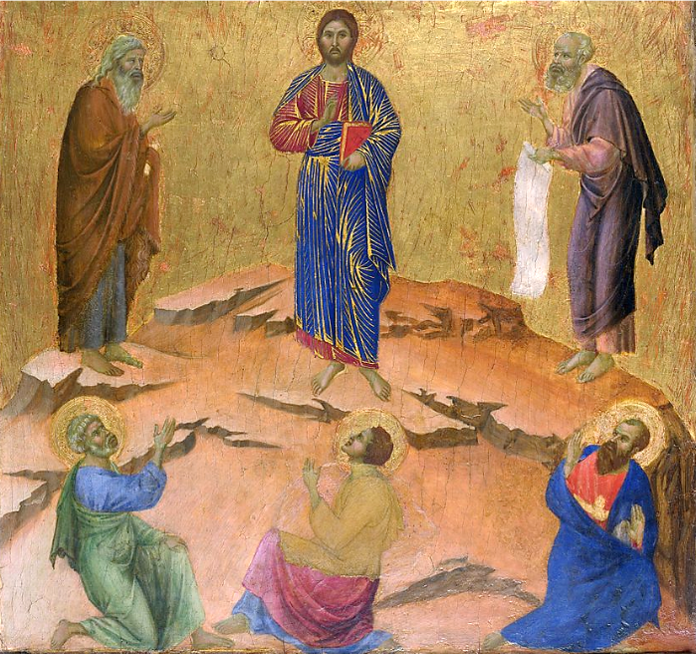
Transfiguration  —  Duccio, National Gallery of Art, Washington, DC

Sermon – Pastor Meggan Manlove

For weeks we’ve been up on a mountain with crowds of Jesus’ new followers. We listened in as Jesus spoke about what it means to follow him. This morning we skip ahead in the story and go up a very different mountain with the inner group. There is no long sermon or speech. It has the form of a historical narrative, but its content is so otherworldly that it is hard for us to accept its historical authenticity. 

No matter how we read it, the story points us to mystery, a mystery beyond the reach of historical reconstruction or scientific verification. Scholars can talk about Jesus the historical figure. But none of it tells us anything about the mystery of Jesus’ as it was experienced by the community that grew up around him. The story of the transfiguration attempts to draw us into that mystery.  

The Gospel writer Matthew refers to what occurred on the mountain as a vision.  He does not mean an inner psychological experience. He does mean that the “seeing’ is not a natural function of ordinary eyes but is God-given. God grants the disciples the power to see what otherwise would have been invisible to mortal perception.

The inside troika, Peter, James, and John are asked to see before listening, to see past it all–Jesus’ words, his ministry, his teaching, his healing, his preaching, his friendships, his prayer, his wisdom. Jesus invites them now to see through and beyond all that. He invites them to see something that can be apprehended most accurately not by ear or eye, but by the heart and soul: his true identity. “And he was transfigured before them, and his face shone like the sun, and his clothes became dazzling white.”

The transfiguration comes at a critical point in Jesus’ life, a point of major transition. Here he shifts from his active ministry among the people and toward Jerusalem, the place of his death and resurrection, the place where human and divine will intersect. And knowing how hard it would be for his disciples to understand and witness this, Jesus takes his closest disciples and heads up a mountain.  

There they come into the presence of God in a new way. Their hearts and souls are opened to see what their eyes can barely believe. Their friend and teacher, the very human Jesus, is transfigured before them. The appearance of his face changes.  His clothes become dazzling white. They sense the presence of Moses and Elijah. And God perceives their fear and responds by speaking to them. God wants them to begin to understand how this Jesus, fully human, is also fully divine.  

The story of the transfiguration of Christ functions, according to one writer [Henri Nouwen], as something of an icon. The transfiguration offers access through the gate of the visible to the mystery of the invisible. There, high on the mountain, the familiar face of their beloved friend and teacher is revealed in a new light, and in that light their hearts can hear the voice of God saying: “This is my Son, the Beloved; with him I am well pleased. Listen to him!”  

Icons have long been important to the Orthodox churches of the Christian family.  Painted in egg tempura on wood, these tools for prayer and liturgy most often depict scenes of Christ, Mary and the saints. Created according to rules handed down from generation to generation, icons are venerated as representations of the divine, windows through which the soul can see the realities of the kingdom of heaven. Their purpose is to pull one into the image in order to see through it and beyond it to the heart of God, to the reality of the great Mystery.

The story of the transfiguration becomes a luminous narrative icon, a painting in words that points beyond the text to the true reality of Christ, the light of the world.  Its aim is to help us see beyond Jesus of Nazareth, the Galilean, to see him radically transformed into the Son of God, the fulfillment of the law and the prophets. Only then will we begin to take in the foreshadowing of his resurrection and future glory.  

This moment on the mountain will sustain the disciples in the weeks ahead. We might assume it grounded Jesus once again in his identity and gave him what he needed has his ministry changed. Transfiguration Sunday is always celebrated the Sunday before Ash Wednesday. No matter where we are in the three-year cycle of assigned readings, we stop reading about Jesus’ teaching and healing and head up the mount of Transfiguration before beginning the Lenten journey. The vision of Jesus’ glory is meant to sustain us for the forty days.

It has been a bit strange really to remember where we were three years ago when we were reading these same verses, about to enter into the strangest and hardest Lent of my time as a pastor. And yet I am so grateful for all the glimpses of God’s glory that I and we collectively experienced before we closed the church. All sorts of icon moments and glimpses of God’s glory sustained our community. As we are about to embark on another Lent, I invite you to ponder for a few moments what glimpses of glory have sustained and will sustain you in faith: it might be a verse or story from scripture, a sacred song, relationships, or something in the natural world. Close your eyes if you’re comfortable and let something surface. Pause.

Give thanks for whatever came to the surface. Put it somewhere accessible in your heart or mind. The transfiguration is about God’s presence. God repeats the words spoken at Jesus’ baptism, “This is my Son, the Beloved; with him I am well pleased,” and then God adds, “Listen to him!” We hear of the intimacy that marks Jesus’ relationship with God.  

The transfiguration is a means of grace, an event in which God is present. It is sacramental. How does this event shape Jesus’ first disciples? Peter offers to make three dwellings, one for Jesus, one for Moses, and one for Elijah. He wants to make the event permanent. But the transfiguration, like whatever you came up with in your mind’s eye, cannot be made permanent. It is mystery. It is a glimpse. Peter is interrupted by the voice from the cloud. After God speaks, the disciples fall to the ground and are overcome with fear. Jesus touches them, they are healed. Jesus tells them, “Do not be afraid.”  

These are hard times in which to see clearly.  A murky human-made smog of dreams deferred, of violence, confusion and fear stings our eyes and blurs even what is closest to us. Where God would bring light, we linger in the darkness of ignorance and fear. Our reading from 2nd Peter this morning is speaking directly to us: “You will do well to be attentive to this as to a lamp shining in a dark place, until the day dawns and the morning star rises in your hearts.”

God’s gift is in the transfiguration icon, the intense light that allows vision and insight. God permits us from time to time to see through to the heart of the matter.  God permits us to see purpose and future, hope and possibilities for meaningful action and participation. And God’s gift is that God is there, waiting to be seen.  God is the reality behind the icon. The challenge to us is to be committed enough and bold enough to keep our eyes open. Will we dare to look, to pass through the gate of the visible to the mystery of the invisible, and then to accept responsibility for everything we see. 

The truth is that every time we gather around the table for the Lord’s Supper, we enter into a bit of a mystery. I have studied scripture, church history, and numerous theologians, and still I am overwhelmed with the mysteries of both sacraments: Baptism and the Lord’s Supper. How can water and a few words bestow such great gifts as forgiveness of sins and abundant life? How can these great gifts be given so freely through words and ordinary bread? Because Christ promised it would be so. God chooses to bestow God’s grace through these mysterious and marvelous sacraments. Baptism and Communion are means of grace. All of this is true, and I can explain it to some extent but when I try to expand on it I usually end up pausing and proclaiming—it’s a marvelous mystery. 

Like the Transfiguration, this meal is a glimpse and then it is over. Never was I so mindful of this as when on internship with campus ministry at Eastern Washington University. Every Saturday evening after worship I was responsible for disposing of the remaining elements. I dutifully went out the back door and poured the wine on the ground and broke up the bread for birds and other critters. Sometimes our gatherings were so wonderful that, like Peter, I wanted to create a marker, but disposing of the bread and wine was a reminder that we were meant to go back down the mountain and keep welcoming the reign of God. So it is for us in this place. After Communion we give thanks for the healing that springs forth abundantly from this table and ask God to renew our strength to do justice, love kindness, and journey humbly with you. 

Prayers of Intercession

Called together to follow Jesus, we pray for the church, the world, and all in need.

A brief silence.

Embolden your church as it witnesses to the majesty and mercy of your Son. Equip lay preachers, deacons, and pastors. Move us to share our stories of your faithfulness and forgiveness; may our lives proclaim your greatness. Merciful God,

receive our prayer.

Dwell with your whole creation, from the tallest mountain peak to the deepest valley. Bless the work of conservation organizations and protect vital habitats (locally threatened waters or lands may be named). Support the work of disaster relief agencies around the world. Merciful God,

receive our prayer.

Guide and give wisdom to all in authority: our mayor (name) and local leaders, our governor (name) and state legislators, our president (name) and national legislators. Bring freedom and justice to all nations. Merciful God,

receive our prayer.

Give shelter to those lacking safe homes. Spur communities to work for fair housing for all. Protect our neighbors whose dwellings do not keep out dangerous cold or heat; accompany with your touch those who are homebound, sick, or isolated (especially). Merciful God,

receive our prayer.

Make us eager to receive your Word in scripture. Help us recognize Jesus’ voice in the needs of our neighbors; make us confident to follow the way of the cross. Merciful God,

receive our prayer.

Here other intercessions may be offered.

Receive our thanksgiving for the holy ones who have guided us in faithfulness and gathered even the unlikely as your people. With our forebears in faith and all who have hoped in you, teach us to wait with courage until the promised day dawns. Merciful God,

receive our prayer.

We bring to you our needs and hopes, O God, trusting your wisdom and power revealed in Christ crucified.

Amen.

Posted in Sermons, Trinity Lutheran | Leave a comment

Feb. 12, 2023

Prayer of the Day

O God, the strength of all who hope in you, because we are weak mortals we accomplish nothing good without you. Help us to see and understand the things we ought to do, and give us grace and power to do them, through Jesus Christ, our Savior and Lord.

Amen.

Deuteronomy 30:15-20

[Moses said to the people:] 15See, I have set before you today life and prosperity, death and adversity. 16If you obey the commandments of the Lord your God that I am commanding you today, by loving the Lord your God, walking in his ways, and observing his commandments, decrees, and ordinances, then you shall live and become numerous, and the Lord your God will bless you in the land that you are entering to possess. 17But if your heart turns away and you do not hear, but are led astray to bow down to other gods and serve them, 18I declare to you today that you shall perish; you shall not live long in the land that you are crossing the Jordan to enter and possess. 19I call heaven and earth to witness against you today that I have set before you life and death, blessings and curses. Choose life so that you and your descendants may live, 20loving the Lord your God, obeying him, and holding fast to him; for that means life to you and length of days, so that you may live in the land that the Lord swore to give to your ancestors, to Abraham, to Isaac, and to Jacob.

Psalm 119:1-8

1Happy are they whose | way is blameless,
  who follow the teaching | of the Lord!
2Happy are they who observe | your decrees
  and seek you with | all their hearts,
3who never do | any wrong,
  but always walk | in your ways.
4You laid down | your commandments,
  that we should | fully keep them. 
5Oh, that my ways were made | so direct
  that I might | keep your statutes!
6Then I should not be | put to shame,
  when I regard all | your commandments.
7I will thank you with | a true heart,
  when I have learned your | righteous judgments.
8I will | keep your statutes;
  do not utter- | ly forsake me. 

1 Corinthians 3:1-9

1Brothers and sisters, I could not speak to you as spiritual people, but rather as people of the flesh, as infants in Christ. 2I fed you with milk, not solid food, for you were not ready for solid food. Even now you are still not ready, 3for you are still of the flesh. For as long as there is jealousy and quarreling among you, are you not of the flesh, and behaving according to human inclinations? 4For when one says, “I belong to Paul,” and another, “I belong to Apollos,” are you not merely human?
5What then is Apollos? What is Paul? Servants through whom you came to believe, as the Lord assigned to each. 6I planted, Apollos watered, but God gave the growth. 7So neither the one who plants nor the one who waters is anything, but only God who gives the growth. 8The one who plants and the one who waters have a common purpose, and each will receive wages according to the labor of each. 9For we are God’s servants, working together; you are God’s field, God’s building.

Matthew 5:21-37

[Jesus said to the disciples:] 21“You have heard that it was said to those of ancient times, ‘You shall not murder’; and ‘whoever murders shall be liable to judgment.’ 22But I say to you that if you are angry with a brother or sister, you will be liable to judgment; and if you insult a brother or sister, you will be liable to the council; and if you say, ‘You fool,’ you will be liable to the hell of fire. 23So when you are offering your gift at the altar, if you remember that your brother or sister has something against you, 24leave your gift there before the altar and go; first be reconciled to your brother or sister, and then come and offer your gift. 25Come to terms quickly with your accuser while you are on the way to court with him, or your accuser may hand you over to the judge, and the judge to the guard, and you will be thrown into prison. 26Truly I tell you, you will never get out until you have paid the last penny.
27“You have heard that it was said, ‘You shall not commit adultery.’ 28But I say to you that everyone who looks at a woman with lust has already committed adultery with her in his heart. 29If your right eye causes you to sin, tear it out and throw it away; it is better for you to lose one of your members than for your whole body to be thrown into hell. 30And if your right hand causes you to sin, cut it off and throw it away; it is better for you to lose one of your members than for your whole body to go into hell.
31“It was also said, ‘Whoever divorces his wife, let him give her a certificate of divorce.’ 32But I say to you that anyone who divorces his wife, except on the ground of unchastity, causes her to commit adultery; and whoever marries a divorced woman commits adultery.
33“Again, you have heard that it was said to those of ancient times, ‘You shall not swear falsely, but carry out the vows you have made to the Lord.’ 34But I say to you, Do not swear at all, either by heaven, for it is the throne of God, 35or by the earth, for it is his footstool, or by Jerusalem, for it is the city of the great King. 36And do not swear by your head, for you cannot make one hair white or black. 37Let your word be ‘Yes, Yes’ or ‘No, No’; anything more than this comes from the evil one.”

Sermon: Pastor Meggan Manlove

I want to say at the top of my sermon that if your attention landed on those verses about divorce you are likely not alone. I will address those verses briefly but maybe not to everyone’s satisfaction, but I love theological conversations so please call me if you leave today feeling a bit unresolved about any of this.

As Jesus gets deeper into his Sermon on the Mount, his words today remind me of the first time I got a letter from the local regional hospital hospice while serving as a pastor in rural Iowa. A parishioner had been admitted and the letter went something like—at the end of this person’s life we want to care for the whole person—body, mind, and spirit. To that end, we are wrapping around the person with medical staff, pastor, social worker, family, and volunteers. Hospice knew how to care about the whole person.

As part of ushering in the kingdom of heaven, which actually comes to us in Matthew’s gospel, Jesus is showing people again what it means to live in community. I say “again” because this is not new. God did something quite similar after he brought the Hebrew people out of Egypt and gave them the 10 Commandments. The commandments were a gift more than anything else. Because of our sinful nature, people need rules for how to live well together. They are the side bumpers that help us thrive. They are the mother telling us not to touch the hot stove. They are the speed limit and stop signs that help us navigate living in the world together. Collectively, good laws, whether civic or from God, have the goals of wellness and wholeness for the collective body.

Because of our sinful nature, it was never enough to say, “be nice to one another.” To return to the body image, think of the doctor who is with a patient who says, “I’m experiencing pain.” For a good doctor, that is not enough. A good doctor probes physically and with verbal questions until the source of the pain is found. The remedy must fit the condition. Likewise, the body of Christ needs specificity. 

Further, like the practice of medicine itself, as the world changes, as societies evolve, the law needs new interpretations. This is what Jesus does when he takes up adultery and divorce, already addressed in the Old Testament. Jesus’ teachings reinforce the dignity of women and warns against a culture of male privilege. We know today that there are other good reasons for both women and men to ask for divorce. And, to return to the goal for the collective, many of those divorces are good for the entire body, the entire community, even if they initially cause pain. 

Those of you who grew up memorizing Martin Luther’s Small Catechism, know that Luther followed Jesus’ example when he wrote his explanations to the Ten Commandments. It’s his Large Catechism that I want to lift up today, particularly his explanation of the Fourth Commandment, to honor mother and father, which is again about the collective body.

After writing several paragraphs about how children ought to treat their parents, Luther writes “In addition, it would also be well to preach to parents on the nature of their responsibility, how they should treat those whom they have been appointed to rule.” He argues later, “therefore let all people know that it is their chief duty—at the risk of losing divine grace—first to bring up their children in the fear and knowledge of God, and, then, if they are so gifted, also to have them engage in formal study and learn so that they may be of service wherever they are needed.” Do you hear how Luther, in the spirit of the Sermon on the Mount, is interested in the wellness and wholeness of the entire body, the society, the beloved community.

I admit that the verses in our passage that I am most interested in for our own time are those about oath keeping. Jesus’ suggestion to let one’s “yes” be “yes” is essentially an encouragement to ensure that one’s spoken word is so authentic and so in line with one’s intentions that it is already above question just on its own, even without an additional strengthener. In other words, then, Jesus is calling for his audience to demonstrate the highest possible level of trustworthiness and integrity, not only in their dealings with other humans, but also in their dealings with God.

Oh that the Holy Spirit could come among us as at Pentecost and give us new rules for interacting with the internet. But seriously, what does the kingdom of God look like in the face of algorithms that are continuously connecting our data and then filling our feeds accordingly? I cannot, with complete confidence, draw a line from Matthew 5 to a new catechism for the Digital Information Age, but I think it’s something the church needs to consider, and I have these wonderings. 

First, the incarnation is at the center of our Christian faith. God came to earth and decided to live as a human being. The most obvious and faith inspired anecdote to the internet is to live an embodied life. It’s one reason I celebrate ten of our members being on retreat this weekend up in the mountains. Go on a walk, have coffee with a neighbor, hug your grandkids, fold your hands and pray to God, sing aloud in your home, in the car, during worship, feast on the Lord’s Supper. God made us embodied, and our bodies are truly remarkable. Live an embodied life.

That said, it’s hard for even the oldest or most technology resistant among us to avoid the internet. And even if we do, friends, neighbors, and relatives are impacted by the internet. We are all living in the Digital Information Age. And it has a huge impact on the concept of truth and information sharing.

So, know what’s going on and have some understanding for how it all works. People are living in different “fact world” described by a variety of narratives. If it feels like you and your neighbor have completely different understandings of what is going on in the world or community, you very well might. These often-conflicting narratives are reinforced by Computerized Recommendation Systems (algorithms) which encourage reactive responses. They reinforce a particular world view (no matter what it is). And these world views are one dimensional and lack any nuance. And, as someone said, know that when you go out to research something on the internet, the internet has already researched you. 

In a discussion about all this, a woman lamented that when she switched her newspaper subscription to an online subscription, she noticed how her reading patterns changed. The online subscription knew which headlines to feed her. Before, she would occasionally end up reading an interesting sports story, but now that doesn’t happen. I think you can still get some papers to send you an exact digital replica of the physical paper, but that may take an extra effort. What she was illustrating was how algorithms stifled her curiosity. She now has to be more intentional about nurturing and feeding her curiosity. 

What is in our power to respond to the algorithms, in addition to living an embodied life and nurturing curiosity? What response might help usher in Jesus’ reign in the Digital Information Age? Become aware of your own patterns of reactivity. Stay in relationship with those you disagree with, no one said reign of God work was easy. When you bump into resistance it may be that you are on the right track, though you may not be. Understand that other people may be living in a different “fact world” than you.

Nothing in this scripture passage says that we are going to, in this lifetime, create a world without sin, pain, or suffering. But we can ask for less violence, more actual truth, less retaliation, more generosity, more embodiment, more curiosity, and more true empathy.

Someone in my text study asked, where is the good news in any of this? I admit that it’s hard to hear much of God’s promises in this particular passage from Matthew. And yet, for those of us who know the whole story, it should be very clear that Jesus does not ask of us anything God does not do. For example, Jesus calls us to practice of nonretaliation because that is the form that God’s care of us took in his cross. In like manner we are to give more than we are asked to give, we are to give to those who beg, because that is the character of God. We are to be honest in relationships because God is honest with us.

But there is more good news, really. For the sake of this new collective body Jesus is forming, Jesus’ own body was broken on the cross. Dietrich Bonhoeffer wrote, “The sign of that body, which was given for us, and communion with it provide the disciples with the strength for [all] Jesus commands.”

Luther himself says the Lord’s Supper “is given as a daily food and sustenance so that our faith may be refreshed and strengthened and that it may not succumb in the struggle but become stronger and stronger. For the new life should be one that continually develops and progresses. But it has to suffer a great deal of opposition…. For times like these, when our heart feels too sorely pressed, this comfort of the Lord’s Supper is given to bring us new strength and refreshment” (LC). So come to the feast as the Holy Spirit shapes us as the body of Christ.

Prayers of Intercession

Called together to follow Jesus, we pray for the church, the world, and all in need.

A brief silence.

Inspire your church that it may be a sign of life throughout the world. From the exploration of faith with children and new believers to missionaries and bishops, shape lives of faithfulness, so that all find abundant life in your ways. Merciful God,

receive our prayer.

Nourish your creation. Accompany all who plant and water. Bless the work of farmers; provide for subsistence farmers facing drought and climate change. Guide the work of agricultural scientists toward sustainable ways to feed the world. Merciful God,

receive our prayer.

Give growth where there seems to be no hope for life. In nations and regions where reconciliation seems impossible (especially), empower peacemakers with your Spirit. Where death holds sway through violence, disease, and hunger, equip relief workers to bring hope. Merciful God,

receive our prayer.

Nurture all in need (especially). Bring healing to all who experience trauma caused by systems of injustice and destructive relationships. Give courage to those struggling to repent and those seeking reconciliation. Sustain all who work for restoration (local restorative efforts may be named). Merciful God,

receive our prayer.

Encourage this congregation. Call us to a common purpose and keep us from quarrelling. Turn our hearts toward you and guide our leaders, so that our choices may be lifegiving for all. Merciful God,

receive our prayer.

Here other intercessions may be offered.

Thanks be to you for the lives of all who have died in Christ. Teach us to follow them in your ways and gather us with them into the promise of eternal life with you. Merciful God,

receive our prayer.

We bring to you our needs and hopes, O God, trusting your wisdom and power revealed in Christ crucified.

Amen.
Posted in Sermons, Trinity Lutheran | Leave a comment

The Camper Goes Online

Originally posted on tvprays.org as Video Conferencing and Sacred Space

Hebrews 10:24-25, 24And let us consider how to provoke one another to love and good deeds, 25not neglecting to meet together, as is the habit of some, but encouraging one another, and all the more as you see the Day approaching.

I first opened a Zoom video conferencing account when the Lutheran Outdoor Ministry board president moved us from conference phone calls to Zoom in 2015. I asked our synod if we could use its account while convening the executive director search committee for Luther Heights in 2018. But it was not until I volunteered for Thriving Leadership, a Lilly funded initiative shared by California Lutheran University and Pacific Lutheran Theological Seminary, that I really understood how video conferencing, and Zoom specifically, could be used to create and foster community. The week before Trinity Lutheran, the congregation I serve as pastor, shut down in March 2020 I participated in an online training about Zoom. I learned about simple tools like letting people turn off their cameras, encouraging people to light a candle to separate our time and space, sharing my screen for litanies and prayers, and using break-out rooms. These became vital tools during the early months of the pandemic and I have continued to employ the them often, even after our congregation resumed in-person gatherings. As traffic congestion increases, as people search for faith communities and are nervous about stepping inside church buildings, I have taken book studies, Bible Studies, and spiritual practices online. I am so grateful to Desta Goehner (CLU) and Ray Pickett (PLTS) for writing the Thriving Leadership FormationLilly grant and to Mark Yaconelli, author and founder of The Hearth, for writing our spiritual practices handbook. Leading spiritual practices groups for our synod, as part of this project, nudged me to enhance online spaces and experiment with different curriculums and methods of operation. I am also grateful for the group of women who started meeting around the same time tvprays.org was launched. We met weekly for at least 18 months and my online leadership was nurtured by our time together.

Every time I gather a group using video conferencing, it feels a bit like I am on the trail again with a group of high school youth and we have stopped for Bible Study. I love campfire and all-camp worship and games during which youth get to run and scream, but for me the best part of camp as both a camper and counselor was the cabin group—the relationship formed between young adult and campers. I love the small group for relationship building and mutual learning.

But there is also something surprising about how video conferencing can help create sacred space for people. It surely is not the only modern tool that can do that (check out several applications on my smart phone) and I would first in line to argue that whenever possible we should be in sacred spaces offline (feasting on the Lord’s Supper together, digging in gardens, hiking in the Boise Foothills). But when I read an article arguing that silence was a worship practice Zoom could not replicate, I argued against it in my head. When I sit in silence with groups I am leading on Zoom, it is most often during a spiritual practice. I have given the participants prompts for their imaginations—a memory, an image, a scripture passage. Is that really so very different than the silence I give our congregation in the midst of Confession and Forgiveness or in the midst of the bidding prayers on Good Friday? I am not so sure. For now, I am grateful for the technology and the ways it is helping me connect with people across the Treasure Valley and across the entire synod. 

I am grateful to have found new ways to both connect and serve. I will also be one of the first to get myself up to the Sawtooth Mountains this summer to unplug, pull up a chair on the deck at Luther Heights and talk to a new or old friend. It does not have to an either/or option. We can embrace both in person and online communities.  

Prayer: Gracious God, thank you for new and ancient ways of creating Christian community. We ask your Holy Spirit to guide us as we nurture our relationships with you, one another, our neighbors, and the natural world.

Posted in Reflections | Leave a comment

Feb. 5, 2023

Prayer of the Day

Lord God, with endless mercy you receive the prayers of all who call upon you. By your Spirit show us the things we ought to do, and give us the grace and power to do them, through Jesus Christ, our Savior and Lord.

Amen.

Isaiah 58:1-9a [9b-12]

1Shout out, do not hold back!
  Lift up your voice like a trumpet!
 Announce to my people their rebellion,
  to the house of Jacob their sins.
2Yet day after day they seek me
  and delight to know my ways,
 as if they were a nation that practiced righteousness
  and did not forsake the ordinance of their God;
 they ask of me righteous judgments,
  they delight to draw near to God.
3“Why do we fast, but you do not see?
  Why humble ourselves, but you do not notice?”
 Look, you serve your own interest on your fast day,
  and oppress all your workers.
4Look, you fast only to quarrel and to fight
  and to strike with a wicked fist.
 Such fasting as you do today
  will not make your voice heard on high.
5Is such the fast that I choose,
  a day to humble oneself?
 Is it to bow down the head like a bulrush,
  and to lie in sackcloth and ashes?
 Will you call this a fast,
  a day acceptable to the Lord?

6Is not this the fast that I choose:
  to loose the bonds of injustice,
  to undo the thongs of the yoke,
 to let the oppressed go free,
  and to break every yoke?
7Is it not to share your bread with the hungry,
  and bring the homeless poor into your house;
 when you see the naked, to cover them,
  and not to hide yourself from your own kin?
8Then your light shall break forth like the dawn,
  and your healing shall spring up quickly;
 your vindicator shall go before you,
  the glory of the Lord shall be your rear guard.
9aThen you shall call, and the Lord will answer;
  you shall cry for help, and he will say, Here I am.

9bIf you remove the yoke from among you,
  the pointing of the finger, the speaking of evil,
10if you offer your food to the hungry
  and satisfy the needs of the afflicted,
 then your light shall rise in the darkness
  and your gloom be like the noonday.
11The Lord will guide you continually,
  and satisfy your needs in parched places,
  and make your bones strong;
 and you shall be like a watered garden,
  like a spring of water,
  whose waters never fail.
12Your ancient ruins shall be rebuilt;
  you shall raise up the foundations of many generations;
 you shall be called the repairer of the breach,
  the restorer of streets to live in.

Psalm 112:1-9 [10]

1Hallelujah! Happy are they who | fear the Lord
  and have great delight in | God’s commandments!
2Their descendants will be mighty | in the land;
  the generation of the upright | will be blessed.
3Wealth and riches will be | in their house,
  and their righteousness will | last forever.
4Light shines in the darkness | for the upright;
  the righteous are merciful and full | of compassion. 
5It is good for them to be gener- | ous in lending
  and to manage their af- | fairs with justice.
6For they will nev- | er be shaken;
  the righteous will be kept in everlast- | ing remembrance.
7They will not be afraid of any | evil rumors;
  their heart is steadfast, trusting | in the Lord.
8Their heart is established and | will not shrink,
  until they see their desire up- | on their enemies.
9They have given freely to the poor, and their righteousness stands | fast forever;
   they will hold up their | head with honor.
[ 10The wicked will see it and be angry; they will gnash their teeth and | pine away;
  the desires of the wick- | ed will perish. 

1 Corinthians 2:1-12 [13-16]

1When I came to you, brothers and sisters, I did not come proclaiming the mystery of God to you in lofty words or wisdom. 2For I decided to know nothing among you except Jesus Christ, and him crucified. 3And I came to you in weakness and in fear and in much trembling. 4My speech and my proclamation were not with plausible words of wisdom, but with a demonstration of the Spirit and of power, 5so that your faith might rest not on human wisdom but on the power of God.
6Yet among the mature we do speak wisdom, though it is not a wisdom of this age or of the rulers of this age, who are doomed to perish. 7But we speak God’s wisdom, secret and hidden, which God decreed before the ages for our glory. 8None of the rulers of this age understood this; for if they had, they would not have crucified the Lord of glory. 9But, as it is written, 
 “What no eye has seen, nor ear heard,
  nor the human heart conceived,
 what God has prepared for those who love him”—
10these things God has revealed to us through the Spirit; for the Spirit searches everything, even the depths of God. 11For what human being knows what is truly human except the human spirit that is within? So also no one comprehends what is truly God’s except the Spirit of God. 12Now we have received not the spirit of the world, but the Spirit that is from God, so that we may understand the gifts bestowed on us by God. [13And we speak of these things in words not taught by human wisdom but taught by the Spirit, interpreting spiritual things to those who are spiritual.
14Those who are unspiritual do not receive the gifts of God’s Spirit, for they are foolishness to them, and they are unable to understand them because they are spiritually discerned. 15Those who are spiritual discern all things, and they are themselves subject to no one else’s scrutiny.
16“For who has known the mind of the Lord
  so as to instruct him?”
But we have the mind of Christ.]

Matthew 5:13-20

[Jesus said:] 13“You are the salt of the earth; but if salt has lost its taste, how can its saltiness be restored? It is no longer good for anything, but is thrown out and trampled under foot.
14“You are the light of the world. A city built on a hill cannot be hid. 15No one after lighting a lamp puts it under the bushel basket, but on the lampstand, and it gives light to all in the house. 16In the same way, let your light shine before others, so that they may see your good works and give glory to your Father in heaven.
17“Do not think that I have come to abolish the law or the prophets; I have come not to abolish but to fulfill. 18For truly I tell you, until heaven and earth pass away, not one letter, not one stroke of a letter, will pass from the law until all is accomplished. 19Therefore, whoever breaks one of the least of these commandments, and teaches others to do the same, will be called least in the kingdom of heaven; but whoever does them and teaches them will be called great in the kingdom of heaven. 20For I tell you, unless your righteousness exceeds that of the scribes and Pharisees, you will never enter the kingdom of heaven.”

Festival of Lights by John August Swanson

Sermon – Pastor Meggan Manlove

This was one of those weeks during which I was reminded how much a congregation is captive to the type of week their pastor had. Our Monday study group is reading a spiritual memoir by a former Ladder Day Saint. The overwhelming feelings of never-good-enough, never-pure-enough ooze off the page. The stories she tells and guilt she expresses are both unique to the LDS experience and shared by people from many traditions with a strict moral code. But for me it has all served as a reminder that lots of us, maybe some of you gathered here today, often suffer from similar feelings. At the end of the week, I attended a leadership conference at Northwest Nazarene University. It had moments of deep connection, inspiration, and encouragement. But I also experienced moments of conviction and reminders of all it takes to be a good leader today. 

I have often suffered from what one of my best friends calls a case of the shoulds. I should be doing this or that, I should have done this. I should do this one thing and then I will be enough—for myself, the universe, in the eyes of God. And we live in a society which seems to demand the lethal combination of perfection and productivity. How much weight are you supposed to lose in the new year? How many hours are you supposed to put in at your job? Are students achieving the right test scores? Are you making enough money? 

And sometimes, if we are not careful, our theology gets mixed up with these earthly expectations which are so antithetical to the gospel. We think we will only be right with God if we accomplish x, y, and z.

So, in other years my sermon on these verses from Matthew might go a very different direction, this week I find it utterly life-giving and I experience pure joy to hear Jesus’ declaration this morning. You are the salt of the earth. Period. You are the light of world. Period. There is no you are salt and life IF or, you will be salt and light AFTER. It’s pure declaration. As one author put it, “The office of the prophet has now fallen on this new community, who has become salt and light for the world. (Hauerwas)” 

All we did was say “Yes. I will and ask God to help and guide me” at our baptisms, and yet through the power of the Holy Spirit, Jesus makes us salt and light. It is so. In our passage from Matthew, Jesus addresses his disciples and the crowd. The “you” is a “you all.” In other words. You all are the salt of the earth. You are the light of the world. At other times in his ministry, Jesus will warn about the public practice of one’s righteousness. But today Jesus encourages the people to let others see their good works. Why? Not for their or our praise, but for the praise of God.

Before the annual meeting I invited our leadership to write on a shared document people/events/wins we could celebrate at the annual meeting. In essence, I asked “where have we been salt and light?” Council president Jerry Armbrust read them during the annual meeting, but I think some of them are worth hearing again.

One member wrote, “A huge win that I have seen throughout Trinity Lutheran is how everyone within our congregation has really stepped up and helped out when needed. When there is a need you will see many church members offer to help. I also love how everyone is so welcoming to newcomers and always have a smile on their faces.” You all are the salt of the world.

Remember how I began the sermon, talking about how so many of us never feel that we are enough, never feel we fit in? Another member wrote, “I love that I have found a group [the Monday Morning Study Group] of like-minded, or not, people of faith with whom I can have open discussions.  I can be myself at all times-and my friends at Trinity care for me anyway.” You all are the light of the world.

Another member wrote, “I am inspired by all the stories of how faith intersects with daily life, in large and subtle ways!” You all are the salt of the earth.

Finally, one member added, “I think a win/success has been Trinity and its members showing me their faith every single service and in every get together. It resonated so much in me and filled me with faith when I doubted and has given me courage in myself.” Y’all are the light of the world. And thank you for not hiding the light under a bushel. 

In our introduction to the sacrament of Holy Baptism, the leader proclaims that “We are united with all the baptized in the one body of Christ, anointed with the gift of the Holy Spirit, and joined in God’s mission for the life of the world.” Y’all are salt of the earth. Y’all are the light of the world.

What is Jesus’ own context for today’s teaching? Jesus preaches as a teacher who is steeped within the Jewish tradition and Jewish faith. That is, Jesus should not be understood as offering something that supersedes the law. Instead, his teaching should be viewed as that of one who holds the law in the greatest respect. 

One scholar suggested that “Jesus’ teachings, then, are best understood as those of a Jewish reformer, not as those of one who is attempting to denigrate and displace an ‘outdated’ religious system.” Jesus is at once doing something new; he is God incarnate after all, and Jesus is one in a long line of Jewish teachers and prophets.

We keep Jesus’ own company by looking at a text he would have known, our scripture passage from Isaiah. Jesus himself is looking at a crowd of people who are in many ways being crushed by the power of the Roman Empire. His audience would have resonated with Isaiah’s situation. It’s a time and place when the people wonder how is God present in a context with so much misery, poverty, injustice, and infighting? And in these conditions, what does salty salt taste like? What does light that is allowed to shine do?

Isaiah 58 shares the condemnation of hypocritical worship practices found so often in the prophets. Proper fasting, says Isaiah, is to loose the bonds of injustice, let the oppressed go free, feed the poor, and clothe the naked. In other words, fasting is not simply a ritual exercise done by an individual for his or her own benefit. By freeing the worshiper from concern for the self, fasting contributes to God’s mission of justice and liberation for all people.

Isaiah calls the people to restore and mend the divided community, mirroring God’s restorative action outlined earlier. The community will “represent and resemble God in the world.” This is a perfect place to lift up the Jewish notion of Tiqum Olam, the mending of the world. How might our actions, great and small, play a role in mending the world? What does it look like to follow God in building, restoring, feeding, clothing, caring, and repairing individuals and a community in need?

Before we get too far building that long list, it is good to hear one more final word of promise, this time from Isaiah, who declares, “You shall cry for help, and [God] will say, Here I am” (v. 9). “Here I am” is the typical and appropriate biblical response of a person called by a superior or by God. It was in fact Isaiah’s response when God commissioned him to be a prophet. But now, surprisingly, God takes those words of quintessential human response into God’s own mouth. Now, God says, “Here I am.” 

When Luther Heights program coordinator Allie McIntosh was commissioned to writing a blessing for the end of the camp week, these verses from Isaiah 58 inspired the blessing’s bridge. Now, at the end of each week of camp, campers going down the mountain hear their counselors remind them, “Then you will call. And the Lord will answer. You’ll cry for help, and he will say “Here I am!” Thanks be to God for the one who answers all our cries as we try to help usher in the kingdom.

Prayers of Intercession

Called together to follow Jesus, we pray for the church, the world, and all in need.

A brief silence.

Call your people to seek your wisdom in difficult conversations and action. Give the church everywhere courage to repent for the ways we have tolerated and practiced injustice (injustice such as systemic racism, church sanction of colonialism, church protection of sexual abusers may be named). Merciful God,

receive our prayer.

Inspire our wonder at creation, from the light of dawn to the beauty of the dark night. Sustain the unseen depths of the ocean to the plants and animals we know well. Bring healing to lands and communities experiencing natural disasters (especially). Merciful God,

receive our prayer.

Instruct the powerful in your ways. Provide upright leadership in business and industry, that workers are not oppressed. Throughout the world, inspire voters and raise up politicians to heed your call for nations to practice righteousness. Merciful God,

receive our prayer.

Loosen the bonds of injustice in our midst. Grant peace to endless quarrels, put an end to hunger, and break every yoke of oppression. Shelter all who flee abuse in their homes or violence in their communities. Satisfy those afflicted in any way (especially). Merciful God,

receive our prayer.

Shape our congregation to be salt for the earth. Give us delight in your commandments, that we are generous with those in need. Make us steadfast in our trust in you, ready with tangible mercy and compassion for our neighbors. Merciful God,

receive our prayer.

Here other intercessions may be offered.

The cross and resurrection bring redemption from sin and death. We praise you for (the Martyrs of Japan and) all whose unshaken faith in Christ shines forth in their witness. Keep them in our remembrance and bring us with them into the kingdom of heaven. Merciful God,

receive our prayer.

We bring to you our needs and hopes, O God, trusting your wisdom and power revealed in Christ crucified.

Amen.

Posted in Sermons, Trinity Lutheran | 1 Comment

Jan. 29, 2023

Prayer of the Day

Holy God, you confound the world’s wisdom in giving your kingdom to the lowly and the pure in heart. Give us such a hunger and thirst for justice, and perseverance in striving for peace, that in our words and deeds the world may see the life of your Son, Jesus Christ, our Savior and Lord.

Amen.

Micah 6:1-8

1Hear what the Lord says:
  Rise, plead your case before the mountains,
  and let the hills hear your voice.
2Hear, you mountains, the controversy of the Lord,
  and you enduring foundations of the earth;
 for the Lord has a controversy with his people,
  and he will contend with Israel.

3“O my people, what have I done to you?
  In what have I wearied you? Answer me!
4For I brought you up from the land of Egypt,
  and redeemed you from the house of slavery;
 and I sent before you Moses,
  Aaron, and Miriam.
5O my people, remember now what King Balak of Moab devised,
  what Balaam son of Beor answered him,
 and what happened from Shittim to Gilgal,
  that you may know the saving acts of the Lord.”

6“With what shall I come before the Lord,
  and bow myself before God on high?
 Shall I come before him with burnt offerings,
  with calves a year old?
7Will the Lord be pleased with thousands of rams,
  with ten thousands of rivers of oil?
 Shall I give my firstborn for my transgression,
  the fruit of my body for the sin of my soul?”
8He has told you, O mortal, what is good;
  and what does the Lord require of you
 but to do justice, and to love kindness,
  and to walk humbly with your God?

Psalm 15

1Lord, who may dwell in your | tabernacle?
  Who may abide upon your | holy hill?
2Those who lead a blameless life and do | what is right,
  who speak the truth | from their heart; 
3they do not slander with the tongue, they do no evil | to their friends;
  they do not cast discredit up- | on a neighbor.
4In their sight the wicked are rejected, but they honor those who | fear the Lord.
  They have sworn upon their health and do not take | back their word.
5They do not give their money in hope of gain, nor do they take bribes a- | gainst the innocent.
  Those who do these things shall never be | overthrown.

1 Corinthians 1:18-31

18The message about the cross is foolishness to those who are perishing, but to us who are being saved it is the power of God. 19For it is written, 
 “I will destroy the wisdom of the wise,
  and the discernment of the discerning I will thwart.”
20Where is the one who is wise? Where is the scribe? Where is the debater of this age? Has not God made foolish the wisdom of the world? 21For since, in the wisdom of God, the world did not know God through wisdom, God decided, through the foolishness of our proclamation, to save those who believe. 22For Jews demand signs and Greeks desire wisdom, 23but we proclaim Christ crucified, a stumbling block to Jews and foolishness to Gentiles, 24but to those who are the called, both Jews and Greeks, Christ the power of God and the wisdom of God. 25For God’s foolishness is wiser than human wisdom, and God’s weakness is stronger than human strength.
26Consider your own call, brothers and sisters: not many of you were wise by human standards, not many were powerful, not many were of noble birth. 27But God chose what is foolish in the world to shame the wise; God chose what is weak in the world to shame the strong; 28God chose what is low and despised in the world, things that are not, to reduce to nothing things that are, 29so that no one might boast in the presence of God. 30He is the source of your life in Christ Jesus, who became for us wisdom from God, and righteousness and sanctification and redemption, 31in order that, as it is written, “Let the one who boasts, boast in the Lord.”

Matthew 5:1-12

1When Jesus saw the crowds, he went up the mountain; and after he sat down, his disciples came to him. 2Then he began to speak, and taught them, saying:
3“Blessed are the poor in spirit, for theirs is the kingdom of heaven.
4“Blessed are those who mourn, for they will be comforted.
5“Blessed are the meek, for they will inherit the earth.
6“Blessed are those who hunger and thirst for righteousness, for they will be filled.
7“Blessed are the merciful, for they will receive mercy.
8“Blessed are the pure in heart, for they will see God.
9“Blessed are the peacemakers, for they will be called children of God.
10“Blessed are those who are persecuted for righteousness’ sake, for theirs is the kingdom of heaven.
11“Blessed are you when people revile you and persecute you and utter all kinds of evil against you falsely on my account. 12Rejoice and be glad, for your reward is great in heaven, for in the same way they persecuted the prophets who were before you.”

Sermon – Pastor Meggan Manlove

The Beatitudes are first of all descriptive of Jesus’ life and ministry. Jesus is a messiah, a savior, who quite literally walks the talk. Before climbing the mount and preaching, Jesus has been very busy. He went throughout Galilee, teaching in the synagogues and proclaiming the good news of the kingdom. He cured diseases and every sickness among the people. It’s no wonder his fame spread. So, the one who preaches the Sermon is the one who is physically making all things new. The sayings of the Sermon on the Mount are the interpretation of Jesus’s life.

There were times Jesus was all those things he names in the Beatitudes. He was the ultimate peacemaker. His life and death encapsulate those who are persecuted for righteousness’ sake. He mourned for individuals and for our broken world. And in emptying himself for the world he showed us what it meant to be poor in spirit. 

That Jesus lived what he preached may be a faithful reading of the Beatitudes. But it does not fully answer the question of what this iconic text means for us living some 2000 years later on a different continent. For that, it’s helpful to remember that the Sermon on the Mount was not addressed originally to individuals but to a community that Jesus began through calling the disciples. 

Sometimes the word makarios is translated as happy. Do any of you remember that translation? Our translation today uses the word blessed, which carries with it all sorts of problems, including what is sometimes called the prosperity gospel, the idea that earthly riches are a sign of God’s blessing. I prefer the translation I read online by a fellow pastor who wrote, “Jesus is saying to those who are hurting and those who side with them, God loves you too. Although it seems sometimes like God sides with the rich and powerful, Jesus has good news: God cares for those who feel they have lost in the game of life. So, good news, you who are poor. God is with you. When you are grieving, God is near. 

Jesus’ trip up the mountain is much like Moses before him. Like during the time of Moses, Israel suffers under an oppressive ruler. Like Moses, Jesus’ life is threatened in its earliest days. Like Moses, Jesus (and his family) has to flee the threat of death. Like Moses, Jesus too emerges out of Egypt to follow God’s call to liberate the people. Like Moses, Jesus wanders in the wilderness and relies on God for sustenance.

This morning, like Moses at Mt. Sinai, Jesus interprets God’s vision of a world aligned with God’s concerns. In this way, Jesus’ sharing and interpreting of these commandments is not so much an imposition of rules for an obedient life. It is instead a guide to a life of wholeness aligned with God’s creation and grace. So, both the Sermon on the Mount and the Ten Commandments are not rules as much as they are visions for communal wholeness rooted in God’s liberation of the oppressed. Also, like the Ten Commandments, the Sermon on the Mount is narrated and set within a larger story about the character of a faithful God.

You might ask, is this vision for the reign of God about heaven or about the here and now? The absolute answer is that it is about both. Are the Beatitudes supposed to drive us to God’s grace by showing us how we can never love perfectly or are the beatitudes showing us how to live now? The answer is both. It’s true that we cannot depend on our works for salvation, but we also cannot cast aside the radical demands of the law.

There is great symmetry and order to the Beatitudes and its worth paying attention to. Let’s take the first four as one stanza. Take a look at your bulletin. This stanza includes those who are suffering. Blessed are the poor in spirit; blessed are those who mourn; blessed are the meek; blessed are those who hunger and thirst for righteousness. In other words, blessed are the dispossessed, abandoned, poor, homeless. Is anyone here mourning today, last week? This blessing if for you, who looks on the many tragedies near and far and weeps. They will be satisfied and comforted in the eschaton, the age to come. God loves them.

One scholar wrote, “no one is asked to go out and try to be poor in spirit or to mourn or to be meek. Rather, Jesus is indicating that given the reality of the kingdom we should not be surprised to find among those who follow him those who are poor in spirit, those who mourn, those who are meek.” And Jesus is not idealizing poverty. Later he will encourage his followers to fight it. The Kingdom of Heaven, which we will hear about throughout Matthew’s gospel, has come near you. When God reigns, the poor get a better deal.

If the first four beatitudes are about those who are suffering, the second four are about those who help them. Look again at your bulletin. Blessed are the merciful, blessed are the pure in heart, blessed are the peacemakers, and blessed are those who are persecuted for righteousness sake.

All of these are preludes to Jesus’ later teachings, in which he will favor mercy over sacrifice, in which he will emphasize forgiving not just in words but from the heart, in which he will teach peacemaking within community and in the larger world. Finally, blessed are those who are persecuted for righteousness, or justice, sake. In other words, serve others and give generously, and see what happens. Blessed are those who hunger for the well-being of others, justice for all (Rinehart).

The last verses switch from third person to second person and things get personal. “Blessed are you when people revile you and persecute you and utter all kinds of evil against you falsely on my account. Rejoice and be glad, for your reward is great in heaven, for in the same way they persecuted the prophets who were before you.” This world is suffering, Jesus says. Look around, listen, feel the earth groaning. God cares about the suffering, as God always has. If we are the people of God, the body of Christ, we will care about the suffering too.

We often talk about the Season after Epiphany being this time when we learn more and more about who Jesus is. His identity is manifested or revealed gradually over the course of weeks. But this season is also about what it means to be Jesus’ followers, both as individuals and as community of faithful followers. The scripture passages encourage us to have specific types of encounters—with those who are meek, mourning, poor in spirit, and yes persecuted for righteousness sake. When we have those encounters, we then have our own epiphanies. Dietrich Bonhoeffer wrote, “Action in accord with Christ does not originate in some ethical principle, but in the very person of Jesus Christ.” In other words, our discipleship is inextricably tied to the person and ministry of the one we follow—Jesus. 

If none of this sounds like really good news to you, you are not alone. Remember that this is the very beginning of Jesus’ very long Sermon on the Mount. For today we do well to pair the Beatitudes with our reading from First Corinthians, the Apostle Paul’s first letter to that early church community, with its many dysfunctionalities. Paul reminds the Corinthians that God is making all things new. 

As is consistent with God’s character, God chooses what looks foolish to the world. In this case that includes both the Corinthians themselves and the cross, that ugly symbol and wretched thing which Jesus died on. The new life the Corinthians, you and I enjoy is not the result of our worthiness. It is the result of the connection between God and Jesus the Christ, and the choice God made to give us life in that same Jesus Christ. Today, tomorrow, forever, Jesus Christ is both the messenger, preaching the Beatitudes and painting a vision for the reign of God coming to us, and Jesus Christ is the message itself—the message of God’s abundant and unfailing love. Amen. 

Prayers of Intercession

Called together to follow Jesus, we pray for the church, the world, and all in need.

A brief silence.

Cultivate humility in your church. In gatherings of every size, teach us to boast only in the cross. Shape your church to be people of kindness, generosity, and justice. Merciful God,

receive our prayer.

The foundations of the earth bear witness to your faithfulness; the mountains and hills echo with your holiness. When we mistreat your creation, show us the error of our ways. Inspire us with reverent awe to honor all you have made. Merciful God,

receive our prayer.

You make foolish the wisdom of the world. Raise up honorable leaders who seek justice, love mercy, and pursue peace. Frustrate plans that are corrupt, wicked, and self-seeking. Prosper the work of peacemakers (local and international reconciliation efforts may be named). Merciful God,

receive our prayer.

Bless all whom the world rejects. Accompany those who are regarded as foolish, weak, low, and despised; reveal your power and presence at work where it is least expected. Give your life, strength, and wisdom to all in need (especially). Merciful God,

receive our prayer.

As with your people Israel, remind this congregation of your saving acts. Remind us how your faithfulness brought us through difficulties and sustained us despite our weaknesses. Establish the cross as the center of our life together. Merciful God,

receive our prayer.

Here other intercessions may be offered.

Praise to you for your blessed saints in every time and place (especially). Trusting you accompanied them in poverty, persecution, and in every trial, we trust you abide with your people always. Merciful God,

receive our prayer.

We bring to you our needs and hopes, O God, trusting your wisdom and power revealed in Christ crucified.

Amen.

Posted in Sermons, Trinity Lutheran | Leave a comment

TLC 2023 Ann Rprt- Pastor’s Report

PASTOR’S REPORT

In 2022 it seemed that we traded the word pivot for transition. Or maybe we have just grown so accustomed to pivoting that the switch from the ELCA Youth Gathering (cancelled) to a different trip to the Twin Cities and the Labor Day Weekend fire evacuation at Luther Heights that led to fall retreats down in the valleys seem almost normal. But in the life of the congregation there were multiple transitions. Sometimes they were behind the scenes, like different people climbing the ladder to change cloths on the suspended cross and Karissa Armbrust stepping fully into role of Treasurer. Other times they were roles everyone sees, like College of Idaho student Kaiti Walton joining our team of accompanists after Trish Bishop’s move to Washington. New volunteers were added to our sound and streaming team and altar guild. We also transitioned our annual God’s Work. Our Hands. Day in September—partnering with CWI student groups to beautify neighboring West Middle School. Read about more transitions in our team and committee reports. I have thought often of these scripture passages as we transition roles and equip new disciples.

Numbers 27:22-23

22So Moses did as the Lord commanded him. He took Joshua and had him stand before Eleazar the priest and the whole congregation; 23he laid his hands on him and commissioned him—as the Lord had directed through Moses.

Romans 16:1-2

I commend to you our sister Phoebe, a deacon of the church at Cenchreae, 2so that you may welcome her in the Lord as is fitting for the saints, and help her in whatever she may require from you, for she has been a benefactor of many and of myself as well.

We also had transitions in the cluster. The Confirmation Co-op Team looks completely different than the pre-pandemic one. We added a quarterly cluster e-news publication and two-part workshop: Listening with Ear of My Heart. Pastor Lucas Shurson was installed at Faith, Caldwell and hopefully more installations will happen around the cluster in 2023.

One of our council’s goals was to keep telling our stories. If you look at the tvprays.org website (with its many contributions from Trinity members), our Video Devotions page on nampatrinity.org, and our Advent Daily Devotional, you will see that, though the work of storytelling never ends, this year we made great strides.

Thank you finally for the faith active in love that you each exhibit in your daily lives. Everything we do at Midland and Lone Star is done so you can share the love of God wherever you are: work, home, playground, senior center, coffee shop, and even the highway. Thank you for taking seriously our dismissal to Go in peace and serve the Lord. At Luther Heights we all shout this response: You know we will. So it is at Trinity, I know you will and for that I am grateful. 

Pastor Meggan Manlove

Posted in Trinity Lutheran | Leave a comment

TLC 2023 Ann Rprt-Trinity New Hope

TRINITY NEW HOPE

Trinity New Hope’s tagline is “Help and hope for those in need.”  That’s what we do!  We are very proud of the numerous families we have been able to help this year, including assisting several families transition from homelessness to a clean, safe home in which to live.  Trinity members have participated by helping to provide furniture, appliances, cleaning supplies, and holiday gifts for our tenants. Pastor Meggan created videos this year of several tenants telling their stories about how Trinity New Hope has changed their lives. If you would like to see these videos, please ask and we will share! They tell a wonderful and uplifting story of hope.  

Since Trinity New Hope is a 501(C)(3) non-profit corporation, we are eligible to receive donations.  In 2022 Trinity New Hope participated in the Home Partnership Foundation’s Avenues for Hope housing campaign, which raised $15,451.  We exceeded our fundraising goal of $15,000 and received donations from more than a dozen different states!  Our goal is to use part of the funds raised to improve our property’s landscaping.  We used the Avenues for Hope funds raised in 2021 to complete the construction of a new maintenance shop on the Trinity New Hope land, which provides space for a workshop for our maintenance staff and a place to store maintenance tools and materials. We also began work on landscape renovations to improve drainage around our homes.  

Trinity New Hope’s 16 single family homes are overseen by our amazing staff:  Tami Romine (property manager) and Steve Van Atter (maintenance manager).  If you see these fine individuals, please thank them for their excellent work! In addition, Jerry Armbrust has been a huge help this year with unit turnovers. Thank you!  

The Board of Directors is proud of the difference that Trinity New Hope is making in Nampa.  If you have a heart forthis ministry, please contact Pastor Meggan or any board member.  There are many opportunities to volunteer, and we would welcome you to the team.

The Board of Directors, Trinity New Hope

(Pastor Meggan Manlove, Tami McHugh, Cathy Winwood, Judy Kellar, Andrew Hanson, Shelly Regis, Debra Harris, Carl Radke, and Tom Dale)

Posted in Housing, Trinity Lutheran | Leave a comment

TLC 2023 Ann Rprt-Worship, Music, Altar Guild

WORSHIP AND MUSIC / ALTAR GUILD

Worship and Music and Altar Guild work together throughout the liturgical year planning ways to integrate our worship services and worship space to allow members to fully experience God’s word. 

Your worship and music group meet to plan the different liturgies that we use throughout the year.  In our hymnals are several settings that we cycle through with the different seasons of the year.  We try to mix up traditional gospel music, with different cultural experiences (Latin and others).  This year we even sang a couple of songs in Spanish.  We have several other settings including Tree of Life, Dakota Road, Taizé and, of course, Holden Evening Prayer that we incorporate during special seasons.  We also try to add new things occasionally, while keeping many of our most familiar and favorite songs/liturgies.  We know Trinity is always willing to try something new . . . at least once. Worship and music also choose the songs we sing each week to accompany the readings and sermon.  

Altar guild is primarily responsible for the sanctuary and setting things up behind the scenes.  As we visited the various seasons and color during our Christ the King (the end of the liturgical year) service, you may have noticed how altar guild makes sure the sanctuary is decorated to call to our attention these changes in color.  We bring in additional decorations and may even move some of the essential elements to emphasize different themes amongst the seasons.  Altar guild prepares the sacraments every week so we can engage in communion.  We ready all of the candles, paraments, baptismal font, eternal candle and banners for each week’s service.  During our Christmas, Epiphany, Lent and Easter seasons we hope you enjoy the extra touches that are provided to help you experience the “reason for the season” through all of your senses.  

Together these two groups help Pastor emphasize different themes throughout every week and season of services.  Last, but not least, our groups collectively look at our service worship practices to ensure that “All are welcome”.  We look for ways to include our community through outdoor worship opportunities as well as online (thank you to our AV team).  This year we did our Pet Blessing, blessing of bicycles and Longest Night services outdoors.  We also continue to support practices that allow individuals the freedom and support to protect themselves from illness while returning to our “normal” practices:  passing the peace, collecting offering, and gathering for communion.  As you can imagine, none of this can happen without many dedicated people.  Our worship assistants including assisting ministers, crucifers, acolytes, accompanists, ushers and greeters allow our weekly and special services to flow so smoothly.  We are so grateful for those who have so diligently continued to serve on worship and music and/or altar guild.  We are excited to welcome those who have recently agreed to join us as we look forward to learning and serving together.  Yours in Christ – Kim Mills  

Posted in Trinity Lutheran | Leave a comment

TLC 2023 Ann Rprt-Stewardship

STEWARDSHIP

How does a church “do stewardship” in the ever-changing world of the 2020s? Using grant money that Pastor Meggan secured from the Northwest Intermountain Synod of the ELCA and the Myrtle Foundation, Trinity began exploring this question. Starting in May 2022, we joined four other congregations from the region, meeting four times as a cohort on Zoom with consultants from GSB. During alternate months, the Trinity team met separately with our consultants, plus we had ongoing access to them by text, phone and email throughout the year. With their help, we created a very different fall financial appeal, complete with full-color bulletin inserts, a brochure, and statement of intent cards. Our thanks to Kristina and Carl Radke, Sarah Henthorn and Dean Metzger for speaking in church during the appeal – outlining the ways Trinity impacts their lives in the areas of faith formation, having tough conversations, and ministry excellence. In response to this appeal, 37 households submitted statement of intent cards, with a total of $120,912.00 committed to our 2023 ministries.  That’s an increase in commitments of 19.7% over what was pledged for 2022. What is even more heartening, during a global period of financial uncertainty related to inflation, 29 households pledged to increase their average weekly offerings to Trinity in 2023.                                         

We will continue our relationship with GSB in 2023, focusing on other aspects of stewardship, including how we volunteer our time and our talents, how we approach the endowment fund and legacy giving, and how we encourage people to connect the dots between money given to Trinity and our ministries within the congregation and beyond our walls. Be watching this spring for Trinity to host a community event on how to have tough conversations about difficult topics.  

Yet “stewardship” is much bigger than “the pledge drive”. The broader perspective is this: Christians acknowledge that ALL we are and have are gifts from God. This concept permeates our daily decisions about how we use our time, what we do with our stuff, how we care for our bodies and our world, and how we share our giftedness (both within our church and in the world beyond the narthex doors.) “Year-Round-Stewardship” is how Trinity addresses stewardship in daily life.             

In January, we let our Epiphany Star Words guide us to a deeper sense of how our faith connects with our daily lives. In February, our focus was on Stewardship of Our Attention, asking us to ponder *where do I notice and pay attention to God?  *who is God asking me to pay attention to this week? *how does where I direct my attention during my discretionary time align with my values? *how do I critically engage with media? March was Stewardship of Our Property – asking people to notice different parts of our property: the patio area; the garden; the entrance; the narthex; the hallway, etc., and to participate in the pre-Easter work day.                                                             

During Lent, we encouraged you to be good stewards of God’s Presence…. to ponder how “we come from dust” each time we touch dust or dirt; to position our arms like pretzels as we pray; to compliment others; to give to our neighbors; to connect with the symbols of faith, such as candles. During April-May, we talked about being stewards of God’s Gift of Water, particularly since we live in a desert and drought impacts so many areas of the world. We took time during June to be good stewards of our relationships, re-energizing them at our very popular “food trucks and lawn games” event, at fellowship time after worship and at the church CampOut.  In July-August, we focused on stewardship of our stories. Our thanks to Phil Cronk, Mary Braudrick, Sarah Henthorn, Judy Kellar, Dean Metzger, Bryce Quarve, Steve Ward, and our teens who went to Minneapolis for sharing how God and their faith community have impacted their daily lives. Links to these videos are available on the church website   nampatrinity.org .        

During the rest of the year, we looked at stewardship of generosity, stewardship of creation, and plunged into a ‘season of gratitude’, followed by a ‘season of celebration.’ 

We are also grateful for generosity during special appeals: fundraisers such as Idaho Gives in May, raising $1550 (including $700 from non-members) and Avenues for Hope, supporting Trinity New Hope housing in December. The “Avenues” effort yielded $9,201 in donations PLUS another $6,550 in combined matches and prizes. We continue to be heartened by the 41 family and friend (ie, non-member) households who demonstrate they share our concern for affordable housing by supporting this financially.

We continue to encourage people to give in a variety of ways, including through online giving, using your bank’s bill-pay system, mailing checks to the church, and qualified charitable donations from IRAs, and of course using the offering plate on Sunday morning.

Phil Cronk, Sarah Henthorn, David Sheriff, Penelope Smith, Brandon Ziemer

Posted in Uncategorized | Leave a comment