May 22, 2022 (Confirmation Sunday)

Prayer of the Day

Bountiful God, you gather your people into your realm, and you promise us food from your tree of life. Nourish us with your word, that empowered by your Spirit we may love one another and the world you have made, through Jesus Christ, our Savior and Lord, who lives and reigns with you and the Holy Spirit, one God, now and forever.

Amen.

Acts 16:9-15

9During the night Paul had a vision: there stood a man of Macedonia pleading with him and saying, “Come over to Macedonia and help us.” 10When he had seen the vision, we immediately tried to cross over to Macedonia, being convinced that God had called us to proclaim the good news to them.

 11We set sail from Troas and took a straight course to Samothrace, the following day to Neapolis, 12and from there to Philippi, which is a leading city of the district of Macedonia and a Roman colony. We remained in this city for some days. 13On the sabbath day we went outside the gate by the river, where we supposed there was a place of prayer; and we sat down and spoke to the women who had gathered there. 14A certain woman named Lydia, a worshiper of God, was listening to us; she was from the city of Thyatira and a dealer in purple cloth. The Lord opened her heart to listen eagerly to what was said by Paul. 15When she and her household were baptized, she urged us, saying, “If you have judged me to be faithful to the Lord, come and stay at my home.” And she prevailed upon us.

Altar commemorating Lydia’s Baptism   —  Thyatira, Macedonia

Psalm 67

 1May God be merciful to | us and bless us;
  may the light of God’s face | shine upon us.
 2Let your way be known | upon earth,
  your saving health a- | mong all nations.
 3Let the peoples praise | you, O God;
  let all the | peoples praise you.
 4Let the nations be glad and | sing for joy,
  for you judge the peoples with equity and guide all the nations on earth. 
 5Let the peoples | praise you, O God;
  let all the | peoples praise you.
 6The earth has brought | forth its increase;
  God, our own | God, has blessed us.
 7May God | give us blessing,
  and may all the ends of the earth | stand in awe. 

Revelation 21:10, 22–22:5

10And in the spirit [one of the angels] carried me away to a great, high mountain and showed me the holy city Jerusalem coming down out of heaven from God.
 22I saw no temple in the city, for its temple is the Lord God the Almighty and the Lamb. 23And the city has no need of sun or moon to shine on it, for the glory of God is its light, and its lamp is the Lamb. 24The nations will walk by its light, and the kings of the earth will bring their glory into it. 25Its gates will never be shut by day—and there will be no night there. 26People will bring into it the glory and the honor of the nations. 27But nothing unclean will enter it, nor anyone who practices abomination or falsehood, but only those who are written in the Lamb’s book of life.
 22:1Then the angel showed me the river of the water of life, bright as crystal, flowing from the throne of God and of the Lamb 2through the middle of the street of the city. On either side of the river is the tree of life with its twelve kinds of fruit, producing its fruit each month; and the leaves of the tree are for the healing of the nations. 3Nothing accursed will be found there any more. But the throne of God and of the Lamb will be in it, and his servants will worship him; 4they will see his face, and his name will be on their foreheads. 5And there will be no more night; they need no light of lamp or sun, for the Lord God will be their light, and they will reign forever and ever.

John 14:23-29

23Jesus answered [Judas (not Iscariot),] “Those who love me will keep my word, and my Father will love them, and we will come to them and make our home with them. 24Whoever does not love me does not keep my words; and the word that you hear is not mine, but is from the Father who sent me.
 25“I have said these things to you while I am still with you. 26But the Advocate, the Holy Spirit, whom the Father will send in my name, will teach you everything, and remind you of all that I have said to you. 27Peace I leave with you; my peace I give to you. I do not give to you as the world gives. Do not let your hearts be troubled, and do not let them be afraid. 28You heard me say to you, ‘I am going away, and I am coming to you.’ If you loved me, you would rejoice that I am going to the Father, because the Father is greater than I. 29And now I have told you this before it occurs, so that when it does occur, you may believe.”

Sermon – Pastor Meggan Manlove and Confirmands

This morning I am simply setting the framework for you to hear the faith stories of our two confirmands, Jason and Giada. I never would have selected this passage from Acts for Affirmation of Baptism Sunday, but it’s a good one. First, I want to back up and read the verses preceding what Tami Robinson read.

6 [Paul and Timothy] went through the region of Phrygia and Galatia, having been forbidden by the Holy Spirit to speak the word in Asia. 7When they had come opposite Mysia, they attempted to go into Bithynia, but the Spirit of Jesus did not allow them; 8so, passing by Mysia, they went down to Troas. 

Sometimes I think it would be great if the Holy Spirit was this direct with my individually, our congregation, and the larger church in our era. The story from Acts 9, Paul and Timothy’s travels through their time with Lydia, was the story we explored at our Northwest Intermountain Synod Regional Gathering in Burley last Saturday. Six of us from Trinity, along with over 50 others spent time in triads reflecting on the story. 

We were asked when and how we had an experience or challenge in the past two years like Paul and Timothy? A second question followed, was there something new that came out of the experience or challenge? And finally, was there an unexpected blessing we could see now?

Much of Giada’s and Jason’s stories are shaped by similar reflections about their entire lives. These young disciples are well practiced in seeing God at work in their lives, often in unanticipated and surprising ways. 

I was also struck, reading their faith stories or statements ahead of time, how steeped our youth have been in the faith practices in our passage from acts: prayer, meaningful conversation, hearing or reading the Word of God, and hospitality. 

And I love most of all that we read that it was outside the gate by the river, where they all sat down and spoke together. The river is also prominent in our reading from Revelation. The natural world overwhelms in Idaho to anyone paying attention. Mountains, lakes, valleys, canyons, and rivers are places where we cannot but help but be reminded of the God who made all things and the Holy Spirit who sustains us still. Giada and Jason and most of us gathered here have been impacted for better by the landscapes of the Mountain West.

Finally, the Holy Spirit is the driver, in our story from Acts, in the faith stories we will soon hear, and in the affirmation of faith ritual itself. It is the gift of the Holy Spirit which sustains and leads each of us and the church collectively. So now let us hear how the Spirit has been at work specifically in two people’s lives.

Jason’s Faith Statement

Hello everyone, 

Thank you for coming to church this sunday. I will start today by introducing myself. My name is Jason Mills, and I have been part of Trinity Lutheran Church all of my life. My faith journey started a while back in September 2019 and I had just lost my dog Rosco. I went up to Luther Heights as part of my conformation class. When I got there, I was thinking about leaving that night because I didn’t think that I could handle being away from home. It was a challenging time for me. I’m grateful I had a huge amount of support through this time from friends who were up there. I became closer with a very special person by the name of Kelly Preboski, the new camp director up at luther heights, who I barely knew. She talked me through my struggles, and made sure everything would be okay. 

The following day, I was feeling sad but wanted to make the most of this opportunity. Soon, I open my mind to this crazy idea that following what God wants for me is more than just reading the bible. I needed to understand that God is with me all the time. The Holy Spirit is working in ways that are not clearly always clearly recognized. The following year, Covid hit and I was stuck in the house with nothing to do. Luther Heights was closed like most other things but I had just started to open my mind to Christ and became optimistic as to what I could learn. 

Finally, I got to go back to my church and was excited to start paying attention to the service. I heard about a youth program coming up. The Luther Heights program came up with a new idea called L.I.T. which stands for Leader In Training. After learning more about it, I knew that is what I wanted to do last summer. When I got there, I couldn’t believe what a great opportunity it 

was. I met 7 other amazing L.I.T’s who had made the same choice as me to go up to camp. I loved how diverse and relatable that we were. 

One thing that kept sticking out to me during bible study every day was the book in the bible by the name Corithians.It spoke to me as a book. I could relate to and find answers that made sense to me very quickly. Part of Corinthians is Chapter 12: verse 12. It sums up what I saw a lot of with people at camp, it reads: 

For just as the body is one and has many members and all the members of the body though many are one body so it is with Christ. 

This verse was immediately shown by the camp counselors and how all of them felt called. They were part of something bigger than they could by themselves. Yet, all of what they were experiencing belonged to them individually. I see my faith take many shapes, forms, pathways, and roads. But I know that the place I go, is where I will belong. Just like how I felt like I belonged as an L.I.T this last summer. 

The best experiences in my faith journey come from the people. There I find myself becoming more connected to everyone and my own self. 

There is where I felt accepted, loved and maybe sometimes a little confused to be around. The rest of my time as an L.I.T went by really slow and I don’t quite know why. It could have been the cute little kid that I stayed up with until 1 in the morning because he was home sick and 

needed to have someone sit with him until he fell asleep, or the endless questions I got from everyone in my cabin asking me what time are we gonna go get food or do I have to sing this song.I created a group of close friends up at camp that I feel like I could tell anything to before the first week was over. The experience changed my faith forever in more ways than I can explain,to name a couple. The best experiences in my faith journey come from the people. There I find myself becoming more connected to everyone and my own self. 

This other verse from Corinthian 1 -13:13 is another great verse. It says “And now these three remain; faith,hope, and love abide by these three and the greatest of these is love.”
Love was one that took a while, but is a strong part of who I am as a person and as a member of my community. Hope is another thing that has shaped me in the eyes of faith. It doesn’t matter the views of people who have not seen God, but I have hope that he will come and show them as well for me. I continue to have hope and trust in the people that are in my life. 

To the many and all people in my church that have changed my faith. I say thank you. To name a few: Pastor Megan for being my pastor for as long as I can remember, Tammy Torrey and Steve and Renee VanAtter, for being a big part of making sure I stay on the right path as a youth at this church. David Sheriff, for sitting down with me and having one of the deepest most life changing discussions that give me a different perspective on life. Specifically, how I should cherish every part of my life and never take anything for granted. My parents who raised me and brought me to church every Sunday and a couple Wednesdays, even when I didn’t feel like it. And last, but not least, for encouraging me to go to camp and experience that once in a lifetime experience year after year. 

For those wondering what is next for me on my faith journey? I can say confidently that this is not the end of the journey for me. I will continue to explore and live out my faith, through love and hope. I will continue to be an active member of our worship leaders: whether It be doing sound and video, crucifer, acolyte, or lector. I will continue to go to Luther Heights as a L.I.T and progress as I get older into being part of kitchen staff until I have the opportunity to be a counselor. I hope that as I get older, I can become someone that helps younger youth like I once was. To find their purpose in life. I want to show them the path that God has created for them so that they can connect with Him and continue to live and grow in their faith, as I did. 

Giada’s Faith Statement

The most important part of my faith is trusting the path God has for me. I wanted to start off my faith statement with a bible verse from the book of Psalms. Psalm 28:7 “The LORD is my strength and my shield; in him my heart trusts; so I am helped. And my heart exults, and with my song I give thanks to him.” The way I receive this verse is that the Lord will hear my calls and he will protect me and guide me to be strong. I want to thank my family for always supporting me and wanting what’s best for me. I know I can be a little sassy and spoiled sometimes but I really do appreciate everything that you guys do for me, and I know that I wouldn’t be who I am today without you guys. Choosing people who impacted my faith was difficult because the whole congregation has. So many of you have been here for me growing up in this church. I have been here since I was a baby, and there have been many people who have had an influence in my faith. Some of these people consist of the Wards, Penelope, the Mills, Amanda, Sandy and Sharon, and the list goes on. But thank you to those people because you guys definitely made going to church more enjoyable as a kid. But there are 3 main people who have really taught me about God and helped me grow in my faith. First is Pastor Meggan, Pastor has really impacted my faith journey because she is always pushing us to be involved and pushes us to bring out our best abilities. Even if you don’t want to do something or if you are scared to, she will encourage you to do it, and when you look back on it you are glad you did. One thing I love about Pastor is that she supports our congregation outside of church.  She has shown up to some of my basketball games and it shows that she cares about me and I really appreciate it. I think it’s amazing that she puts time into getting to know the people from her congregation better. The second person is Mrs. Renee, she played an important role in educating me about God and our religion as a child. I remember going to Crop Walks with her and having to memorize the Lord’s Prayer in her class. I always wanted to sit next to her when I was younger because she’s such a welcoming and sweet person and I think anyone in this church would say the same. The last person is Mrs. Tammy.  She taught me about God and the bible as I got older but she always made it fun. we always had a super fun craft, and I remember having toilet paper roll fights. Mrs. Tammy is the kindest soul you will ever meet and she cares a lot about the kids in church. I don’t think I have ever seen her at church without a smile on her face. This church means a lot to me, and I have gained family-like bonds and even best friends from it.

            One of the places I feel closest to God is definitely at camp. I have made such amazing memories at camp over the years, but one of my favorites was the second or third year I went to camp. It was the first year I went with Alexa and I had a huge crush on the boy cabin counselor. We were splitting up to do activities and he was going to do basketball so I obviously chose that one because the love of my life was leading it. But I go play basketball and I was the only girl there and I remember going back to the cabin and talking to Alexa about how I had probably impressed him. Another one of my favorite memories was when Penelope was driving us back from camp that year and we stopped in Hailey to get lunch at Shorty’s diner. It was Alexa, Jason, Michael and I with Penelope. We were looking at the menus and deciding what to eat when the waitress came to take our order. Michael then asked the waitress if they served horse and the memory has stayed with me ever since. Church isn’t just a place to worship God it’s also a place to create relationships. That’s why I love church campouts because I get to spend time with some people from church that are like family to me. I have some really good memories like, Alexa and I driving up to the campout and watching Barbie, going into Jason’s tiny tent and watching dance moms, launching off each others shoulders at the lake, and playing games in the dark which didn’t really end well. 

I know that God is always with me, and that there are reasons people come in and out of your life and sometimes things won’t go your way but it can end up being what is best. There have been times where I have lost way in my faith and have been angry or upset at God for putting me through things. Last year I was getting ready for basketball practice when I found out that my grandparents were moving to Illinois. I tried to act strong and not be upset about it, but it was a really hard thing for me to go through. My grandparents had been there my whole life and suddenly they were moving to a different state. This would mean no more going to their house and beating them in Trouble or Kings in the Corner, no more candy muffins or delicious lefse, no more going out for breakfast in the morning and asking for extra crispy bacon. I didn’t really comprehend that they were leaving until they came to say goodbye. I know it wasn’t an easy thing for them to do either, but everyone knew it was for the best. Another time I have been angry at God was during my basketball season, I had gotten a stress fracture in my back halfway through the season. The injury caused me to be out for the remainder of it, but even though I couldn’t step on the court in my uniform I still involved myself with my team and the sport I love playing. I was confused why out of everyone, I was being put through this. One of the worst feelings is watching your team and some of your best friends have fun and succeed without you. This experience was really hard because I couldn’t do the thing I love with the people I love. I didn’t understand what I had done to deserve it, but after all the hard work and physical therapy I realized that it was a learning experience. I got to see things from a different angle and really figure out that I shouldn’t take things for granted. When these things happen it’s hard to believe that Gods doing what’s best for you. But even through all the anger and sadness, you will always find your way back to God and you have to remember that he will always love you and accept you. I plan to continue to grow in my faith and still be an active part in the church. This summer I have amazing opportunities that will help me strengthen my relationship with God. I am going to be an LIT up at Luther Heights in July which I’m super excited about. We also have our youth trip to Minneapolis which I think will be a really good learning experience and a good way to give to the community. Hopefully in the future I will be able to continue to serve at camp and here at Trinity. 

Prayers (Sundays and Seasons)

Set free from captivity to sin and death, we pray to the God of resurrection for the church, people in need, and all of creation.

A brief silence.

God of new life, open your church to the unexpected ways your Spirit is at work. Guide bishops, pastors, deacons, and lay leaders in their visioning, partnership, and planning. Surround us with your peace. God, in your mercy,

hear our prayer.

Give a vision of increase and abundant harvest for farmers, laborers, and gardeners who are beginning their growing season. Join their efforts with the goodness of creation to feed all living things. God, in your mercy,

hear our prayer.

Shine your light of wisdom and peace among nations. When those in power seek to assert dominance over others, confound their ways and make them yield to your humble authority. God, in your mercy,

hear our prayer.

Give safe haven to those who seek healing, liberation, or peace (especially). Create places filled with hospitality where hurting people find your loving presence and wholeness. God, in your mercy,

hear our prayer.

Uphold the work of ministries and organizations in our communities who assist people experiencing homelessness, citizens returning from prison, and all marginalized people (especially). Accomplish your will through their efforts. God, in your mercy,

hear our prayer.

Assemble your people at rivers, streams, and fonts, where we remember our baptism and welcome others into the communion of saints. Gather us with those who have died (especially) when we meet together at your river of life. God, in your mercy,

hear our prayer.

In your mercy, O God, respond to these prayers, and renew us by your life-giving Spirit; through Jesus Christ, our Savior.

Amen.
Posted in Sermons, Trinity Lutheran | Leave a comment

May 15, 2022

Prayer of the Day

O Lord God, you teach us that without love, our actions gain nothing. Pour into our hearts your most excellent gift of love, that, made alive by your Spirit, we may know goodness and peace, through your Son, Jesus Christ, our Savior and Lord, who lives and reigns with you and the Holy Spirit, one God, now and forever.

Amen.

Acts 11:1-18

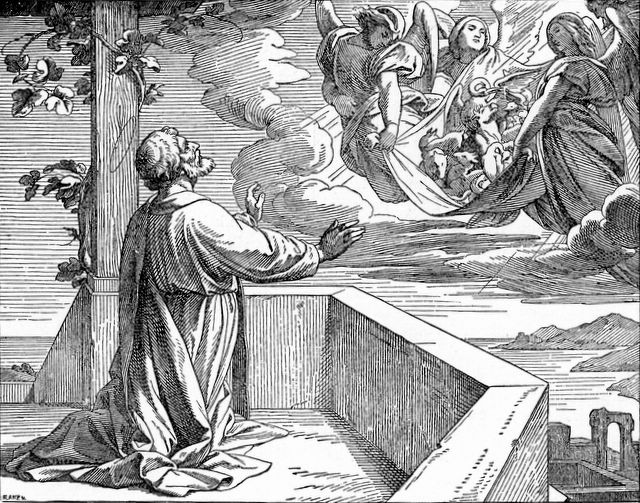
1Now the apostles and the believers who were in Judea heard that the Gentiles had also accepted the word of God. 2So when Peter went up to Jerusalem, the circumcised believers criticized him, 3saying, “Why did you go to uncircumcised men and eat with them?” 4Then Peter began to explain it to them, step by step, saying, 5“I was in the city of Joppa praying, and in a trance I saw a vision. There was something like a large sheet coming down from heaven, being lowered by its four corners; and it came close to me. 6As I looked at it closely I saw four-footed animals, beasts of prey, reptiles, and birds of the air. 7I also heard a voice saying to me, ‘Get up, Peter; kill and eat.’ 8But I replied, ‘By no means, Lord; for nothing profane or unclean has ever entered my mouth.’ 9But a second time the voice answered from heaven, ‘What God has made clean, you must not call profane.’ 10This happened three times; then everything was pulled up again to heaven. 11At that very moment three men, sent to me from Caesarea, arrived at the house where we were. 12The Spirit told me to go with them and not to make a distinction between them and us. These six brothers also accompanied me, and we entered the man’s house. 13He told us how he had seen the angel standing in his house and saying, ‘Send to Joppa and bring Simon, who is called Peter; 14he will give you a message by which you and your entire household will be saved.’ 15And as I began to speak, the Holy Spirit fell upon them just as it had upon us at the beginning. 16And I remembered the word of the Lord, how he had said, ‘John baptized with water, but you will be baptized with the Holy Spirit.’ 17If then God gave them the same gift that he gave us when we believed in the Lord Jesus Christ, who was I that I could hinder God?” 18When they heard this, they were silenced. And they praised God, saying, “Then God has given even to the Gentiles the repentance that leads to life.”

Peter’s vision of the sheet with animals, Henry Davenport Northrop, “Treasures of the Bible,” published 1894

Psalm 148

 1Hallelujah! Praise the Lord| from the heavens;
  praise God | in the heights.
 2Praise the Lord, | all you angels;
  sing praise, all you | hosts of heaven.
 3Praise the Lord, | sun and moon;
  sing praise, all you | shining stars.
 4Praise the Lord, heav- | en of heavens,
  and you waters a- | bove the heavens.
 5Let them praise the name | of the Lord,
  who commanded, and they | were created,
 6who made them stand fast forev- | er and ever,
  giving them a law that shall not | pass away. 
 7Praise the Lord| from the earth,
  you sea monsters | and all deeps;
 8fire and hail, | snow and fog,
  tempestuous wind, do- | ing God’s will;
 9mountains | and all hills,
  fruit trees | and all cedars;
 10wild beasts | and all cattle,
  creeping things and | flying birds;
 11sovereigns of the earth | and all peoples,
  princes and all rulers | of the world;
 12young | men and maidens,
  old and | young together. 
 13Let them praise the name | of the Lord,
  whose name only is exalted, whose splendor is over | earth and heaven.
 14The Lord has raised up strength for the people and praise for all | faithful servants,
  the children of Israel, a people who are near the Lord. | Hallelujah!

Revelation 21:1-6

1I saw a new heaven and a new earth; for the first heaven and the first earth had passed away, and the sea was no more. 2And I saw the holy city, the new Jerusalem, coming down out of heaven from God, prepared as a bride adorned for her husband. 3And I heard a loud voice from the throne saying, 
 “See, the home of God is among mortals.
 He will dwell with them;
 they will be his peoples,
 and God himself will be with them;
 4he will wipe every tear from their eyes.
 Death will be no more;
 mourning and crying and pain will be no more,
 for the first things have passed away.”
 5And the one who was seated on the throne said, “See, I am making all things new.” Also he said, “Write this, for these words are trustworthy and true.” 6Then he said to me, “It is done! I am the Alpha and the Omega, the beginning and the end. To the thirsty I will give water as a gift from the spring of the water of life.”

John 13:31-35

31When he had gone out, Jesus said, “Now the Son of Man has been glorified, and God has been glorified in him. 32If God has been glorified in him, God will also glorify him in himself and will glorify him at once. 33Little children, I am with you only a little longer. You will look for me; and as I said to the Jews so now I say to you, ‘Where I am going, you cannot come.’ 34I give you a new commandment, that you love one another. Just as I have loved you, you also should love one another. 35By this everyone will know that you are my disciples, if you have love for one another.”

Sermon – Pastor Meggan Manlove

Patterns, habits, and routines are good. When I am with friends with little kids, I am especially mindful of this. But I also am healthier and more whole when I stick to a consistent bedtime, when I stick to an exercise routine, when life is somewhat calm and predictable. Disruption is hard on the mind, body, and soul. 

I appreciate routine and calmness in my journey of faith too. I like that our music changes, but that I generally know what to expect when I lead worship here or worship with other ELCA Lutherans. The routine lets me enter into the liturgy more deeply. Words repeated year after year, through songs, prayers, and creeds bubble up when I need them outside of Sunday morning. Furthermore, part of making a community of faith trustworthy is making it predictable. We build trust in one another and the God we follow through meaningful rituals and by predictably showing up for one another with our words and actions.

But sometimes the life of faith includes disruption. The Holy Spirit’s work often challenges our deepest assumptions about how Jesus Chris is present and at work in the world. We may look to things like the cross, the sacraments, and prayer as reliable places where God has promised to be available and gracious. 

But there are also times when the Holy Spirit works in ways that are unexpected, offensive, and downright transgressive. One scholar wrote, “The fact that a thing is transgressive does not make it holy, but it can—and often is—the case that Christ frequently calls us into encounters that upend our deepest theological commitments.” 

Peter has had a conversion experience of sorts. This experience has led him to a new understanding of the Christian community; it is a place where Jews and Gentiles participate together, on the same ground, in the salvation God provides. But everyone else has not reached the same conclusion as quickly as Peter. And the implications of Peter’s new understanding apply not only to him but to the wider church as well. 

When Peter returns to Jerusalem he gets a question, which sounds more like a rebuke: “Why did you go to uncircumcised men and eat with them?” Why did Peter accept hospitality from and share meals prepared by Gentiles? Peter had acted in ways that fly in the face of generations of practices that certain Jews adopted to honor God and safeguard holiness. 

Peter responds with a summary appropriate to his audience. He bears witness to what happened to him. He notes that he recognized in his new Gentile friends “the same gift” that God previously gave to him and other Jewish believers. He also calls his audience’s attention to something Jesus said back in Acts Chapter 1, “John baptized with water, but you will be baptized with the Holy Spirit.” 

In other words, Jesus himself authorized Peter’s conclusion that God regards Gentile believers in the same light as Jewish believers, for Jesus identified the Holy Spirit as a gift from him. Peter urges his listeners to see his actions as a faithful response to God’s owninitiative, certified by Jesus himself. 

The witness itself is remarkable for several reasons. Peter has no textual witness to fall back on. He has no prophetic utterances to conjure from the collective memory of his people. Very little prepared him for this Gentile emergency, though he did stay with Simon the Tanner before his encounter on the roof. That stay, in an unclean house, perhaps laid some groundwork. 

Peter is speaking to those who knew him and know his faith. The only argument Peter could give with kinship eyes bearing down on him was no argument at all, simply an experience. This fact kind of terrifies me; makes me a little squeamish. Why? Because the idea of experience has gotten a bad reputation in Christian thought in recent years, and for good reason. 

Claiming an experience of God, of faith and truth, has served as a tool for every will to religious power. The claim to an experience has graced greed, violence, and oppression with a facade of righteousness. But, and this is a big but, Peter shows us its proper use, [experience] confronts the cult of the familiar—of family, faith, nation, and story. 

This story of Peter’s witness shows the breaking open of a life, Peter’s life, and the breaking open of a whole people’s life. God spoke to Peter and now through Peter God is speaking to the saints gathered there to hear. Peter remembered a promised baptism for the Jewish body and saw with his own eyes that baptismal promise stretched over Gentile bodies. “Gentile bodies have been touched by God, just as we have,” Peter states. 

The Holy Spirit is surely in this moment. The listeners all take note. They must consider their people’s relationship with God, going back centuries. God has again done a marvelous new thing beyond anticipation: even Gentiles receive the repentance that leads to life. 

Look what happens when you bear witness to Jesus and his good news with boldness and generosity. The church watches what the Spirit does, discerns whether there’s some kind of precedent for that, and follows where the Spirit leads. 

There is a lot about discernment in this story. In Acts, discernment comes about as communities of believers consider their circumstances, their convictions about Jesus, their sacred texts, their lived experiences, their values, and their hopes. In other words, there is a rich mix of influences: experience, scripture, memory, conversation. This defines the church as a community always endeavoring to live into the new possibilities it believes God has in store. When faced with challenging seasons of discernment, we should also make space for a variety of witnesses as we attempt to understand the Triune God’s work in our world.

Not much has changed really, as far as what goes into discernment. When I came to Trinity from rural Iowa, where everyone was still baptized whether they came to worship again or not, I had to do my own discernment with this congregation. Would we commune those who were not yet baptized? My own personal experience was that people came to the table and were hungry for the Sacrament. Hands were outstretched. I could not always be sure that these strangers were baptized. I read scripture and the Lutheran Confessions. I also read written witnesses by other people who had already gone through this conversion. Sara Miles’ book Take this Bread was at first a very disruptive read, but later everything she said seemed like common sense. 

In a literate society, books are often the medium for witness. Although podcasts might be bringing Peter’s oral witness back in vogue. Our time, some say, is the golden age of memoir. Everyone has a story to tell. Novels, memoirs, nonfiction books have taken me all over our country and all over the world, introducing me to individuals and cultures I may never have been exposed to if I had not opened a particular book. They have increased both my empathy and my imagination.

We know it’s true that written words hold great power and books can change readers’ hearts. English professor Farah Jasmine Griffin notes that many books, from the Bible to Uncle Tom’s Cabin to Elie Wiesel’s Night, confront readers “with powerful narratives that not only tell the stories of oppressed people, but also hold the mirror up to humanity, often showing us parts of ourselves we’d rather not see.” As I read this week, “Books about difficult topics can show us our failures. They can impel us to make our society more just. They can transform us into more empathetic people.”

And so I was heartbroken this week when I read the article about the Nampa School Board banning 22 books forever from our school libraries. I cannot imagine the work of either formation or transformation in a world that simply erases these particular books. What’s more, the board set up a process for discernment and then ended its own process prematurely. 

Then on Thursday afternoon I went to an end of year event and chanced to talk with the librarian for our neighbors at West Middle School. She was still devastated, and new grief had come over her the last few days as she kindly asked students to please return various books on the banned list.

What does all of this have to do with the church? A whole lot. What happens after Peter’s witness was a very big deal and ushered in a whole new way of being church. Jews and Gentiles will participate together, on the same ground, in the salvation God provides. 

We too, as the church, are part of such a change. Depending on who you ask, the big shift began 50 to 100 years ago. It was accelerated by the pandemic. We have no idea how long it will take to all resolved, easily another 50 to 100 years. We are not going back to what was. We are in the midst of something big, what Phyllis Tickle called the church’s every-500-years rummage sale. 

What this means is, we are in the midst of big discernment. “Discernment” isn’t just a dressed-up word for “decision making.” Discernment is the process by which people, or a group of people, clarify their choices and values to see which next step best aligns with what they believe to be the right thing. And then they can decide. In some sense, discernment is a process of clarifying one’s choices and comparing them with one’s “yardstick” that holds meaning. And there is always an expectation that God is in some way present and active in the process.

As the community of Acts discerned what was next for them, so we are also discerning our next chapter. And here is what I know to be true. We are going to need all the influences and tools we can handle—experience, scripture, witness, memory, conversation, and yes, books that carry other people’s experiences and memories, even if those books make us uncomfortable. “Fear not” or “be not afraid,” appears over 90 times in scripture. We do not need to be afraid of what the Holy Spirit is doing in and for the church. We can simply trust that God is doing something new and follow where the Holy Spirit is leading.

Prayers of Intercession (Sundays and Seasons)

Set free from captivity to sin and death, we pray to the God of resurrection for the church, people in need, and all of creation.

A brief silence.

Loving God, lead us to follow your Spirit, rather than our own prejudices or desires, as the church cares for one another. Open us to perceive your gifts in those we least expect. God, in your mercy,

hear our prayer.

Inspire us to praise you through the beauty and majesty of the natural world around us (local natural areas may be named). Urge us toward more deliberate care of the world you have made. God, in your mercy,

hear our prayer.

Humble the rulers of nations before your splendor. Direct them to the people who need their attention most, and turn them from the temptation to hoard wealth or power. God, in your mercy,

hear our prayer.

Hasten to dwell among those who are in pain or distress (especially). As Christ enters our deepest suffering, remain with those experiencing despair and great need. God, in your mercy,

hear our prayer.

Place holy love at the center of all our relationships and communities. By your love heal us, convict us, and renew us. Bring an end to racism in our churches and communities. Let everyone know your goodness by the love we show one another. God, in your mercy,

hear our prayer.

Give us a place in the diverse company of your beloved saints. Teach us the value of each person’s identity, and bless us with a shared identity as your children, kindred of Christ. God, in your mercy,

hear our prayer.

In your mercy, O God, respond to these prayers, and renew us by your life-giving Spirit; through Jesus Christ, our Savior.

Amen.
Posted in Sermons, Trinity Lutheran | Leave a comment

Telling Our Faith Stories: A Congregational Model

            “I tend to get uncomfortable sharing about myself with strangers and was surprised with the comfort level I felt,” reflected one of my parishioners after our workshop. After surveying various methods and practices in storytelling, I concluded that Anne E. Streaty Wimberly’s practice of story-linking, both simple and adaptable, made the most sense for a faith storytelling workshop for my parishioners. In February 2020, twelve church members and I spent a day with the biblical story, the stories of others, and our own stories.  

Follow this LINK for the rest of the article published in Word and World: Theology for Christian Ministry, Winter 2022. I will keep it posted here until this journal issue is online.

Posted in Reflections, Trinity Lutheran | Leave a comment

May 8, 2022

Prayer of the Day

O God of peace, you brought again from the dead our Lord Jesus Christ, the great shepherd of the sheep. By the blood of your eternal covenant, make us complete in everything good that we may do your will, and work among us all that is well-pleasing in your sight, through Jesus Christ, our Savior and Lord, who lives and reigns with you and the Holy Spirit, one God, now and forever.

Amen.

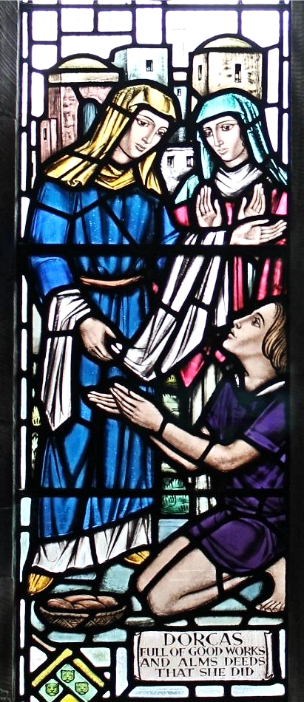
Acts 9:36-43

36Now in Joppa there was a disciple whose name was Tabitha, which in Greek is Dorcas. She was devoted to good works and acts of charity. 37At that time she became ill and died. When they had washed her, they laid her in a room upstairs. 38Since Lydda was near Joppa, the disciples, who heard that Peter was there, sent two men to him with the request, “Please come to us without delay.” 39So Peter got up and went with them; and when he arrived, they took him to the room upstairs. All the widows stood beside him, weeping and showing tunics and other clothing that Dorcas had made while she was with them. 40Peter put all of them outside, and then he knelt down and prayed. He turned to the body and said, “Tabitha, get up.” Then she opened her eyes, and seeing Peter, she sat up. 41He gave her his hand and helped her up. Then calling the saints and widows, he showed her to be alive. 42This became known throughout Joppa, and many believed in the Lord. 43Meanwhile he stayed in Joppa for some time with a certain Simon, a tanner.

Dorcas

St. Twrog’s Church
Maentwrog, Wales

Psalm 23

 1The Lord| is my shepherd;
  I shall not | be in want.
 2The Lord makes me lie down | in green pastures
  and leads me be- | side still waters.
 3You restore my | soul, O Lord,
  and guide me along right pathways | for your name’s sake.
 4Though I walk through the valley of the shadow of death, I shall | fear no evil;
  for you are with me; your rod and your staff, they | comfort me. 
 5You prepare a table before me in the presence | of my enemies;
  you anoint my head with oil, and my cup is | running over.
 6Surely goodness and mercy shall follow me all the days | of my life,
  and I will dwell in the house of the | Lord forever.

Revelation 7:9-17

9After this I looked, and there was a great multitude that no one could count, from every nation, from all tribes and peoples and languages, standing before the throne and before the Lamb, robed in white, with palm branches in their hands. 10They cried out in a loud voice, saying, 
 “Salvation belongs to our God who is seated on the throne, and to the Lamb!”
11And all the angels stood around the throne and around the elders and the four living creatures, and they fell on their faces before the throne and worshiped God, 12singing, 
 “Amen! Blessing and glory and wisdom
 and thanksgiving and honor
 and power and might
 be to our God forever and ever! Amen.”
 13Then one of the elders addressed me, saying, “Who are these, robed in white, and where have they come from?” 14I said to him, “Sir, you are the one that knows.” Then he said to me, “These are they who have come out of the great ordeal; they have washed their robes and made them white in the blood of the Lamb.
 15For this reason they are before the throne of God,
  and worship him day and night within his temple,
  and the one who is seated on the throne will shelter them.
 16They will hunger no more, and thirst no more;
  the sun will not strike them,
  nor any scorching heat;
 17for the Lamb at the center of the throne will be their shepherd,
  and he will guide them to springs of the water of life,
 and God will wipe away every tear from their eyes.”

John 10:22-30

22At that time the festival of the Dedication took place in Jerusalem. It was winter, 23and Jesus was walking in the temple, in the portico of Solomon. 24So the Jews gathered around him and said to him, “How long will you keep us in suspense? If you are the Messiah, tell us plainly.” 25Jesus answered, “I have told you, and you do not believe. The works that I do in my Father’s name testify to me; 26but you do not believe, because you do not belong to my sheep. 27My sheep hear my voice. I know them, and they follow me. 28I give them eternal life, and they will never perish. No one will snatch them out of my hand. 29What my Father has given me is greater than all else, and no one can snatch it out of the Father’s hand. 30The Father and I are one.”

Sermon – Pastor Meggan Manlove

There was something compelling to me this year and this week about the story of Tabitha, Dorcas, and the widows. Maybe it’s because this is only the second Mother’s Day when my own mother is a widow, a new word for us. Maybe coming back into the sanctuary, there have been times when I have missed dearly the widows who sat faithfully every week in the back center pew. Many of them have since joined the community of saints who have died. Maybe it was the story coming across my newsfeed this week of the first women ordained as Lutheran pastors in Poland.

Women have made great advances in my lifetime. We can celebrate that the two young women whose high school graduations we will aplaud next week have opportunities their great grandmothers might not have imagined. And yet we know there is still work to do, locally and globally. For every Dorothy Day serving the poor whose memoir is published, Malala Yousafzai standing up to the Taliban, Leymah Gbowee working for peace in Liberia winning the Nobel Peace Prize, or Amanda Gorman using her poetry to paint a vision, there are women whose voices never get heard. 

Widows are still vulnerable, but we also might think of single moms fleeing violence in Honduras, Guatemala, and El Salvador; stories of missing indigenous women in our own country; women of all ethnicities escaping domestic violence; or widows next door to you worried about keeping their houses during this crazy housing market. 

To be sure, we all know men vulnerable to the brokenness of this world too. But on a day when our country, or at least Hallmark, prods us to honor our mothers, and when a New Testament writer takes time to mention the only woman disciple ever mentioned by name in the entire New Testament, it is a good day to take stock of women’s places in our own communities and the world. It’s a perfect day to examine how the Gospel might inform our lenses, our perspective.

All of this assumed that in this place, in person and online, we believe and confess that scripture and our faith are not just about the salvation of our souls or what happens to us after we die. The good news of Jesus Christ informs our living here today. It informs how we see the world and encounter all God created. 

Collectively, all our readings from Acts during the Easter Season, serve as powerful illustrations of the living and resurrected Jesus Christ continuing to live and bring redemption and reconciliation through the church. That is an incredibly accurate description of what happens in today’s text from Chapter 9.

Tabitha, a woman, is a disciple of Jesus. Here we get a view of a new future in which men and women in Christ have a different way of seeing themselves–as disciples, followers of Jesus. By referring to her with both names (Tabitha is Aramaic and Dorcas is Greek) the author hints that she lives in a multicultural environment. Maybe she has friends who speak Aramaic and others who speak Greek. She sounds like a bridge builder in her community. 

We also learn about her charity work for the widows–she clothed them. What an intimate and caring gift. Making clothes for someone else requires you to know that person–what size she wears, maybe what she likes, what you think is appropriate for her life. One scholar wrote that Tabitha “helped knit the community together, literally clothing the people with protection, beauty, dignity, and love.”

We enter the story at the end. As in our own encounters with the end of life, there is glory and grief. The glory is a life well lived, lived in service to others. Tabitha’s life hangs together beautifully as someone devoted to helping people, especially widows. Widows, that group of people vulnerable in ancient and current times, made vulnerable by death’s sting, have always been a special concern for God and here for Tabitha as well.

We know from this story that Tabitha’s life was woven in good works of charity. So, the widows weep. They weep for her and maybe for themselves. We will never know if Tabitha was in fact one of them. What we do know is that they claimed her as one who cared for them. Here glory joins grief because to lose someone who cares for the weak and the vulnerable, whose life is turned toward making a difference in the world and who is making a difference, is a bitter loss. The widows have lost Tabitha and a disciple is gone. This is what stops Peter in Joppa.

Peter’s presence declares an unmistakable and wonderful truth: women matter. This woman matters, and the work she does for widows matters to God. It matters so much that God will not allow death the last word. Others had been raised from the dead in the Gospels, but this is different. This is not a little girl or the brother of a friend of Jesus; this is a disciple raised from the dead. Tabitha is not finished in life or service. “Tabitha, get up.” 

Tabitha is an activist who lives again in resurrection power. Her body has been quickened by the Holy Spirit, and her eyes are opened again to see a new day. She has work to do and joy to give to the widows: you have not been abandoned, dear widows, God has heard your weeping and returned her to you. 

More importantly she is alive. Willie James Jennings writes that “we know that death imagines a special claim to the bodies of women. Their deaths are normalized and naturalized in social orders that value men’s bodies far above all others. It will not be so among the disciples. They will find Peter standing next to Tabitha, a gift of God who has been given again the gift of life. It is not accident that the first disciples to have this little taste of the resurrection is a woman, because it was a woman who gave birth to the resurrection. And Peter is there once again to see a miraculous sign point to faith’s direction–many who found out about this believed in the Lord.”

Peter does not bring her back to life as a reward for all her good behavior or because he can’t handle the grief around him. Bringing her back to life validates the urgency of her work. She, as her own person, also matters, but we assume she will not live forever. Eventually death will overtake her a second time, after her story ends. But the leadership and love she provides now has an opportunity to live again–through her ongoing efforts and the charity that is supposed to dwell at the center of every Christian community. Her contributions are essential to the church’s ability to bear witness to the wholeness Jesus Christ brings to individuals and communities.

Today happens to be the saint day of another remarkable disciple, Julian of Norwich. During her lifetime, Julian experienced the first and second waves of the Black Death in England. Resulting turmoil from the plague was a major cause of the Peasants’ Revolt in 1381, which ended with suppression of the rebels by King Richard II.

Little is known about Julian’s real name or background. Her decision to become an anchoress followed a severe illness when she was 30 years old, high fever, difficulty breathing and the sense of being paralyzed. But it was while fighting this illness that Julian began to experience the first of her many visions.

Julian’s first vision took place as a priest was approaching her bed. “The priest brings a cross to her. The cross begins to glow. She sees Christ standing right in front of her, is quite startled, and then a voice at one point says to her, ‘Look up to heaven. Don’t look at the cross but look up to heaven.’”

Julian interpreted this voice as a temptation and not the voice of Christ: “She was looking directly at the suffering Christ but was being tempted to look away from his suffering.” Instead, Julian looked down to the crucifix as the priest told her to.

Where her eyes had been fixed upward “towards heaven” prior to her visions, now she held her gaze on the cross each time she experienced one. By fixing her eyes on the cross, Julian perceived that “glory comes through suffering, in particular the suffering of Christ, and not in spite of it.”

Julian would continue to experience religious visions throughout her life, writing detailed accounts of each. The visions declared that love was the meaning of religious experience, provided by Christ who is love, for the purpose of love. These descriptions were eventually compiled into Revelations of Divine Love, the earliest surviving English-language book written by a woman. 

Her words have been carried down to us in the ELW hymn 735, “Mothering God, you gave me birth in the bright morning of this world. Creator source of every breath, you are my rain, my wind, my sun. Mothering Christ, you took my form, offering me your food of light, grain of life, and grape of love, your very body for my peace.”

Something about the good news of Jesus Christ gave life and callings to both Tabitha and Julian. The message of mercy, forgiveness, reconciliation, and most importantly abundant love, that they heard, envisioned, and experienced is the same message passed on to us as well. We hear it proclaimed we receive the gifts and promises of Jesus’ mercy and love in the simple meal of bread and wine. Might we be strengthened for service and follow in the ways of these two remarkable disciples.

Prayers of Intercession (Sundays and Seasons)

The prayers are prepared locally for each occasion. The following examples may be adapted or used as appropriate.

Set free from captivity to sin and death, we pray to the God of resurrection for the church, people in need, and all of creation.

A brief silence.

Gentle Shepherd, enable your church to respond to the voice of Jesus. Give us unfailing trust, unafraid to join in Jesus’ work of renewing all things. God, in your mercy,

hear our prayer.

Feed your people at the table of creation. Prepare a safe place for those whose environments are dangerous or unhealthy, especially those making difficult journeys. Prosper your creation for the sake of every living thing. God, in your mercy,

hear our prayer.

Warm the hearts of all who celebrate and all who mourn on Mother’s Day. Accompany those yearning to be mothers. Help us to heal from broken family relationships and open us to receive your nurturing love from all who serve mothering roles in our lives (especially). God, in your mercy,

hear our prayer.

Seek out those who weep while they await healing or consolation (especially). Set people in their path who can provide the care they need, and wipe away every tear from their eyes. God, in your mercy,

hear our prayer.

Inspire the words of prophets and saints who employ innovative imagery to stretch our understanding (as did Julian of Norwich, whom we commemorate today). Send Christ to instruct us with motherly care. God, in your mercy,

hear our prayer.

Here other intercessions may be offered.

Enfold us in the great multitude of saints from every nation, from all tribes and peoples and languages. Wash us in your saving grace every day, guiding us to your waters of life. God, in your mercy,

hear our prayer.

In your mercy, O God, respond to these prayers, and renew us by your life-giving Spirit; through Jesus Christ, our Savior.

Amen.

Posted in Sermons, Trinity Lutheran | Leave a comment

Praise With Creation

Originally published on tvprays.org

Revelation 5:11-14

11 Then I looked, and I heard the voice of many angels surrounding the throne and the living creatures and the elders; they numbered myriads of myriads and thousands of thousands, 12singing with full voice,
‘Worthy is the Lamb that was slaughtered
to receive power and wealth and wisdom and might
and honour and glory and blessing!’ 
13Then I heard every creature in heaven and on earth and under the earth and in the sea, and all that is in them, singing,
‘To the one seated on the throne and to the Lamb
be blessing and honour and glory and might
for ever and ever!’ 
14And the four living creatures said, ‘Amen!’ And the elders fell down and worshipped. (Revelation 5:11-14)

I have always loved this passage from Revelation because it connects us with every part of creation in a chorus praising God. Many people think first of Handel’s Messiah, but I first start singing “All God’s critters got a place in the choir. Some sing low, some sing higher, some sing out loud on the telephone wire, and some just clap their hands, or paws or anything they got now.” The verses name each section of the chorus. The bullfrog and hippopotamus carry the bass notes. The little birds sing on top. The dogs, cats, donkey, and coyote take up the middle. And human beings fit in wherever they can.

I think of so many songs that may have been inspired by Revelation or various Psalms that include the natural world: All Creatures of our God and King, Lift up your voice with us and sing; This is My Father’s World, and to my list’ning ears all nature sings and round me rings the music of the sphears; Let all things now living a song of thanksgiving to God the creator triumphantly raise. Earth and All Stars has planets, flowers, leaves, and snowstorms sing to the Lord a new song.

As we prepare to enjoy the beautiful outdoors of Southwest Idaho (or wherever your summer travels might take you), consider taking a photo in your mind and bringing it into the sanctuary where you worship. In worship, we enter God’s presence not just with our fellow and sister human beings, but with all of creation. How would our lives of worship change if we turned away from seeing worship as something that only human creatures offer to God? 

Long before our existence, long before John of Patmos’ vision recorded in Revelation, long before our ancestors Abraham and Sarah looked at the stars in the sky and heard God’s promises, the natural world had been responding to God the Creator with praise. How would both worship and stewardship of the natural world change if we remembered this and kept in mind that when we enter worship, we enter God’s presence with all creation, creation which has offered God praise for eons? I seem to write with more questions than answers today.

Prayer: Praise to you, Lord Jesus Christ, who in your self-emptying love gathered up and reconciled all creation to the Father. Innumerable galaxies of the heavens worship you. Creatures that grace the earth rejoice in you. All those in the deepest seas bow to you in adoration. As with them we give you praise, grant that we may cherish the earth, our home, and live in harmony with this good creation, for you live and reign with the Father and the Holy Spirit, one God, now and forever. Amen. (ELW p. 81).

Posted in Reflections | Leave a comment

May 1, 2022

Prayer of the Day

Eternal and all-merciful God, with all the angels and all the saints we laud your majesty and might. By the resurrection of your Son, show yourself to us and inspire us to follow Jesus Christ, our Savior and Lord, who lives and reigns with you and the Holy Spirit, one God, now and forever. Amen.

Acts 9:1-6 [7-20]

1Saul, still breathing threats and murder against the disciples of the Lord, went to the high priest 2and asked him for letters to the synagogues at Damascus, so that if he found any who belonged to the Way, men or women, he might bring them bound to Jerusalem. 3Now as he was going along and approaching Damascus, suddenly a light from heaven flashed around him. 4He fell to the ground and heard a voice saying to him, “Saul, Saul, why do you persecute me?” 5He asked, “Who are you, Lord?” The reply came, “I am Jesus, whom you are persecuting. 6But get up and enter the city, and you will be told what you are to do.” [7The men who were traveling with him stood speechless because they heard the voice but saw no one. 8Saul got up from the ground, and though his eyes were open, he could see nothing; so they led him by the hand and brought him into Damascus. 9For three days he was without sight, and neither ate nor drank.
 10Now there was a disciple in Damascus named Ananias. The Lord said to him in a vision, “Ananias.” He answered, “Here I am, Lord.” 11The Lord said to him, “Get up and go to the street called Straight, and at the house of Judas look for a man of Tarsus named Saul. At this moment he is praying, 12and he has seen in a vision a man named Ananias come in and lay his hands on him so that he might regain his sight.” 13But Ananias answered, “Lord, I have heard from many about this man, how much evil he has done to your saints in Jerusalem; 14and here he has authority from the chief priests to bind all who invoke your name.” 15But the Lord said to him, “Go, for he is an instrument whom I have chosen to bring my name before Gentiles and kings and before the people of Israel; 16I myself will show him how much he must suffer for the sake of my name.” 17So Ananias went and entered the house. He laid his hands on Saul and said, “Brother Saul, the Lord Jesus, who appeared to you on your way here, has sent me so that you may regain your sight and be filled with the Holy Spirit.” 18And immediately something like scales fell from his eyes, and his sight was restored. Then he got up and was baptized, 19and after taking some food, he regained his strength. 
  For several days he was with the disciples in Damascus, 20and immediately he began to proclaim Jesus in the synagogues, saying, “He is the Son of God.”]

Psalm 30

 1I will exalt you, O Lord, because you have lift- | ed me up
  and have not let my enemies triumph | over me.
 2O Lord my God, I cried | out to you,
  and you restored | me to health.
 3You brought me up, O Lord, | from the dead;
  you restored my life as I was going down | to the grave.
 4Sing praise to the Lord, | all you faithful;
  give thanks in ho- | ly remembrance. 
 5God’s wrath is short; God’s favor | lasts a lifetime.
  Weeping spends the night, but joy comes | in the morning.
 6While I felt se- | cure, I said,
  “I shall never | be disturbed.
 7You, Lord, with your favor, made me as strong | as the mountains.”
  Then you hid your face, and I was | filled with fear.
 8I cried to | you, O Lord;
  I pleaded with | my Lord, saying,
 9“What profit is there in my blood, if I go down | to the pit?
  Will the dust praise you or de- | clare your faithfulness?
 10Hear, O Lord, and have mer- | cy upon me;
  O Lord, | be my helper.” 
 11You have turned my wailing | into dancing;
  you have put off my sackcloth and clothed | me with joy.
 12Therefore my heart sings to you | without ceasing;
  O Lord my God, I will give you | thanks forever.

Revelation 5:11-14

11Then I looked, and I heard the voice of many angels surrounding the throne and the living creatures and the elders; they numbered myriads of myriads and thousands of thousands, 12singing with full voice, 
 “Worthy is the Lamb that was slaughtered
 to receive power and wealth and wisdom and might
 and honor and glory and blessing!”
13Then I heard every creature in heaven and on earth and under the earth and in the sea, and all that is in them, singing, 
 “To the one seated on the throne and to the Lamb
 be blessing and honor and glory and might
 forever and ever!”
14And the four living creatures said, “Amen!” And the elders fell down and worshiped.

John 21:1-19

1After [he appeared to his followers in Jerusalem,] Jesus showed himself again to the disciples by the Sea of Tiberias; and he showed himself in this way. 2Gathered there together were Simon Peter, Thomas called the Twin, Nathanael of Cana in Galilee, the sons of Zebedee, and two others of his disciples. 3Simon Peter said to them, “I am going fishing.” They said to him, “We will go with you.” They went out and got into the boat, but that night they caught nothing.
 4Just after daybreak, Jesus stood on the beach; but the disciples did not know that it was Jesus. 5Jesus said to them, “Children, you have no fish, have you?” They answered him, “No.” 6He said to them, “Cast the net to the right side of the boat, and you will find some.” So they cast it, and now they were not able to haul it in because there were so many fish. 7That disciple whom Jesus loved said to Peter, “It is the Lord!” When Simon Peter heard that it was the Lord, he put on some clothes, for he was naked, and jumped into the sea. 8But the other disciples came in the boat, dragging the net full of fish, for they were not far from the land, only about a hundred yards off.
 9When they had gone ashore, they saw a charcoal fire there, with fish on it, and bread. 10Jesus said to them, “Bring some of the fish that you have just caught.” 11So Simon Peter went aboard and hauled the net ashore, full of large fish, a hundred fifty-three of them; and though there were so many, the net was not torn. 12Jesus said to them, “Come and have breakfast.” Now none of the disciples dared to ask him, “Who are you?” because they knew it was the Lord. 13Jesus came and took the bread and gave it to them, and did the same with the fish. 14This was now the third time that Jesus appeared to the disciples after he was raised from the dead.
 15When they had finished breakfast, Jesus said to Simon Peter, “Simon son of John, do you love me more than these?” He said to him, “Yes, Lord; you know that I love you.” Jesus said to him, “Feed my lambs.” 16A second time he said to him, “Simon son of John, do you love me?” He said to him, “Yes, Lord; you know that I love you.” Jesus said to him, “Tend my sheep.” 17He said to him the third time, “Simon son of John, do you love me?” Peter felt hurt because he said to him the third time, “Do you love me?” And he said to him, “Lord, you know everything; you know that I love you.” Jesus said to him, “Feed my sheep. 18Very truly, I tell you, when you were younger, you used to fasten your own belt and to go wherever you wished. But when you grow old, you will stretch out your hands, and someone else will fasten a belt around you and take you where you do not wish to go.” 19(He said this to indicate the kind of death by which he would glorify God.) After this he said to him, “Follow me.”

Sermon – Pastor Meggan Manlove

“Saul, Saul, why do you persecute me?”  It may be difficult to picture Paul before his conversion on the Damascus Road.  We know him primarily as the author of many of the beautifully written and passionate letters in the New Testament.  His letter to the Romans holds a special place in our Lutheran tradition.  Martin Luther had his own conversion experience while reading Romans.  But Paul, Saul, had a passionate career before he became a disciple of Jesus.

 The first time we hear about Saul (7:58), he was standing guard over the coats of those who would execute Stephen in brutal fashion. But he’s not just a passive witness. No, he “approved of their killing him” (8:1a). Furthermore, Stephen’s is not the only Christian life whose taking he has approved. Saul is portrayed as arch-persecutor, “ravaging the church … dragging off both men and women,” he shut them all behind bars.

We meet Saul this morning as he draws near to Damascus and a slew of new persecutions.  On the road Saul is struck by a heavenly light and addressed by a heavenly voice. This voice belongs to none other than Jesus himself.  If we needed a reminder of what happened to Jesus after he ascended to heaven, here it is.  Jesus’ ascension was not the inauguration of a time when Jesus is absent from the life of the faithful. Jesus’ is fully present in the life of these Christian communities, in this case, catching a persecutor off guard as he travels down a road.

Jesus’ instructions to Saul are specific but mysterious. Go into the city, and there you will discover what you need to do. This opens up the wideness of this story.  This is in fact a call story. Saul does not just turn away from a previous way of life.  More importantly, he is called, commissioned to walk in a new “Way.” Saul’s monumental experience on the road to Damascus is a call, a commissioning like the call of Isaiah or Jesus’ mother Mary or one of the twelve disciples.

God, however, works in unusual ways. Instead of continuing to dictate instructions from the clouds, Jesus calls upon a disciple in the city. Now the story shifts to Damascus and to a disciple named Ananias, who is one of Saul’s former targets. The close parallels of the accounts of Saul and Ananias suggest that there are really two call stories taking place here. 

To his obedient “Here I am, Lord,” Ananias receives the same cryptic “Get up and go,” but with explicit instructions regarding the object of his mission: Saul (9:11). The voice adds reference to Saul’s “prayer” and vision of one coming to lay hands on him so that he can regain his sight.  The narrative already anticipates the effective promises of God. The story invites us into a future that even Ananias is not quite ready to see.

Instead, Ananias responds, “I have heard from many …how many evil things he has done.” Ananias knows too much about the ways of the world and about persons like Saul. Even after the reference to God’s “name” (9:14); even after the promise to Mary that with God “all words” are possible (Luke 1:37), the past still seeks to define and control the present. But in the promise of God’s word, then, as now, the ways of the world are being rearranged.

So, the command needs repetition along with supporting rationale. “Go, because..” Because Saul is God’s chosen vessel who will carry God’s name. Surprise, surprise! Saul’s name will be added to the list of those who “call upon the name” and now will bear this name to strange places and to strange peoples like Gentiles and kings, and yes even to the children of Israel.

Ananias’s initial response is perfectly reasonable. Saul, with all of his threats and murder, is the last person in the world a Christian disciple wants to meet face-to-face. That’s when Jesus does more than reassure Ananias; he also tells him that Saul is being transformed. No longer is Saul a persecutor, for Jesus has renamed him a chosen instrument. Jesus decides who people really are; their reputations do not.

If the sole point of Jesus’ confrontation of Saul on the road was to get Saul to switch teams, then this story could have been shorter. Because Ananias plays a role, there must be more going on. If Jesus is powerful enough to generate a bright light, blind Saul, and speak with a disembodied voice, then surely Jesus is capable of telling Saul directly all the things he told Ananias to tell Saul. Why?

Ananias is necessary because Saul is not only being brought out of something, his old ways and understandings. He is also being brought into something; a new identity woven into the communal existence of Jesus’ church. No follower of Jesus in Damascus, Jerusalem, or anywhere between is going to trust that Saul has changed. Ananias can help with that. Furthermore, Saul’s transformation needs to be acknowledged by the people of God as an act of God. If an enemy like Saul can turn around, potentially anyone can. Starting with Ananias, the church needs to know that. 

All that Ananias is asked to do looks challenging but by far the most difficult thing he does is addressing the man as “Brother Saul.” He looks at Saul, once the ravager of the church, and greets him as family. If the church’s comforting messages about new life, forgiveness, reconciliation, hope, and community are true for anyone, they must also be true for Saul. His transformation is an implication of the good news that no one saw coming. It is a possibility made reality. 

Our conventional ways of assessing people and circumstances often hold me back from embracing Jesus’ efforts to reconfigure our outlook. It is far easier to talk about the new possibilities the good new brings into being than it is to actually live into them wholeheartedly like Ananias. That takes a willingness to risk and to love. 

Can we see with God? Or can we see those who are in rumor or in truth dangerous as God sees them–with a future drenched in divine desire? Willie James Jennings says, “Discipleship, truly being a follower of Jesus, presses us to reorder our knowledge. The truth we know of a person or people must move to the background, and what we know of God’s desire for them must move to the foreground. The danger we imagine inscribed on their bodies must be read against the delight we know God takes in their life. Thanks be to God, that same divine delight covers us too.”

In this story a profound transformation takes place between Saul’s opening threats and his concluding preaching in the synagogues that Jesus is God’s Son. The two conversions are a vision, a sign, of how the name of the risen Lord takes shape and unfolds in the lives of believers, then and now. In this story disciples and non-disciples alike are swept up in the necessary plan of God’s design.

The story of Saul and Ananias invite us to ponder how we will look at our own world when God takes our “no way,” and our “we’ve never done that before” and transforms them into “yes.” Like Saul’s and Ananias’ new vision, God rearranges our ways of seeing, being, and acting. God changes our world and calls us to be part of it in active ways.

Prayers of Intercession (Sundays and Seasons)

The prayers are prepared locally for each occasion. The following examples may be adapted or used as appropriate.

Set free from captivity to sin and death, we pray to the God of resurrection for the church, people in need, and all of creation.

A brief silence.

Holy One of new beginnings, fill us with new life. Send us into the world as you sent your apostles Philip and James, to invite people to come and see your wondrous acts in Christ. God, in your mercy,

hear our prayer.

Revive ecosystems along coastlands that have been devastated by natural forces and human negligence. Reestablish plant and animal life that purifies air and water and that feeds humans and other living creatures. God, in your mercy,

hear our prayer.

Accompany laborers who get little rest from their work. Give them hope when they struggle to produce what they need. Give all who labor fair treatment and just wages. God, in your mercy,

hear our prayer.

Restore all people who cry to you for help (especially). Turn their mourning into dancing, clothe them with joy, and put a testimony of healing and praise on their lips. God, in your mercy,

hear our prayer.

Be present to faithful ones who are persecuted for following you (and especially the church in . . .). Sustain them by your faithfulness, and give them strength in the name of Jesus. God, in your mercy,

hear our prayer.

Join our voices with angels, creatures, and all the saints in praising Christ and bestowing upon him all blessing and honor and glory. Reveal Christ’s glory to us and through us in our worship. God, in your mercy,

hear our prayer.

In your mercy, O God, respond to these prayers, and renew us by your life-giving Spirit; through Jesus Christ, our Savior.

Amen.
Posted in Sermons, Trinity Lutheran | Leave a comment

Easter Season

Pastor’s Column from the Trinity May 2022 Epistle/Newsletter

Dear Friends in Christ, 

The cycle of readings we hear read and interpreted during the Easter Season are rich in imagery and themes of faith. Collectively they can stir our imaginations. Though we are in the Year of Luke, most of our gospel lessons during the Easter Season come from John’s gospel. We begin with Jesus’ resurrection appearances and then return to a section from Maundy Thursday. We see what resurrection looks like and are reminded of the implications of Jesus’ resurrection. Easter is a season, not just a day. Instead of a first lesson from the Old Testament, our readings during Easter come from the Book of Acts. I have grown to love these stories and what they might say to us as the church today. Together the readings from Acts serve as powerful illustrations of the living and resurrected Christ continuing to live and bring redemption and reconciliation through the church. Finally, our second readings will come from Revelation. There are many rich images in these passages, but the dominant one (irony) is the Lamb, an image which is also central to our liturgy/worship life: “Lord God, Lamb of God, you take away the sin of the world,” “For the Lamb who was slain has begun his reign,” and the “Lamb of God” we sing during Communion. While the image of the lamb is prominent in the redemption stories of the Old Testament, it is full of meaning in Revelation. The lamb whose blood marked the doors of the Israelites becomes the Lamb who conquers evil, takes away the sin of the world, and opens the seals. I know that it can feel like a lot to have all of these scripture passages swirling around on a Sunday morning, especially when I often only focus on one passage in my preaching. The lessons are all listed in the monthly Epistle, and I invite you to read them outside of Sunday mornings this Easter Season. Let me know what they stir up in you. How might those stirring inspire and direct ministry in Nampa in 2022? 

Peace, 

Pastor Meggan 

Posted in Reflections, Trinity Lutheran | Leave a comment

April 17, 2022 – Easter

Prayer of the Day

God of mercy, we no longer look for Jesus among the dead, for he is alive and has become the Lord of life. Increase in our minds and hearts the risen life we share with Christ, and help us to grow as your people toward the fullness of eternal life with you, through Jesus Christ, our Savior and Lord, who lives and reigns with you and the Holy Spirit, one God, now and forever. Amen.

Acts 10:34-43

34Peter began to speak to [the people]: “I truly understand that God shows no partiality, 35but in every nation anyone who fears him and does what is right is acceptable to him. 36You know the message he sent to the people of Israel, preaching peace by Jesus Christ—he is Lord of all. 37That message spread throughout Judea, beginning in Galilee after the baptism that John announced: 38how God anointed Jesus of Nazareth with the Holy Spirit and with power; how he went about doing good and healing all who were oppressed by the devil, for God was with him. 39We are witnesses to all that he did both in Judea and in Jerusalem. They put him to death by hanging him on a tree; 40but God raised him on the third day and allowed him to appear, 41not to all the people but to us who were chosen by God as witnesses, and who ate and drank with him after he rose from the dead. 42He commanded us to preach to the people and to testify that he is the one ordained by God as judge of the living and the dead. 43All the prophets testify about him that everyone who believes in him receives forgiveness of sins through his name.”

Psalm 118:1-2, 14-24

 1Give thanks to the Lord, for the | Lord is good;
  God’s mercy en- | dures forever.
 2Let Israel | now declare,
  “God’s mercy en- | dures forever.”
 14The Lord is my strength | and my song,
  and has become | my salvation.
 15Shouts of rejoicing and salvation echo in the tents | of the righteous:
  “The right hand of the | Lord acts valiantly!
 16The right hand of the Lord| is exalted!
  The right hand of the | Lord acts valiantly!”
 17I shall not | die, but live,
  and declare the works | of the Lord. 
 18The Lord indeed pun- | ished me sorely,
  but did not hand me o- | ver to death.
 19Open for me the | gates of righteousness;
  I will enter them and give thanks | to the Lord.
 20“This is the gate | of the Lord;
  here the righ- | teous may enter.”
 21I give thanks to you, for you have | answered me
  and you have become | my salvation. 
 22The stone that the build- | ers rejected
  has become the chief | cornerstone.
 23By the Lord has | this been done;
  it is marvelous | in our eyes.
 24This is the day that the | Lord has made;
  let us rejoice and be | glad in it.

1 Corinthians 15:19-26

19If for this life only we have hoped in Christ, we are of all people most to be pitied.
 20But in fact Christ has been raised from the dead, the first fruits of those who have died. 21For since death came through a human being, the resurrection of the dead has also come through a human being; 22for as all die in Adam, so all will be made alive in Christ. 23But each in his own order: Christ the first fruits, then at his coming those who belong to Christ. 24Then comes the end, when he hands over the kingdom to God the Father, after he has destroyed every ruler and every authority and power. 25For he must reign until he has put all his enemies under his feet. 26The last enemy to be destroyed is death.

Luke 24:1-12

1On the first day of the week, at early dawn, [the women] came to the tomb, taking the spices that they had prepared. 2They found the stone rolled away from the tomb, 3but when they went in, they did not find the body. 4While they were perplexed about this, suddenly two men in dazzling clothes stood beside them. 5The women were terrified and bowed their faces to the ground, but the men said to them, “Why do you look for the living among the dead? He is not here, but has risen. 6Remember how he told you, while he was still in Galilee, 7that the Son of Man must be handed over to sinners, and be crucified, and on the third day rise again.” 8Then they remembered his words, 9and returning from the tomb, they told all this to the eleven and to all the rest. 10Now it was Mary Magdalene, Joanna, Mary the mother of James, and the other women with them who told this to the apostles. 11But these words seemed to them an idle tale, and they did not believe them. 12But Peter got up and ran to the tomb; stooping and looking in, he saw the linen cloths by themselves; then he went home, amazed at what had happened.

The Women at the Tomb – The miniature of the Women at the Tomb introduces the Mass for Easter in the Stammheim Missal, probably 1170s

Sermon – Pastor Meggan Manlove

The most noticeable thing about the story this morning is that Jesus makes no appearance. To me, this makes the story very relatable to our own experiences. We rely on witnesses and the activity of remembering. How much have we all needed that reminder the last two years, either because of the pandemic or because of all the other losses and grief we have born. When did you need to hear from the witnesses, “He is not here, but has risen”?

The story this morning begins with the obvious. Jesus is dead and his followers assume the he remains dead. The women come to the tomb because that is where they saw the body of Jesus placed after his crucifixion. They bring the spices along to anoint the body of Jesus. They want to show proper respect for the dead. The discovery of the empty tomb does not lead to an easy change of perspective. Instead it brings confusion, not clarity. Bodies that are dead presumably stay dead. The best we can do is to treat them with respect.

We too assume that death is death. The proper response should be to enshrine the dead Jesus in the tomb of memory. We might recall that he was an insightful teacher, a fiery prophet, and a compassionate healer. But he died. So, we might imagine ourselves called to hallow his memory with praise for his legacy. We might think that is enough.

The women receive a word that runs counter to what they know to be true. “Why do you look for the living among the dead? He is not here, but has risen.” What a thing to hear. What a word. What a question. The women at the tomb encounter the resurrection through a message, this message. They are told that Jesus has been raised, but they do not see the risen Jesus himself. What they have is a word, a message.

This is what we have—the word of the resurrection. One would think God would work differently. It would seem so much easier to have the women come to the tomb and watch Jesus walk out into the light of a new day. And it would seem much easier for Jesus simply to appear in dazzling glory to us, who gather on this Easter morning. Like the women on the first Easter, we are all given a message of resurrection, which flies in the face of what we know to be true. We, like them, are also asked to remember.

The only logical response to such a message is unbelief. Experience teaches that death wins. The Easter message says that Jesus lives. When such contradictory claims collide, it only makes sense to continue affirming what we already know. The women bring the message of resurrection to the others, and the hearers respond as thinking people regularly respond. They thought the message was garbage and they did not believe the women.

Unbelief does not mean that people believe nothing. Instead, it means that they believe something else. People say “I don’t believe it” because there is something else that they believe more strongly. But here is where the Easter message begins its work, by challenging our certainties. Experience teaches that death wins and that even the strongest succumb to it. Experience teaches that life is what you make it. The Easter message says, “Really? How can you be so sure?” Death is real. But it is not final. In Jesus, life gets the last word. 

The Easter message calls us from our old belief in death to a new belief in life. The claim that the tomb could not hold Jesus; the idea that the one who died by crucifixion has been raised is so outrageous that it might make you wonder whether it might be true. 

Those of us who gather on Easter morning, I think we must have some wonder in us. What if death is real, but not final? What if Jesus is not merely past but present? What if Jesus were to meet us here? What would life be then?

It is perfectly fine to tell God you believe that death gets the final word. God has heard it before but refused to believe it. “Why do you seek the living among the dead?” God wonders. Through the living Jesus I give you the gift of life. Why would you think that I would offer you anything else?”

I find myself longing for signs of resurrection right now. Sometimes it’s with a view of the pandemic, covid deaths, isolation, the toll on mental illness. Sometimes it is in light of what is being called the great resignation but is perhaps more accurately a realignment of life and work for so many. 

Resurrection smells and tastes like gathering again with friends around a meal. Resurrection sounds like laughter and joy in the voice of someone who has just found a new job. Resurrection looks like a smile on someone who is coming out of depression. Resurrection feels like my soul is just a bit more whole and right than it was a year ago. All of that resonates with us this Easter, which is well and good.

And yet, I also know that we witnessed resurrection the last two Easters. I know that God is always bringing life out of death, even when I can’t feel it. God is feeding the hungry in body and soul, making peace between enemies, healing communities, and reconciling people to one another. 

A professor told the story about having the opportunity to travel to the Holy Land with a church group. Her husband told their eldest son about the trip. “Why?” he asked. The husband was a bit confused. His response was, “Well, you know, Jesus.” The teacher has long recalled her son’s response because she is sure he understood the angels’ admonition. He told his father, “Tell her he’s not there.”

Jesus is not there; he is risen. He has burst the bonds of time and space, yet we continue to focus on the unexplainable empty tomb, looking for him among the dead. The tale of Jesus’ birth, death, and resurrection can seem like an idle tale. It is the story of a “king” born in a stable, an innocent man arrested and executed, and a tomb that is empty, astounding from beginning to end. He is not there—he is risen. 

Yesterday morning at a the 4T Sports Bar in downtown Nampa, I presided at a memorial service for a 45-year-old Zimbabwean man who died of a lung infection in June 2021. Eric had come to the United States first in 2001 to study at Idaho State University. He had been baptized Lutheran in Zimbabwe and so his two sisters had asked his ex-wife, arranging the memorial from the Tri-cities, to find a Lutheran minister. The low covid numbers finally allowed the sisters to make the journey from Africa for this memorial. Also gathered with us were four of Eric’s friends and co-workers, all also originally from Zimbabwe. They attended ISU together and then worked for Simplot. There we were, the ex-wife, the teenage son, the two sisters, and the groups of friends. Each friend talked about Eric, and they all said that he was the glue who had held them together. They were all a bit lost, and their friendship was floundering. But they each named, in that space, their commitment to one another, to deep friendship, to love in action. 

Could all of that have happened outside of a memorial service in which Jesus’ resurrection was simultaneously proclaimed? Of course. The Holy Spirit does not need our prayers, words, rituals. But I for one am grateful to have spaces and times for such gatherings again. The men in dazzling white said, “remember.” It is different to remember has a community than it is to remember on my own, whether we are remembering the life of a friend or relative or the life, death, and resurrection of Jesus the Christ. 

God is always doing a new thing, every day. For the past two years and on into the future. We who have met the risen Christ are to join the women in telling “all of this” today and every day. Remember. Witness resurrection. Bear witness to the hope that is now ours. Amen.

Prayers of Intercession (Sundays and Seasons)

On this day of resurrection joy, let us offer our prayers for ourselves, our neighbors, and our world.

A brief silence.

Renewing God, the good news of your resurrection changed the world. Give church leaders and all the baptized the same excitement as the women at the tomb, and inspire us to share your abundant life. Merciful God,

receive our prayer.

Sustaining God, your creation abounds with signs of new life in budding trees and newborn creatures. Provide fertile soil, ample sunlight, and nourishing rain for the growth of plants, and provide farmers with a plentiful harvest. Merciful God,

receive our prayer.

Sheltering God, strengthen and sustain all who support vulnerable people across the world (especially). Empower government agencies and international organizations that provide for refugees and migrants forced to leave their homelands. Merciful God,

receive our prayer.

Encouraging God, you do a new thing among us. We pray for those gripped by fear and anxiety or who suffer in any way (especially). Send us as your healing presence to places of hunger, pain, illness, or overwhelming sorrow. Merciful God,

receive our prayer.

Surprising God, you offer endless ways for us to delight in your grace. Give this community of faith a sense of joy and wonder in exploring new avenues of faith formation, worship, and discipleship. Merciful God,

receive our prayer.

Here other intercessions may be offered.

Resurrecting God, you make us alive in Christ. Thank you for blessing us with faithful witnesses who now rest in you (especially). Merciful God,

receive our prayer.

We offer to you these petitions and those we carry in our hearts, trusting in your abundant and ever-present mercy.

Amen.

Posted in Sermons, Trinity Lutheran | Leave a comment

April 14 – Maundy Thursday

Prayer of the Day

Holy God, source of all love, on the night of his betrayal, Jesus gave us a new commandment, to love one another as he loves us. Write this commandment in our hearts, and give us the will to serve others as he was the servant of all, your Son, Jesus Christ, our Savior and Lord, who lives and reigns with you and the Holy Spirit, one God, now and forever. Amen.

John 13:1-17, 31b-35

1Now before the festival of the Passover, Jesus knew that his hour had come to depart from this world and go to the Father. Having loved his own who were in the world, he loved them to the end. 2The devil had already put it into the heart of Judas son of Simon Iscariot to betray him. And during supper 3Jesus, knowing that the Father had given all things into his hands, and that he had come from God and was going to God, 4got up from the table, took off his outer robe, and tied a towel around himself. 5Then he poured water into a basin and began to wash the disciples’ feet and to wipe them with the towel that was tied around him. 6He came to Simon Peter, who said to him, “Lord, are you going to wash my feet?” 7Jesus answered, “You do not know now what I am doing, but later you will understand.” 8Peter said to him, “You will never wash my feet.” Jesus answered, “Unless I wash you, you have no share with me.” 9Simon Peter said to him, “Lord, not my feet only but also my hands and my head!” 10Jesus said to him, “One who has bathed does not need to wash, except for the feet, but is entirely clean. And you are clean, though not all of you.” 11For he knew who was to betray him; for this reason he said, “Not all of you are clean.”
 12After he had washed their feet, had put on his robe, and had returned to the table, he said to them, “Do you know what I have done to you? 13You call me Teacher and Lord—and you are right, for that is what I am. 14So if I, your Lord and Teacher, have washed your feet, you also ought to wash one another’s feet. 15For I have set you an example, that you also should do as I have done to you. 16Very truly, I tell you, servants are not greater than their master, nor are messengers greater than the one who sent them. 17If you know these things, you are blessed if you do them.”

 31b“Now the Son of Man has been glorified, and God has been glorified in him. 32If God has been glorified in him, God will also glorify him in himself and will glorify him at once. 33Little children, I am with you only a little longer. You will look for me; and as I said to the Jews so now I say to you, ‘Where I am going, you cannot come.’ 34I give you a new commandment, that you love one another. Just as I have loved you, you also should love one another. 35By this everyone will know that you are my disciples, if you have love for one another.”

Christ Washes the Disciples’ Feet  —  Gaudin and Le Breton, Amiens Cathedral, Amiens, France

Sermon – Pastor Meggan Manlove

The thread through tonight’s service is summed up in the name of this day, Maundy. A mandate, “A new commandment I give to you. Love one another.  Just as I have loved you, you also should love one another.” 

The new commandment is preceded by Jesus washing his disciples’ feet, something that bewilders his disciples. Foot washing was a way of welcoming guests. A person’s feet would become dusty during the journey.  The host offered water so that guests could wash their feet—on their own.  Maybe one of the host’s servants would do the washing. When Jesus washes his disciples’ feet, he combines the roles.  He is both servant and host.  

Most of us gathering for worship around the world on this night probably know this story so well that we gloss over how radical his actions really are.  Here is a God who comes in human form and kneels at the feet of others. He holds his friend’s dirty, tired, callused feet in the palms of his hands and washes them clean. It’s as far from anything the world would expect in an almighty god. It’s as unexpected as God being laid in a manger, sharing meals with criminals, being friends with foreigners. 

Instead of reenacting the foot washing, tonight we are invited to imagine what might take the place of such an act today. It is a tough question, tougher than I anticipated when a colleague first presented it to me. We are far enough from first century Palestine and places and times like Regency England that servants or slaves are no more. Certainly, there are people who take what we might see as less-desirable jobs. But that is not an accurate comparison with tonight’s text. Jesus shares these moments with the people that have been following him, eating with him, and journeying with him. Though the love command is something we carry with us outside our faith community, it is truly about the faith community itself.

Another pastor wrote about the intimacies of Maundy Thursday and compared it to a work-around his congregation in Chicago discovered earlier in the pandemic. The older members of his parish had a long-standing practice of gathering monthly for lunch. It moved online early in the pandemic and the digital cubes were helpful, but something was missing. Intimacy through food was what they needed. When possible, they began cooking, portioning, and delivering a homemade meal to participating seniors and then sharing that lunch together online. And while not all the intimacy of the gathering was reclaimed, something about sharing the same food opened them up to one another again. The sharing of common smells, tastes, and textures cements community in unique ways. Shared meals even from a distance have power. The intimacy is undeniable.

Jesus knows his followers so well that his decision to include them all in these acts of holy intimacy is profound. Gathered in that place are those with strong faith in Jesus’ mission, though they know not yet what costs will come with following him. Judas is known, washed, and fed in all his fear and duplicity. Peter is known, fed, and loved despite his impending denials. All the rest will, in their own ways, flee in fear, leaving Jesus accompanied only by the women in his life and by his fellow condemned. But Jesus does not cancel this intimate evening to distance himself from those who will flee. Instead, he draws them that much closer to his soon-to-be-wounded side.

This is helpful context as we consider what it means to wash another’s feet today. Each of us is different and has different barriers. On the one hand I think that intimacy with others comes easier to some of us than others. And yet this evening is a reminder that all disciples are called to this work, to be open for moments of closeness and intimacy and acts of love.

I can only speak for myself that what most often has prevented me from acts of intimacy is the fear that I don’t have enough: enough energy, enough good answers, enough time, enough compassion. Teachers and mentors wiser than me, plus some experience, has taught me that just showing up is often more than enough. People long to be really and truly seen. We don’t have to have answers or special training to be present in another’s life.

For the last few years, I have been leading groups online through different spiritual practices. One of the favorite practices is titled, “Gazing at a beloved or friendly others.” What participants have shared with me is how much they appreciate the questions. While imagining in their minds eye a person they have recently encountered, they are asked to ponder what fears the person carries/ what unmet longings do they hold, what ancient wounds haunt them, what gifts or joys light them up and yearn to flourish more fully? 

The truth is, we all want someone to wonder those things about each of us. And we, gathered this night, believe that Jesus, the Good Shepherd, already knows all the answers for each one of us. But we who hear his voice, who follow him, who obey his command to love one another, then are called to be compassionately curious about others, both those in our community of faith and those beyond. What fears the person carries/ what unmet longings do they hold, what ancient wounds haunt them, what gifts or joys light them up and yearn to flourish more fully?

Jesus’ new commandment to love one another can only be lived with the help of the Holy Spirit. The Spirit empowers us to share in Christ’s vision of communities where vulnerability and intimacy are embraced, not for themselves but for real beloved community. God’s own love makes this possible. A favorite author refused to compose devotions for Maundy Thursday and Good Friday, instead writing, “These days’ events are too immense, the love of the Triune God too far beyond my imagining, the meaning of it all unfathomable.” She is right. It’s more reasonable to imagine how we pass on that love to others, following the example Jesus sets on this evening full of intimacy.

Posted in Sermons, Trinity Lutheran | Leave a comment

Palm/Passion Sunday

Procession with Palms

Luke 19:28-40

28After he had said this, [Jesus] went on ahead, going up to Jerusalem.
 29When he had come near Bethphage and Bethany, at the place called the Mount of Olives, he sent two of the disciples, 30saying, “Go into the village ahead of you, and as you enter it you will find tied there a colt that has never been ridden. Untie it and bring it here. 31If anyone asks you, ‘Why are you untying it?’ just say this, ‘The Lord needs it.’ ” 32So those who were sent departed and found it as he had told them. 33As they were untying the colt, its owners asked them, “Why are you untying the colt?” 34They said, “The Lord needs it.” 35Then they brought it to Jesus; and after throwing their cloaks on the colt, they set Jesus on it. 36As he rode along, people kept spreading their cloaks on the road. 37As he was now approaching the path down from the Mount of Olives, the whole multitude of the disciples began to praise God joyfully with a loud voice for all the deeds of power that they had seen, 38saying, 
 “Blessed is the king
  who comes in the name of the Lord!
 Peace in heaven,
  and glory in the highest heaven!”
39Some of the Pharisees in the crowd said to him, “Teacher, order your disciples to stop.” 40He answered, “I tell you, if these were silent, the stones would shout out.”

Entry into Jerusalem – John August Swanson

Prayer of the Day

Everlasting God, in your endless love for the human race you sent our Lord Jesus Christ to take on our nature and to suffer death on the cross. In your mercy enable us to share in his obedience to your will and in the glorious victory of his resurrection, who lives and reigns with you and the Holy Spirit, one God, now and forever. Amen.

Isaiah 50:4-9a

 4The Lord God has given me
  the tongue of a teacher,
 that I may know how to sustain
  the weary with a word.
 Morning by morning he wakens—
  wakens my ear
  to listen as those who are taught.
 5The Lord God has opened my ear,
  and I was not rebellious,
  I did not turn backward.
 6I gave my back to those who struck me,
  and my cheeks to those who pulled out the beard;
 I did not hide my face
  from insult and spitting.

 7The Lord God helps me;
  therefore I have not been disgraced;
 therefore I have set my face like flint,
  and I know that I shall not be put to shame;
  8he who vindicates me is near.
 Who will contend with me?
  Let us stand up together.
 Who are my adversaries?
  Let them confront me.
 9aIt is the Lord God who helps me;
  who will declare me guilty?

Psalm 31:9-16

 9Have mercy on me, O Lord, for I | am in trouble;
  my eye is consumed with sorrow, and also my throat | and my belly.
 10For my life is wasted with grief, and my | years with sighing;
  my strength fails me because of affliction, and my bones | are consumed.
 11I am the scorn of all my enemies, a disgrace to my neighbors, a dismay to | my acquaintances;
  when they see me in the street | they avoid me.
 12Like the dead I am forgotten, | out of mind;
  I am as useless as a | broken pot. R
 13For I have heard the whispering of the crowd; fear is | all around;
  they put their heads together against me; they plot to | take my life.
 14But as for me, I have trusted in | you, O Lord.
  I have said, “You | are my God.
 15My times are | in your hand;
  rescue me from the hand of my enemies, and from those who | persecute me.
 16Let your face shine up- | on your servant;
  save me in your | steadfast love.” 

Philippians 2:5-11

5Let the same mind be in you that was in Christ Jesus,
 6who, though he was in the form of God,
  did not regard equality with God
  as something to be exploited,
 7but emptied himself,
  taking the form of a slave,
  being born in human likeness.
 And being found in human form,
  8he humbled himself
  and became obedient to the point of death—
  even death on a cross.

 9Therefore God also highly exalted him
  and gave him the name
  that is above every name,
 10so that at the name of Jesus
  every knee should bend,
  in heaven and on earth and under the earth,
 11and every tongue should confess
  that Jesus Christ is Lord,
  to the glory of God the Father.

Luke 22:14–23:56

14When the hour came, [Jesus] took his place at the table, and the apostles with him. 15He said to them, “I have eagerly desired to eat this Passover with you before I suffer; 16for I tell you, I will not eat it until it is fulfilled in the kingdom of God.” 17Then he took a cup, and after giving thanks he said, “Take this and divide it among yourselves; 18for I tell you that from now on I will not drink of the fruit of the vine until the kingdom of God comes.” 19Then he took a loaf of bread, and when he had given thanks, he broke it and gave it to them, saying, “This is my body, which is given for you. Do this in remembrance of me.” 20And he did the same with the cup after supper, saying, “This cup that is poured out for you is the new covenant in my blood. 21But see, the one who betrays me is with me, and his hand is on the table. 22For the Son of Man is going as it has been determined, but woe to that one by whom he is betrayed!” 23Then they began to ask one another which one of them it could be who would do this.

 24A dispute also arose among them as to which one of them was to be regarded as the greatest. 25But he said to them, “The kings of the Gentiles lord it over them; and those in authority over them are called benefactors. 26But not so with you; rather the greatest among you must become like the youngest, and the leader like one who serves. 27For who is greater, the one who is at the table or the one who serves? Is it not the one at the table? But I am among you as one who serves.
 28“You are those who have stood by me in my trials; 29and I confer on you, just as my Father has conferred on me, a kingdom, 30so that you may eat and drink at my table in my kingdom, and you will sit on thrones judging the twelve tribes of Israel.

 31“Simon, Simon, listen! Satan has demanded to sift all of you like wheat, 32but I have prayed for you that your own faith may not fail; and you, when once you have turned back, strengthen your brothers.” 33And he said to him, “Lord, I am ready to go with you to prison and to death!” 34Jesus said, “I tell you, Peter, the cock will not crow this day, until you have denied three times that you know me.”

 35He said to them, “When I sent you out without a purse, bag, or sandals, did you lack anything?” They said, “No, not a thing.” 36He said to them, “But now, the one who has a purse must take it, and likewise a bag. And the one who has no sword must sell his cloak and buy one. 37For I tell you, this scripture must be fulfilled in me, ‘And he was counted among the lawless’; and indeed what is written about me is being fulfilled.” 38They said, “Lord, look, here are two swords.” He replied, “It is enough.”

 39He came out and went, as was his custom, to the Mount of Olives; and the disciples followed him. 40When he reached the place, he said to them, “Pray that you may not come into the time of trial.” 41Then he withdrew from them about a stone’s throw, knelt down, and prayed, 42“Father, if you are willing, remove this cup from me; yet, not my will but yours be done.” 43⟦Then an angel from heaven appeared to him and gave him strength. 44In his anguish he prayed more earnestly, and his sweat became like great drops of blood falling down on the ground.⟧ 45When he got up from prayer, he came to the disciples and found them sleeping because of grief, 46and he said to them, “Why are you sleeping? Get up and pray that you may not come into the time of trial.”

 47While he was still speaking, suddenly a crowd came, and the one called Judas, one of the twelve, was leading them. He approached Jesus to kiss him; 48but Jesus said to him, “Judas, is it with a kiss that you are betraying the Son of Man?” 49When those who were around him saw what was coming, they asked, “Lord, should we strike with the sword?” 50Then one of them struck the slave of the high priest and cut off his right ear. 51But Jesus said, “No more of this!” And he touched his ear and healed him. 52Then Jesus said to the chief priests, the officers of the temple police, and the elders who had come for him, “Have you come out with swords and clubs as if I were a bandit? 53When I was with you day after day in the temple, you did not lay hands on me. But this is your hour, and the power of darkness!”

 54Then they seized him and led him away, bringing him into the high priest’s house. But Peter was following at a distance. 55When they had kindled a fire in the middle of the courtyard and sat down together, Peter sat among them. 56Then a servant-girl, seeing him in the firelight, stared at him and said, “This man also was with him.” 57But he denied it, saying, “Woman, I do not know him.” 58A little later someone else, on seeing him, said, “You also are one of them.” But Peter said, “Man, I am not!” 59Then about an hour later still another kept insisting, “Surely this man also was with him; for he is a Galilean.” 60But Peter said, “Man, I do not know what you are talking about!” At that moment, while he was still speaking, the cock crowed. 61The Lord turned and looked at Peter. Then Peter remembered the word of the Lord, how he had said to him, “Before the cock crows today, you will deny me three times.” 62And he went out and wept bitterly.

 63Now the men who were holding Jesus began to mock him and beat him; 64they also blindfolded him and kept asking him, “Prophesy! Who is it that struck you?” 65They kept heaping many other insults on him.

 66When day came, the assembly of the elders of the people, both chief priests and scribes, gathered together, and they brought him to their council. 67They said, “If you are the Messiah, tell us.” He replied, “If I tell you, you will not believe; 68and if I question you, you will not answer. 69But from now on the Son of Man will be seated at the right hand of the power of God.” 70All of them asked, “Are you, then, the Son of God?” He said to them, “You say that I am.” 71Then they said, “What further testimony do we need? We have heard it ourselves from his own lips!”23:

 1Then the assembly rose as a body and brought Jesus before Pilate. 2They began to accuse him, saying, “We found this man perverting our nation, forbidding us to pay taxes to the emperor, and saying that he himself is the Messiah, a king.” 3Then Pilate asked him, “Are you the king of the Jews?” He answered, “You say so.” 4Then Pilate said to the chief priests and the crowds, “I find no basis for an accusation against this man.” 5But they were insistent and said, “He stirs up the people by teaching throughout all Judea, from Galilee where he began even to this place.”

 6When Pilate heard this, he asked whether the man was a Galilean. 7And when he learned that he was under Herod’s jurisdiction, he sent him off to Herod, who was himself in Jerusalem at that time. 8When Herod saw Jesus, he was very glad, for he had been wanting to see him for a long time, because he had heard about him and was hoping to see him perform some sign. 9He questioned him at some length, but Jesus gave him no answer. 10The chief priests and the scribes stood by, vehemently accusing him. 11Even Herod with his soldiers treated him with contempt and mocked him; then he put an elegant robe on him, and sent him back to Pilate. 12That same day Herod and Pilate became friends with each other; before this they had been enemies.

 13Pilate then called together the chief priests, the leaders, and the people, 14and said to them, “You brought me this man as one who was perverting the people; and here I have examined him in your presence and have not found this man guilty of any of your charges against him. 15Neither has Herod, for he sent him back to us. Indeed, he has done nothing to deserve death. 16I will therefore have him flogged and release him.”
 18Then they all shouted out together, “Away with this fellow! Release Barabbas for us!” 19(This was a man who had been put in prison for an insurrection that had taken place in the city, and for murder.) 20Pilate, wanting to release Jesus, addressed them again; 21but they kept shouting, “Crucify, crucify him!” 22A third time he said to them, “Why, what evil has he done? I have found in him no ground for the sentence of death; I will therefore have him flogged and then release him.” 23But they kept urgently demanding with loud shouts that he should be crucified; and their voices prevailed. 24So Pilate gave his verdict that their demand should be granted. 25He released the man they asked for, the one who had been put in prison for insurrection and murder, and he handed Jesus over as they wished.

 26As they led him away, they seized a man, Simon of Cyrene, who was coming from the country, and they laid the cross on him, and made him carry it behind Jesus. 27A great number of the people followed him, and among them were women who were beating their breasts and wailing for him. 28But Jesus turned to them and said, “Daughters of Jerusalem, do not weep for me, but weep for yourselves and for your children. 29For the days are surely coming when they will say, ‘Blessed are the barren, and the wombs that never bore, and the breasts that never nursed.’ 30Then they will begin to say to the mountains, ‘Fall on us’; and to the hills, ‘Cover us.’ 31For if they do this when the wood is green, what will happen when it is dry?”
 32Two others also, who were criminals, were led away to be put to death with him. 33When they came to the place that is called The Skull, they crucified Jesus there with the criminals, one on his right and one on his left. 34⟦Then Jesus said, “Father, forgive them; for they do not know what they are doing.”⟧ And they cast lots to divide his clothing. 35And the people stood by, watching; but the leaders scoffed at him, saying, “He saved others; let him save himself if he is the Messiah of God, his chosen one!” 36The soldiers also mocked him, coming up and offering him sour wine, 37and saying, “If you are the King of the Jews, save yourself!” 38There was also an inscription over him, “This is the King of the Jews.”
 39One of the criminals who were hanged there kept deriding him and saying, “Are you not the Messiah? Save yourself and us!” 40But the other rebuked him, saying, “Do you not fear God, since you are under the same sentence of condemnation? 41And we indeed have been condemned justly, for we are getting what we deserve for our deeds, but this man has done nothing wrong.” 42Then he said, “Jesus, remember me when you come into your kingdom.” 43He replied, “Truly I tell you, today you will be with me in Paradise.”

 44It was now about noon, and darkness came over the whole land until three in the afternoon, 45while the sun’s light failed; and the curtain of the temple was torn in two. 46Then Jesus, crying with a loud voice, said, “Father, into your hands I commend my spirit.” Having said this, he breathed his last. 47When the centurion saw what had taken place, he praised God and said, “Certainly this man was innocent.” 48And when all the crowds who had gathered there for this spectacle saw what had taken place, they returned home, beating their breasts. 49But all his acquaintances, including the women who had followed him from Galilee, stood at a distance, watching these things.

 50Now there was a good and righteous man named Joseph, who, though a member of the council, 51had not agreed to their plan and action. He came from the Jewish town of Arimathea, and he was waiting expectantly for the kingdom of God. 52This man went to Pilate and asked for the body of Jesus. 53Then he took it down, wrapped it in a linen cloth, and laid it in a rock-hewn tomb where no one had ever been laid. 54It was the day of Preparation, and the sabbath was beginning. 55The women who had come with him from Galilee followed, and they saw the tomb and how his body was laid. 56Then they returned, and prepared spices and ointments. 
  On the sabbath they rested according to the commandment.

Crucifixion

Tenancingo Cathedral
Tenancingo, Mexico

Sermon – Pastor Meggan Manlove

What are we to make of the event central to today and Good Friday’s gospel, Jesus’ death? We say Jesus died for our sins. What does that mean really? We are going to dive in quickly to a long interesting and important dialogue within the Christian family. The consensus among Christians for the first millennium was that the sacrificial death of Jesus on the cross was being paid to the devil. This made the devil quite powerful and God weak, but it gave people something to blame for Jesus’ death. And it wasn’t God.

Then, in the eleventh century, a guy named Anselm thought he could solve the problem of sin inside of the medieval code of feudal honor and shame. Anselm basically said, “Yes, a price did need to be paid to restore God’s honor, and it needed to be paid to God the Father–by one equally divine.” This theory does not lend itself to any in-depth spiritual journey: Why would you love or trust or desire to be with such a God?

Still, this theory about Christ dying for our sins became dominant in recent centuries. It’s called the penal substitutionary atonement theory. Put another way, substitutionary atonement is the theory that Christ, by his own sacrificial choice, was punished in the place of us sinners, thus satisfying the” demands of justice” so that God forgive our sins. 

This theory has become central to the faith of many, so much so that Christ’s death and what it means has sometimes become more important than what he did in his life, as if we could ever separate his life from what his death means. If only his death mattered, then all we needed was the last three days or even three hours of Jesus’ life. Just pull out a Bible and rip out the first 21 chapters of Luke’s gospel. With the theory of substitutionary atonement, salvation, the healing of individuals and the world, became a one-time transactional affair between Jesus and his Father, instead of an ongoing transformational lesson for the human soul and community for all of history.

At its best, the theory of substitutionary atonement caused us to largely thank Jesus instead of imitating him, which is exactly what our reading from Philippians calls us to do–imitate the self-emptying Jesus. At its worst, substitutionary atonement led us to see God as a cold, brutal figure, who demands acts of violence before God can love God’s own creation.

This dominate theory is steeped in retributive justice: required punishment for wrongdoing. That is not in our God’s character, to begin with, not if we truly believe in a relational Triune God. Put another way, if the cross is payment, or punishment, then who is receiving the payment? Why would God need to pay Godself? If God is God, above all else, then there is no one else that God needs to pay.

Is there any other way to consider Jesus’ death on the cross? Yes, there is. Instead of payment or punishment, instead of any transaction, the cross is a dramatic demonstration of God’s outpouring love, meant to utterly shock the heart and turn it back toward trust and love of the Creator. God does not need to be paid in order to love and forgive God’s own creation for its failures. Love cannot be bought by some “necessary sacrifice.” If it could, love would not and could not work its transformative effects. This theory protects and preserves the absolute freedom and love of God. If forgiveness and love need to be bought or paid for, then it is not authentic forgiveness or love at all, which must be a free letting go. Instead of retributive justice, what God does on the cross is what is most in God’s character, restorative justice. 

With the lens of this restorative justice love theory, the cross does several things. First, the cross reveals that we’re “curved in on ourselves.”  Jesus Christ comes into a broken world. Through Him sinners are forgiven; the sick are healed; the cursed become blessed; the hungry are fed; suffering is relieved; and death is transformed to life.

But healing what is broken means recognizing that things are broken. Jesus revealed not just the brokenness of individuals, but the brokenness of whole systems. An emphasis on religious rules often labels and excludes the sick and suffering, rather than healing them. The Roman Empire claimed to be source of all goodness and benefits, yet vast portions of society had no share. The systems are sin-sick and serve their own needs.

The difficult thing is that we can’t remove ourselves from sinful and broken systems that surround us. The systems are too vast, too complex, too interconnected. Most of the time we just “go along to get along”. And the hope-filled message of the cross is that Jesus shows up even here, in our broken lives and broken systems. The light shines into the darkness. Remember, Jesus was present even for the Roman centurion who stood guard at the foot of the cross (Luke 23:47).

The cross also shows that we have God’s unfailing love. Yes, we are sinful and broken people, stuck in and participating in sinful and broken systems. And yet, at the same time, we are people saved by the grace, love, and the mercy of Jesus Christ. Jesus is the love of God coming into the world for the world (John 3:16-17). At the cross we see that God’s love in Jesus Christ will not stop.  That unfailing, unstoppable love for the whole creation lives in us and makes us one in Him (John 17:11).


There is more to the story, including the empty tomb, but the story unfolds best over the next seven days. Even if Christians are not of one mind when it comes to how the cross leads to salvation, we are all are all stewards of an amazing story that continues to transform lives. This most holy of weeks is one crucial part of the long remarkable story of God and God’s beloved creation. Come back for more of the story.

Prayers of Intercession (Sundays and Seasons)

Drawn close to the heart of God, we offer these prayers for the church, the world, and all who are in need.

A brief silence.

We pray for the church, called to follow Jesus in the way of the cross. Make us unflinching servants of the gospel. Deliver us from hardship as we confront the forces of injustice and practice radical compassion. Merciful God,

receive our prayer.

For the earth and all its inhabitants, created in love: Train us to recognize your divine goodness in the world around us. Rouse in us a reverence for creation, that we take greater care of its resources. Merciful God,

receive our prayer.

For those in positions of authority called to lead with integrity and compassion: Supply them with courage and vulnerability when challenged with new ideas. Deliver them from fear that limits imagination and impedes justice. Merciful God,

receive our prayer.

For those who suffer, waiting expectantly for mercy and consolation: Accompany those who feel abandoned or betrayed, defend those who are wrongly accused, and embrace those who are incarcerated or detained. Heal those who are ill (especially). Merciful God,

receive our prayer.

For Christians around the world, preparing this week to journey with Jesus to the cross: Reveal to us once again the earthshaking power of humble service, unmerited forgiveness, and sacrificial love. Lead us all from death to life. Merciful God,

receive our prayer.

Here other intercessions may be offered.

We remember those who have died (especially Mikael Agricola and . . .), who were commended into your hands. Remember us when you come into your kingdom, and prepare a place for each of us with you in paradise. Merciful God,

receive our prayer.

Accept the prayers we bring, O God, on behalf of a world in need, for the sake of Jesus Christ.

Amen.

Posted in Sermons, Trinity Lutheran | Leave a comment